
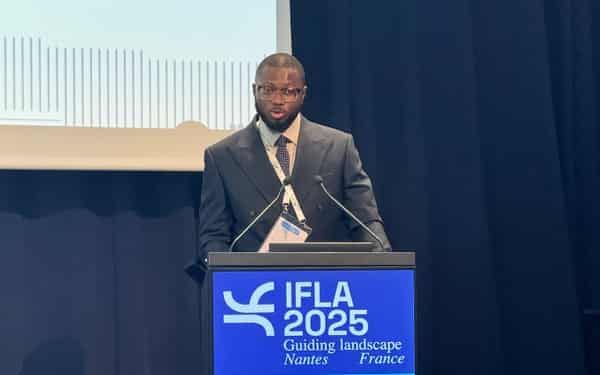
A Nigerian architect and landscape designer, Precious Ovat, has outlined his vision for sustainable city-making, presenting research on artificial intelligence and native ecosystems at the 61st World Congress of the International Federation of Landscape Architects (IFLA) in Nantes, France.
The paper, titled “From Grey to Green: Modelling European Industrial Cities through Native Ecosystems and Digital Landscape Innovation,” examined how technology can be applied to tackle climate change, biodiversity loss, and urban resilience.
“Design must meet the challenges of our time: affordable housing, climate migration, energy transition, and the need for inclusive, smart cities,” he said in an interview. “I see AI and data-driven design not as threats, but as tools to create sustainable, equitable, and inspiring environments for future generations.”
Tracing his professional journey, the architect recalled being introduced to the field through his father’s practice in Nigeria, where he first observed sketches evolving into real projects. “What began as tracing lines on paper grew into a lifelong conviction that design is more than a profession – it is a way of shaping how people experience the world,” he explained.
He completed his undergraduate studies in architecture at Bells University of Technology in Nigeria before pursuing landscape architecture at Newcastle University in the UK. His dissertation in Newcastle reimagined a contaminated site in Gateshead as a play park to address antisocial behaviour, blending ecology, social justice, and adaptive reuse of brownfield land.
His experience spans both Nigeria and the UK, including residential, educational, hospitality, and religious projects, where he has overseen construction from setting-out to foundation. While in the UK, he balanced academic research with part-time work during the cost-of-living crisis, an experience he said “built resilience and discipline while reinforcing my commitment to global impact.”
Beyond architecture, he has also launched an entrepreneurial venture exporting palm oil and palm kernel oil to connect Nigerian agriculture with international markets. He is currently engaging policymakers in Nigeria on strategies for regional development, which he describes as part of a broader vision to use “design and business as vehicles for positive change, job creation, and community wellbeing.”
Looking ahead, he said he plans to pursue chartership with both the Landscape Institute (LI) in the UK and the Royal Institute of British Architects (RIBA), with the goal of extending his influence across Africa, Europe, and America.
“Ultimately, I want to be recognised not only for creating buildings and landscapes, but for building futures: futures that are greener, smarter, and more humane,” he said.



