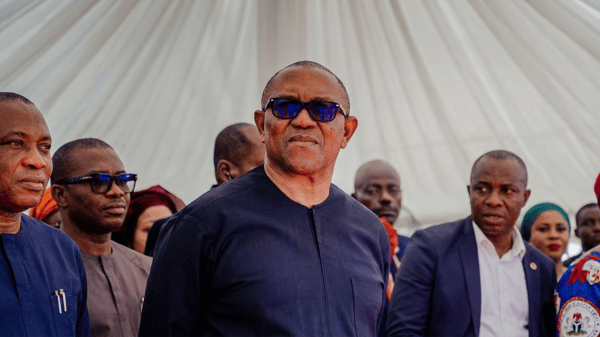
Former Anambra State Governor and 2023 Labour Party presidential candidate, Peter Obi, has criticised the Federal Government’s approval of a nearly ₦8 trillion debt write-off for the Nigerian National Petroleum Company Limited (NNPC), describing the decision as reckless and symptomatic of deepening fiscal irresponsibility amid unresolved audit queries and widespread economic hardship.
In a statement issued on Wednesday, Obi questioned the rationale and timing of the approval, which covered the cancellation of ₦5.57 trillion and $1.42 billion in outstanding obligations owed by the NNPC to the Federation Account Allocation Committee (FAAC).
He argued that the move was troubling, given the company’s recent claims of profitability and ongoing investigations into massive unaccounted funds.
“Financial recklessness is increasingly becoming normalised in our country,” Obi said. “Just last week, it was alarmingly reported that the President approved the write-off of ₦5.57 trillion and $1.42 billion, approximately ₦8 trillion, in debts owed by NNPC, a company that recently announced profits and claimed it had turned a new leaf.”
He added that the decision was particularly concerning because the same agency was facing serious audit scrutiny. “This is the same agency currently facing serious audit inquiries for failing to account for ₦210 trillion, an amount that far exceeds the combined Federal budgets of Nigeria from 2023 to 2026,” he said.
Obi noted that Nigeria’s Federal Government budgets over the four-year period amounted to about ₦178.56 trillion, broken down as ₦21.83 trillion in 2023, ₦43.56 trillion in 2024, ₦54.99 trillion in 2025 and an estimated ₦58.18 trillion for 2026.
He said Nigerians were still awaiting the outcome of the National Assembly’s investigation into the alleged missing funds linked to the NNPC.
“Nigerians are still waiting for the outcome of the National Assembly investigation into the missing trillions,” he said. “This company is also under scrutiny for trillions spent on non-functional refineries.”
According to Obi, the debt forgiveness comes at a time when citizens are grappling with the effects of fuel subsidy removal, rising electricity tariffs and increasing taxation, without corresponding improvements in living conditions.
“Nigerians, already enduring severe hardships due to the removal of petroleum and electricity subsidies, with no tangible improvements in their lives, are now confronted with this unexplained debt forgiveness,” he said.
He argued that the write-off would effectively be replaced by higher taxes imposed on citizens, describing this as unjust and poorly prioritised. Obi further highlighted the scale of the forgiven debt, noting that it exceeded key social sector allocations in the 2025 budget.
“The amount exceeds the 2025 combined Federal budget allocations for education, health, and agriculture, which total ₦7.1 trillion,” he said. “Such resources could empower eight million youths, 10 per cent of the 80 million unemployed, creating approximately 1,000 jobs for each of the 8,809 wards.”
Obi said the decision raised fundamental questions about governance and accountability, insisting that Nigerians deserved transparency and fiscal discipline. “The President, who is also the Minister, owes the Nigerian people clear answers,” he stated.
“The citizens deserve honesty, fiscal discipline, and governance that protects their interests, not the interests of mismanaged corporations or political elites.”
The controversy follows a report by the Nigerian Upstream Petroleum Regulatory Commission (NUPRC), which disclosed that President Bola Tinubu approved the cancellation of the NNPC’s outstanding obligations as of December 31, 2024, following a reconciliation exercise.
According to the commission, the debts previously stood at $1.48 billion and ₦6.33 trillion before the presidential approval reduced them by $1.42 billion and ₦5.57 trillion.
While the NUPRC said it had implemented the directive and passed the appropriate accounting entries, the report also revealed that new debts incurred by the NNPC in 2025 remained unresolved, with outstanding statutory obligations exceeding ₦1 trillion and $1.8 million as of October 2025.
The decision has also drawn criticism from opposition parties. The African Democratic Congress (ADC) accused President Tinubu of lacking the constitutional authority to unilaterally cancel the NNPC’s debts without legislative approval or consultation with state governments.
In a statement, ADC spokesperson Bolaji Abdullahi said, “This write-off was done without legislative or parliamentary approval or clear constitutional authority. This purported justification of ‘reconciliation’ cannot lawfully override the constitutional requirements for revenue sharing.”
He argued that the action reduced revenues due to states and local governments and amounted to a violation of Section 162 of the 1999 Constitution. “The federation account is not subject to executive discretion,” Abdullahi said.
“No president, including this one, has the unilateral authority to cancel constitutionally due revenues.”
As criticism mounts, Obi and other critics have called for greater accountability, warning that decisions of such magnitude, taken without transparency, risk deepening public distrust and worsening Nigeria’s already fragile economic situation.