The Federal Government has explained that its decision to launch the Child Nutrition Fund was to curb malnutrition in children in the country.
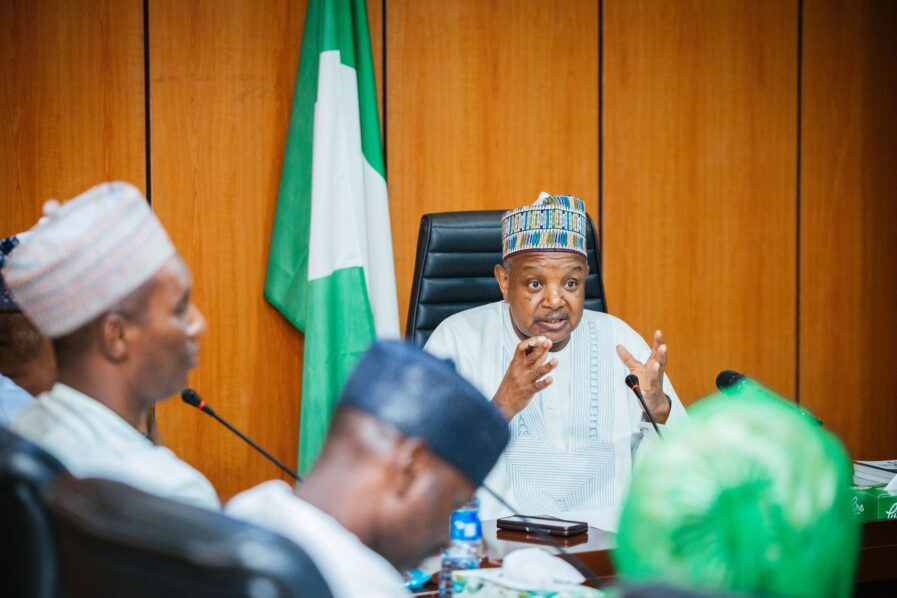
Minister of Budget and Economic Planning, Sen. Abubakar Bagudu, who disclosed this, also reiterated the federal government’s commitment towards achieving a healthy society for children to ensure that they achieve enviable heights through good nutrition.
The minister was speaking when he received members of the United Nations Children’s Fund (UNICEF), led by the Regional Director for West and Central Africa, Mr. Gilles Fagninou.
The minister, who was represented by the Permanent Secretary of the Ministry, Dr. Emeka Vitalis Obi, thanked UNICEF for the technical support in ensuring the update of the situation analysis of children in Nigeria.
He said the government cherishes the support of UNICEF in the domestication of the National Monitoring and Evaluation Policy at the state level, in addition to strengthening multi-sectoral collaboration for nutrition through the launch of the “Nutrition 774 Initiative.”
He noted that through these initiatives, Nigeria is strategically moving down to the grassroots to ensure that children and all persons who are victims of or exposed to malnutrition or undernutrition are considered and taken care of.
He further disclosed that domestic financing had been launched through the Child Nutrition Fund to ensure that funds were available to address the needs of children domestically.
The Permanent Secretary listed the National Social Protection Policy as another great initiative by the government aimed at strengthening capacity in public financial management, especially at the sub-national level. This initiative, he said, would be launched before the end of 2025.
In his words, “We can do better. We have the vision to be able to leverage the successes we have recorded so far and strengthen them because we are building capacity that should outlive us and protect the future of the Nigerian child.
“Our role is key, it’s critical and vital. We will continue to work on the policy ecosystem and space in order to shape policies that would continue to see to the inclusion of children at the heart of the economy.”
Speaking earlier, Mr. Gilles Fagninou commended the Ministry’s leadership for driving the social inclusion agenda and advised on how things could be done better, especially with the very ambitious programs in Nigeria. According to him, “The Social Inclusion Agenda plays a key role in budget allocation, especially when it comes to children.”
Mr. Fagninou explained that the advantage of UNICEF’s exposure to the 24 countries of its operations was to enable the organization to gather experiences and see how lessons learned from Nigeria and elsewhere could help UNICEF make progress in the 24 countries within their purview.
He commended the federal government for being the first country under their watch to successfully conduct a progress report on the Sustainable Development Goals (SDGs).
Fagninou, however, stressed the need for the ministry to continuously review the progress made by line ministries as it relates to their mandates while engaging UNICEF for support in promoting children’s needs.
Also speaking, the Director of International Cooperation in the Ministry, Dr. Samson Ebimaro, pointed out that UNICEF’s intervention in Nigeria had been impressive and that Nigeria was very much aware of its contributions to the nation’s economy, especially in areas of education, nutrition, water and sanitation, and child rights.
“Nigeria is a very strategic partner to UNICEF, and UNICEF has been a very amiable partner that has worked with the Ministry for over 15 – 20 years,” Ebimaro added.