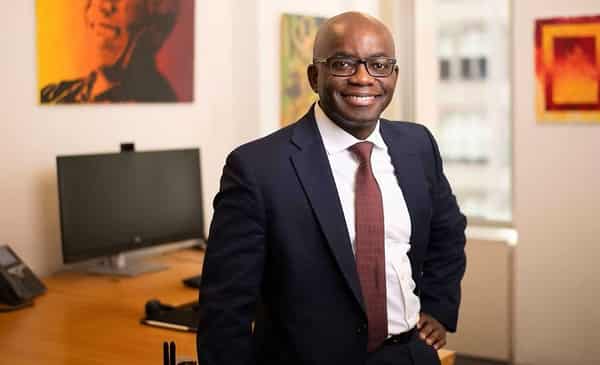
Sometimes, presidential destinies are shaped less at the ballot box than through the patient continuity of a lifelong commitment. That of Samuel Munzele Maimbo—former Vice President of the World Bank and now a candidate for the presidency of the African Development Bank (AfDB)—has been written over three decades at the intersection of international finance, regional integration, and economic justice. His vision, which he describes as “action- and impact-oriented engagement,” stands in stark contrast to the formality of an institution often perceived as distant. What if the upcoming May election at the AfDB were to elevate a rare profile: that of a discreet builder, ready to shake off inertia?
A Grounded Path, a Structured Ambition
Born in Lusaka, Zambia, and a graduate of the University of Birmingham, Maimbo does not come from the insular world of technocrats detached from African realities. He grew up on a farm, worked in local agricultural sales during university, then rose through the ranks of the banking sector at the Bank of Zambia before establishing himself as a key figure at the World Bank. There, he led teams of 600 people, managed massive portfolios, and orchestrated the record-breaking $93 billion replenishment of the International Development Association (IDA) in 2021—an achievement widely praised in development circles.
Fixing the System, Changing Course
But Maimbo is more intent on convincing with his vision than with his résumé. His approach is grounded in a demand for measurable results, a strong ethic of accountability, and a deep belief that South-South cooperation should be the central driver of sovereign development.
For Maimbo, the AfDB is not an ivory tower but a still-underutilized lever. In his strategic platform, he calls for structural reform of the institution—greater transparency, decentralized decision-making, and, above all, a focus on tangible outcomes. No more decorative indicators: every department will be held accountable for concrete goals. Governance? It must reflect Africa’s diversity. Performance? It will be measured, financed, and tailored to the complex challenges of development.
He envisions transforming the AfDB into a “broker of knowledge and finance,” capable of rivaling major multilateral institutions in African expertise. This implies major investments in data collection and analysis, training African talent, and aligning closely with local actors—governments, regional banks, businesses, and universities.
Freeing the Continent from Its Shackles
In his vision, Maimbo outlines an Africa freed from the cycles of aid and debt. He wants to move beyond outdated financing models, advocating instead for a diversification of instruments—portfolio guarantees, hybrid capital, African sovereign wealth funds—and for intelligent debt management to become a tool for creating sustainable, value-generating assets. “Debt must no longer be a trap, but a lever,” he insists.
While he promotes investment, he never loses sight of sustainability. He calls for an AfDB capable of lowering risk premiums, harmonizing regulations to attract cross-border capital, and co-creating strong African institutions—such as an African Monetary Fund, a Continental Rating Agency, and a Financial Stability Mechanism.
An Africa That Creates, Not One That Endures
One of Maimbo’s strengths lies in his ability to interconnect Africa’s essential transitions—agricultural, energy, industrial, and digital. He doesn’t rely on hollow slogans: each sector is addressed with a detailed operational plan, built on public-private partnerships, a logic of social return, and a decentralization of benefits. Agriculture is reimagined as a driver of prosperity, infrastructure as a lever for regional integration, energy as a fundamental right, and digital technology as a tool of sovereignty.
His advocacy for women and youth goes beyond campaign rhetoric. He denounces the structural invisibility of women in economic policy, calls for the creation of inclusive strategic councils, and promises a Youth Council with real decision-making power. For him, any growth that fails to benefit the 60% of Africans under 25 is a ticking time bomb.
A Vision That Defies Financial Conservatism
By tackling head-on the challenges of fragility, peace, and climate resilience, Maimbo proves he is thinking long-term. He rejects the passivity that often characterizes development banks in times of crisis. He wants to make the AfDB an institution of foresight, not just reaction. In doing so, he aligns with the aspirations of a young, mobile, interconnected continent that isn’t asking for charity, but for the means to act.
He is unequivocal: the AfDB must not be a stage for ribbon-cutting ceremonies or well-rehearsed press conferences—it must be a force for deep, structural change, in service of both governments and citizens.
As the AfDB’s presidential election approaches in May, Samuel Maimbo represents a different kind of ambition for the continent: a leadership that is sober but rigorous, technocratic without being technocrat, political in the noblest sense of the word. In a world where credibility is earned through impact, he offers a bold yet realistic vision, firmly focused on the needs of today’s and tomorrow’s Africa.