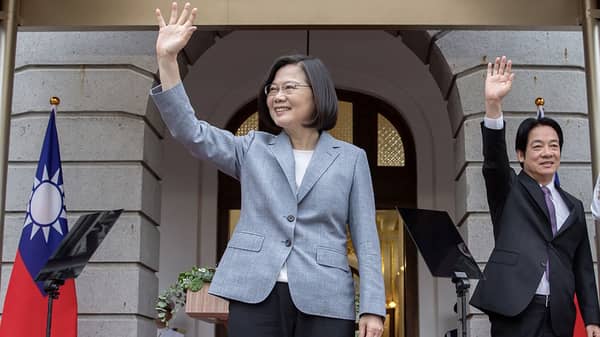
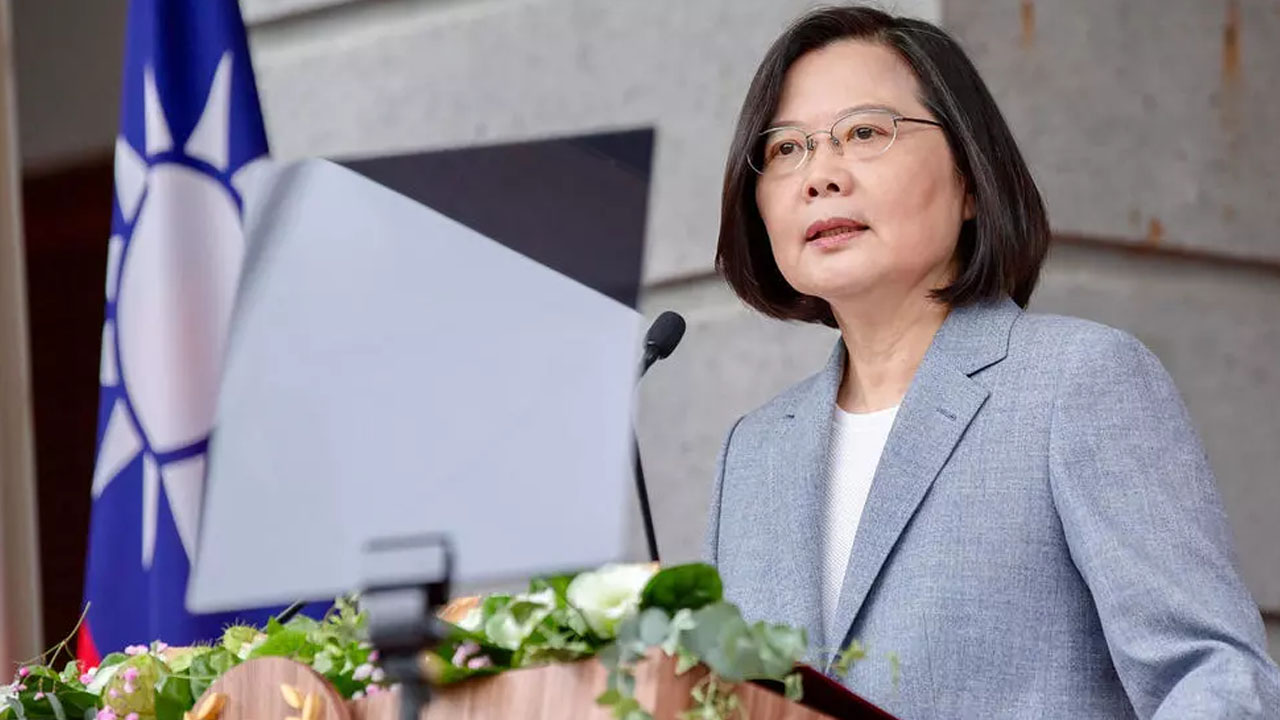
China is not likely to consider a major invasion of Taiwan for now due to domestic challenges, the island’s president Tsai Ing-wen said Wednesday, although Beijing is trying to sway its upcoming election.
“I think the Chinese leadership at this juncture is overwhelmed by its internal challenges,” Tsai told the 2023 DealBook Summit in New York.
“My thought is that perhaps this is not a time for them to consider a major invasion of Taiwan,” she added in a recorded interview.
Tsai was responding to questions about the risks of an invasion, in the aftermath of a closely watched meeting between the US and Chinese presidents, Joe Biden and Xi Jinping, in California this month.
The leaders’ talks, on the sidelines of the Asia-Pacific Economic Cooperation summit, were aimed at preventing growing tensions from spiraling into conflict.
But Xi and Biden remain far apart on the flashpoint of Taiwan, with the Chinese leader telling his US counterpart that reunification was “unstoppable.”
China considers democratic Taiwan its territory, to be taken one day by force if necessary.
For the moment, however, Beijing is grappling with domestic economic, financial and political challenges, Tsai said.
The international community has also made it clear that war is not an option, she added.
But China is still “interested in interfering” in Taiwan’s upcoming presidential election, Tsai said, adding that Beijing is attempting to sway the outcome in its favor.
“All major elections in Taiwan since 1996 have seen similar influence operations from China,” she said, noting these include the use of military threats and economic coercion.
Instead of hoping Beijing would give up on its tactics, Taiwan should “focus on strengthening the resilience of our democracy,” she added.
Responding to Tsai’s comments on Thursday, Beijing’s Ministry of Foreign Affairs said: “As Taiwan is an inseparable part of China’s territory, there is no president of Taiwan.”
Spokesperson Wang Wenbin added that it is necessary to “oppose Taiwan independence and external interference.”
“The (Democratic Progressive Party) authorities’ stubborn stance to Taiwan independence and their continuous provocations for independence are only doomed to fail,” said Wang, referring to Tsai’s party.
Self-ruled Taiwan is set to hold its presidential election in January, a contest that is being scrutinized by policymakers in China and the United States, as it could determine Taipei’s ties with an increasingly bellicose Beijing.
Asked if the United States’ attempt to boost its chip manufacturing capabilities could make Washington’s ties with Taipei less valuable in the long run, Tsai added that the island’s current semiconductor industry cannot be replaced by anywhere else.
Tsai is not able to run in the upcoming election, as she will have completed the maximum of two terms in office.
[ad unit=2]