 Follow Us on Google News


 Follow Us on Google Discover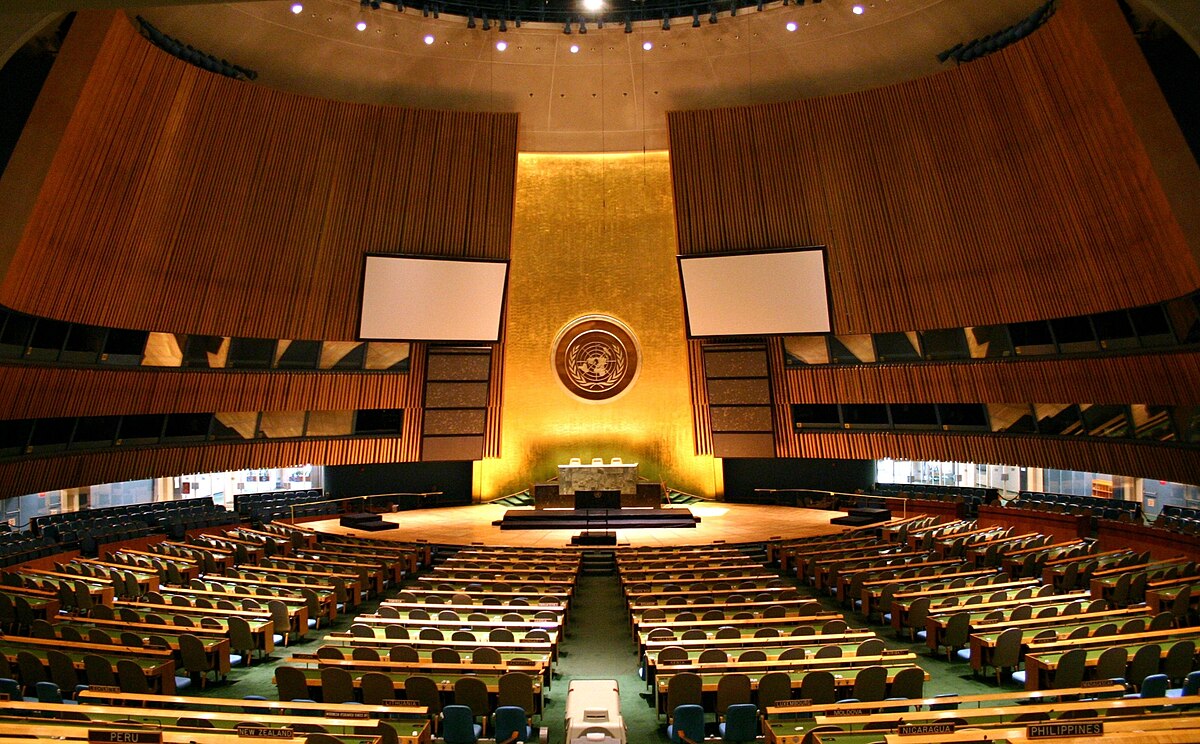
When world leaders gather at the United Nations each September, the atmosphere is typically thick with rhetoric, promises, and photo opportunities. Yet, behind the glamour of speeches at the General Assembly lies a sobering truth: the UN is struggling to remain relevant in a world where strongmen no longer reckon with its authority, JOSEPH ONYEKWERE reports.
WHEN the United Nations (UN) was founded in 1945, it carried the hopes of a world scarred by two devastating wars. The architects of the post-war order envisioned a body that would prevent future global conflicts, uphold international law, and provide a platform where all nations, big or small, could be heard.
The UN Charter promised to “save succeeding generations from the scourge of war.”
Eight decades later, that promise appears fragile. Many world leaders no longer reckon with the UN as a serious force, while strong states openly defy its authority, and weaker ones view it as biased. Citizens, on their part, increasingly dismiss it as ineffective and symbolic. The question is: has the UN outlived its usefulness, or can it be revived?
Nothing illustrates the UN’s declining authority better than its incessant disregard by American President Donald Trump, who recently set up the “Board of Peace,” and withdrew the country from major UN organs.
Before this, the Israeli Prime Minister Benjamin Netanyahu, who was declared wanted by the International Criminal Court (ICC), appeared before the UN General Assembly in New York last September without anyone lifting a finger to arrest him.
It would be recalled that the ICC had issued a warrant for his arrest on charges of war crimes in Gaza. Yet, Netanyahu walked into the UN building unbothered, delivered his speech, and walked away quietly.
Why was he untouchable? The answer reveals the flaws of the global system. First, Israel, like the United States, is not a member of the ICC. Again, the UN has no police force or army of its own; it relies on member states to enforce international law.
Lastly, the United States, wielding its influence, has historically shielded Israel from accountability.
Contrast this with the experience of African leaders such as Sudan’s Omar al-Bashir, who faced travel restrictions and constant threats of arrest after the ICC indicted him. The lesson is clear: international law is enforced selectively. The strong escape accountability; the weak are pursued. This double standard erodes the UN’s legitimacy.
Unfortunately, the UN Security Council, designed as the guardian of international peace, has actually become a theatre of paralysis. The veto power granted to its five permanent members – the United States, Russia, China, Britain and France – was meant to preserve stability by ensuring that powerful nations stayed engaged in the UN system. In practice, it has produced deadlocks.
Russia has repeatedly vetoed resolutions condemning its invasion of Ukraine. America regularly blocks resolutions critical of Israel. China has used its veto to shield allies like Myanmar. As a result, the Security Council is unable to act in some of the most pressing crises of our time.
Syria’s civil war, which had killed hundreds of thousands, saw repeated deadlocks. In Yemen, despite one of the world’s worst humanitarian disasters, the Council failed to take decisive steps. In Gaza, the same story unfolds.
For smaller states, this veto system is proof that the UN is not a neutral body, but an arena where the powerful protect their interests. For citizens watching from afar, it is a symbol of dysfunction.
To be fair, the UN has not been entirely ineffective. Peacekeeping missions have helped stabilise countries like Liberia, Sierra Leone, and East Timor. Its blue helmets, despite their shortcomings, have often been the only international presence standing between warring parties.
But the failures are also monumental. In 1994, UN peacekeepers stood by helplessly as 800,000 people were slaughtered in Rwanda. The Security Council, again paralysed, refused to authorise reinforcements. A year later, in Srebrenica, Dutch UN peacekeepers failed to prevent the massacre of 8,000 Bosniak men and boys.
In Darfur in the 2000s, despite evidence of atrocities, the UN response was slow, fragmented, and inadequate. Even today, UN missions in the Democratic Republic of Congo and Mali are criticised for being underfunded, poorly mandated, and unable to protect civilians effectively.
It would be misleading, however, to argue that the UN has completely failed, as many of its specialised agencies continue to play vital roles. The World Health Organisation coordinated global efforts during the COVID-19 pandemic, despite political wrangling.
The World Food Programme provides food aid to over 100 million people yearly. UNICEF, on its part, supports children’s education and health worldwide, and the UNHCR shelters millions of refugees fleeing from wars and climate disasters.
These humanitarian functions make the UN indispensable. The problem is that while it saves lives at the margins, it struggles to prevent the very conflicts and injustices that create humanitarian crises in the first place.
Part of the UN’s weakening stems from the rise of leaders who openly defy multilateralism.
For instance, Vladimir Putin invaded Ukraine despite UN condemnations. Donald Trump withdrew the United States from key UN institutions, including UNESCO and the Human Rights Council, and undermined global climate agreements. Xi Jinping has strengthened China’s influence through parallel platforms like the Belt and Road Initiative.
Meanwhile, alternative blocs like BRICS, the African Union, and the Association of South East Asian Nations (ASEAN) are stepping into diplomatic and economic roles once dominated by the UN. This fragmentation weakens the UN further, reducing it to a symbolic gathering place rather than the centre of global governance.
The ICC, though technically independent of the UN, is closely linked in perception. And like the UN, it suffers from accusations of double standards. For years, African leaders argued that the ICC targeted their continent unfairly, ignoring crimes committed by Western states. This perception grew stronger when U.S. officials threatened sanctions against ICC judges who investigated American conduct in Afghanistan.
Meanwhile, Israel, shielded by U.S. influence, has faced little consequence for decades of occupation and military campaigns. The result is that both the UN and the ICC are seen not as impartial guardians of justice, but as tools wielded by powerful nations against weaker ones.
So, has the UN outlived its usefulness? The answer depends on how one measures usefulness. If the UN is judged as a guarantor of collective security and global justice, then it has largely failed. Wars rage on, justice is uneven, and powerful states act with impunity. But if judged as a humanitarian lifeline, a platform for dialogue, and a convener of global norms such as on climate change or sustainable development, then the UN remains relevant.
However, reform is the only path forward for the UN. The Security Council must be reformed to reflect today’s realities. Permanent membership should expand to include Africa, Latin America, and Asia, with candidates like India, Brazil, Nigeria, and South Africa obvious contenders. The veto must be restricted or reformed.
Some propose requiring at least two or three permanent members to veto, preventing one state from blocking global consensus. The UN also needs a more robust standing capacity for peace enforcement, not just peacekeeping.
The ICC warrants should automatically trigger enforceable sanctions, regardless of which leader is targeted. Justice must apply equally to all. If African leaders can be indicted, so too should leaders of powerful states when evidence demands it.
The UN must resist becoming a stage where great powers impose selective morality.
Instead of competing, the UN should integrate regional organisations like the African Union and ASEAN into its decision-making and enforcement structures. Many UN agencies are criticised for corruption and inefficiency, and clearer accountability mechanisms would restore trust.
The United Nations is at a crossroads. It has not yet outlived its usefulness, but it is dangerously close to irrelevance in the eyes of many. The world still needs a forum where nations can gather, where humanitarian aid can be coordinated, and where norms on climate, human rights, and development can be set. But the UN is failing at its most important task: holding the powerful accountable and maintaining peace.
If reforms are not carried out, the UN risks becoming a relic – a place for symbolic speeches, while real power shifts to strong leaders and regional blocs. The world still needs a union of nations. The question is whether the UN can transform fast enough to remain that union, or whether it will fade into history as a noble experiment that failed.
For Senior Research Fellow, Nigerian Institute of International Affairs (NIIA), Dr Kester Onoh, the UN has not lost its usefulness.
According to him, without them, there would be war everywhere. He, however, added that the composition of the UN was never really formed to solve global problems, but to protect the interests of the then allied forces.
“Looking at the emergence of African nations, which came from colonialism even before the UN was formed, I don’t expect equal opportunities from the founders of the UN.
“It is obvious that now people can say that we are in the age of neo-liberal democracy. But we’ve come to understand that even the projection of neo-liberal democracy is serving a purpose for a particular group of nations,” he said.
He argued that democracy is not the best form of government, especially the neo-liberal form, and that the world has not reached agreement on an alternative.
He said: “If we look at the problem of the United Nations at this time today, it’s actually the problem created by these big five to project their power, and pursue their own national interest to the detriment of the UN.”
Professor of International Relations, Femi Otubanjo, said the UN has not been able to prevent global conflicts, but has helped to promote the idea of a global human community and international law, with the idea that all human beings, no matter their wealth or size, are subject to the same law.
He admitted that, though there is defiance, there is also common agreement.
Otubanjo noted that recognising a state of Palestine and people walking out while the Israeli PM spoke during UNGA are testaments to UN involvement in speaking against injustice.
“On humanitarian activities, no organisation can do what the United Nations has been doing. Its interventions are visible during pandemics and other global disasters,” he pointed out.
He, however, noted that the current decision-making structure, carried out by the five veto powers, has outlived its usefulness, having been assumed due to the exigencies of the Second World War.
“The five states with veto powers must be democratic. A vote there must be based on majority and not on one power throwing out the choice of other nations who are members of the UN,” Otubanjo advised.

