 Follow Us on Google News
 Follow Us on Google Discover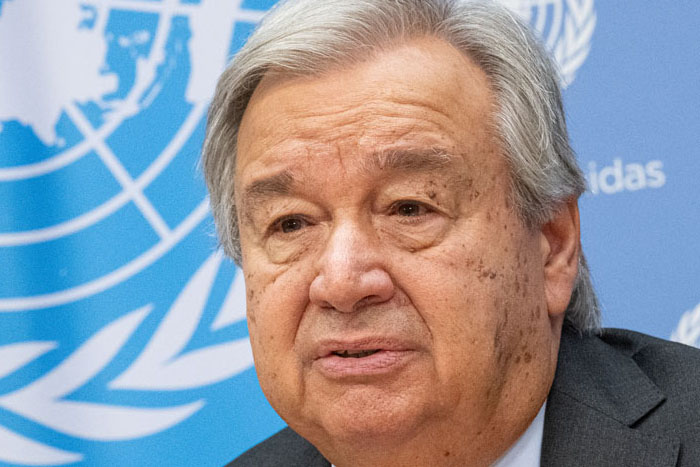
• ‘Participation in IPCC work remains voluntary’
• ‘Withdrawal from UNFCCC a ‘strategic blunder’
United Nations Secretary-General, António Guterres, has expressed regret over the decision by the United States to withdraw from a number of UN entities, but stressed that the multilateral system will continue to deliver on its mandates without wavering.
In a statement issued by the UN Spokesperson, Guterres reiterated that assessed contributions to the UN regular and peacekeeping budgets are binding legal obligations under the UN Charter.
“As we have consistently underscored, assessed contributions to the United Nations regular budget and peacekeeping budget, as approved by the General Assembly, are a legal obligation for all Member States, including the United States,” the statement said.
The reaction followed a memorandum signed by US President Donald Trump directing federal agencies to withdraw from dozens of international organisations, conventions and treaties considered by Washington to be contrary to US interests.
According to the memorandum, the decision affects 31 UN agencies and entities, including the United Nations Population Fund (UNFPA), which supports maternal and child health and combats sexual and gender-based violence; the UN Framework Convention on Climate Change (UNFCCC), which coordinates global climate action; and the UN Democracy Fund, which supports civil society initiatives worldwide.

Other affected bodies include several UN Secretariat offices addressing issues such as children in armed conflict and the use of sexual violence as a weapon of war. The list also covers four of the UN’s five regional commissions — Asia-Pacific, Western Asia, Africa, and Latin America and the Caribbean, which serve as key platforms for regional multilateral cooperation.
For UN entities, the memorandum states that “withdrawal means ceasing participation in or funding to those entities to the extent permitted by law.”
Despite the announcement, the Secretary-General emphasised that the organisation’s work would continue unabated. “All United Nations entities will go on with the implementation of their mandates as given by Member States,” the statement said.
“The United Nations has a responsibility to deliver for those who depend on us. We will continue to carry out our mandates with determination.”
Under the UN Charter, assessed contributions to the organisation’s regular and peacekeeping budgets are approved by the General Assembly and remain binding on all Member States. For 2026, the General Assembly approved a $3.45 billion regular budget, reflecting a sharp reduction from previous years, including a 15 per cent cut in financial resources and nearly 19 per cent reduction in staffing.
Reacting to the US decision to withdraw from the UNFCCC, its Executive Secretary, Simon Stiell, described the move as a setback for global climate cooperation. “The United States was instrumental in creating the UN Framework Convention on Climate Change and the Paris Agreement because both are entirely in its national interests,” Stiell said.
“While other nations are stepping forward together, this latest step back from global leadership, climate cooperation and science can only harm the US economy, jobs and living standards, as wildfires, floods, mega-storms and droughts grow rapidly worse,” he warned, describing the move as “a colossal own goal.”
Stiell noted that the UNFCCC would continue its work, adding that “the door remains open for the United States to re-enter in the future, as it has done before with the Paris Agreement.”
The Intergovernmental Panel on Climate Change (IPCC) also acknowledged the US government’s announcement regarding its withdrawal from more than 60 UN and non-UN organisations, including the IPCC.
The panel clarified that participation in its work and processes is voluntary and open to all World Meteorological Organisation (WMO) and UN Member States, with or without a formal declaration.
“The preparation of scientific reports agreed by member governments for this assessment cycle is underway,” IPCC Chair, Jim Skea, said. “Our attention remains firmly on the delivery of these reports.”
The IPCC, which serves as a unique interface between science and policy, provides governments with rigorous, evidence-based assessments to guide climate policy and international negotiations under the UNFCCC.
In a related development, Chair of the Intergovernmental Platform on Biodiversity and Ecosystem Services (IPBES), Dr David Obura, expressed deep regret over the United States’ intention to withdraw its participation.
Obura noted that the US is a founding member of IPBES and has played a pivotal role since its establishment in 2012, with American scientists, policymakers and Indigenous Peoples among the most active contributors to its work.
“The contribution of US experts ranges from leading landmark assessments to presiding over negotiations, serving as authors and reviewers, and helping steer the organisation scientifically and administratively,” he said.
He added that decision-makers in the US have also been among the most extensive users of IPBES assessments in shaping policies, investments and research priorities. While acknowledging the right of governments to withdraw from global processes, Obura stressed that such decisions do not alter scientific realities.
“We cannot withdraw from the fact that more than one million species face extinction, or that the global economy is losing up to $25 trillion yearly from environmental degradation,” he said, citing IPBES assessments.
“Nor can we reclaim the missed opportunity to generate over $10 trillion in business value and nearly 395 million jobs by 2030 through transformative change.”
Also reacting, Director of World Resources Institute (WRI) US, David Widawsky, described the US withdrawal from the UNFCCC as a “strategic blunder.”
“Pulling out of the UNFCCC gives away American advantage for nothing in return,” Widawsky said.
“The agreement is the foundation of international climate cooperation. Walking away doesn’t just sideline the US; it removes it from the arena entirely.”
He warned that American communities and businesses risk losing economic ground as other countries capture jobs, trade and investment linked to the rapidly growing clean-energy economy.
“Despite today’s action, global climate diplomacy will not falter,” he added.
“When nations work together on climate, it saves lives, creates jobs, strengthens economic stability and builds a more prosperous future.”

