 Follow Us on Google News


 Follow Us on Google Discover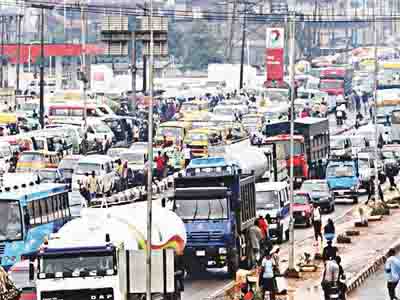
 Among options proffered is the need to seek assistance of the federal government, through the intervention of the national assembly, to grant Lagos a special status, with the corresponding budget. Second, it was suggested that Lagos should redefine its private public partnership (PPP), policy in a way that investors would be attracted to embrace the project
GIVEN the reality on ground, cloud of uncertainty hangs over the proposed take off and execution of an ambitious, but desirable infrastructural project in Lagos State, the 4th Mainland Bridge.
But, the project may not be an elephant one, afterall, if the state re-strategies and secures sustainable financing for the infrastructural project.
However, feelers within the Lagos State Government, the project promoters, point to some reasons while the 4th Mainland Bridge may be far from actualization in the nearest future. To wit, experts have given suggestions on how to kick-start and deliver the project.
Among the options is the need to seek assistance of the Federal Government, through the intervention of the National Assembly, to grant Lagos a special status, with the corresponding budget. Second, it was suggested that Lagos should redefine its private public partnership (PPP), policy in a way that investors would be attracted to embrace the project.
Although, to engineers, the situations on ground may not favour commencement of the project in a hurry, owing to some identified factors.

One, the terrain slated for the project required extensive impact assessment of the environment. This, according to the Deputy President, Nigerian Institution of Structural Engineers, Dr. Ore Fadayomi, is necessary to determine the cost implication of the project. Besides, Fadayomi noted that if the 4th mainland bridge is a priority and that Lagos cannot shoulder it, “then, it is incumbent on the Federal Government to render the necessary assistance. This is in view of strategic importance of Lagos to the Nigeria economy”.
He was of the opinion that the project is achievable, only if the necessary things are done. “In this case, the necessary things include getting competent hands to do the feasibility studies, provide policy statement that would be transparent so that investors’ confidence would be aroused.”
Dr. Isaac Akhiije, of the Department of Civil and Environment Engineering, University of Lagos, while reacting to the problems associating with staggering of project, noted that three indices stand out, namely: performance, time and money.
Akhiije, while reacting to the spate of work on Ibadan-Ilorin expressway stated that the three indices are applicable to every road construction. “By extension if a project was designed to cover route A, B, C, D and by implication, there is a stop work, then one would expect variation against the initial proposal that may affect time, performance and cost”.
By implication, if the 4th mainland bridge is embarked upon and could not be completed as originally planned, it may create unforeseen problem of “abandoned project”.
However, the option of seeking Federal assistance was informed by the position of the Federal Government, as stated by the immediate past Minister of Works, Mike Onolememen, who, barely some months before the expiration of the last administration, said the Economic Management Implementation Team (EMIT), received a proposal from a Chinese company responsible for the development of the deep sea in Lekki area for the construction of an access road to link the Lekki Free Trade Zone and that EMIT had insisted that such must incorporate the bridge.
He said, “Many people are not aware that the Federal Ministry of Works conceived and designed the second Lagos outer ring road, section one of which will take off around Apapa/Tin Can Island area through Igando, across the Abeokuta-Ota road to empty into the Lagos-Ibadan Expressway.
The reason for this project is to permanently solve the nagging traffic problem on the Apapa-Oshodi Expressway by providing a veritable alternative, especially for trucks leaving the ports and heading for other parts of the country without constituting a nuisance to Lagos residents.
The second section of the road will take off from the Lekki area, all the way to Ikorodu on the alignment of the so-called Fourth Mainland Bridge.
And only recently, the Economic Management Implementation Team received a proposal from the Chinese company responsible for the development of the deepsea port of the Lekki Free Trade Zone for government support to have an access road that will link the Lekki Free Trade Zone.
When we reviewed the proposal, the issue of the bridge was raised and we insisted that the package must necessarily include the Fourth Mainland Bridge that will link Lekki directly with Ikorodu, a statement that observers are to see how feasible it is.
However, the much-publicized plans for the construction of bridge that have been considered as a project capable of providing a sustainable solution to the perennial traffic bottleneck in Lagos and enhance economic development may have to wait much longer than envisaged if the feelers from government officials are anything to go by.
Two factors stand against any hope of actualizing the dream in the nearest future, namely: funding and government’s policy on private sector’s participation on project executions.
According to The Guardian’s sources, Lagos government is not in position to embark on the project for now, in view of some fundamental factors. The first factor has to do with two major road projects the state has embarked upon and are yet to fully complete.
One is the Orile-Badagry expressway that is yet to get to an appreciable level and the second is the Ikorodu-Mile 12 road expansion, which, although, is about 80 percent completion, but which loan will take a longer time to be fully offset.
Apart from the project cost, compensation that would due to owners of the properties that may likely be affected was another big issue that required serious consideration.
Government would require up to N10 billion as compensation to house owners at Olokanla, Ajah, whose properties are situated on the way to the bridge head, apart from those along Ikorodu and Ijede, which it was learnt, would gulp over N5 billion, also as compensation.
This excludes other communities that the bridge would traverse”, said the source, saying till date, there still remains scores of people that are yet to receive their compensation along Badagry expressway.
Government would have little or no problem to construct the bridge through the private public participation (PPP) arrangement, but experience of Lekki-Epe expressway, where tolling has been a contentious issue has already made mess of whatever confidence or enthusiasm investors demonstrated when the last administration mooted the idea”, said the source, who viewed unstable policy as another obstacle to attracts investors.
Although, it was learnt that government had initially mapped out a plan to solely finance the scheme, if suitable private sector partners could not be found.
As at that time, the search for the concessionaire had assumed a global dimension, after the Singaporean consortium, earlier slated for the project, was found to lack the capacity to execute it. “Indeed, the former Governor, Mr. Babatunde Fashola and few officials specifically made some trips to Singapore, as that single city nation was adopted as model for a new Lagos megacity development project.
The prospect for the project was however stalled, as the consortium that was initially recommended for the job could not mobilise enough resources for it. “Consequently, the search for a new concessionaire began, with the administration considering proposals from several consortia around the globe, including about three local outfits that were said to have shown interest in the project”.
The state government will not mind to go it alone as the project has become a serious political issue, which may undermine the credibility of the state government, if the scheme fails to take-off during the tenure of the current administration.
I can confirm to you that the state government, under its ‘plan B’ initiative, has started approaching offshore sources for funding, since the project itself has been found financially viable”, the source added.
However, indication that the project would resume under the current administration is quite unrealistic. This is in view of the pronouncement by Governor Akinwunmi Ambode, that his administration is committed to the completion of the Badagry expressway in the next one-year.
The project, under its initial public-private partnership arrangement, was scripted to attract tolls for users of the bridge, to, at least, recover costs for its execution.
The immediate past Commissioner for Works and Infrastructure, Dr. Obafemi Hamzat, in one of his press briefings, who also made allusion to government’s commitment to the project, described it as “government’s response to the need to create a ring around the state which would allow ease of movement”. According to him, the bridge was the missing link.
He said, “Three alignment options are being proposed for the bridge construction. The options come with its own financial implications and challenge. Bridge component is only about 3.5 kilometres, while the rest are road component.” “For now, most of the preliminary works involving soil test, environment impact assessment, survey of topography and biometric survey have been conducted,” Hamzat, added. 1,526

