 Follow Us on Google News
 Follow Us on Google Discover
Hello, and welcome to what I can honestly say is the result of months of careful demographic research and years of writing about Nigerian society for this publication. Today we are tackling one of those questions that sounds simple on the surface but opens up into a genuinely fascinating portrait of a nation in transition.
How many children does the average Nigerian have? The answer, as tracked by the Nigeria Demographic and Health Survey, sits at approximately 4.8 children per woman as of 2024. That figure already tells a story. It is down from 5.3 in 2018, and down considerably from the peak of 6-plus children per woman recorded in previous decades. Nigeria is changing, and its families are changing with it. But that headline number barely scratches the surface of what is actually happening across our 36 states and the Federal Capital Territory.
I have spent time in both the bustling markets of Kano and the high-rise apartments of Victoria Island in Lagos, speaking to mothers, fathers, grandparents, and young professionals about family size. What I found was not a single Nigerian story. It was dozens of them, all layered on top of each other. So let us get into all of it.
How Many Kids Do Nigerians Have on Average?
This is the question most people arrive with, and I want to give it proper treatment.
Nigeria’s national average of 4.8 children per woman, confirmed by the National Population Commission’s 2024 NDHS launch, represents the statistical midpoint between two very different Nigerias. There is the northern Nigeria of Sokoto, Yobe, and Jigawa states, where a woman might still have six, seven, or even eight children over her lifetime. And there is the southern urban Nigeria of Lagos Island, Ikeja, or Port Harcourt’s GRA, where a professional couple might deliberately plan for two children and stop there.
The national average, therefore, is almost a fiction. It is arithmetically accurate but culturally misleading. A woman in Sokoto state averages roughly 6.4 to 6.8 children, whilst her Lagos counterpart averages closer to 2.8 to 3.2. Both are Nigerian women. Both are counted in that 4.8 figure. Understanding why those numbers are so different is where the real story begins.

Several interconnected factors shape how many children a Nigerian family ultimately has. Education levels for women play perhaps the biggest role. The National Bureau of Statistics demographic data consistently shows that women with secondary or tertiary education have significantly fewer children than women with no formal schooling. Economic realities matter enormously too. In the south, where urban living costs are high and private school fees can reach ₦2 million per year or more, the financial logic of having fewer children becomes very persuasive. In the north, particularly in rural communities where children contribute to agricultural labour from a young age and where land is still relatively available, the economic calculus runs in the opposite direction.
Religion and cultural tradition also play genuine roles. Polygamy, which remains legal and practised in parts of northern Nigeria, naturally produces larger household sizes. And then there is simple geography: urban families consistently have fewer children than rural ones, regardless of region.
Seven Steps to Understanding Nigeria’s Fertility Landscape
If you want to genuinely grasp why Nigerians have the family sizes they do, working through these seven factors in order will give you the clearest possible picture.
- Look at education levels first. Women’s educational attainment is the single most reliable predictor of family size in Nigeria. Women with no education average around 6.5 children. Women with secondary education average around 4.2. Women with tertiary education average around 3.0. Every additional year of schooling correlates with a measurable reduction in completed family size. This is why education investment and demographic change are so tightly connected.
- Map the urban-rural divide. Urban Nigerian women average approximately 3.6 children, whilst rural women average around 5.8. This gap exists because urban living costs are higher, women in cities have greater access to family planning services, and urban employment opportunities make delaying childbearing economically rational. The rural-urban migration that is reshaping Nigeria’s population geography is also quietly reshaping its fertility landscape.
- Understand the north-south split. Northern states, particularly those in the Northwest and Northeast geopolitical zones, have fertility rates significantly above the national average. Southern states, particularly Lagos, Rivers, and Anambra, sit well below it. This geographical pattern reflects differences in education, urbanisation, religion, cultural attitudes to family planning, and women’s economic participation.
- Consider the role of contraceptive access. Nigeria’s modern contraceptive prevalence rate sits at just 15% among currently married women, according to data from the Federal Ministry of Health’s NDHS findings. This is low by regional standards and partly explains why fertility rates remain higher than Nigeria’s overall development indicators might predict. Where women cannot access reliable family planning, family sizes are shaped more by biology than by choice.
- Factor in economic pressure. The rising cost of raising a child in Nigeria is a genuine driver of smaller family preferences, particularly among urban middle-class families. School fees, healthcare costs, feeding expenses, and transport all add up considerably. A Lagos couple planning seriously might calculate that two children in good schools will cost ₦6 million to ₦15 million to raise to university level. That calculation is increasingly common.
- Account for generational attitude shifts. Young Nigerians today hold noticeably different views on family size than their parents or grandparents. Nigerian women under 35 in urban areas increasingly cite two to three children as their ideal family size. Their mothers’ generation often said five or six. This shift is happening faster than demographic data can always capture, which means Nigeria’s fertility rate will likely continue declining in coming years.
- Track child survival rates. This one often surprises people. In communities where child mortality has historically been high, families have often had more children as a hedge against losing some. As Nigeria’s child mortality rates have improved (under-5 mortality fell from 132 per 1,000 live births in 2018 to 104 in 2024), the perceived need for larger families as a form of insurance has diminished. Improving child health quietly reduces fertility rates over time.
What Sells Very Fast in Nigeria? The Connection to Family Size
This might seem like an unusual section in an article about family sizes, but bear with me. What sells fastest in Nigeria is directly shaped by the fact that Nigeria is a young, large-family nation with a particular demographic profile. And understanding that connection tells us something important about how family size translates into economic behaviour.
Nigeria’s fast-moving consumer goods market is enormous precisely because of our demographic structure. Think about what a household with four to six children needs: food staples, cooking oil, rice, flour, sachet water, noodles, hygiene products, soap, and affordable clothing. These categories dominate Nigeria’s consumer markets because they serve the reality of Nigerian households.
Phones and phone accessories currently top the fast-selling list in Nigeria’s e-commerce space. This connects to family size in an interesting way: with more young people in larger families reaching adolescence and early adulthood simultaneously, demand for affordable smartphones and accessories is enormous. Every family with teenage children is a potential phone-accessory customer multiple times over.
Foodstuffs, particularly staples like rice (especially the 50 kg bag), vegetable oil, tomato paste, and seasoning cubes such as Maggi and Knorr, sell extraordinarily fast. Given that roughly 85% of Nigerian household income goes toward food expenditure, and that the average household has five to seven members, fast-moving food products are essentially guaranteed constant demand. A trader stocking good-quality rice in Oyingbo market or Kasuwan Gwari in Kaduna barely has to work to sell it.
Nappies and baby products also shift remarkably fast. Given that Nigeria records approximately seven million births per year, the baby products market is enormous and largely recession-resistant. This is entrepreneurship territory worth noting: if you are wondering what to sell, Nigeria’s demographics practically hand you the answer.
Children’s clothing, school bags, exercise books, and stationery all follow a similar pattern. Larger average family sizes mean a higher proportion of households have school-age children at any given moment, making back-to-school products one of the most reliably strong seasonal categories in the entire Nigerian retail calendar.
The connection here is not accidental. Nigeria’s fertility rate shapes its consumer economy just as profoundly as it shapes its social structures. As the Guardian Nigeria features team noted in their analysis of Nigeria’s fast-moving consumer goods sector, the FMCG space is driven primarily by the general public’s consumption patterns rather than government policy. And that general public is young, numerous, and family-oriented.
Which Country Has the Most Kids Per Woman?
Placing Nigeria within the global picture is illuminating.
As of 2025, according to the United Nations World Population Prospects 2024 Revision, Chad holds the distinction of having the world’s highest fertility rate at approximately 5.94 children per woman. Somalia follows at 5.91, with the Democratic Republic of Congo close behind at 5.90. All three are sub-Saharan African nations, which reflects a broader regional pattern: Africa as a continent has the world’s highest fertility rates, averaging around 3.95 children per woman.
Nigeria, at 4.8 children per woman, sits notably above the African continental average but below the top three. This places Nigeria roughly eighth to tenth globally in terms of total fertility rate, depending on which data source and year you use. By comparison, the global average is approximately 2.2 children per woman. The United Kingdom averages 1.6, the United States 1.7, and South Korea a remarkable 0.75, one of the lowest ever recorded for any nation.
Niger, which borders Nigeria to the north, held the world’s highest fertility rate for many years and still ranks among the top five globally. The contrast between Niger’s persistently high fertility and Nigeria’s gradually declining rate illustrates that demographic transitions are shaped by urbanisation, education investment, and economic development rather than simply by geography or religion.
What this global picture tells us is that Nigeria’s fertility rate is high but not outlying for its region and development stage. The more interesting story is the direction of travel. Every credible demographic projection anticipates Nigeria’s fertility rate continuing to decline over the coming decades, though the pace of that decline remains genuinely uncertain.
Fertility Rates Across Nigerian Regions and Selected Countries
The table below illustrates how Nigeria’s regional fertility variations compare internally and how Nigeria positions within the African and global fertility landscape.
| Region / Country | Total Fertility Rate (Children per Woman) | Key Driver |
|---|---|---|
| Sokoto State, Nigeria | 6.4 to 6.8 | Low education, low contraceptive use |
| Yobe State, Nigeria | 6.0 to 6.4 | Rural, limited family planning access |
| Kano State, Nigeria | 5.5 to 6.0 | Large urban population, cultural tradition |
| Nigeria (National Average) | 4.8 | Declining from 5.3 in 2018 |
| Ogun State, Nigeria | 3.8 to 4.2 | High urbanisation, proximity to Lagos |
| Lagos State, Nigeria | 2.8 to 3.2 | Education, cost of living, women in workforce |
| Rivers State, Nigeria | 3.0 to 3.5 | Urban, oil-sector employment |
| Chad | 5.9 | World’s highest nationally |
| Niger Republic | 5.5 | Long-term high fertility |
| African Average | 3.95 | Regional high relative to global |
| Global Average | 2.2 | Declining across most regions |
| United Kingdom | 1.6 | Developed economy, delayed childbearing |
| South Korea | 0.75 | World’s lowest nationally |
This data makes the north-south divide within Nigeria starkly visible. Lagos state’s fertility rate is closer to the United Kingdom’s than it is to Sokoto’s, even though both are within the same country. Economic conditions, education levels, and contraceptive access are doing more demographic work within Nigeria’s borders than most people realise.
What Is the Average Number of Children in an African Family?
The African average of approximately 3.95 children per woman (2025 estimate, UN data) masks an enormous spread of experiences.
Sub-Saharan Africa drives this average upward considerably. Eastern Africa averages around 4.0 to 4.5 children per woman. Western Africa, which includes Nigeria, averages around 4.7. Central Africa, home to the Democratic Republic of Congo and Chad, averages above 5.0. Northern Africa, by contrast, is much closer to global norms. Egypt averages around 2.8. Tunisia sits at approximately 2.0. Morocco is at around 2.2, essentially at replacement level.
Southern Africa has completed the most dramatic demographic transition on the continent. South Africa averages just 2.3 children per woman, Botswana 2.7, and Zimbabwe around 3.4 after its own period of fertility decline. These countries industrialised (or in Zimbabwe’s case, urbanised rapidly), expanded girls’ education, and improved contraceptive access faster than their counterparts further north.
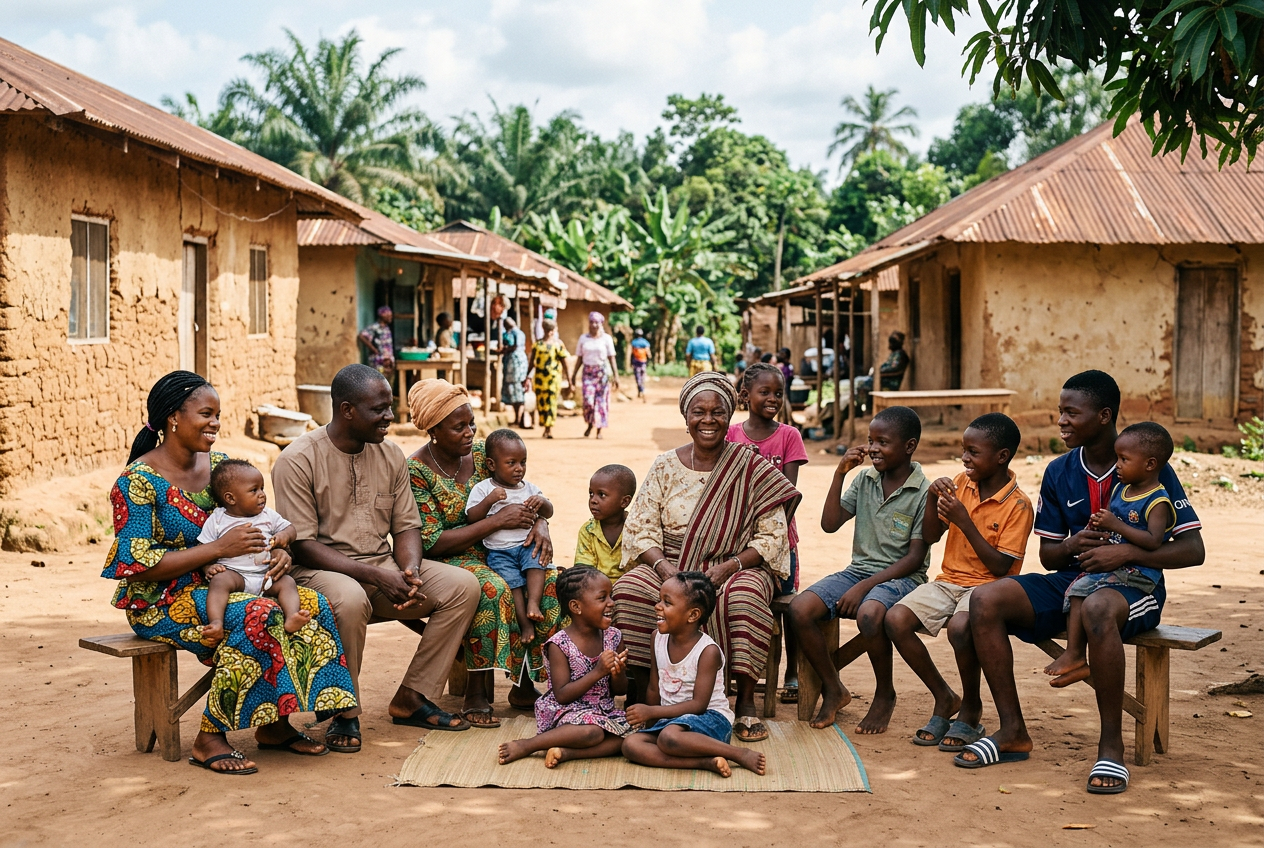
What does the “African family” actually look like in practical terms? It varies enormously. In a rural Malian village, it might mean a polygamous household of 12 to 18 people, multiple wives and their children all living in the same compound and sharing resources. In Nairobi or Cape Town or Lagos, it might mean a nuclear family of four in a two-bedroom apartment, with both parents working and paying school fees for two children. Both are African families. Neither is more authentically “African” than the other.
Nigeria straddles these two realities more dramatically than almost any other African nation, simply because of its size. With over 242 million people, Nigeria contains multitudes. And as Guardian Nigeria’s opinion pages have noted in discussions of Nigeria’s 2050 population projections, the choices Nigerian families make about size in the coming two decades will shape the continent’s demographic future.
How Many Children Does the Average Nigerian Have? The Direct Answer
Let me address the core question as plainly as possible, bringing together the key related factors.
The average Nigerian woman currently has approximately 4.8 children over her lifetime, according to the 2024 Nigeria Demographic and Health Survey. This figure encompasses enormous variation across states, regions, education levels, income brackets, and urban or rural locations. The related factors that most reliably predict a Nigerian woman’s family size include her level of formal education (the strongest predictor), her geographic location (urban or rural, north or south), her access to modern contraception, her household income, and her religious and cultural community’s norms around family planning. Nigeria’s declining fertility trend, from 6-plus children per woman in the 1980s to 5.3 in 2018 to 4.8 in 2024, reflects a genuine demographic shift that correlates with expanding female education, urbanisation, and gradual improvements in contraceptive access.
How Nigerian Family Size Shapes Daily Life
The practical reality of a 4.8-child household is worth exploring, because statistics become real when you see them in context.
I stayed with a family in Lokoja a couple of years back. Father, a civil servant earning approximately ₦180,000 per month. Mother, running a small provisions shop from their compound, pulling in another ₦80,000 to ₦100,000 in good months. Five children, ranging from three to seventeen years old. Three of them in school, with fees ranging from ₦35,000 to ₦90,000 per term. The household budget was not just tight. It was a daily exercise in prioritisation. A bag of rice here. School sandals there. Generator fuel competing with term fees.
That family is not atypical. It represents, quite accurately, a mid-range Nigerian household in a secondary city. Multiply that experience across 50 million or so Nigerian households and you begin to understand why consumer behaviour in this country looks the way it does, why the informal economy is so vast, and why remittances from Nigerians abroad matter so profoundly to so many families.
Larger families also drive the extended family support system that is one of Nigeria’s defining social features. An uncle in Lagos sending money to siblings in Ondo state. A cousin covering school fees for children in Enugu while their father recovers from illness. These networks function partly because individual households cannot cover all their expenses alone, and partly because Nigerian culture places collective family obligation at the centre of social identity.
As the Guardian Nigeria opinion piece on family planning for better living has observed, Nigeria’s high fertility rate carries significant implications not just for individual households but for the nation’s capacity to invest in quality education and healthcare for each child born.
The Generational Shift: What Young Nigerians Are Saying
Something genuinely interesting is happening among Nigerians under 35.
When I speak to young professionals in Lagos, Abuja, or Port Harcourt, the family size conversations are noticeably different from those I had with the same demographic a decade ago. “Two children, maybe three if we are managing well” is a phrase I have heard repeatedly. Young women especially, those who are employed, those with degrees, those navigating the realities of urban rent at ₦800,000 to ₦3 million per year, are thinking about family size in thoroughly economic terms.
This is not just anecdote. Demographic surveys consistently show that young urban Nigerians’ ideal family size is smaller than their parents’. And ideal family size is a leading indicator of actual family size over time.
The economic pressures driving this shift are real. A child in a decent Lagos private school costs ₦300,000 to ₦2 million in annual fees. Healthcare for a family of four without good employer insurance can easily run ₦200,000 to ₦500,000 per year. Housing takes another enormous bite. The maths pushes educated urban couples toward smaller families, not because they love children less, but because they want to do right by the children they have.
Related Articles
If you found this exploration of Nigerian family demographics valuable, two other pieces from this publication offer important related context.
My article on What is Nigerian Family Life Like? explores the extended family structures, daily routines, and social dynamics that shape life inside Nigerian households. Understanding how these extended systems work gives essential context to why Nigerian family sizes have historically been large.
For a clearer picture of the economic forces bearing down on Nigerian families, my piece on What is the Family Income in Nigeria? breaks down household income across different brackets and explains why rising living costs are increasingly reshaping family-size decisions, particularly among urban households.
Putting It All Together: Nigeria’s Children and Its Future
Nigeria is at a genuinely pivotal demographic moment.
The country’s fertility rate is falling, but it is falling from a high base. At 4.8 children per woman, Nigeria still has one of the higher fertility rates in the world, and with a current population of over 242 million and a very young age structure (roughly 44% under age 15), the absolute number of births per year remains enormous. That is not a problem. But it is a responsibility. Each of those children deserves education, healthcare, nutrition, and opportunity. Meeting that responsibility at scale requires continued investment in exactly the interventions that have driven Nigeria’s fertility decline so far: girls’ schooling, family planning access, urban economic development, and maternal healthcare.
The good news is that the trend line is clear and positive. Every reliable demographic projection shows Nigeria’s fertility rate continuing to decline. The pace of that decline depends on policy choices: investment in girls’ education, expansion of contraceptive access, and economic development that creates employment alternatives to subsistence farming in rural areas.
Here are three practical takeaways from everything we have covered:
- If you are a Nigerian parent or planning to become one, understand that family size decisions are among the most consequential financial choices you will make. The cost of giving each child a genuinely good start in life in Nigeria today is significant. Plan carefully, and consider the full range of costs, from school fees through university, not just the joy of the early years.
- If you are watching Nigeria’s consumer market, pay close attention to family-size trends. As fertility rates decline and urban families grow smaller, the mix of products and services in demand will shift. Baby and childhood product markets will remain large for decades due to existing population momentum, but the preferences and purchasing patterns of smaller, more affluent urban families will increasingly shape premium market segments.
- If you are interested in Nigeria’s long-term development trajectory, the single most powerful lever available is investment in girls’ secondary education. Every year of additional schooling for young Nigerian women has a measurable, documented effect on family size, maternal health, child health, and economic productivity. The demographic data is unambiguous on this point.
Nigeria’s children are its greatest asset, provided Nigeria invests in each of them. That is the real answer behind the number.
Frequently Asked Questions About How Many Children the Average Nigerian Has
How many children does the average Nigerian have in 2024?
The average Nigerian woman has approximately 4.8 children over her lifetime, according to the 2024 Nigeria Demographic and Health Survey published by the National Population Commission. This figure represents a decline from 5.3 children per woman in 2018 and reflects ongoing demographic change driven by education, urbanisation, and improved contraceptive access.
Is Nigeria’s fertility rate declining?
Yes, Nigeria’s fertility rate has declined from a historical high of around 6.5 children per woman in earlier decades to 4.8 in the most recent 2024 survey data. The decline reflects expanding female education, urbanisation, and gradual improvements in family planning service access, though the rate of decline remains slower than many other middle-income countries.
Which Nigerian state has the highest number of children per woman?
Sokoto state consistently records Nigeria’s highest fertility rates, with estimates ranging from 6.4 to 6.8 children per woman. Yobe, Jigawa, and Zamfara states in the Northwest and Northeast zones follow closely, all reflecting low female education levels, limited contraceptive access, and strong cultural traditions around large families.
Which Nigerian state has the fewest children per woman?
Lagos state has Nigeria’s lowest regional fertility rate, estimated at between 2.8 and 3.2 children per woman. High urbanisation, the high cost of living, greater female workforce participation, and better access to family planning services all contribute to significantly smaller average family sizes in Lagos compared to the national average.
Why do northern Nigerians tend to have more children than southern Nigerians?
The fertility gap between northern and southern Nigeria reflects several compounding factors, including lower female secondary school enrolment rates in the north, lower modern contraceptive use (often below 5% in some northern states compared to 20-28% in Lagos), higher rates of early marriage, rural economies where children contribute to agricultural labour, and cultural traditions that associate large families with prosperity and status.
What is the connection between education and family size in Nigeria?
Nigerian women with no formal education average approximately 6.5 children over their lifetimes, whilst women with tertiary education average around 3.0. This relationship between education and family size is one of the most robustly documented patterns in Nigerian demographic data, and it explains why investment in girls’ schooling is consistently cited as the most effective tool for managing population growth.
How does Nigeria’s average family size compare to the rest of Africa?
Nigeria’s national average of 4.8 children per woman sits above the African continental average of approximately 3.95. West Africa as a subregion averages around 4.7, making Nigeria broadly typical for its neighbourhood, whilst Southern African nations like South Africa (2.3) and Northern African nations like Egypt (2.8) show much lower fertility due to earlier demographic transitions and higher development levels.
Which country has the most children per woman in the world?
Chad currently holds the highest national fertility rate globally at approximately 5.94 children per woman, followed by Somalia at 5.91 and the Democratic Republic of Congo at 5.90. All three are sub-Saharan African nations, and sub-Saharan Africa as a region has the world’s highest concentration of high-fertility countries.
How many children do Nigerian families need for a comfortable retirement support system?
In Nigerian culture, adult children are expected to support ageing parents, and in communities without formal pension systems, having multiple adult children is genuinely important economic planning. Studies suggest Nigerian parents in informal employment effectively require two to three economically active adult children to ensure reasonable retirement support, though this calculus is changing as formal pension coverage slowly expands.
What products sell fastest in Nigeria because of its high birth rate?
Nigeria’s high birth and family size create enormous demand for staple foodstuffs (rice, cooking oil, noodles), baby and infant products (nappies, baby food, formula), children’s clothing and school supplies, affordable smartphones and accessories for young people, and household hygiene products. With approximately seven million births per year and households averaging four to six members, these categories are structurally guaranteed high-volume demand.
Is Nigeria’s population projected to continue growing?
Yes, Nigeria’s population is expected to continue growing substantially through at least the mid-21st century due to population momentum from its very young age structure, even as fertility rates decline. Projections suggest Nigeria will surpass the United States in total population before 2050 and could reach 400 million people by 2050 depending on the pace of fertility decline.
What can Nigerian families do to plan more effectively given the cost of raising children?
Nigerian families benefit most from deliberate financial planning that accounts for the full cost of each child’s education, healthcare, and daily needs from birth through early adulthood. This means budgeting for school fees (which can range from ₦35,000 to ₦2 million per year per child depending on school type), maintaining emergency health savings of at least ₦100,000 to ₦300,000 per family member, and exploring family planning options with qualified healthcare providers to ensure children arrive when the household is genuinely ready to invest properly in their futures.

