 Follow Us on Google News
 Follow Us on Google Discover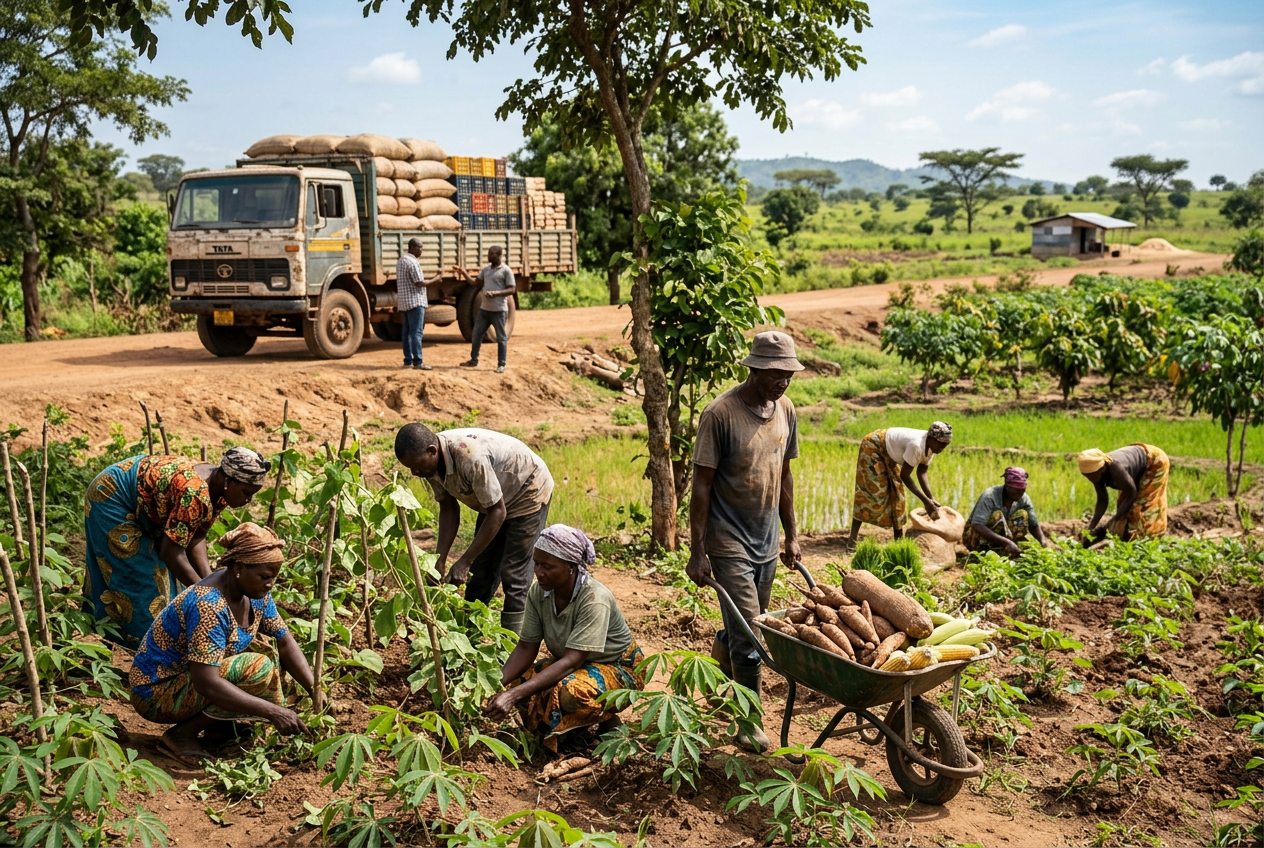
Welcome, and thank you for stopping by. If you have ever found yourself wondering what crops does Nigeria grow, you have landed in exactly the right place. This article is the conclusion of months of dedicated research into Nigerian agriculture and years of professional experience covering the country’s economic and cultural landscape. Whether you are a student, a farmer, an investor, or simply a curious Nigerian who wants to understand what feeds our nation, I hope what follows gives you a genuinely useful and thorough answer.
Nigeria’s agricultural story is one of extraordinary potential meeting extraordinary challenge. The country sits on roughly 70.8 million hectares of agricultural land, stretching from the humid rainforests of the south to the semi-arid savannah of the north. That climatic range means agriculture in Nigeria covers an unusually diverse catalogue of crops. Understanding that catalogue is not just a matter of academic interest. It speaks directly to national food security, household income, export revenue, and the daily meals on millions of Nigerian tables.
Let me take you through the full picture.
What Are the Main Crops Grown in Nigeria?
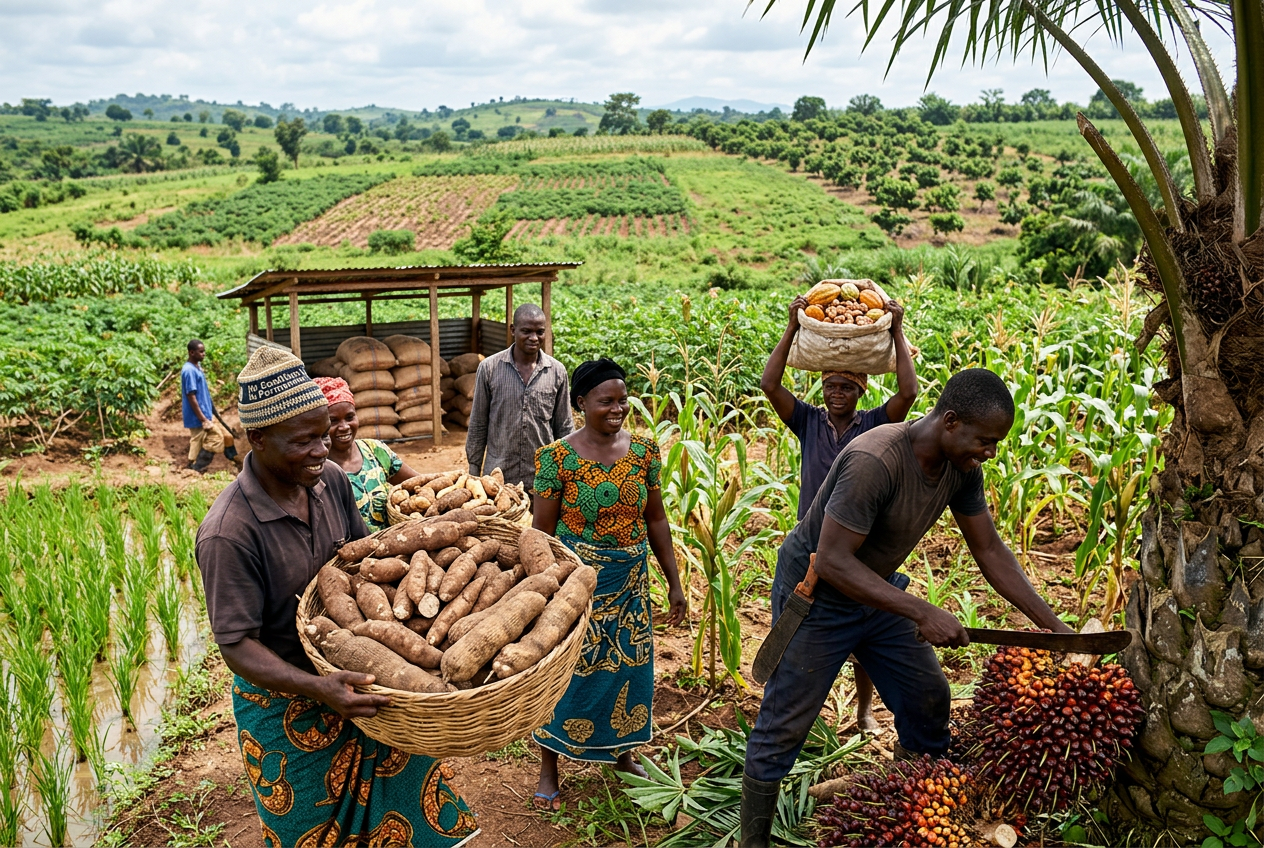
Nigeria’s agricultural geography divides, broadly speaking, into three ecological zones that each favour different crops. The southern rainforest belt, stretching across states like Cross River, Ondo, Edo, Delta, and Rivers, supports oil palm, cocoa, rubber, and plantain. The middle belt, running through Benue, Kogi, Plateau, and parts of Kwara, produces yam, cassava, maize, soybeans, and sorghum in abundance. The northern savannah belt, covering Kano, Kaduna, Kebbi, Sokoto, Katsina, and Zamfara, is the heartland of groundnut cultivation, millet, cotton, and rice production.
The Federal Ministry of Agriculture and Food Security (agriculture.gov.ng) classifies Nigerian crops into two broad categories: food crops and cash crops (sometimes called economic crops). Both categories are deeply interwoven. A farmer in Benue growing yam may sell most of it and eat the rest. A cocoa farmer in Ondo State produces almost entirely for export.
The country’s main food staples include cassava, yam, maize, rice, sorghum, millet, cowpeas, and plantain. These are the crops that go into the pots, the market stalls, and the school feeding programmes. Without them, the day-to-day nutritional baseline of roughly 230 million Nigerians simply collapses.

I remember visiting a small farm in Makurdi in 2022 where a husband and wife team were growing four crops simultaneously on about three hectares: cassava, maize, cowpeas, and sweet potato. They were not unusual. This kind of intercropping is completely standard in Nigerian smallholder farming, and it reflects something practical and intelligent about how our farmers manage climate risk across a season.
Cassava deserves special mention early in this discussion. Nigeria is the world’s single largest producer of cassava, according to the Food and Agriculture Organisation, and the crop is so embedded in Nigerian food culture that it appears in some form at virtually every table, whether as garri in a Lagos flat, fufu at a Yoruba wedding, or tapioca served in a hotel breakfast buffet in Abuja.
How to Understand Nigeria’s Crop Landscape: A 7-Step Guide
- Start with climate zones. Nigeria’s north and south experience dramatically different rainfall patterns, which determines which crops are viable where. The south receives 1,500mm to 3,000mm of rain annually; the north may receive as little as 500mm. Matching your crop expectations to a state’s climate zone is the foundation of everything else.
- Distinguish food crops from cash crops. Food crops (cassava, yam, maize, rice, millet, sorghum, plantain, cowpeas) are grown primarily for domestic consumption, although they also enter commerce. Cash crops (cocoa, rubber, palm oil, groundnut, cotton, sesame, ginger) are grown primarily for sale, often for export.
- Know the major producing states for each crop. Cassava production is heaviest in Benue, Kogi, Cross River, Ondo, and Ogun. Cocoa is almost exclusively a southwestern crop, concentrated in Ondo, Ogun, Osun, and Ekiti. Groundnut production remains centred in Kano, Katsina, and Jigawa. This geographic specificity matters enormously for supply chains and pricing.
- Understand the smallholder reality. According to data cited by the Federal Ministry of Agriculture, roughly 80% of Nigerian farmers are smallholders cultivating less than two hectares. They account for approximately 90% of total agricultural output. Any serious engagement with Nigerian agriculture must start from this fact, not from the large commercial farms that generate most of the press coverage.
- Factor in post-harvest loss. Nigeria loses an estimated 30% to 40% of its agricultural produce to poor storage, inadequate cold chains, and weak rural infrastructure before it ever reaches a market. For perishable crops like tomatoes, the figure can exceed 50% in peak seasons. This is not a peripheral issue; it is central to why Nigeria imports so much food despite producing so much of it.
- Consult research institutions. The Agricultural Research Council of Nigeria (arcn.gov.ng) coordinates the national agricultural research network, overseeing institutes that develop improved crop varieties, soil management techniques, and pest-resistant strains. Their work is directly relevant to what farmers can realistically grow under changing climate conditions.
- Follow policy and incentive shifts. Government programmes like the Anchor Borrowers Programme, the Nigeria Incentive-Based Risk Sharing System for Agricultural Lending (NIRSAL), and various state-level food security initiatives directly influence which crops farmers plant in a given season. Staying current with policy is essential for anyone investing in or writing about Nigerian agriculture.
What Crop Is Nigeria Famous For?
If you had to pick a single crop that defines Nigeria’s agricultural identity globally, it would almost certainly be cassava. Nigeria has held the title of the world’s largest cassava producer for decades, generating well over 60 million metric tonnes per year. That is a remarkable figure, and it underlines just how central the crop is to national life.
But close behind cassava in terms of cultural and historical significance is cocoa. In the 1960s and early 1970s, cocoa was Nigeria’s most valuable export, financing infrastructure, education, and the early ambitions of a newly independent nation. The old Western Region under Chief Obafemi Awolowo built free primary education on cocoa revenues. That legacy still resonates. Today, Nigeria ranks as the world’s fourth-largest cocoa producer, after Ivory Coast, Indonesia, and Ghana, though our share of global output has declined significantly since the oil boom drew resources and attention away from agriculture in the 1970s.
Yam is another crop for which Nigeria holds global bragging rights. The country produces roughly 70% of the world’s total yam output, making Nigeria as dominant in yam as it is in cassava. Yam holds deep cultural significance across Igbo, Yoruba, Tiv, and many Middle Belt communities, where the New Yam Festival is one of the most important calendrical events of the year.
Palm oil completes the quartet of crops most strongly associated with Nigerian identity. Before independence, Nigeria was the world’s largest exporter of palm oil. Though Malaysia and Indonesia have long since overtaken us in global market share, palm oil cultivation remains essential to the economies of Rivers, Akwa Ibom, Cross River, Imo, Edo, and Delta states.
Nigeria’s Key Crops: Production and Economic Data
The table below summarises the major crops Nigeria grows, their primary producing regions, approximate annual production volumes, and their primary economic use.
| Crop | Primary Region(s) | Est. Annual Production | Primary Use |
|---|---|---|---|
| Cassava | Benue, Kogi, Cross River, Ondo | 60+ million metric tonnes | Food (garri, fufu, tapioca) and industrial starch |
| Yam | Benue, Taraba, Plateau, Kogi | 45+ million metric tonnes | Food staple, cultural ceremonies |
| Maize | Kaduna, Kano, Benue, Ogun | 10-12 million metric tonnes | Food, livestock feed, industrial use |
| Sorghum | Kano, Katsina, Borno, Sokoto | 6-7 million metric tonnes | Food, brewing, animal feed |
| Millet | Kano, Jigawa, Sokoto, Borno | 4-5 million metric tonnes | Food staple (north), livestock feed |
| Rice | Kebbi, Ebonyi, Anambra, Niger | 4-5 million metric tonnes | Food staple, import supplement |
| Groundnut | Kano, Katsina, Jigawa | 3-4 million metric tonnes | Oil, food, export |
| Cocoa | Ondo, Ogun, Osun, Ekiti | 280,000-340,000 metric tonnes | Export cash crop |
| Palm Oil | Rivers, Akwa Ibom, Edo, Cross River | 1+ million metric tonnes | Food, export, industrial use |
| Cotton | Katsina, Kebbi, Zamfara, Anambra | 200,000-400,000 metric tonnes | Textile industry, export |
Nigeria’s crop production data reveals a pattern worth noting directly: the country dominates global output in root and tuber crops (cassava, yam) whilst performing well below its potential in cash crops like cocoa and palm oil, where post-independence neglect has allowed other producing nations to pull far ahead.
The National Root Crops Research Institute (nrcri.gov.ng), based in Umudike, Abia State, has been instrumental in developing high-yield and disease-resistant varieties of cassava and yam. Their work on the TM419 cassava variety, developed alongside the International Institute of Tropical Agriculture, has helped some farmers increase yields from two to six tonnes per hectare. That kind of improvement has genuine consequences for rural household incomes.
As pointed out in a detailed piece from The Guardian Nigeria on the fundamental challenges facing local food production, poor access to improved seeds, limited credit, and a collapsed agricultural extension system continue to prevent even these research breakthroughs from reaching most smallholder farmers at scale. The structural gap between what our research institutes develop and what farmers actually plant remains one of the most frustrating features of Nigerian agriculture. Guardian Nigeria explores this in detail in their feature on tackling basic challenges in Nigeria’s food production industry.
What Are the Top 3 Imports of Nigeria?
Given everything Nigeria grows, it might seem surprising that the country spends so heavily on food imports. Yet the Federal Minister of Agriculture himself stated in August 2025 that Nigeria spends over $10 billion annually importing food whilst earning less than $400 million from agricultural exports. That gap is not just a statistical curiosity; it is a structural problem that successive governments have identified but not yet solved.
Nigeria’s top three food imports by value are wheat, rice, and sugar.
Wheat is grown in very limited quantities in Nigeria, primarily in Borno, Plateau, and a few northern states during the harmattan season. Domestic production covers nowhere near national consumption demand. Nigeria imports millions of tonnes of wheat annually to supply its flour mills, which feed the booming bakery and noodle industries. A packet of Indomie noodles and a loaf of sliced bread, both daily staples across Nigerian cities, depend almost entirely on imported wheat.
Rice tells a more complicated story. Nigeria produces significant quantities of domestic rice, particularly in Kebbi, Ebonyi, and Anambra states. The federal government has invested substantially in domestic rice production through irrigation projects in Kebbi and the distribution of improved seed varieties. Yet domestic supply still falls short of the roughly 7 million metric tonnes Nigerians consume annually, and smuggled or officially imported rice continues to fill the gap.
Sugar rounds out the top three. There is a single large domestic sugar producer, Dangote Sugar, and a handful of smaller operations, but their combined output covers only a fraction of national demand. The remainder is imported, primarily from Brazil and India.
Beyond these three, fish (including stockfish, which is culturally significant in southeastern Nigeria), tomato paste, wheat flour, and vegetable oils round out the major import categories. This import dependence is a recurring theme in Guardian Nigeria’s coverage of the agricultural sector. A piece examining whether Nigeria’s agricultural sector is genuinely the backbone of the economy explores this tension between production potential and import reliance particularly well. Read more about this in The Guardian Nigeria’s report on agriculture as Nigeria’s economy driver.
What Are the 10 Economic Crops in Nigeria?
Economic crops, also called cash crops, are cultivated primarily to generate income rather than for direct household consumption. Nigeria’s range of economic crops spans tropical, subtropical, and semi-arid varieties, which reflects the country’s climatic diversity.
Here are the ten most significant economic crops Nigeria grows:
Cocoa remains Nigeria’s most historically significant cash crop and the country’s leading agricultural export. Production is concentrated almost entirely in Ondo, Ogun, Osun, and Ekiti states. Cocoa beans are exported to Europe, the United States, and Asia for chocolate manufacturing.
Palm oil and palm kernel together form one of the most valuable agricultural commodities Nigeria produces. The crop has deep roots in the south-south and south-east regions. Palm oil is used in everything from food cooking to cosmetics to biodiesel, which gives it broad global demand.
Rubber is cultivated primarily in Edo, Delta, Ondo, and Cross River states. Nigeria’s rubber industry, coordinated partly through the Rubber Research Institute of Nigeria, exports natural rubber to the global tyre and latex industries. Output has fluctuated significantly over the decades due to ageing plantations and insufficient replanting.
Groundnut (peanut) was Nigeria’s leading export crop before independence and through the 1960s. The famous groundnut pyramids of Kano were a symbol of northern prosperity. Though the oil boom effectively destroyed that industry, groundnut cultivation has been slowly reviving, with renewed interest in sesame, which increasingly competes with groundnut in northern export agriculture.
Sesame (benniseed) has grown remarkably in economic importance over the past two decades. Nigeria is now one of the world’s top sesame exporters, with Benue, Nasarawa, Taraba, and Cross River being the main producing states. Sesame is exported primarily to Japan, China, and South Korea for use in food processing and oil extraction.
Cotton was another pre-independence giant. Katsina, Kebbi, Zamfara, and Anambra are the primary producing states. Domestic textile mills once absorbed large quantities of Nigerian cotton, but the collapse of the textile industry in the 1980s and 1990s severely disrupted demand. Export-oriented cotton production is gradually recovering.
Ginger is an increasingly important cash crop, particularly in Kaduna and Nasarawa states. Nigeria is the world’s largest producer of ginger by volume, a fact that surprises many people, including Nigerians. The bulk of this ginger is exported to India, China, and Europe.
Cashew production has expanded significantly in Oyo, Kwara, Enugu, Kogi, and Anambra states. Nigeria is Africa’s leading cashew producer and the third-largest globally. Raw cashew nuts are exported primarily to India and Vietnam for processing, though there is growing domestic processing capacity.
Shea (karite) is harvested from wild shea trees across the north-central and northwestern states. Shea butter is a premium ingredient in cosmetics and food products globally. Nigeria’s shea export potential is enormous but largely untapped because most processing still happens abroad rather than domestically.
Tobacco rounds out the list as a crop with significant commercial history, particularly in Oyo, Ogun, and Plateau states. British American Tobacco maintained a longstanding presence in Nigeria, and tobacco farming was a significant income source for many farmers in those regions for decades.
The urban farming movement emerging in Lagos and other large cities is adding new dimensions to Nigeria’s crop picture. As Guardian Nigeria reported in a recent feature on urban farming, over 75% of Lagos’s food supply currently comes from other states, creating interest in localised vegetable and leafy crop production that can supplement and partially replace the long-distance supply chains that dominate urban food access. The Guardian Nigeria’s feature on the imperative of urban farming explores these emerging dynamics in detail.
What Crops Does Nigeria Grow Best? The Honest Conclusion
So, to bring the central question into sharp focus: what crops does Nigeria grow, and which does it grow best?
Nigeria grows a remarkable breadth of crops across its climatic zones, including cassava, yam, maize, sorghum, millet, rice, cowpeas, sweet potato, plantain, cocoa, palm oil, rubber, groundnut, sesame, ginger, cashew, cotton, and shea. It leads the world in cassava and yam production, ranks among the global top five in ginger, cashew, and sesame, and holds historic significance in cocoa, palm oil, and groundnut. The country has 70.8 million hectares of agricultural land, over 80 million rural residents whose livelihoods depend on farming, and research institutions actively working on improved crop varieties.
The challenge is not what Nigeria can grow. The challenge is the gap between what our farmers plant and what they harvest, between what is harvested and what reaches market, and between what the market supplies and what a country of 230 million actually needs. Post-harvest losses, poor rural roads, inadequate irrigation, high input costs, limited financing, and a weakened extension system continue to undermine the extraordinary agricultural endowment this country possesses.
Closing that gap requires sustained investment, policy continuity, and a serious commitment to supporting the smallholder farmers who are, despite everything, feeding most of the nation.
The potential of what crops Nigeria grows is enormous. The work of realising that potential is ongoing.
Related Articles
If you found this exploration of Nigeria’s agricultural landscape useful, you may also enjoy these related pieces from this same author:
Is Nigeria a Developed Country? examines Nigeria’s economic structure in depth, including the role of low-productivity agriculture in holding back broader national development.
What Continent is Nigeria on? explores Nigeria’s geographical position and how its location across multiple ecological zones creates precisely the climatic diversity that makes our wide crop range possible.
Key Takeaways
- Nigeria is the world’s leading producer of cassava and yam, and a significant global producer of ginger, sesame, cashew, and cocoa, with agricultural land spanning multiple climate zones from southern rainforest to northern semi-arid savannah.
- Despite this production breadth, Nigeria spends over $10 billion annually importing wheat, rice, sugar, and other foods, revealing a structural gap between production potential and actual food self-sufficiency that urgently needs addressing.
- Closing the gap requires practical interventions: supporting smallholder farmers with better seeds, accessible credit, functional rural roads, and post-harvest storage infrastructure, rather than simply expanding the acreage under cultivation.
Frequently Asked Questions About What Crops Does Nigeria Grow
What is the number one crop grown in Nigeria?
Cassava is Nigeria’s number one crop by volume, with the country producing more than 60 million metric tonnes annually. It is also the most widely consumed staple food, eaten as garri, fufu, tapioca, and various processed products across all six geopolitical zones.
Does Nigeria grow rice?
Yes, Nigeria grows rice in several states, with Kebbi, Ebonyi, Niger, and Anambra being among the most productive. However, domestic production still falls short of the approximately 7 million metric tonnes Nigerians consume each year, making rice importation an ongoing economic issue.
What food crops does Nigeria grow in the north?
The northern states primarily grow millet, sorghum, groundnut, cowpeas, maize, and onions, with wheat produced in limited quantities in Borno and Plateau states. Cotton, sesame, and ginger are important cash crops in the north-central and northwestern regions.
Is Nigeria the largest producer of yam in the world?
Yes, Nigeria produces approximately 70% of the world’s total yam supply, making it by far the dominant global producer. Benue, Taraba, Plateau, Kogi, and Nasarawa states are the primary yam-growing regions.
What cash crops does Nigeria export?
Nigeria’s main agricultural exports are cocoa, sesame, cashew, palm oil, rubber, ginger, and cotton. Cocoa remains the most historically significant export crop, though sesame and cashew have grown considerably in export value over the past two decades.
Why does Nigeria import food despite growing so much?
Nigeria’s food imports are driven by a combination of factors: post-harvest losses of up to 40%, poor rural infrastructure that limits market access, production volumes that still fall short of demand for staples like wheat and rice, and inadequate processing capacity. The country grows a great deal but loses a significant portion before it reaches consumers.
What crops grow best in southern Nigeria?
Southern Nigeria’s humid climate and high rainfall support oil palm, cocoa, rubber, plantain, banana, cassava, yam, and a wide range of fruits and vegetables. Cross River, Ondo, Delta, and Edo states are particularly productive for tree crops and root crops alike.
Does Nigeria grow wheat?
Nigeria grows wheat in very small quantities, mainly in Borno, Plateau, and parts of the northwest during the cool dry season. Domestic production covers only a tiny fraction of national demand, with the vast majority of wheat consumed in Nigeria coming from imports, particularly from the United States and Canada.
What is the most important cash crop in Nigeria historically?
Cocoa holds the most significant historical position as a cash crop, having financed the free primary education programme in the old Western Region and representing Nigeria’s leading agricultural export through the 1960s. Nigeria was once the world’s second-largest cocoa producer before the oil boom redirected economic attention away from agriculture.
How many hectares of arable land does Nigeria have?
Nigeria has approximately 70.8 million hectares of agricultural land, of which a significant portion remains underutilised. The Federal Ministry of Agriculture and Food Security has repeatedly cited this land endowment as the foundation for achieving food self-sufficiency, though converting potential into production requires sustained investment in infrastructure and farming technology.
What role does the government play in Nigerian crop production?
The Federal Ministry of Agriculture and Food Security (agriculture.gov.ng) sets agricultural policy, manages input subsidy programmes, and coordinates food security initiatives. Research coordination falls to the Agricultural Research Council of Nigeria (arcn.gov.ng), which oversees a national network of crop-specific research institutes developing improved varieties and farming techniques.
What is Nigeria’s newest economic crop opportunity?
Sesame has emerged as one of Nigeria’s fastest-growing export crops, with Benue, Nasarawa, Taraba, and Cross River states leading production. Nigeria is now among the world’s top sesame exporters, supplying markets in Japan, China, and South Korea, and the crop requires relatively little irrigation, making it well-suited to the north-central belt.
Nigeria grows crops that could feed and enrich an entire continent if the infrastructure, investment, and policy support were aligned. The seeds of that possibility are already in the ground.

