 Follow Us on Google News


 Follow Us on Google Discover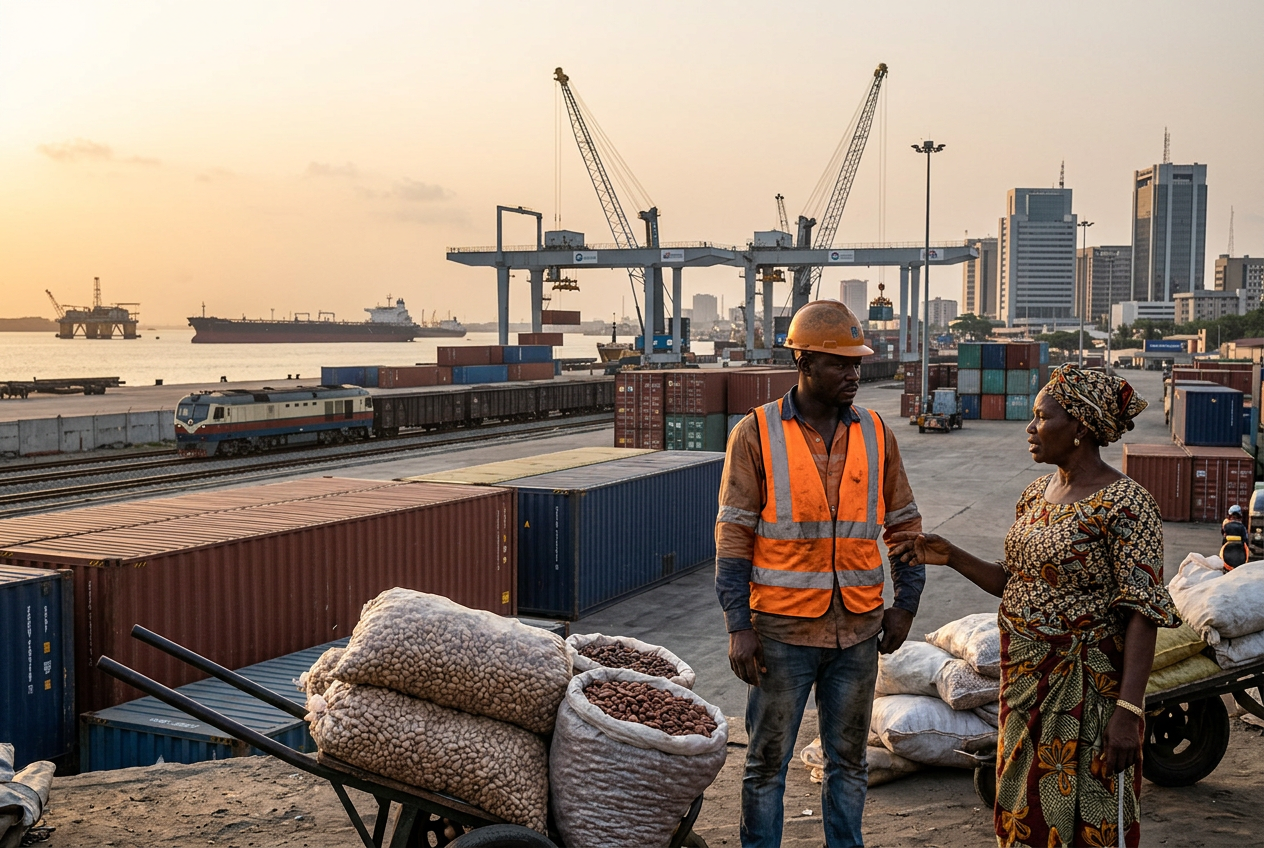
Welcome, and thank you for bringing this question here rather than to the first search result that shouted “oil” at you and went quiet.
What is Nigeria’s main source of income? After months pulling apart quarterly national accounts, revenue disclosures and balance of payments tables, and years spent writing about how this country earns and spends, I can tell you the popular one word answer is not wrong so much as unfinished. It is also how a nation ends up with something close to Dutch disease while sincerely believing it has diversified.
The single most useful thing anyone can learn about the Nigerian economy is that “income” means three different things depending on who is asking, and that confusing them is how sensible people end up arguing past each other for hours.
So let us take our time.
Ask a currency trader in Lagos where Nigeria’s income comes from and you will get one answer. Ask an accountant at the Nigeria Revenue Service and you will get a different one. Ask a farmer in Benue, or a POS operator in Aba, or a nurse whose brother sends money from Manchester every month, and you will get a third. All three are describing the same economy. None of them is lying.
The trick is knowing which question you are answering.

Where does Nigeria get its money from today?
Let us start with the plumbing, because the plumbing is where the confusion lives.
Nigeria has five significant money taps. Crude oil and gas exports. Taxes. Customs duties. Diaspora remittances. And borrowing. Everything else, and I do mean everything, is either a tributary of one of these or too small to move the national picture in a given quarter.
Take crude first, since it is the one everybody names. Production has been quietly recovering. The upstream regulator’s monthly output figures put average crude oil and condensate production at roughly 1.74 million barrels per day in June 2026, a fourth consecutive month of growth and about 104 per cent of the OPEC quota of 1.5 million barrels per day. Crude alone accounted for around 1.56 million barrels of that, with condensate making up the balance. For a country that spent 2022 struggling to hit 1.2 million barrels while pipelines were being tapped like a communal keg, that is a real recovery, and it matters.
Here is the number that surprises people. In the first quarter of 2026, crude oil exports were worth ₦11.20 trillion, which came to 52.92 per cent of Nigeria’s total exports. Add refined products and gas and the mineral products category swells to about ₦18.16 trillion, or roughly 86 per cent of everything Nigeria sold abroad. So when anyone says Nigeria is an oil exporter, they are simply correct. There is no clever revision to be made there.
But now walk two streets over to the tax office and the picture changes completely.
The Nigeria Revenue Service, which most of us still think of as FIRS, collected ₦28.3 trillion in 2025 and had already collected ₦27.1 trillion in the first seven months of 2026 alone. Roughly 76 per cent of that came from non-oil sources. The tax to GDP ratio has climbed from about 10.3 per cent in 2023 to around 13 per cent. For anyone who remembers when that ratio sat at 6 per cent and Nigerian officials had to explain it away at every international meeting, this is not a rounding adjustment. It is a different fiscal machine.
Then there is the output side, which is different again. According to national accounts data, the oil sector contributed just 3.92 per cent to real GDP in the first quarter of 2026. The non-oil sector contributed 96.08 per cent. Services alone made up 57.73 per cent, driven by telecommunications, trade, financial institutions, real estate and construction. Agriculture contributed 25.67 per cent to nominal GDP in the last quarter of 2025.
Read those two paragraphs again and you will see the whole puzzle. Oil is 86 per cent of what Nigeria sells to foreigners and under 4 per cent of what Nigeria produces. Both figures are accurate. They are measuring different things.
The fourth tap is one Nigerians feel more personally than any statistic can convey. Diaspora remittances came to $5.30 billion in the first quarter of 2026, down slightly from $5.72 billion the previous quarter. The Nigerians in Diaspora Commission has long argued that these flows rival and sometimes exceed oil receipts, and the central bank now treats them as a policy target rather than a happy accident, aiming for a billion dollars a month through formal channels by the end of 2026. Monthly formal inflows have tripled since the reforms began, from roughly $200 million to over $600 million.
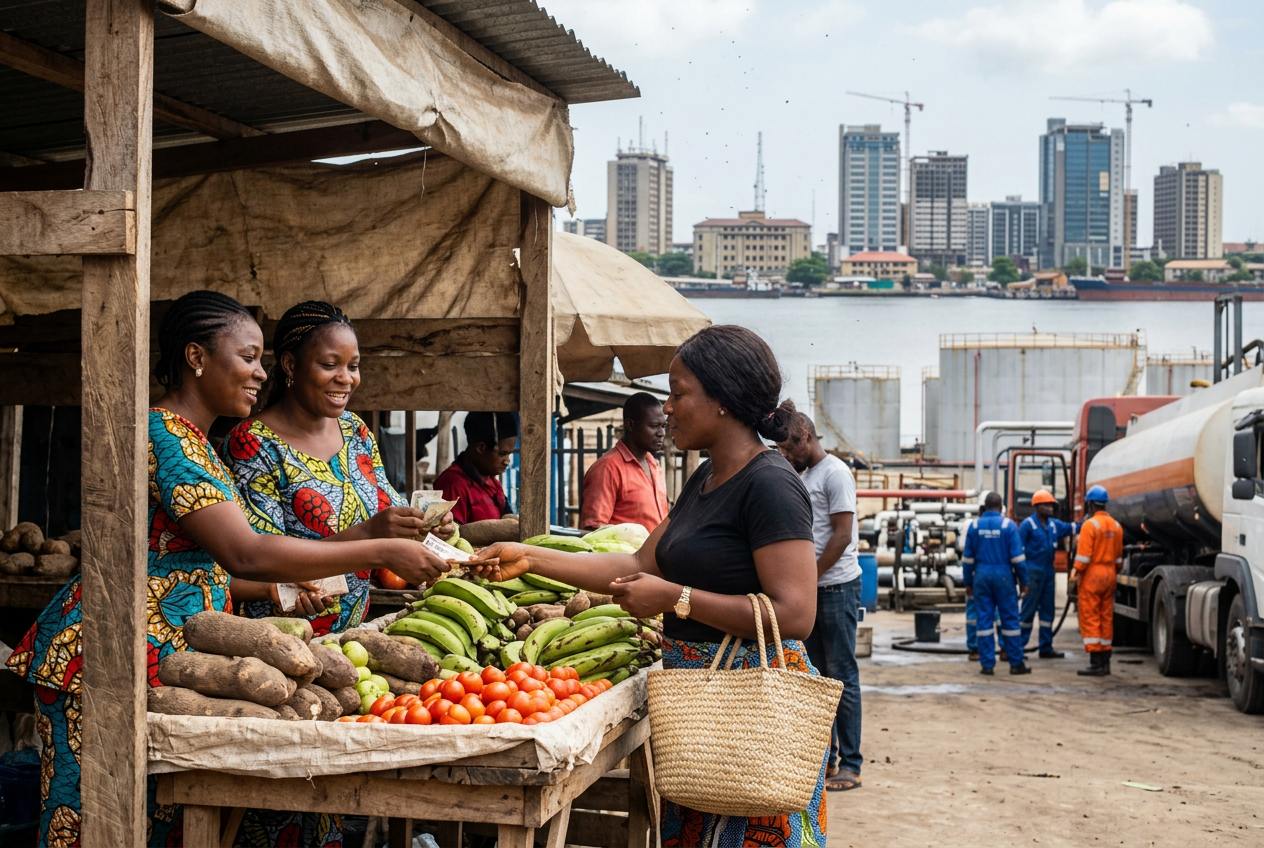
Think about what that money does. It does not pass through the Federation Account. It does not get shared at a monthly FAAC meeting in Abuja. It lands in a bank account in Ikeja or Owerri and pays school fees, rent, a mother’s hospital bill, a nephew’s apprenticeship. It is possibly the most efficiently targeted income Nigeria receives, and nobody planned it.
The fifth tap is borrowing, and it deserves its own honest paragraph. Nigeria’s external debt stood at $51.90 billion as at 31 March 2026, with total public debt at ₦159.35 trillion, according to the published federal debt profile. Borrowed money is not income in any household sense, but it funds a meaningful share of federal spending, and it is the reason the debt question in the next section is not academic.
Nigeria’s main income streams compared, latest available figures
| Income stream | Most recent figure | Period covered | What it mainly funds |
|---|---|---|---|
| Crude oil exports | ₦11.20 trillion | Q1 2026 | Foreign exchange, reserves, FAAC pool |
| Other oil and gas exports | ₦6.78 trillion | Q1 2026 | Foreign exchange, refinery earnings |
| Tax collections | ₦27.1 trillion | January to July 2026 | Federal and state budgets |
| Non-oil exports | ₦3.19 trillion | Q1 2026 | Farmers, processors, manufacturers |
| Diaspora remittances | $5.30 billion | Q1 2026 | Household spending, fees, rent |
| External debt outstanding | $51.90 billion | As at 31 March 2026 | Deficit financing, infrastructure |
Read the table sideways rather than downwards and the point becomes obvious. The largest single number belongs to tax, the most reliable foreign currency belongs to oil, and the money that reaches ordinary households most directly belongs to the diaspora. No single row is the answer on its own.
So what is Nigeria’s main source of income, in one honest paragraph?
Here is the direct answer, and I want to give it plainly before qualifying it.
Nigeria’s main source of income depends on which ledger you are reading, and in 2026 there are three defensible answers running simultaneously. Measured by foreign exchange earnings, the main source of income is crude oil and gas, which supplied about 86 per cent of export value in the first quarter of 2026 and remains the anchor of the ₦48 billion dollar reserve position. Measured by government revenue, the main source is now taxation, with the Nigeria Revenue Service collecting ₦27.1 trillion in seven months and roughly three quarters of it coming from non-oil sources such as company income tax, value added tax and the development levy. Measured by economic output, meaning what Nigerians actually make and do all day, the main source is services, at 57.73 per cent of GDP, followed by agriculture, with oil trailing at under 4 per cent. The closely related entities you will see cited alongside this question are the National Bureau of Statistics, the Nigeria Revenue Service, the Nigerian Upstream Petroleum Regulatory Commission, the Central Bank of Nigeria and the Debt Management Office, and each of them is measuring a genuinely different quantity.
If you need one sentence for a classroom or a WhatsApp argument, use this. Oil earns Nigeria its dollars, tax funds Nigeria’s government, and services keep Nigerians employed.
Now, why does this matter beyond pedantry?
Because policy failures follow directly from picking the wrong ledger. Treat oil as the main income and you build a budget that lives or dies on a price assumption, which is exactly what the 2026 budget of ₦58.4 trillion did with its $64.85 per barrel benchmark. Treat tax as the main income and you start asking harder questions about who pays, who does not, and why 93 per cent of employment sits in an informal sector that is almost impossible to assess. Treat services as the main income and you notice that telecommunications and trade are carrying an economy whose infrastructure has not been built for them.
A Guardian columnist made a version of this point well when the oil price spiked past $114 earlier this year, warning in a piece on whether the boom is opportunity or illusion that every additional 100,000 barrels per day is worth roughly $4.1 billion a year in export revenue, and that Nigeria’s missing capacity is therefore a multi-billion dollar leak rather than a technicality. High prices are not the same as high earnings when you cannot fill the tanker.
I have watched this cycle three times now in my working life. The price goes up, the mood in Abuja lifts, the diversification conversation goes quiet, and then the price falls and we start again. The one thing genuinely different this time is the tax number, which does not care what Brent is doing on a Tuesday.
Here is how to check any of this for yourself rather than taking my word or anyone else’s.
- Start with the quarterly GDP report from the National Bureau of Statistics, published roughly eight weeks after each quarter closes, and go straight to the sectoral contribution table rather than the headline growth figure. The growth number is the least informative line in the whole document.
- Cross-check the oil share against the upstream regulator’s monthly production data, which is released within the first two weeks of the following month and broken down terminal by terminal. If GDP oil share and barrels per day are moving in opposite directions, the price is doing the work, not the wells.
- Pull the foreign trade statistics release for the same quarter and note the crude share of total exports as a separate figure from the mineral products share, because the second includes gas and refined products and will always look larger.
- Read the revenue service collection figures against their own target rather than against the previous year, since a 20 per cent rise on a badly missed target is not the same story as a 20 per cent rise on a target that was met.
- Check the central bank balance of payments report for the remittance line, which sits under personal transfers, and compare it with the crude oil export line in the same document rather than with figures from a different source or period.
- For debt, go to the Debt Management Office quarterly tables and read external and domestic separately, because a stronger naira shrinks the naira value of external debt without a single dollar being repaid.
- Give any figure you find a shelf life of one quarter and write the date next to it. Nigerian economic data moves fast enough that a nine month old number quoted confidently is worse than no number at all.
That sequence takes about forty minutes the first time and perhaps fifteen once you know where things sit. It is the closest thing to an honest personal briefing that exists.
What is the biggest economy in Nigeria itself?
People ask this question meaning two quite different things, so let us take both.
If you mean which sector is biggest, the answer is services, and it is not close. At 57.73 per cent of GDP in the first quarter of 2026, services outweigh agriculture and industry put together. Within services, telecommunications and trade do most of the heavy lifting. Every time someone buys airtime in Onitsha or a small trader restocks from a container in Alaba, that is the biggest sector of the Nigerian economy quietly doing its work.
If you mean which state is biggest, the answer is Lagos, and that is not close either.
Lagos put its nominal GDP at about ₦62.66 trillion for 2025 and projected roughly ₦73.15 trillion for 2026, with a stated ambition of becoming a trillion dollar economy by 2052. On a purchasing power basis the state government has cited a figure of $259 billion, which would make Lagos the second largest city economy on the continent after Cairo. The state’s 2026 budget came in at ₦4.44 trillion, against total sub-national budgets of about ₦36.98 trillion across the federation.
But the number that tells the real story is internally generated revenue. Lagos raised ₦1.17 trillion in the first half of 2026, more than the other thirty-one states in the comparison combined. Ogun came second at ₦140.57 billion. Enugu third at ₦95.62 billion. Kano fourth at ₦60.14 billion.
Sit with that for a moment. One state out-earns thirty-one others put together, and it does it from taxes on economic activity rather than from oil derivation.
That is the whole diversification argument compressed into a single statistic, and it is why the Lagos model gets studied so obsessively by other governors. It is also why Lagos was the biggest beneficiary of Federation Account revenue in the first half of 2026, receiving ₦365.78 billion in net FAAC revenue, overtaking the traditional oil producing states. Of that, ₦344.06 billion came from VAT rather than statutory oil revenue.
Rather like a market trader who stops relying on one wholesaler and builds a dozen supply lines, Lagos has made itself harder to knock over.
The uncomfortable corollary is that most states have not. Twelve states have crossed the ₦1 trillion budget threshold, which sounds encouraging until you notice how many of those budgets depend on monthly allocations rather than on anything the state itself generates. A budget funded by someone else’s crude is a wish list with letterhead.
Which country is Nigeria owing most, and does the answer change anything?
This is the question I get asked most often at dinner tables, usually with China already assumed in the asking. The honest answer is more interesting than the assumption.
As at 31 March 2026, Nigeria’s external debt stood at $51.90 billion on the Debt Management Office’s own tables. Total public debt, external plus domestic, reached ₦159.35 trillion.
Now, the creditors. Nigeria’s single largest external creditor is not a country at all. It is the World Bank’s International Development Association, holding about $18.39 billion, roughly 35 per cent of the total. Add Eurobond investors, who are scattered pension funds and asset managers across several continents, and the two together account for around 71 per cent of everything Nigeria owes abroad.
China’s Export-Import Bank comes third at $4.95 billion, about 9.54 per cent. That does make China Nigeria’s largest single-country creditor, so if the question is strictly “which country”, the answer is China. But China holds less than a tenth of Nigeria’s external debt, and that exposure has actually been shrinking as older facilities amortise.
Behind them sit the African Development Bank at $2.19 billion, First Abu Dhabi Bank at $1.87 billion, the World Bank’s IBRD arm at $1.43 billion, the African Development Fund at $1.01 billion, France’s development agency at $902.17 million, Afreximbank at $637.82 million and China Development Bank at $507.52 million.
So the popular framing, the one about Nigeria being mortgaged to Beijing, does not survive contact with the DMO tables. Nigeria is far more exposed to multilateral development finance and to global bond markets than to any bilateral partner. That is a meaningfully different risk profile. Concessional multilateral loans carry low interest and long tenors. Eurobonds carry market rates and refinancing risk that moves with global sentiment rather than with any single government’s goodwill.
One more thing worth holding onto. Just over half of Nigeria’s total debt is domestic, denominated in naira and owed largely to Nigerian banks, pension funds and individuals through FGN bonds and treasury bills. Domestic debt rose from ₦84.85 trillion in December 2025 to ₦87.40 trillion by March 2026. When your uncle buys an FGN savings bond, he becomes one of Nigeria’s creditors. The country owes a great deal of money to itself.
An editorial in this paper on Nigeria’s stalled oil reserves put the underlying tension well, noting that reserves of 37.01 billion barrels as at January 2026 should be read as a deadline for transformation rather than as a safety net. Debt taken against a depleting asset is a different proposition from debt taken against a growing tax base.
Which country in Africa is richer than Nigeria on the numbers?
Now we arrive at the question that generates the most heat and the least clarity, because “richer” is doing enormous unacknowledged work in that sentence.
Take total economic size first. IMF projections for 2026 place South Africa at the top, somewhere between $443 billion and $480 billion depending on which compilation you read, followed by Egypt at roughly $400 billion to $430 billion, with Nigeria third at somewhere between $334 billion and $377 billion. Algeria sits close behind at around $285 billion to $317 billion, close enough that some compilations put Nigeria fourth rather than third. I should be straight with you here. These figures are contested, they shift between releases, and the reason is almost entirely exchange rate movement rather than anything happening in a factory or a field. Nigeria held the largest economy in Africa title from the 2013 rebasing until the naira reforms of 2023 and 2024 rewrote the dollar arithmetic.
That is a humbling thing to sit with. The economy did not shrink. The measuring stick changed.
But now flip to income per person, which is what most people actually mean when they say richer, and the picture rearranges entirely. On a purchasing power parity basis for 2026, Nigeria sits seventeenth in Africa at roughly $9,994 per person. Sixteen African countries are ahead, and the list is worth reading properly:
Seychelles at about $35,855, Mauritius at about $34,830, Gabon at about $25,847, Egypt at about $23,321, Botswana at about $22,039, Algeria at about $19,677, Equatorial Guinea at about $19,061, Libya at about $18,749, South Africa at about $16,740, Tunisia at about $15,833, Eswatini, Cabo Verde, Namibia, Morocco, Angola and Djibouti.
Look at that list and a pattern jumps out. Almost every country above Nigeria has either a small population, a large hydrocarbon endowment relative to that population, or both. Seychelles has about 100,000 people and an economy built on tourism. Gabon and Equatorial Guinea are oil producers with populations you could fit inside Ibadan. This is arithmetic more than achievement.
Which leads to the observation that reframes the whole question. Nigeria produces roughly 1.7 million barrels a day and shares them among more than 200 million people. Saudi Arabia produces around ten million barrels among about 35 million. Roughly ninety Nigerians share a barrel of oil where three Saudis share one. Nigeria was never going to become rich per head on petroleum, no matter how well the sector was run.
That is not a counsel of despair. It is a redirection. A column in this paper describing crude oil as a defining moment for Nigeria argued that the country has a finite window to convert hydrocarbon reserves into diversified productive capacity before global energy shifts reduce the premium on those resources. The countries above Nigeria on the per capita list did not get there by producing more oil. Mauritius got there through financial services and manufacturing. Botswana got there by managing diamond revenues with institutional discipline that became a case study.
The lesson is not that Nigeria is poor. It is that Nigeria is large, and largeness and prosperity are different achievements that require different work.
Final Thoughts on Nigeria’s main source of income
If you take one idea from all of this, let it be that the question needs a follow-up question before it can be answered honestly.
Oil remains Nigeria’s main earner of foreign exchange, and anyone who tells you otherwise is arguing with the trade statistics. Tax has become Nigeria’s main funder of government, and that shift, from ₦12.3 trillion in 2023 to ₦28.3 trillion in 2025 and ₦27.1 trillion in seven months of 2026, is the most consequential fiscal change of the decade. Services are Nigeria’s main source of output and employment, and they will stay that way regardless of what happens at OPEC meetings.
All three are true. None of them cancels the others.
What should you actually do with this? If you are a student or a writer, stop using “oil” as a complete answer and specify the ledger. If you are a business owner, note that your customers’ spending power now tracks non-oil activity and remittance flows more closely than it tracks Brent. If you are simply a citizen trying to follow the argument, learn the difference between GDP share, export share and revenue share, because almost every misleading headline about the Nigerian economy depends on the reader not knowing it.
And keep an eye on that tax number. It is the one that determines whether Nigeria’s next oil price crash is a crisis or an inconvenience.
- Specify which ledger you mean before answering, because oil, tax and services each lead on a different measure.
- Check the date on any Nigerian economic figure you are quoting and replace it every quarter.
- Watch the tax to GDP ratio rather than the oil price if you want to know where the country is genuinely heading.
Related Articles
If the revenue picture here interested you, the employment side is the natural companion, because the gap between what the economy earns and what ordinary people earn is where most of the frustration lives. I looked at that in detail in a piece unpicking the official jobless figures, which explains why a headline rate of 4.3 per cent can be technically accurate and still tell you almost nothing about how hard it is to find work in Aba or Sokoto.
For the wider view, and particularly for the argument about why Nigeria’s economic weight matters beyond its own borders, I would point you to my earlier examination of Nigeria’s global standing, which covers the demographic and cultural reach that the GDP tables consistently fail to capture.
Key Takeaways
- Oil supplies about 86 per cent of Nigeria’s export earnings but under 4 per cent of GDP, which is why “oil” is both the right and the wrong answer.
- Taxation has overtaken oil as the main funder of government, with ₦27.1 trillion collected in seven months of 2026 and roughly 76 per cent of it non-oil.
- Nigeria’s largest external creditor is the World Bank’s IDA rather than any single country, with China Exim holding under a tenth of external debt.
Frequently Asked Questions: What is Nigeria’s main source of income?
What is Nigeria’s main source of income?
It depends on the measure, because oil supplies most foreign exchange while taxation now supplies most government revenue and services supply most economic output. Crude and gas made up roughly 86 per cent of exports in the first quarter of 2026, yet the oil sector contributed only 3.92 per cent of GDP.
Is Nigeria still an oil economy?
Nigeria is an oil exporter but not an oil economy in the way Saudi Arabia or Kuwait are, because the non-oil sector produces 96.08 per cent of GDP. The distinction matters because oil dominates what Nigeria sells abroad without dominating what Nigerians actually do for a living.
Where does Nigeria get money from apart from oil?
The main non-oil streams are taxation, customs duties, diaspora remittances, non-oil exports and borrowing. Taxes collected by the Nigeria Revenue Service reached ₦27.1 trillion in the first seven months of 2026, while remittances brought in $5.30 billion in the first quarter alone.
Which country is Nigeria owing most?
China is Nigeria’s largest single-country creditor through China Exim Bank, with $4.95 billion outstanding, or about 9.54 per cent of external debt. However, Nigeria’s largest creditor overall is the World Bank’s International Development Association at roughly $18.39 billion, which is not a country at all.
How much is Nigeria’s total debt?
Nigeria’s total public debt stood at ₦159.35 trillion as at 31 March 2026, comprising external debt of $51.90 billion and domestic debt of ₦87.40 trillion. Slightly more than half of the total is domestic, owed mainly to Nigerian banks, pension funds and individual bondholders.
What is the biggest economy in Nigeria?
By sector, services are the biggest part of Nigeria’s economy at 57.73 per cent of GDP in the first quarter of 2026. By state, Lagos is the largest sub-national economy, with nominal GDP projected at about ₦73.15 trillion for 2026.
Which country in Africa is richer than Nigeria?
By total economic size, South Africa and Egypt are both larger than Nigeria on 2026 IMF projections, with Algeria close enough that some compilations place it ahead too. By income per person, sixteen African countries sit above Nigeria, including Seychelles, Mauritius, Gabon, Egypt, Botswana and South Africa.
How much does Nigeria earn from crude oil exports?
Crude oil exports were worth ₦11.20 trillion in the first quarter of 2026, which was 52.92 per cent of total export value. In dollar terms the central bank recorded $8.11 billion in crude export receipts for the same quarter, alongside $2.53 billion from gas and $2.37 billion from refined products.
Do diaspora remittances beat oil earnings?
Remittances have exceeded oil export receipts in some past years, and the central bank now describes them as more stable than crude during periods of market stress. In the first quarter of 2026 remittances were $5.30 billion against $8.11 billion in crude receipts, so oil led that particular quarter.
What share of Nigeria’s GDP comes from oil?
The oil sector contributed 3.92 per cent to real GDP in the first quarter of 2026, down slightly from the same quarter of 2025. This low share coexists with oil’s dominance of exports because petroleum is capital intensive, geographically concentrated and employs relatively few people.
Is Nigeria still Africa’s largest economy?
Nigeria held that position from the 2013 rebasing until currency reforms reshaped the dollar comparison, and IMF projections for 2026 now place it third behind South Africa and Egypt. Some compilations place Nigeria fourth behind Algeria, so the ranking should be treated as contested rather than settled.
Can Nigeria survive without oil money?
Nigeria could survive without oil revenue but not comfortably without oil foreign exchange, since crude and gas still supply the bulk of export earnings and reserve accumulation. The rise in tax collections and the growth of formal remittance channels are the two developments that would make such a transition survivable.

