 Follow Us on Google News


 Follow Us on Google Discover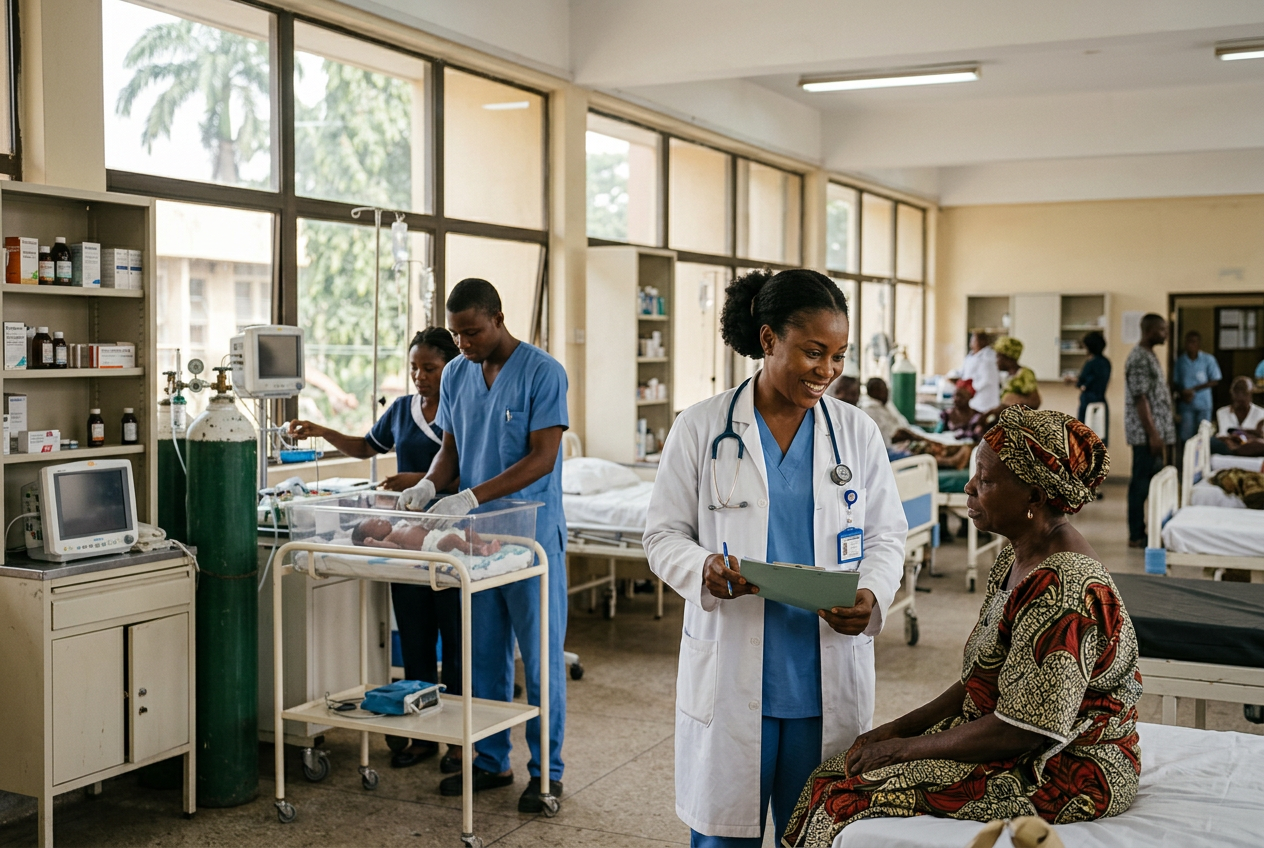
Welcome, and thank you for stopping by. This piece is the conclusion of months of research into how care is actually delivered in this country, and of years spent sitting in waiting rooms, reading budget documents nobody else wanted to read, and listening to nurses tell me things that never make the evening news.
So: what is the healthcare system like in Nigeria? The honest answer is that healthcare in Nigeria is not one system at all. It is several systems sharing a country, some of them excellent, most of them exhausted, and all of them held together by the personal sacrifice of people who could earn five times as much elsewhere.
I want to walk you through it properly. Not the brochure version.
What Is the Structure of the Health Care System in Nigeria?
On paper, the structure is tidy. Three tiers, three levels of government, each with a job.
Local government councils run primary health care: the ward-level clinics, the immunisation posts, the antenatal registers. State governments run secondary care through general hospitals, where you go when the clinic cannot cope. The federal government runs tertiary care: the teaching hospitals, the federal medical centres, the specialist institutions in Ibadan and Zaria and Enugu that train nearly every doctor you will ever meet.
That is the theory. The National Health Act of 2014 was the first law in our history to describe this arrangement in writing, which tells you something about how long we operated on custom rather than statute.

In practice the tiers leak. A woman in Ondo with a treatable fever bypasses her ward clinic (closed, or open with one overworked community health extension worker) and travels to a general hospital, which refers her onward to a teaching hospital that was designed for organ transplants and is instead running a very expensive malaria ward. Everyone ends up at the top of the pyramid. The pyramid was never built to hold them.
Financing follows a similarly layered logic. The Basic Health Care Provision Fund, drawn from not less than one per cent of the Consolidated Revenue Fund, flows to facilities through four gateways: the National Primary Health Care Development Agency, the National Health Insurance Authority, the emergency medical treatment committee, and the Nigeria Centre for Disease Control and Prevention. The stated goal is 17,600 functional primary health care facilities, at least one per political ward, by 2027.
Sitting over the money is the National Health Insurance Authority Act of 2022, which repealed the old voluntary scheme and made health insurance mandatory for every Nigerian and legal resident. It also created a Vulnerable Group Fund so that the poorest are meant to be covered by government rather than by their own pockets.
And watching for outbreaks is the NCDC, whose weekly situation reports on Lassa fever, cholera, diphtheria and meningitis are, I would argue, the single most useful public health document Nigeria produces. Almost nobody reads them. I read them the way other people read football tables.
Here is the thing about our structure. It is not badly designed. It is badly funded and unevenly enforced, which produces the same result but requires a different fix.
What Are the Different Types of Healthcare in Nigeria?
Ask a Lagos banker and a Sokoto farmer the same question and you will get two answers that barely overlap.
Nigeria runs a plural health economy. Public facilities across the three tiers. Private for-profit hospitals, which range from world-class to frankly alarming. Faith-based and mission hospitals, many of them the only serious medicine within eighty kilometres, and disproportionately rural. Patent medicine vendors, the small shops with the green cross that sell you paracetamol and, too often, an antibiotic you should never have been given. Traditional and spiritual healers, who remain the first point of contact for a very large number of Nigerians, particularly in mental health.
The private sector delivers the majority of care in this country. Read that again, because most policy conversations proceed as though government were the main provider. It is not. It is the main employer of last resort and the main regulator, which are different things.
I once watched a mission hospital in Benue run a caesarean section on generator power while the state general hospital forty minutes away was on strike. The surgeon had trained at a federal teaching hospital. The generator had been donated by a diaspora nurse in Manchester. That single theatre contained the whole Nigerian health story: public training, private delivery, faith-based persistence, diaspora money.
Rather like our electricity supply, Nigerian healthcare is something most families end up providing for themselves and then paying for twice.
Where Nigerians Actually Get Care: Provider Types, Coverage and Typical 2026 Costs
The table below sets out the main provider types, roughly what each is meant to do, and what a straightforward outpatient episode tends to cost a family paying cash in mid-2026. Treat the figures as working ranges from my own field notes and current reporting rather than a published tariff schedule, because Nigeria has no single national price list.
| Provider type | Run by | Typical services | Typical out-of-pocket cost per outpatient episode (2026) | Realistic waiting time |
|---|---|---|---|---|
| Primary health centre | Local government / SPHCB | Immunisation, antenatal care, malaria, minor injuries | ₦0 to ₦3,000 where BHCPF drugs are in stock | 1 to 5 hours |
| General hospital (secondary) | State government | Surgery, obstetrics, inpatient wards, basic imaging | ₦5,000 to ₦25,000 plus drugs | 3 to 6 hours |
| Teaching hospital / FMC (tertiary) | Federal government | Specialist care, oncology, dialysis, complex surgery | ₦15,000 to ₦60,000 before investigations | 4 hours to several days for a slot |
| Private hospital | For-profit owners | Full spectrum, quality varies enormously | ₦20,000 to ₦150,000 | Under 1 hour |
| Mission / faith-based hospital | Churches, Islamic trusts | Surgery, maternity, rural coverage | ₦5,000 to ₦30,000, often subsidised | 1 to 3 hours |
| Patent medicine vendor | Private individual | Over-the-counter drugs, informal advice | ₦500 to ₦5,000 | Minutes |
Two conclusions jump out of that table. The first is that speed is purchasable in Nigeria and quality is not reliably purchasable, which is precisely the wrong way round. The second is that the cheapest tier, the primary health centre, is the one most families skip, and that single behavioural fact drives a great deal of our preventable mortality.
What Is the Healthcare System Like in Nigeria? A Direct Answer
Here is the paragraph I would give you if we had ninety seconds in a lift.
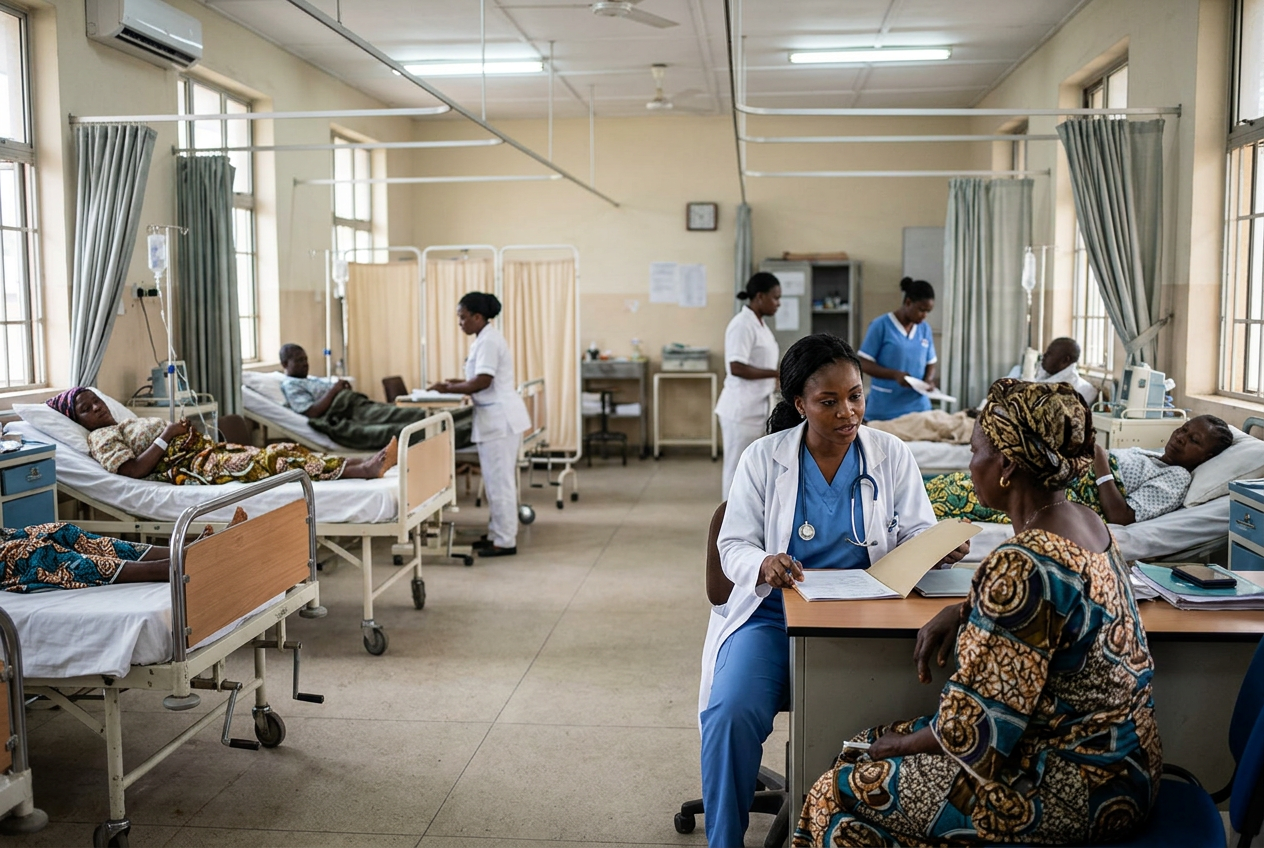
The healthcare system in Nigeria is a three-tier, federally divided, pluralistic system in which primary care belongs to local government, secondary care to the states, and tertiary care to the federal government, all of it governed by the National Health Act 2014 and financed principally by patients themselves. Between roughly 69 and 77 per cent of health spending in Nigeria comes straight out of household pockets, one of the highest such rates in West Africa. Health insurance is mandatory under the NHIA Act 2022, yet enrolment sits at around 21 million people against a population of some 220 million, so the mandate is real in law and largely theoretical in life. The federal health budget for 2026 came in at roughly ₦2.48 trillion, about four per cent of national spending, against the 15 per cent that Nigeria itself promised under the 2001 Abuja Declaration. The workforce that holds all of this up is emigrating: the Medical and Dental Council has registered well over 100,000 doctors, but only around 55,000 are actively practising here, which works out at roughly one doctor for every 3,600 to 4,000 Nigerians against a World Health Organisation benchmark of one to 600. So the system is best understood not as broken but as structurally sound, chronically underfunded, and quietly subsidised by the poorest people in it.
That is the whole essay in one breath. The rest of this piece is me showing my working.
What Are the Five Major Health Issues in Nigeria Today?
If you want to know what a health system is like, look at what it fails to prevent.
Malaria. Still the great constant. Nigeria carries a larger share of the global malaria burden than any other country, and it kills children under five and pregnant women disproportionately, which is to say it kills the people least responsible for the conditions that breed it.
Maternal and neonatal mortality. This is the one that keeps me up. Nigeria records an estimated 993 maternal deaths per 100,000 live births and accounts for something like a fifth of all maternal deaths on earth while holding about two per cent of the world’s people. Roughly 82,000 Nigerian women die every year from pregnancy-related complications, and the tragedy is that most of those deaths are preventable with a functioning ward-level clinic and a working ambulance.
Epidemic-prone infectious disease. Lassa fever, cholera, diphtheria, meningitis, mpox. Lassa alone has claimed 221 lives in 2026 with a case fatality rate around 24 per cent, well up on the previous year, concentrated in Ondo, Bauchi, Taraba, Edo and Benue. The fatality rate is high largely because people arrive late, and people arrive late because arriving early costs money.
The rising non-communicable burden. Hypertension, diabetes, stroke, kidney disease. We are acquiring the diseases of affluence without acquiring the affluence, and our system has almost no infrastructure for conditions that require monthly management rather than a single dramatic intervention.
Malnutrition and water-related illness. Diarrhoeal disease should not kill anyone in 2026. It kills a great many Nigerian children, and it does so for reasons that belong to the ministry of water resources as much as to the ministry of health.
Notice what those five have in common. Not one of them is a mystery. Every single one has a known, cheap, boring intervention attached to it. We are not losing to medical complexity. We are losing to logistics.
What Is the Biggest Issue in Healthcare Right Now?
I get asked this constantly, usually with the expectation that I will say malaria.
I will not. The biggest issue in Nigerian healthcare right now is financing, and everything else is a symptom of it.
Consider what The Guardian uncovered when it obtained Budget Office data showing a ten-year capital funding gap across the health sector. Of roughly ₦218 billion appropriated for capital projects in 2025, the reported actual release was a fraction of that. Appropriation is a promise. Release is a payment. We have spent a decade confusing the two, and then wondering why the theatre lights flicker.
Underfunding produces the workforce crisis. The Guardian’s reporting on exhausted doctors and lengthening queues in public hospitals documents what japa actually feels like from inside: a patient at a Lagos primary health centre waiting from a quarter to nine in the morning until two in the afternoon because one doctor was on the ground. Around 15,000 to 16,000 doctors have left in five years. You cannot retain a consultant cardiologist with patriotism alone.
Underfunding also produces the insurance failure. More than two years after the NHIA Act made cover compulsory, The Guardian found that states were badly under-enrolling while roughly 90 per cent of Nigerians still paid out of pocket, with informal-sector workers saying plainly that they wanted insurance and could not afford the annual premium. A mandate without affordability is a wish with a legal citation attached.
So what do you actually do about it, today, as a person with a family and a budget?
- Enrol in a health insurance plan and treat it as a utility bill, not a luxury. Check your state’s social health insurance agency first, since state schemes are usually cheaper than private HMO cover and are the route through which the Vulnerable Group Fund reaches households. Get your National Identification Number sorted before you start, because enrolment now depends on it.
- Identify your nearest functional primary health centre before you need it. Drive there on a quiet Tuesday. Find out its opening hours, whether it has a midwife, and whether its drug shelf is stocked under the BHCPF. Knowing this in advance is worth more than any emergency fund.
- Pick your referral hospital in advance too. Know which general hospital and which teaching hospital you would use, how long the journey takes at rush hour, and which one has a functioning blood bank. Emergencies are not the time to be researching.
- Build a health float separate from your savings. I suggest at least one month’s household income kept liquid and untouched. Medical expenses are the single most common route from Nigerian middle-class comfort into genuine poverty.
- Use the primary tier for primary problems. Fever, antenatal visits, immunisation, minor wounds. Every time you take a simple case to a teaching hospital you make the queue longer for the person who actually needs a neurosurgeon, and you pay more for the privilege.
- Stop buying antibiotics from patent medicine vendors. Please. Antimicrobial resistance is the slow-motion catastrophe hiding underneath every other item on this list, and Nigeria’s national action plan on it achieved well under half of its intended implementation.
- Read the NCDC weekly report during outbreak season. It takes four minutes, it is free, and in January and February it will tell you whether Lassa is in your local government area before your neighbour does.
None of that fixes the system. All of it protects your household while the system is being fixed, and I would rather hand you a working torch than a lecture about the electricity company.
Final Thoughts on What the Healthcare System Is Like in Nigeria
If you have read this far, you already know the shape of the answer.
The healthcare system in Nigeria is a well-designed skeleton wearing borrowed clothes. The three-tier structure is sensible. The National Health Act is sound law. The NHIA Act 2022 is genuinely good policy. The BHCPF is exactly the right instrument. We are not short of architecture. We are short of money reaching the building site, and short of the people who know how to lay the bricks, because we have made staying here financially irrational for them.
But I want to resist the tidy pessimism, because it is not accurate either. Insurance enrolment has climbed past 21 million from a much lower base. Over 1,295 primary health centres were revitalised as of August 2025 against a four-year target, and thousands more have been upgraded under BHCPF 2.0. Medical school admissions rose sharply between 2023 and 2025. Delta, Lagos and Kano have each enrolled more than a million people in health insurance, which proves that state-level ambition works when it is actually attempted.
So here is what I would ask you to do. Enrol yourself and, if you can afford it, enrol somebody who cannot. Learn where your ward clinic is. Use the tiers as they were intended. And when the budget is debated next, notice the difference between what was appropriated and what was released, because that single number explains more about Nigerian healthcare than any speech ever will.
The system is what we fund. It always was.
Related Articles
If this overview raised more questions than it settled, two earlier pieces of mine go deeper where this one had to be brief. My article on what the biggest health problem in Nigeria is takes the disease burden apart properly, working through malaria, tuberculosis, neonatal disorders and the rising tide of hypertension and diabetes, and it is the natural companion to the five major health issues section above.
For the wider context, my piece on what Nigeria’s quality of life is situates healthcare inside the whole picture of infrastructure, income and regional inequality. Health outcomes in this country are downstream of electricity, water and roads far more than most of us are comfortable admitting, and that article makes the connection explicit.
Key Takeaways
- Enrol in health insurance this month, through your state scheme if one exists. Cover is mandatory under the NHIA Act 2022, state schemes are usually the cheapest route, and you will need your NIN to register.
- Map your primary health centre and your referral hospital before an emergency forces you to. Using the right tier for the right problem saves you money and shortens the queue for everyone behind you.
- Watch releases, not appropriations. Nigeria allocated roughly ₦2.48 trillion to health in 2026, about four per cent of the budget against a 15 per cent promise, and the gap between what is promised and what is paid is the truest measure of the system you will actually meet.
Frequently Asked Questions About What the Healthcare System Is Like in Nigeria
What is the healthcare system like in Nigeria?
Nigeria runs a three-tier, pluralistic health system in which local governments handle primary care, states handle secondary care and the federal government handles tertiary care, alongside a large private and faith-based sector that delivers most actual services. It is structurally sensible but chronically underfunded, with most households paying for care directly out of pocket rather than through insurance.
What is the structure of the health care system in Nigeria?
The structure has three tiers matched to the three tiers of government, formalised by the National Health Act 2014: ward-level primary health centres under local councils, general hospitals under state governments, and teaching hospitals and federal medical centres under the federal government. In practice the referral chain leaks badly, so tertiary hospitals end up treating cases that a functioning ward clinic should have handled.
What are the five major health issues in Nigeria today?
The five biggest are malaria, maternal and neonatal mortality, epidemic-prone infectious diseases such as Lassa fever and cholera, the rising non-communicable burden of hypertension, diabetes and stroke, and malnutrition alongside water-related illness. Every one of them has a known, inexpensive intervention attached, which means Nigeria’s losses are logistical rather than medical.
What are the different types of healthcare in Nigeria?
Nigerians access care through public facilities across the three tiers, private for-profit hospitals, faith-based and mission hospitals, patent medicine vendors, and traditional or spiritual healers. The private and faith-based sector delivers the majority of care in the country, which is a fact most policy discussions still fail to reckon with.
What is the biggest issue in healthcare right now?
Financing is the biggest issue, and the workforce exodus, drug stockouts and long queues are all downstream symptoms of it. Between roughly 69 and 77 per cent of Nigerian health spending comes directly from patients, and the gap between money appropriated and money actually released has persisted for a decade.
Is healthcare free in Nigeria?
No, healthcare in Nigeria is not free in any general sense, though specific services such as routine immunisation, some antenatal care and certain BHCPF-funded drugs at primary health centres are provided at no charge where supplies exist. Everything else is paid for either by insurance or, far more commonly, by the patient in cash on the day.
How much does health insurance cost in Nigeria?
Costs vary widely by scheme, but informal-sector state plans have historically been priced in the region of ₦13,000 to ₦20,000 per person annually, while the newer group and family plan regulated by the NHIA has been quoted at around ₦38,718 per person per year. Private HMO cover for a family typically runs considerably higher, and state social health insurance agencies are almost always the cheaper starting point.
How many doctors does Nigeria have?
The Medical and Dental Council of Nigeria has registered well over 100,000 doctors, but the Nigerian Medical Association estimates only around 55,000 are actively practising within the country. That gives roughly one doctor per 3,600 to 4,000 Nigerians, against a World Health Organisation benchmark of one per 600.
What percentage of Nigeria’s budget goes to health?
The 2026 federal health allocation of roughly ₦2.48 trillion represents about four per cent of national spending, well under a third of the 15 per cent Nigeria committed to under the 2001 Abuja Declaration. Health’s share has stayed below six per cent of the federal budget every year since 2023, even as nominal naira figures have risen.
Are private hospitals better than public hospitals in Nigeria?
Private hospitals are almost always faster and more comfortable, but they are not reliably better clinically, and quality across the private sector varies enormously from excellent to genuinely dangerous. Teaching hospitals still hold most of the country’s specialist expertise and equipment, which is why serious cases frequently end up there regardless of what a family can pay.
What is the Basic Health Care Provision Fund?
The BHCPF is a dedicated fund drawn from not less than one per cent of the Consolidated Revenue Fund, created by the National Health Act 2014 and disbursed through four gateways covering primary care, health insurance, emergency treatment and disease control. It is the main mechanism by which federal money reaches ward-level clinics, with a stated target of 17,600 functional primary health care facilities by 2027.
How do I enrol in the national health insurance scheme?
Start with your state’s social health insurance agency rather than the federal portal, since state schemes handle informal-sector and vulnerable-group enrolment and are usually cheaper. You will need a valid National Identification Number, as enrolment records without a NIN are no longer accepted under the BHCPF 2.0 framework.

