Welcome! After months of researching Nigeria’s educational landscape and years of covering stories across our nation’s schools and communities, I’m excited to share what I’ve learned about literacy rates in Nigeria. The numbers tell a complex story, one that’s both challenging and hopeful, frustrating yet inspiring. This question matters deeply because literacy forms the foundation of everything we aspire to achieve as a nation.
I remember visiting a primary school in Yobe State three years ago. The headmistress, a woman who’d taught for 27 years, showed me classrooms where 70 children sat on the floor because there weren’t enough desks. Yet these same children recited English poems with such enthusiasm that it brought tears to my eyes. That’s Nigeria’s literacy story in miniature: tremendous challenges meeting remarkable determination.
The current literacy rate in Nigeria stands at approximately 70.4% as of 2024, according to recent data. This means that about seven in ten Nigerians aged 15 and above can read and write a simple statement about their everyday life. But that national figure conceals enormous regional variations and tells us nothing about the quality of literacy or the millions of children still outside classrooms.
Let me be frank with you. We’ve made progress, certainly. In 2010, our literacy rate was 68.11%. By 2021, it had climbed to 77.62%. But here’s the confusing part: the 2024 data shows a dip to 59.57% in some measurements, whilst other sources report 70.4%. These conflicting figures reflect different methodologies and the challenges of accurate data collection across our vast nation.
What is the Illiteracy Rate in Nigeria Today?
When we flip the question around and ask about illiteracy, we’re looking at roughly 30% of Nigeria’s adult population, or about 60 million people, who struggle with basic reading and writing. That’s nearly twice the entire population of Ghana. Think about that for a moment.
The Universal Basic Education Commission has been working for decades to address this challenge, but the numbers remain stubbornly high in certain regions. During my time covering education stories, I’ve met brilliant young Nigerians whose dreams were derailed simply because they couldn’t access quality schooling during their formative years.
Illiteracy in Nigeria isn’t distributed evenly. It clusters in specific areas and affects particular groups more severely. Girls in northern states face significantly higher illiteracy rates than boys. Rural communities lag far behind urban centres. Poverty and illiteracy feed each other in a vicious cycle that’s proven devilishly difficult to break.
The out-of-school children crisis compounds our illiteracy challenge. UNICEF reports that 18.3 million Nigerian children aren’t in school. That’s more than the entire population of the Netherlands! These children aren’t just missing lessons; they’re missing the fundamental skill that unlocks virtually every opportunity in modern life.
I once interviewed a 35-year-old woman in Katsina who’d never learned to read. She ran a successful fabric business through memory and calculation but couldn’t help her own children with homework. “I count everything in my head,” she told me, tapping her temple. “But I want my daughter to read books, to go further than I could.”
Which Country is No. 1 in Literacy?
Multiple countries claim the number one spot with 100% literacy rates. Finland, Norway, Luxembourg, Andorra, Greenland, Liechtenstein, and Uzbekistan all report perfect or near-perfect literacy. These nations achieved universal literacy through decades of sustained investment in education, free schooling for all children, and strong social systems that ensure no child falls through the cracks.
Finland particularly stands out. They’ve maintained their 100% literacy rate whilst also topping global rankings in reading comprehension, numeracy, and problem-solving skills. Finnish children start school at age seven (rather like our traditional six years), but their education system emphasises play-based learning in early years and highly trained teachers who command respect similar to doctors or lawyers.
What’s fascinating is how these top-performing countries spend their education budgets. Norway allocates roughly $15,000 per student annually. Finland invests about 6.2% of its GDP in education. Compare that with Nigeria’s education budget, which has historically fallen short of the 26% UNESCO benchmark.
The gap between Nigeria and these literacy leaders isn’t just about money, though. It’s about consistent policy implementation, teacher training, safe learning environments, and a cultural consensus that education matters above almost everything else. When I visited Lagos State’s literacy intervention programmes, I saw what’s possible when resources meet commitment.
Political will makes the difference. Countries like Uzbekistan achieved near-universal literacy through mass campaigns and making education genuinely compulsory. Every parent understood that their child must attend school. No exceptions, no alternatives.
But here’s something encouraging: several African nations are making remarkable strides. Seychelles reports 96% literacy, whilst South Africa and Sao Tome and Principe hover around 95-96%. These countries prove that African nations can achieve high literacy rates when education becomes a national priority backed by consistent investment and smart policy.
Answering the Core Question: What is the Literacy Rate in Nigeria?
Nigeria’s literacy rate currently stands at approximately 70.4% for adults aged 15 and above, based on 2024 estimates. This figure represents the percentage of Nigerians who can both read and write a short, simple statement about everyday life, generally including basic numeracy skills. However, this national average masks dramatic regional disparities, gender gaps, and quality differences. Youth literacy rates are slightly higher at around 81.43% for females aged 15-24, suggesting gradual improvement among younger generations. Key entities affecting this rate include the Universal Basic Education Commission (UBEC), State Universal Basic Education Boards (SUBEBs), the National Bureau of Statistics, UNESCO, international development partners, and approximately 18.3 million out-of-school children whose exclusion from education directly impacts future literacy statistics.
Which State in Nigeria Has the Highest Literacy Rate?
Imo State leads Nigeria with a literacy rate of 96.43%, followed closely by Lagos at 96.3%, Ekiti at 95.79%, and Rivers at 95.76%. These southern states have maintained their educational advantage for generations, building on historical investments in schooling and stronger economic foundations.
I’ve spent considerable time in both Imo and Yobe States (which has the lowest literacy), and the contrast is stark. In Owerri, Imo’s capital, you see bookshops on street corners and parents queuing before dawn to register children for school. The culture prizes education intensely, rather like the old Western Region under Chief Obafemi Awolowo’s free education programme.
Lagos deserves special mention because it combines high literacy with Nigeria’s largest population. The state government has poured billions of Naira into education infrastructure, teacher training, and innovative programmes like the Eko Excel initiative. Lagos schools aren’t perfect (far from it, as any parent will tell you), but the commitment is visible.
What makes these high-literacy states successful? Several factors converge: better-funded schools, more qualified teachers, stronger parental emphasis on education, economic opportunities that reward literacy, and state governments that actually release education budgets. When I covered the digital literacy programme in Lagos, officials explained how they’d trained thousands of teachers and equipped schools with basic technology.
The southern states also benefit from lower insecurity. Children can actually get to school without fearing kidnapping or bandit attacks. This sounds basic, but it’s a luxury northern states can’t always provide. Safe schools mean consistent attendance, which directly impacts literacy outcomes.
Ekiti State, despite being smaller and less wealthy than Lagos, maintains exceptional literacy through sheer determination. The state’s free education policy extends through secondary school, and communities rally around education with almost religious fervour. During a visit there in 2023, I watched parents donate their labour to build classroom extensions.
Literacy Rates Across Nigerian States
| State | Literacy Rate (%) | Regional Zone | Primary Challenge |
|---|---|---|---|
| Imo | 96.43 | South-East | Maintaining standards amid funding constraints |
| Lagos | 96.30 | South-West | Managing population growth and school capacity |
| Ekiti | 95.79 | South-West | Limited economic opportunities for graduates |
| Rivers | 95.76 | South-South | Infrastructure damage from environmental issues |
| Anambra | 92.11 | South-East | Teacher retention in rural areas |
| Abia | 89.50 | South-East | Funding gaps in public schools |
| National Average | 70.40 | N/A | Regional disparities and out-of-school children |
| Zamfara | 19.16 | North-West | Insecurity and cultural barriers to girls’ education |
| Katsina | 10.36 | North-West | Poverty and inadequate school infrastructure |
| Yobe | 7.23 | North-East | Insurgency, displacement, and destroyed schools |
This table demonstrates the troubling north-south divide in Nigerian literacy. The gap between Imo’s 96.43% and Yobe’s 7.23% represents one of the world’s starkest regional educational disparities within a single country. These differences reflect historical disadvantages, ongoing insecurity in northern regions, economic inequalities, and varying cultural attitudes towards Western education, particularly for girls.
Which is the Lowest Literacy Rate?
Yobe State holds the unfortunate distinction of having Nigeria’s lowest literacy rate at just 7.23%. Let that sink in. In Yobe, fewer than eight people in every hundred can read and write. It’s a statistic that should shame us all.
The reasons are complex and painful. Boko Haram’s insurgency devastated Yobe’s education infrastructure. Schools were bombed, teachers fled, and an entire generation of children grew up associating education with danger. Even now, with improved security, rebuilding trust takes time.
But blaming insurgency alone oversimplifies the problem. Yobe’s literacy challenges predate Boko Haram. Poverty runs deep. Many families need children working rather than studying. Girls particularly face early marriage, often by age 13 or 14, ending their education before it properly begins.
Zamfara (19.16%) and Katsina (10.36%) complete the bottom three. All three states are in the North-West or North-East, regions where decades of under-investment in education have created a crisis. The Almajiri system, where young boys study in Quranic schools without formal literacy training, also contributes, though this system serves important cultural and religious purposes.
I remember meeting 15-year-old Fatima in Yobe. Bright, curious, desperate to learn, she’d never attended formal school. “My father says Western education is not for girls,” she explained quietly. “But I teach myself from my brother’s books when he’s not watching.” Her story breaks my heart, multiplied by millions.
The Federal Ministry of Education recognises these challenges and has implemented special interventions in low-literacy states. The BESDA programme (Better Education Service Delivery for All) specifically targets nine northern states with the poorest educational indicators. Results are emerging, but progress feels glacially slow when you’re on the ground.
Economic factors matter too. Yobe received ₦30.95 billion in federal allocations in 2016, similar to high-literacy Imo’s ₦29.85 billion. The money existed. The difference lies in how it was spent, whether schools were actually built, whether teachers were properly paid, whether communities prioritised education.
Insecurity remains the biggest barrier. When Boko Haram attacks a school and kidnaps children, parents understandably think twice about sending their kids to class. Education becomes a death sentence rather than an opportunity. No literacy programme can succeed in such an environment.
Understanding Regional Literacy Disparities
The north-south literacy divide didn’t happen by accident. It reflects historical patterns dating back to colonial times and even earlier. The British colonial government invested heavily in mission schools in southern Nigeria whilst adopting an indirect rule approach in the North that preserved traditional power structures, including those sceptical of Western education.
Post-independence, these patterns persisted. Southern states continued building schools and universities. Families scraped together school fees because they’d seen education transform lives. In the North, particularly the far North, these incentives worked differently.
Religious and cultural factors play complex roles. Some communities view Western education with suspicion, seeing it as a threat to traditional values. The tragic irony is that Islamic scholarship historically valued literacy immensely. The great Sokoto Caliphate produced scholars and poets of extraordinary learning. Modern resistance to literacy isn’t “traditional” at all, but a response to specific historical and political circumstances.
Gender compounds regional disparities. In states like Lagos, girls and boys attend school at roughly equal rates. In Yobe or Zamfara, the gender gap yawns wide. UNESCO’s data shows that nearly two-thirds of illiterate Nigerian adults are women, with northern states driving this imbalance.
Poverty amplifies everything. Poor families everywhere struggle to keep children in school, but northern Nigeria contains Nigeria’s highest concentration of poverty. When a family earns ₦500 per day and needs three children working to survive, education becomes an unaffordable luxury. We can moralise about priorities, but hunger focuses the mind rather sharply.
Language policies matter more than people realise. Teaching children literacy in a language they don’t speak at home creates enormous barriers. The Jolly Phonics programme has shown remarkable success partly because it incorporates mother-tongue instruction. Children learning to read in Hausa or Yoruba before transitioning to English achieve better outcomes.
Infrastructure remains critical. You can’t teach literacy without schools, desks, books, and teachers. Northern states often lack these basics. I’ve visited “schools” that were mud huts with no windows, no materials, and one teacher for 120 children across six grade levels. Those children deserve better, but wanting doesn’t make it so.
Seven Essential Steps to Improve Your Literacy Skills
Whether you’re learning to read for the first time or helping someone else, these practical steps can make a real difference:
1. Start with Your Mother Tongue First Begin literacy learning in the language you speak at home, whether that’s Hausa, Yoruba, Igbo, or any of Nigeria’s 500+ languages. Research consistently shows that children who first learn to read in their mother tongue develop stronger literacy skills overall. Once you’ve mastered reading in your primary language, transitioning to English becomes significantly easier. Many adult literacy programmes now offer Hausa, Yoruba, and Igbo instruction alongside English.
2. Establish a Daily Reading Routine (Even Just 15 Minutes) Consistency matters more than duration. Set aside 15 minutes daily for reading practice, preferably at the same time each day. Morning reading with breakfast or evening reading before bed works well for most people. Choose materials at your current level rather than jumping to complex texts. Newspapers like The Guardian provide accessible content that builds vocabulary whilst connecting to real-world events.
3. Use the Phonics Method for Systematic Learning Phonics teaches the relationship between letters and sounds, forming the foundation of reading in any alphabetic language. The Jolly Phonics programme, now used across Nigeria, breaks down reading into manageable chunks. Start by learning individual letter sounds, then blending them into simple words (c-a-t becomes “cat”), then progressing to more complex patterns. Adults benefit from phonics just as much as children do.
4. Practice Writing Alongside Reading Literacy includes both reading and writing, skills that reinforce each other. Spend half your practice time reading and half writing. Start with copying short passages to build hand-eye coordination and letter formation. Progress to writing simple sentences about your day, shopping lists, or messages to family members. Keep a basic diary in whatever language feels comfortable. The physical act of writing strengthens neural pathways that support reading.
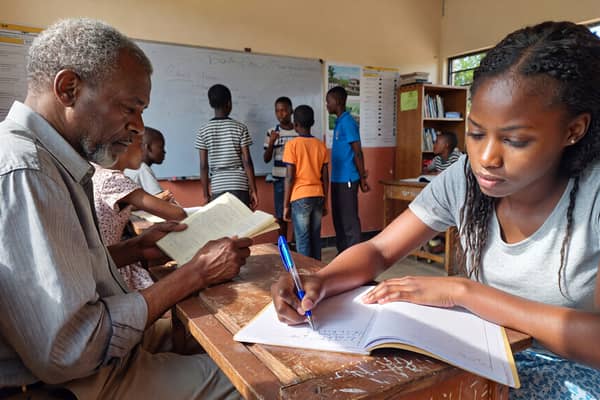
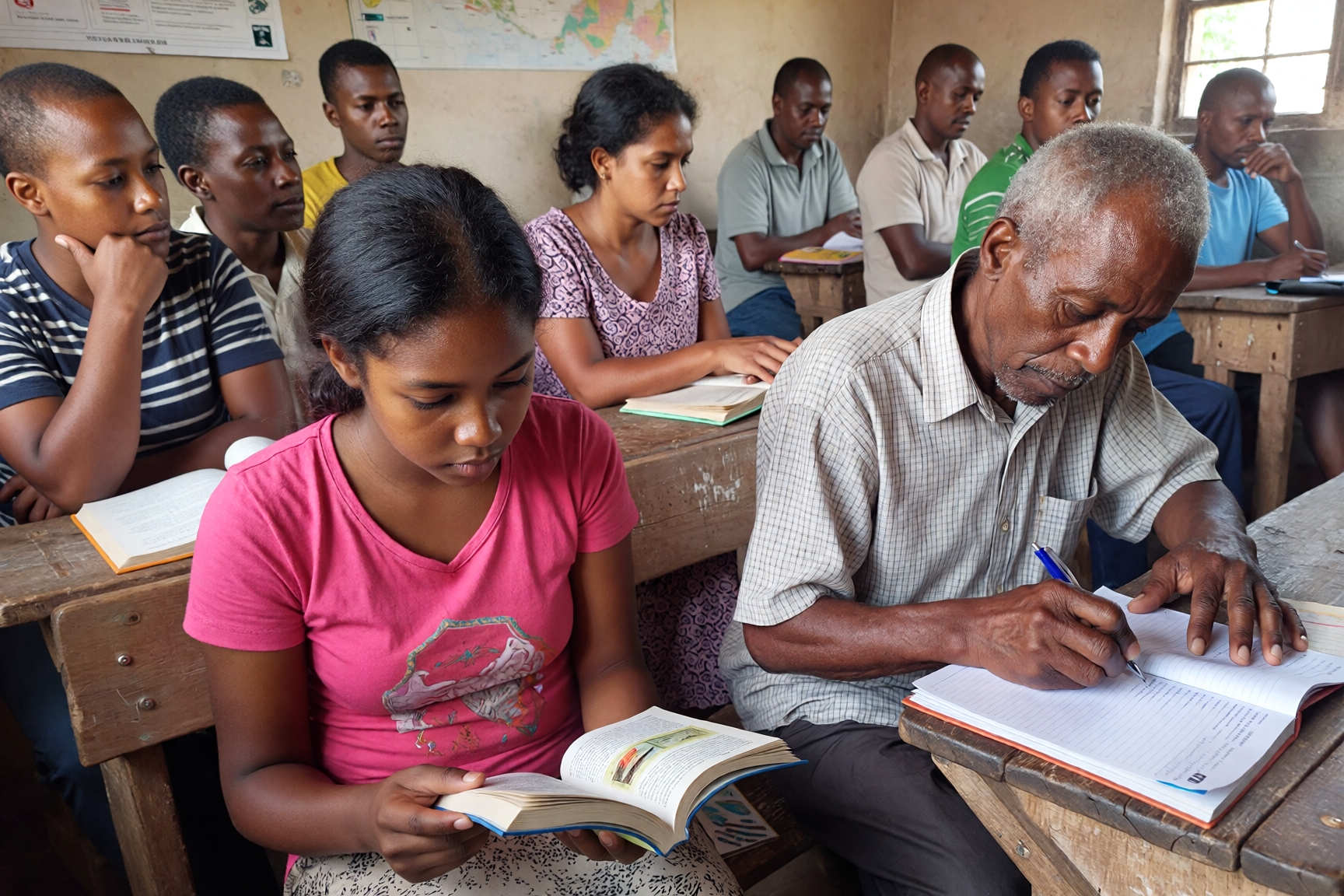
5. Find a Learning Buddy or Join a Literacy Group Learning alone is harder than learning together. Seek out a friend, family member, or community group where you can practice without judgment. Many churches, mosques, and community centres run free literacy classes. The National Commission for Mass Literacy can direct you to programmes in your local government area. Learning with others provides motivation, accountability, and the social support that sustains long-term progress.
6. Use Technology to Your Advantage Mobile phones have revolutionised literacy learning. Apps like Ustad Mobile offer free Hausa literacy courses. The BBC’s Jantar Reading App teaches English basics. YouTube channels provide countless free lessons. Even WhatsApp can support literacy through text practice with family and friends. If data costs concern you, many programmes offer offline content you can download once and use repeatedly.
7. Apply Your Skills Immediately in Real-Life Contexts Use your emerging literacy skills for practical purposes right away. Read product labels at the market. Send text messages to family. Fill out forms yourself rather than asking for help. Read bus destination signs. Calculate change when shopping. Practical application reinforces learning whilst demonstrating the immediate benefits of literacy, which motivates continued practice. The goal isn’t perfect literacy but functional literacy that improves your daily life.
Building a More Literate Nigeria: Systemic Changes Needed
Individual effort matters enormously, but Nigeria’s literacy crisis requires systemic solutions. The question isn’t whether Nigerians value education (we do, intensely) but whether our systems support that value.
First, we must actually fund education properly. Nigeria’s education budget hovers around 5-8% of total spending, well below UNESCO’s 15-20% recommendation and far below the 26% benchmark for developing nations. Every budget season, education advocates plead for more funding. Every budget season, education gets shortchanged. This must change.
Teacher quality determines everything. Finland’s education miracle rests on excellent teachers drawn from the top third of university graduates and trained rigorously. Nigeria needs similar investment in teacher training, decent salaries, and professional development. A primary school teacher in Lagos earning ₦60,000 monthly struggles to survive, let alone inspire children towards literacy.
The UBEC Teacher Professional Development programme shows what’s possible. By training teachers in phonics, mathematics, and child-centred approaches, literacy outcomes improve dramatically. But these programmes need expansion, sustained funding, and integration into regular teacher training rather than remaining special projects.
School infrastructure can’t be ignored. You can’t teach literacy in mud huts without roofs during rainy season. The BESDA programme has started addressing this through community-driven school development, but the need vastly exceeds current supply. Every local government needs functioning schools with roofs, desks, toilets, and learning materials.
Girls’ education requires special attention. Keeping girls in school through secondary level transforms literacy rates in one generation. This means addressing early marriage, providing sanitary facilities, ensuring safe transport, and challenging cultural norms that undervalue female education. Programmes supporting girls’ literacy in northern states show promising results when sustained and properly funded.
The out-of-school children crisis demands immediate attention. Getting 18 million children back into classrooms won’t happen through conventional approaches alone. Alternative education pathways, accelerated learning programmes, and flexible schooling options all have roles to play. Some children missed their primary school years; they need rapid, intensive literacy instruction, not the standard curriculum.
Community ownership transforms education outcomes. When communities build, maintain, and protect schools, when parents engage with teachers, when local leaders prioritise education, literacy rates improve. Top-down directives from Abuja can’t create this ownership, but government can support and incentivise it.
Technology offers opportunities we’re barely exploring. Even in areas without electricity, solar-powered tablets can deliver literacy instruction. Radio programmes reach millions. SMS-based learning adapts to the simplest phones. Nigeria’s mobile phone penetration (over 80%) creates possibilities for mass literacy campaigns our grandparents couldn’t imagine.
Mother-tongue education needs expansion. Children learn to read faster in languages they speak at home. Once literate in Hausa, Yoruba, or Igbo, they transition to English more successfully. This isn’t about abandoning English but recognising that the path to English literacy often runs through mother-tongue literacy first.
The Economic Cost of Illiteracy
Low literacy rates don’t just affect individuals; they constrain Nigeria’s entire economy. Illiterate workers can’t read safety instructions, operate complex machinery, or advance to skilled positions. Businesses spend fortunes training workers in basic skills that schools should provide.
The World Bank estimates that literacy correlates directly with GDP growth. Countries with 100% literacy rates typically have much higher per capita incomes. The relationship isn’t just correlation but causation: literacy enables economic productivity, which generates wealth, which funds better education, creating a virtuous cycle.
Nigeria’s poverty statistics mirror our literacy statistics rather precisely. States with low literacy have high poverty. States with high literacy have lower poverty. The northern states that struggle with literacy also lead in poverty rates. This isn’t coincidence.
During my coverage of Nigeria’s economic challenges, I’ve consistently seen how illiteracy limits economic participation. The informal economy absorbs millions of illiterate Nigerians, but informal work typically pays poorly and offers no advancement. The formal economy, where better wages exist, requires literacy as a basic entry requirement.
Consider the agricultural sector, which employs most Nigerians. Illiterate farmers can’t read planting instructions, understand market price information, or access agricultural extension services effectively. Literacy doesn’t make someone a better farmer automatically, but it provides access to information that improves farming practices and market participation.
Healthcare suffers from low literacy. Illiterate patients can’t read medication instructions, understand treatment plans, or access health information. This contributes to poor health outcomes, which then reduce economic productivity. The connections spiral outward in every direction.
Understanding Nigeria’s Cultural Wealth and Educational Heritage
Nigeria’s current literacy challenges don’t reflect our historical relationship with learning. The Sokoto Caliphate produced renowned Islamic scholars. Igbo communities pioneered community-funded schools. Yoruba societies developed sophisticated oral and written literary traditions. Our ancestors valued knowledge intensely.
What changed? Colonialism disrupted traditional education systems whilst imposing alien ones. Independence brought opportunities but also challenges. Decades of military rule underinvested in education. Oil wealth created the illusion that we could ignore human capital development. Now we’re paying the price.
But Nigeria’s cultural diversity remains our strength. Every Nigerian language carries unique knowledge, wisdom, and ways of understanding the world. Literacy in these languages preserves cultural heritage whilst providing practical communication skills. When we talk about improving Nigeria’s literacy rate, we’re not just talking about English literacy but literacy in all our languages.
I’ve visited communities across Nigeria where oral traditions remain incredibly vibrant. Storytellers can recite hours of epic poetry. Elders know detailed histories passed down through generations. This oral literacy is real and valuable, even though it doesn’t show up in UNESCO statistics. The challenge is combining oral traditions with written literacy, not replacing one with the other.
The diversity of Nigerian culture includes diverse approaches to learning. What works in Lagos won’t necessarily work in Maiduguri. What succeeds in Igbo communities might need adaptation for Hausa communities. Rather than imposing one-size-fits-all solutions, we need flexible approaches that respect cultural differences whilst achieving common literacy goals.
Linking Education to Nigeria’s Future Development
If you’ve read my previous article about whether Nigeria is a developed country, you’ll know that literacy forms a crucial development indicator. Countries don’t develop without educated populations. Full stop. Every nation that has successfully transitioned from poverty to prosperity did so by investing heavily in education and achieving near-universal literacy.
The good news is that literacy rates can improve rapidly with sustained effort. South Korea achieved near-universal literacy in a single generation through massive investment and political will. Vietnam made similar progress. Both countries were poorer than Nigeria when they started their education transformations.
Nigeria has the resources to achieve universal literacy. We’re not talking about building nuclear power plants or colonising Mars. We’re talking about classrooms, teachers, books, and political will. The technical knowledge exists. The financial resources exist (if we prioritise them). What we need is sustained commitment from government, communities, and individuals.
Conclusion: The Path Forward for Nigerian Literacy
The literacy rate in Nigeria stands at roughly 70%, but this figure tells an incomplete story of dramatic regional variations, gender disparities, and millions of out-of-school children. We’ve made progress from 68% in 2010, yet we’ve also backslid in some measurements, and the gap between high-performing states like Imo (96.43%) and struggling states like Yobe (7.23%) represents a national crisis that demands urgent attention.
Improving Nigeria’s literacy rate isn’t impossible. It requires sustained funding (at least 20% of federal budgets), better teacher training and compensation, safe learning environments particularly in northern states, special focus on girls’ education, expansion of mother-tongue instruction, technology integration, and community ownership of schools. Countries with far fewer resources than Nigeria have achieved universal literacy through sustained effort over 10-15 years.
Every Nigerian who gains literacy transforms not just their own life but their family’s trajectory, their community’s possibilities, and ultimately our nation’s future. Whether you’re a parent ensuring your children attend school, a teacher dedicating yourself to student success, a policymaker allocating resources, or an adult learner taking those brave first steps towards reading, you’re contributing to building a more literate Nigeria. The question isn’t whether we can achieve universal literacy but whether we’ll make the choices, sacrifices, and sustained commitments required to get there.
Key Takeaways:
- Nigeria’s current literacy rate is approximately 70.4%, with dramatic variations from 96.43% in Imo State to just 7.23% in Yobe State, reflecting deep regional and socioeconomic disparities that require targeted interventions.
- Countries like Finland, Norway, and Luxembourg achieve 100% literacy through sustained education investment (6-7% of GDP), excellent teacher training, safe learning environments, and cultural consensus that prioritises education above almost all else.
- Improving literacy requires individual action (daily reading practice, phonics-based learning, writing alongside reading) and systemic changes (adequate funding, better teacher compensation, expanded mother-tongue instruction, addressing the 18.3 million out-of-school children crisis, and ensuring girls’ access to education).
Frequently Asked Questions About Nigeria’s Literacy Rate
What is the Literacy Rate in Nigeria?
Nigeria’s literacy rate stands at approximately 70.4% for adults aged 15 and above as of 2024, meaning roughly seven in ten Nigerians can read and write a simple statement about everyday life. However, this national average conceals enormous regional disparities, with southern states like Imo achieving 96.43% whilst northern states like Yobe record just 7.23% literacy rates.
Why is Nigeria’s Literacy Rate So Low Compared to Developed Countries?
Multiple factors contribute including inadequate education funding (typically 5-8% of federal budget versus UNESCO’s 15-20% recommendation), 18.3 million out-of-school children, poor teacher training and compensation, insecurity in northern regions destroying educational infrastructure, and poverty forcing children into work rather than school. Additionally, gender disparities particularly in northern states and insufficient mother-tongue instruction create barriers to literacy acquisition.
Which Nigerian State Has the Highest Literacy Rate?
Imo State leads with 96.43% literacy, followed by Lagos at 96.3%, Ekiti at 95.79%, and Rivers at 95.76%. These southern states benefit from historical educational investment, stronger economic foundations, better-funded schools, safer learning environments, and cultural emphasis on education dating back to missionary schools and pre-independence regional government policies.
Which Nigerian State Has the Lowest Literacy Rate?
Yobe State records Nigeria’s lowest literacy at just 7.23%, followed by Katsina at 10.36% and Zamfara at 19.16%. These North-East and North-West states face compound challenges including Boko Haram insurgency destroying schools, extreme poverty, cultural resistance to girls’ education, inadequate infrastructure, and decades of systematic under-investment in education despite receiving substantial federal allocations.
How Does Nigeria’s Literacy Rate Compare to Other African Countries?
Nigeria’s 70.4% literacy rate falls below the African average of 67%, significantly trailing leaders like Seychelles (96%), South Africa (95%), and Sao Tome and Principe (94%). However, Nigeria performs better than countries like Niger (19.10%), Guinea (30.47%), and Mali (33.07%), though these comparisons provide little comfort given Nigeria’s resources and potential.
What is Nigeria Doing to Improve Literacy Rates?
The Universal Basic Education Commission implements teacher training programmes like Jolly Phonics and SMASE across all states, the BESDA programme targets nine northern states with poor educational indicators, the Federal Government has introduced digital literacy into the curriculum, and partnerships with UNICEF, UNESCO, and World Bank support literacy interventions. However, implementation remains inconsistent and funding inadequate relative to the 18.3 million out-of-school children crisis.
How Many Out-of-School Children Does Nigeria Have?
UNICEF reports 18.3 million Nigerian children are currently out of school, the highest number globally and more than the entire population of the Netherlands. The North-West region accounts for 8,044,800 out-of-school children, followed by the North-East with 5,064,400, whilst the South-East has just 240,200, reflecting the stark regional disparities in educational access that directly impact future literacy rates.
What Role Does Gender Play in Nigeria’s Literacy Rates?
Women represent nearly two-thirds of illiterate Nigerian adults, with gender disparities most pronounced in northern states where cultural practices including early marriage remove girls from school. However, youth female literacy (ages 15-24) has improved to 81.43%, suggesting gradual progress, whilst southern states show minimal gender gaps with girls often outperforming boys in examinations.
How Does Poverty Affect Literacy in Nigeria?
States with the lowest literacy rates also have the highest poverty rates, as poor families often require children to work rather than attend school, cannot afford school fees or materials despite “free” education, and lack resources to supplement inadequate public schooling. The correlation between poverty and illiteracy creates a vicious cycle where lack of education perpetuates poverty, which then prevents the next generation from accessing education.
What is the Jolly Phonics Programme and How is it Helping?
Jolly Phonics is a synthetic phonics programme teaching children to read by connecting letters with sounds, now implemented across all 36 Nigerian states and reaching an estimated 30 million pupils through training of 241,227 teachers. Independent assessments show pupils taught with Jolly Phonics consistently outperform peers in reading and writing, with Primary 1 English word recognition climbing from one in five meeting national benchmarks in 2019 to significantly higher rates by 2025.
Can Adults Learn to Read and Write in Nigeria?
Yes, the National Commission for Mass Literacy, Adult and Non-Formal Education offers programmes across local government areas, whilst churches, mosques, and community centres frequently run free literacy classes. Adult learners benefit from the same phonics-based approaches used with children, with many programmes offering instruction in Hausa, Yoruba, and Igbo alongside English, recognising that mother-tongue literacy often provides the fastest path to multilingual literacy.
How Long Would it Take Nigeria to Achieve Universal Literacy?
With sustained political will and adequate funding, Nigeria could achieve 95%+ literacy within 10-15 years, following examples from South Korea and Vietnam who transformed literacy rates in single generations. This requires maintaining education spending at 20%+ of federal budgets, getting all 18.3 million out-of-school children into classrooms, training and properly compensating hundreds of thousands of teachers, building thousands of schools in underserved areas, ensuring girls complete secondary education, and maintaining security in conflict-affected regions.