 Follow Us on Google News
 Follow Us on Google Discover
Welcome, dear reader. Few questions in African linguistics spark as much debate, passion, and genuine curiosity as this one, and after months of research into African language demographics and years spent writing about Nigerian cultural identity, I’m delighted to share everything I’ve uncovered. The question of what is the most spoken language in Africa turns out to be wonderfully complicated, far more so than a simple list might suggest.
I remember the first time someone asked me this during a cultural research trip. My instinct was to say “English,” which felt logical given how widely it appears across the continent. I was wrong, at least by most measures. The real answer depends almost entirely on how you define “spoken,” and that distinction matters enormously.
Let’s work through this together, because understanding Africa’s linguistic landscape tells us something profound about our shared history, our colonial past, and the extraordinary resilience of indigenous languages that have survived centuries of pressure.
What Are the Top 3 African Languages?
Africa is home to more than 2,000 distinct languages. To put that number in perspective, that is roughly one third of all languages spoken anywhere on earth, crammed into a single continent. The Federal Ministry of Communications, Innovation and Digital Economy has recognised this extraordinary linguistic wealth by launching Nigeria’s N-ATLAS initiative, positioning the country as a continental leader in preserving and digitising African languages for the modern era.
So, which three languages rise to the top when you count speakers across all 55 African countries?
The answer shifts depending on whether you count first-language (native) speakers or total speakers including second and third-language users. That distinction is crucial, because many Africans grow up speaking one language at home and acquire two or three more through school, trade, and everyday life.

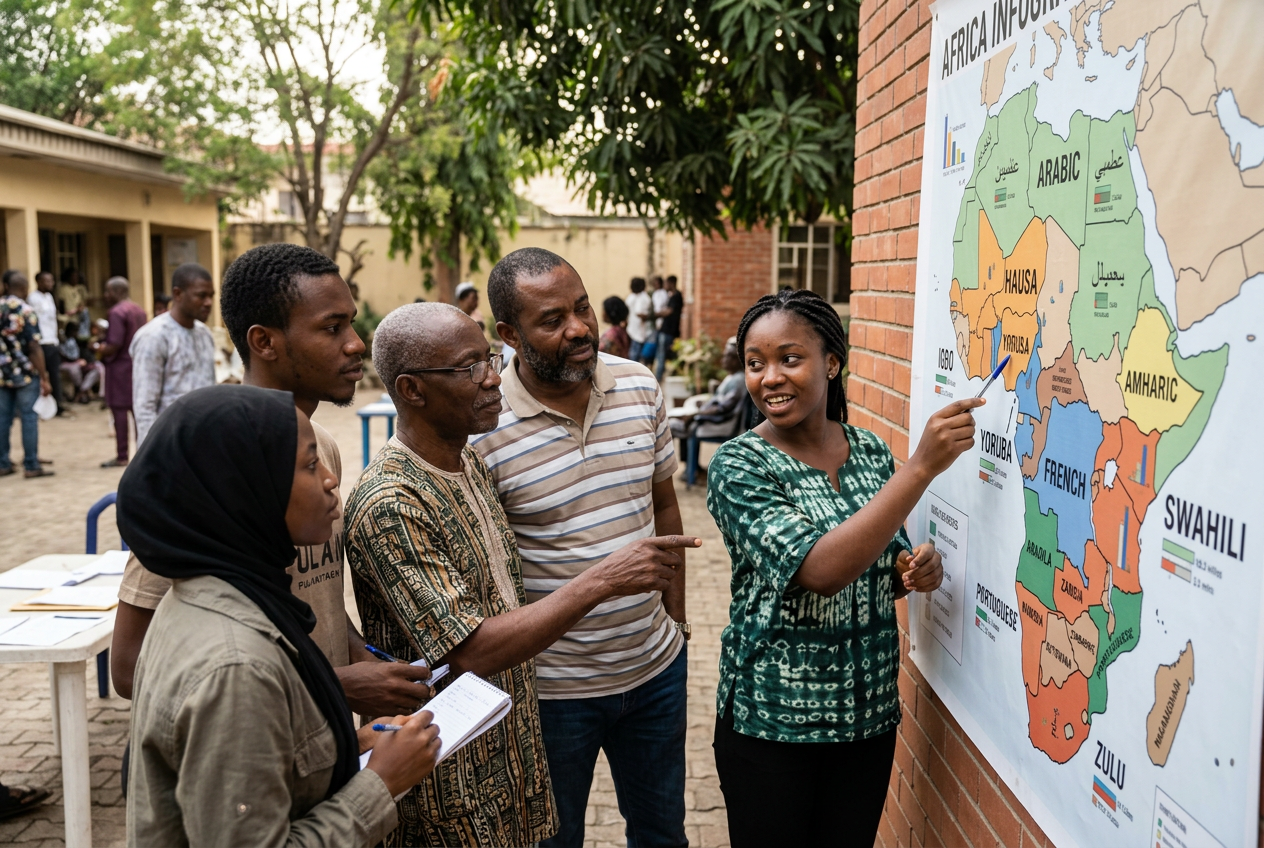
Arabic emerges as the frontrunner by most academic measures. With over 300 million speakers across the continent, primarily concentrated in North Africa and parts of the Horn, Arabic holds official status in countries including Egypt, Sudan, Algeria, Morocco, Tunisia, and Libya. It is also one of the six official languages of the United Nations, which tells you something about its global weight. The language divides into Modern Standard Arabic (used for writing and formal occasions) and the rich variety of regional dialects spoken daily. That distinction matters practically: an Egyptian dialect speaker and a Moroccan darija speaker may struggle to understand each other in conversation, even though they both “speak Arabic.”
Swahili (or Kiswahili, as it is properly called) makes a compelling case for second place and, by some measures, edges ahead of Arabic in terms of geographic reach and continental identity. Swahili serves as the official language of Tanzania, Kenya, Uganda, and the Democratic Republic of Congo, and it functions as the de facto lingua franca across East and Central Africa. The African Union formally recognised Swahili as an official continental language in 2022, a landmark moment. With between 150 and 200 million speakers when second-language users are included, Swahili is extraordinary. Only around 2 to 18 million people speak it as a mother tongue, yet it is understood and used daily across a region stretching from the Swahili Coast to the Congo Basin. That is the power of a true lingua franca.
French rounds out the top three, and this might surprise people who think of it as a European language. Due to France’s extensive colonial footprint across West and Central Africa, French is now the official language of 21 African countries. Around 120 to 167 million Africans speak it with varying degrees of fluency, from formal written registers to heavily creolised street varieties. West African French in Senegal or Côte d’Ivoire sounds and feels quite different from Parisian French, and linguists increasingly treat these as distinct varieties in their own right.
Depending on the criteria, Hausa and English also make very strong cases for inclusion in any “top three.” We will come to both shortly.
Top African Languages by Speaker Count
The table below summarises the major African languages by estimated total speaker figures, combining first and second-language users. These numbers vary across sources and should be read as ranges rather than precise counts, given the difficulty of consistent census data across 55 countries.
| Language | Family | Approx. Total Speakers | Primary Region | Official AU Status |
|---|---|---|---|---|
| Arabic | Afro-Asiatic | 300+ million | North Africa, Horn | Yes |
| French | Indo-European | 120-167 million | West, Central Africa | Yes |
| Swahili | Niger-Congo (Bantu) | 150-200 million | East, Central Africa | Yes |
| Hausa | Afro-Asiatic (Chadic) | 80-100 million | West Africa | No |
| English | Indo-European | 130+ million | Widespread | Yes |
| Amharic | Afro-Asiatic (Semitic) | 22-57 million | Ethiopia | No |
| Yoruba | Niger-Congo | 47+ million | West Africa (Nigeria) | No |
| Oromo | Afro-Asiatic (Cushitic) | 37+ million | Ethiopia, Kenya | No |
A glance at this table reveals something important: the top positions are dominated by languages that spread through trade, religion, and colonisation rather than through pure population size. Arabic spread with Islam. French spread through colonialism. Swahili spread through Indian Ocean trade networks long before Europeans arrived. That historical context shapes everything.
Which Country in Africa Has the Most Spoken Language?
This is a subtly different question from the one above, and I rather love it for that reason.
If you are asking which African country contains the greatest diversity of languages, Nigeria wins that contest by a considerable margin. Nigeria is home to over 520 distinct indigenous languages, making it one of the most linguistically diverse nations on earth. The Voice of Nigeria Broadcasting Service has noted that preserving this extraordinary diversity is a national priority, particularly as Indigenous Mother Language Day each February reminds us how quickly languages can disappear when they are not actively maintained.
However, if you mean which country produces the single most widely spoken African language, that is a much closer contest between Nigeria (Hausa, Yoruba, Nigerian Pidgin), Ethiopia (Amharic, Oromo), Egypt (Arabic), and Tanzania (Swahili).
Nigeria is perhaps the most fascinating case. Hausa, with an estimated 94 million total speakers across Nigeria and Niger, is the most spoken indigenous language in Sub-Saharan Africa and functions as the primary trade language across the entire West African Sahel. Yoruba follows with over 47 million speakers. And then there is Nigerian Pidgin, which a 2025 report identified as the most spoken language in Africa within its category, with 116 million users making it their second language and a vital commercial and social bridge across the country’s ethnic boundaries.
It is worth pausing on that Pidgin figure, because it is remarkable. The Guardian Nigeria has reported that Nigerian Pidgin now ranks 14th globally by total speakers, placing it ahead of Egyptian Arabic, standard Hausa, and Swahili by that particular measure. For a language that barely existed in its current form a century ago, that growth is staggering.
Ethiopia also deserves attention here. Oromo, spoken by an estimated 37 million people primarily in Ethiopia and northeastern Kenya, is one of Africa’s fastest-growing languages in terms of official recognition and digital presence. Amharic, Ethiopia’s federal working language, counts between 22 and 57 million speakers depending on the methodology used.
The Federal Ministry of Information and National Orientation has reaffirmed Nigeria’s commitment to an Inclusive Language Policy that encourages teaching at least one indigenous Nigerian language alongside English in schools, recognising that language is a tool for identity, unity, and cognitive development. This policy directly responds to the reality that Nigeria’s extraordinary language count is both a cultural treasure and a logistical challenge.
What Is the Most Spoken Language in Africa? A Direct Answer
Here, at the heart of the matter, is the honest answer: there is no single definitive response, and anyone who gives you one without qualification is oversimplifying.
By number of total speakers (including second-language users), Arabic leads with over 300 million speakers. By geographic spread and continental institutional recognition, Swahili makes the strongest claim, having been adopted as an African Union official language and spoken across the widest variety of African nations. By number of countries where it serves as an official language, French dominates with 21 countries. By the population of individual nations, Hausa holds the title of the most spoken indigenous African language in Sub-Saharan Africa, with Nigeria and Niger alone accounting for nearly 100 million speakers.
English, while not indigenous to Africa, is spoken with some proficiency by well over 130 million Africans and remains the primary language of business, higher education, and formal government in anglophone nations stretching from Nigeria to South Africa to Kenya.
The question becomes even more interesting when you consider that Africa’s language map does not respect national borders. Hausa is a daily commercial language in markets from Kano to Accra to Nairobi, carried by the Hausa diaspora and trade networks. Arabic crosses North Africa in one continuous belt. Swahili flows from the Tanzanian coast deep into the DRC. Yoruba is spoken in Benin, Togo, and diaspora communities in Brazil and Cuba. Languages, unlike countries, are not contained by lines on a map.
A Seven-Step Guide to Understanding Africa’s Language Groups
Language families are the organising principle beneath Africa’s apparent linguistic chaos. Here is how to navigate them systematically:
- Start with Afro-Asiatic. This is Africa’s largest language family by speaker count, encompassing Arabic, Hausa, Amharic, Somali, Berber, and dozens of smaller languages across North Africa, the Horn, and West Africa’s Sahel region. If you encounter a language spoken primarily in the north or northeast of the continent, it is likely Afro-Asiatic.
- Learn the Niger-Congo family. This is the world’s largest language family by number of distinct languages, and it covers most of Sub-Saharan Africa. Swahili, Yoruba, Igbo, Zulu, Shona, and hundreds of others belong here. The Bantu sub-group within Niger-Congo is particularly widespread, covering most of Central, East, and Southern Africa.
- Recognise Nilo-Saharan. Languages like Luo, Maasai, Kanuri, and Songhay belong to this family, spoken primarily across a band of territory from Mali to South Sudan. These languages often feature complex grammatical structures and tonal systems.
- Acknowledge Khoisan. The click languages of Southern Africa, including the various San and Khoekhoe varieties, represent some of the oldest linguistic lineages on earth. They are spoken by relatively small but historically significant communities in Botswana, Namibia, and South Africa.
- Account for colonial languages. English, French, Portuguese, Spanish, and Arabic (in its modern standardised form) are now functionally African languages in the sense that they are used by millions as primary languages of education, government, and commerce. Pretending otherwise would be historically dishonest.
- Pay attention to creoles and pidgins. Nigerian Pidgin, Cameroonian Pidgin, Krio (Sierra Leone), and Sango (Central African Republic) occupy a fascinating middle ground, neither purely indigenous nor purely imported, but hybrid languages that have developed their own grammar, literature, and cultural identity.
- Watch the digital frontier. Research by Guardian Nigeria has highlighted that even widely spoken languages including Yoruba, Hausa, Swahili, and Akan are classified as low-resource languages in artificial intelligence systems due to insufficient digital training data. The next chapter of Africa’s linguistic story will be written in algorithms as much as in classrooms.
What Are the Five Main Languages in Africa?
If you need a working shortlist of the five most significant African languages from a practical standpoint, this is the best case for each:
Arabic comes first on any list, and with good reason. Its native speaker base in Africa alone exceeds 150 million, and its role as the language of Islamic scholarship, North African governance, and formal pan-African diplomacy gives it unmatched institutional weight.
Swahili is the language I personally find most inspiring. Starting as a coastal trade language on the East African shore, it spread organically across a continent through commerce, migration, and eventually deliberate policy. Today, the African Union promotes it as a symbol of African unity and identity, and its adoption as an official language by Uganda and the DRC in recent decades shows that its geographic reach is still expanding. The Guardian Nigeria’s exploration of Africa’s oldest languages places Swahili’s rise in the context of much longer linguistic histories, including the Berber languages of North Africa and the Ge’ez script of Ethiopia, which stretch back to the 4th century.
Hausa deserves far more international recognition than it receives. With approximately 94 million total speakers and a rich tradition of literature, oral arts, and Islamic education, Hausa is not only West Africa’s most important indigenous language but also a lingua franca that stretches from Senegal to Sudan. Its vocabulary, enriched with Arabic loanwords through centuries of Islamic scholarship, reflects a fascinating linguistic and cultural synthesis. For Nigerians reading this, it may come as a surprise that Hausa boasts some of the most comprehensive dictionaries and grammar references of any African language, a testament to the work of both indigenous scholars and colonial-era linguists who recognised its importance early.
French, whatever one’s feelings about colonialism, is now functionally an African language. With speakers across 21 countries and growing populations in DRC, Cameroon, and Côte d’Ivoire, French in Africa is undergoing the same kind of organic transformation that turned Latin into French over many centuries. West African French is developing its own idioms, sounds, and cultural markers that increasingly differentiate it from Parisian standards.
English rounds out the five, functioning as the primary official language of Nigeria, South Africa, Ghana, Kenya, Tanzania, Zimbabwe, and many others. In Nigeria alone, the Nigerian Educational Research and Development Council oversees a curriculum in which English serves as the medium of instruction from primary school onwards, ensuring that hundreds of millions of Africans receive their formal education in this language, whatever their mother tongue may be.
The Most Spoken Language in Africa: What This All Means for Us
Africa’s languages are not a problem to be solved. They are a heritage to be celebrated, protected, and understood. Whether you are fascinated by the structural elegance of Swahili’s noun class system, moved by the tonal poetry of Yoruba, or intrigued by Arabic’s unbroken literary tradition stretching back over a millennium, every African language carries the memory of its people, their migrations, their philosophies, and their ways of understanding the world.
If you take one thing from this article, let it be this: the answer to “what is the most spoken language in Africa” is not a single word. It is a conversation, and that is exactly as it should be.
Actionable takeaways:
- When discussing Africa’s most spoken language, always specify your criteria: native speakers, total speakers, geographic spread, or institutional recognition each produce different answers, and Arabic, Swahili, and French all lead by different measures.
- If you are learning an African language for travel or business, Swahili offers the broadest utility across East and Central Africa, while Hausa opens doors across the West African Sahel, including northern Nigeria.
- Engage with platforms and resources that support indigenous African language learning, because languages like Yoruba, Igbo, and dozens of others are at risk in the digital age and benefit enormously from active community use and promotion.
Related Articles
If Nigeria’s extraordinary linguistic diversity has caught your attention, you may also enjoy a deeper look at the ethnic groups that create this diversity. My piece on Nigeria’s 371 distinct ethnic groups examines how these communities maintain distinct languages, traditions, and governance systems whilst building a shared national identity, including a fascinating look at how Afrobeats artists routinely blend Yoruba, Igbo, Hausa, and Pidgin within single songs.
For a broader picture of what ties all this diversity together, my exploration of what culture Nigeria has and how it expresses itself covers everything from Yoruba talking drums to the linguistic heritage that makes Nigerian music and storytelling so distinct on the world stage.
Frequently Asked Questions About the Most Spoken Language in Africa
What is the most spoken language in Africa overall?
By total speaker count including second-language users, Arabic leads with over 300 million speakers across the continent. However, Swahili is often cited as the most widely spread indigenous African language due to its role as a lingua franca across East and Central Africa.
Is English the most spoken language in Africa?
English is one of the most widely used languages in Africa, spoken by over 130 million people across anglophone nations. However, it falls behind Arabic and French in total speaker numbers when all African countries are counted together.
Is Swahili spoken across all of Africa?
Swahili is primarily spoken in East and Central Africa, including Tanzania, Kenya, Uganda, Rwanda, Burundi, and the DRC. It is not widely spoken in West Africa, North Africa, or Southern Africa, though its profile is growing through the African Union’s promotion of it as a continental official language.
Why is Arabic the most spoken language in Africa by native speakers?
Arabic has been spoken in North Africa since the 7th century when Islamic expansion carried it from the Arabian Peninsula across Egypt, Libya, Tunisia, Algeria, and Morocco. Centuries of settlement and cultural integration mean that North Africans now speak Arabic as their mother tongue rather than as an imported language.
Is Hausa considered a major African language?
Hausa is the most spoken indigenous language in Sub-Saharan Africa, with approximately 94 million total speakers across Nigeria, Niger, Ghana, Cameroon, Chad, and Sudan. It functions as a major trade language across the West African Sahel and has a rich literary tradition dating back centuries.
What is the fastest-growing language in Africa?
Nigerian Pidgin has shown extraordinary growth, reaching 116 million second-language speakers and ranking 14th globally by total speaker count. Swahili is also growing rapidly through deliberate policy adoption in new countries and African Union promotion.
Which African language has the most countries where it is official?
French holds this distinction, serving as an official language in 21 African countries primarily across West and Central Africa. English follows with approximately 25 countries if you include countries where it is a co-official language, though some estimates differ.
Is Yoruba spoken outside Nigeria?
Yes, Yoruba is spoken in Benin, Togo, and in diaspora communities across Brazil, Cuba, Trinidad, and parts of the United States, where it was carried by enslaved West Africans during the transatlantic slave trade. Over 47 million people speak Yoruba worldwide, making it one of Africa’s most globally distributed indigenous languages.
What language do most Nigerians speak daily?
Most Nigerians navigate between multiple languages daily. English serves as the official language, Nigerian Pidgin functions as the everyday lingua franca across ethnic groups, and most Nigerians also speak their ethnic mother tongue, whether Hausa, Yoruba, Igbo, Ijaw, Tiv, or one of hundreds of others.
Are there African languages at risk of extinction?
Yes, many of Africa’s estimated 2,000 plus languages are endangered. Linguists estimate that hundreds face extinction within this century as younger generations shift towards economically dominant languages like English, French, and Swahili. Nigeria alone has several languages with fewer than a thousand remaining speakers.
Why did Swahili become the African Union’s official language?
Swahili was adopted as the African Union’s first official indigenous African language in 2022 because of its unique status as a language with no single ethnic group claiming ownership of it. Unlike Hausa or Yoruba, which are associated with specific ethnic communities, Swahili developed as a trade and contact language, making it politically neutral across ethnic lines.
How does Nigeria’s language diversity compare to the rest of Africa?
Nigeria’s 520 plus indigenous languages place it among the world’s most linguistically diverse nations, ranking alongside Papua New Guinea in terms of sheer language count. Despite this, Nigeria functions as a unified nation using English as its official language, Nigerian Pidgin as its everyday bridge, and Hausa, Yoruba, and Igbo as its three major recognised national languages.

