 Follow Us on Google News


 Follow Us on Google Discover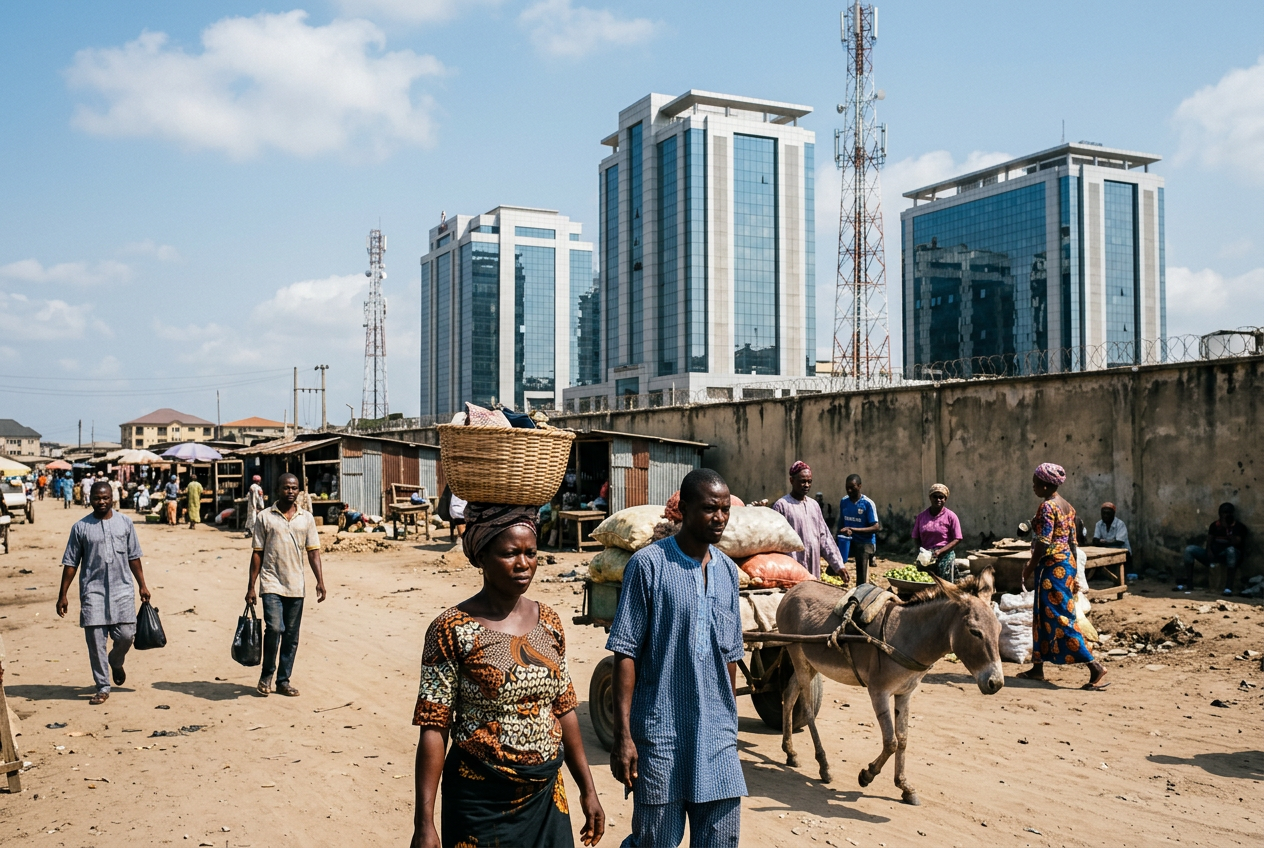
Welcome, and thank you for reading. Why is Nigeria so wealthy? I have been asked that question by a Dutch investor in a Victoria Island lobby and by my cousin in Aba, who laughed because he did not believe the premise. This piece is the conclusion of months of research into where our national money actually sits, built on years of experience writing about the Nigerian economy. Midway through, I stopped reading balance sheets and started reading the literature on what economists call the paradox of plenty, and the whole picture rearranged itself.
Because both my cousin and the investor were right.
That is the uncomfortable thing about this question. It has two correct answers that appear to contradict each other, and most of the arguments you will hear on Nigerian radio are really arguments between people holding different halves of the same fact. One person is talking about the size of the pot. The other is talking about the size of the spoon.
I want to give you both halves properly, with the numbers attached, so that the next time this comes up at a wedding reception in Ikeja you can settle it in about ninety seconds.
Where Nigeria’s Wealth Actually Comes From
Let us start with the physical stuff, because that is the part nobody disputes.
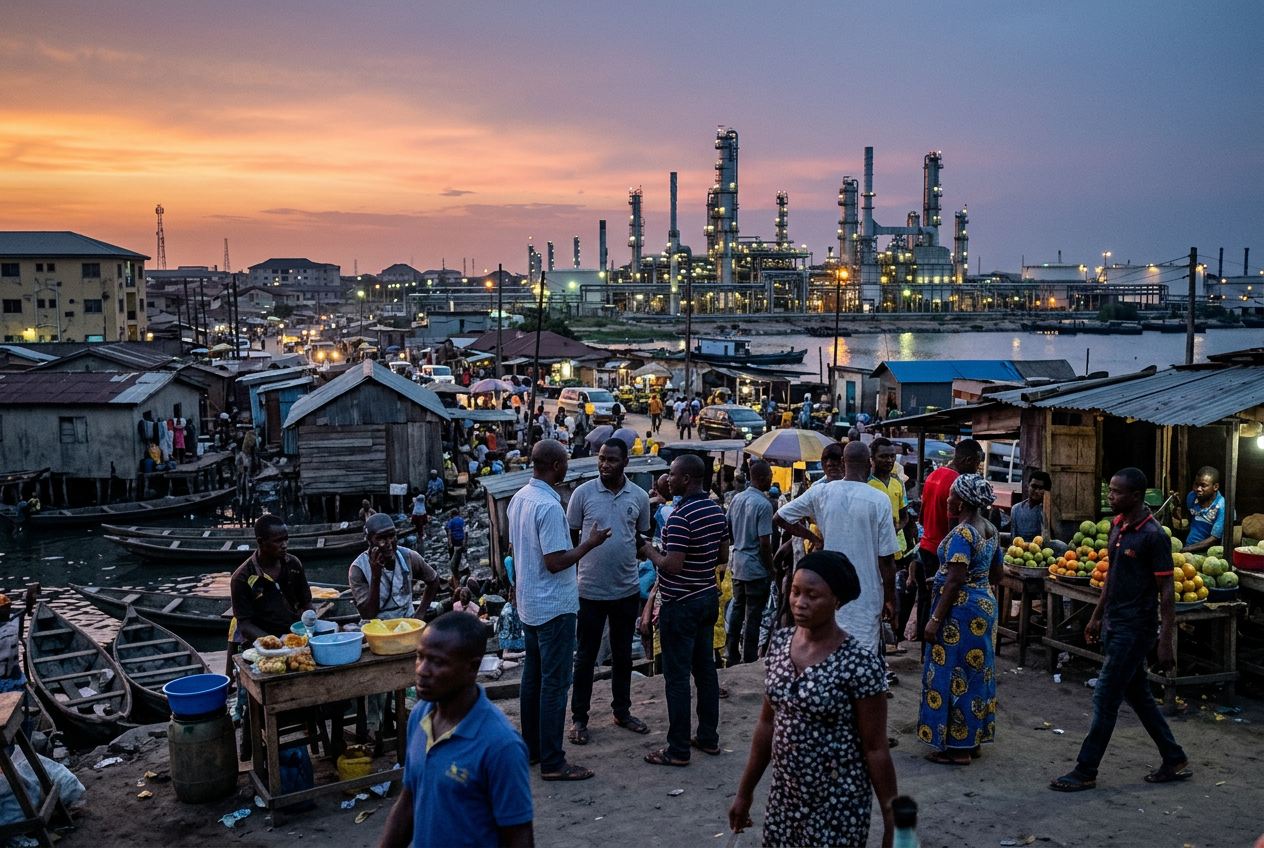
Nigeria holds roughly 36.1 billion barrels of proven oil and condensate reserves and about 209 trillion cubic feet of natural gas, according to the reserves position published by the upstream petroleum regulator. The gas number matters more than most Nigerians realise. It is the largest proven gas endowment on the African continent, and unlike the oil, we have barely begun to sell it properly.

Production in June 2026 averaged around 1.74 million barrels a day of crude and condensate, which was slightly above the OPEC quota for the month and the fourth consecutive month of growth. At current prices that is somewhere in the region of ₦170 billion of crude leaving the country every single day. Read that again slowly.
Then there is what is underneath the oil. Nigeria has more than 44 commercially viable minerals scattered across over 500 known locations in all 36 states: gold in the schist belts of Osun and Zamfara, lithium in the pegmatites of Nasarawa and Kwara, limestone almost everywhere, coal in Enugu, bitumen in Ondo, tin and columbite on the Jos Plateau, and rare earth deposits that a $400 million processing plant in Uke is now being built to handle.
The mining sector’s contribution to output climbed to about 1.8 per cent in 2025, up from below one per cent for most of the previous two decades. Small, yes. But it moved.
And then there are the people, which is the endowment we are worst at counting. Roughly 230 million of us, median age somewhere around eighteen, with a working-age cohort larger than the entire population of Germany and France put together. That is not a footnote to the wealth story. On any long enough timeline it is the whole story.
The economy itself grew 4.07 per cent year on year in the fourth quarter of 2025, according to the national statistics office, and the International Monetary Fund has Nigeria contributing about 1.5 per cent of total global real GDP growth in 2026, which puts us sixth in the world on that particular measure, ahead of Brazil and Germany.
Sixth in the world. For growth contribution. That is a genuinely startling sentence to type about a country where a bag of rice is a household budget event.
Why Is Nigeria So Wealthy? The Direct Answer
Here is the paragraph, if you only read one.
Nigeria is so wealthy because it combines four separate forms of endowment that very few countries hold simultaneously: a hydrocarbon base of about 36 billion barrels of oil and Africa’s largest gas reserves; a solid minerals inventory of more than 44 commercial minerals across 500 sites; the largest domestic consumer market on the continent at around 230 million people; and a globally distributed diaspora that sent home roughly $21.8 billion in 2025. Layer on top of that a nominal economy of about $334 billion, the third largest in Africa, an external reserve position that has climbed past $50 billion, and cultural exports in music and film that generate soft power far beyond their revenue. The wealth is real. What Nigeria lacks is not assets but the institutional machinery to convert assets into household income, which is a completely different problem and, frankly, a much harder one.
If you want it as a list, the sources of Nigerian wealth are:
- Crude oil and condensate, still around 90 per cent of export earnings
- Natural gas, the largest proven reserve in Africa and mostly unmonetised
- Solid minerals, worth ₦354 billion in exports in 2025 and growing fast from a tiny base
- Agriculture, which contributed 25.67 per cent of nominal GDP in the fourth quarter of 2025
- Services, including a financial sector and a telecoms sector that between them carry the majority of output
- Diaspora remittances, now rivalling oil as a foreign exchange source
- The domestic consumer market itself, which is why every multinational on earth keeps a Lagos office
Notice how much of that list is not oil. That is new, and it is the most encouraging development in the Nigerian economy in my professional lifetime.
Nigeria’s total public debt, meanwhile, stood at ₦159.35 trillion at the end of March 2026, or about $114.95 billion, per the Debt Management Office. Hold that figure. We will need it shortly.
Why Nigeria Is Rich Yet So Poor
Now the other half.
The World Bank projected that around 139 million Nigerians were living below the poverty line by 2025, with the poverty rate reaching about 62 per cent in 2026 before a modest fall the following year. The Presidency has publicly disputed those numbers, which is worth knowing, though the direction of travel is not seriously contested by anyone I have spoken to. The National Bureau of Statistics, before it stopped publishing its Multidimensional Poverty Index, put 133 million Nigerians in multidimensional poverty, roughly 63 per cent, defined by overlapping deprivations in health, schooling, sanitation, housing and infrastructure.
So we have a country in the top three economies on the continent, with more than half its people poor.
How?
The mechanism is not mysterious, and it is not unique to us. Oil money does not arrive as wages. It arrives as foreign exchange paid to the federation by a handful of companies operating in an enclave in the Niger Delta that employs relatively few people directly. It enters the economy at the very top and then has to be pushed downwards deliberately, through budgets, salaries, procurement and services. If the pushing mechanism is weak or leaky, the money simply pools where it lands.
One Guardian columnist put the point with real precision earlier this year, arguing in a piece on the case for including host communities in the indigenous oil transition that the resource curse is institutional rather than geological. I have not read a better six-word summary of the Nigerian economic condition.
Then add the second drain. Debt service. Nigeria’s borrowing is not extreme by global debt-to-GDP standards, but the share of federal revenue that goes to servicing it has at times been brutal, which means a large slice of the oil money is spoken for before it reaches a classroom or a clinic.
And add the third, which is the one that annoys me most: for decades we exported crude and imported refined petrol, paying a middleman premium on our own resource. That is finally changing. Refined petroleum imports fell 87.5 per cent to $310 million in the first quarter of 2026 while refined petroleum exports climbed to $2.37 billion. We are, for the first time in my adult life, selling processed fuel rather than only buying it.
Another Guardian opinion piece this year framed the fundamental risk well, warning that Nigeria has only a finite window in which to convert hydrocarbon reserves into industrial and human capacity before global demand patterns shift underneath us. The clock is not hypothetical.
Rather like inheriting a large house in Ikoyi with no income to maintain it, holding the asset and enjoying the asset are separate achievements.
Which Countries In Africa Are Richer Than Nigeria?
Two, on the headline measure. Many, on the one that matters to your household.
By nominal GDP for 2026, the International Monetary Fund’s April projections place South Africa first and Egypt second, with Nigeria third at around $334 billion, having moved back ahead of Algeria. Nigeria held first place on this measure from the 2013 rebasing until 2022 and then lost it, not because the economy shrank in real terms but because the naira did. When your currency loses more than half its dollar value, your dollar-denominated GDP follows it down, regardless of how many yams were harvested.
By income per person, the picture is much less flattering. Seychelles leads Africa at roughly $21,000 a head, followed by Mauritius, then Gabon, Equatorial Guinea, Botswana and Libya. South Africa sits around $6,400. Nigeria falls into the bottom half of the continent.
Africa’s Largest Economies Measured Against Nigeria
| Country | Nominal GDP 2026 (US$ billion) | Africa rank by GDP | Population (millions) | GDP per person (US$) | Main engine of the economy |
|---|---|---|---|---|---|
| South Africa | ≈443 | 1st | ≈64 | ≈6,900 | Mining, finance, manufacturing |
| Egypt | ≈400 | 2nd | ≈118 | ≈3,400 | Suez traffic, tourism, gas, agriculture |
| Nigeria | ≈334 | 3rd | ≈230 | ≈1,450 | Crude oil and gas, services, agriculture |
| Algeria | ≈290 | 4th | ≈47 | ≈6,200 | Hydrocarbons |
| Seychelles | ≈2.4 | Outside top 40 | ≈0.11 | ≈21,800 | Tourism, offshore finance |
The final column of numbers is simply the GDP figure divided by the population figure, which is why Seychelles can run an economy roughly one hundred and forty times smaller than ours and still make every one of its citizens vastly better off on paper. Nigeria’s problem in this table is not the second column, which is healthy, but the arithmetic that happens when you divide it by the fourth.
Which Is The Number One Richest Country In Africa?
You now know why I am about to be annoying and answer this twice.
If “richest” means total economic output, South Africa is number one in Africa for 2026, with roughly $443 billion of nominal GDP, the continent’s deepest capital markets, its largest stock exchange and an industrial base nobody else matches. Egypt is closing the gap and is projected by some analysts to reclaim the top spot before the end of the decade.
If “richest” means how wealthy the average person is, the answer is Seychelles, an archipelago of about 115 islands with a population smaller than Yenagoa, running on luxury tourism and offshore financial services.
And if “richest” means what is still sitting in the ground unextracted, the answer is almost certainly the Democratic Republic of Congo, which holds an estimated $24 trillion in untapped mineral wealth above a GDP per capita of roughly $580. That gap is the most extreme illustration on earth of the difference between having wealth and receiving it.
Three questions. Three different countries. Anyone who gives you a single confident answer without asking which measure you mean is either selling something or has not thought about it.
Which Country Loves Nigeria So Much? Follow The Money
I will be honest: countries do not love each other. They have interests. But the question behind the question is a good one, so let us answer the version that has actual evidence behind it.
If you measure affection by money and attention, China leads. It is Nigeria’s largest bilateral lender and a dominant source of imported consumer and producer goods, and Afrobarometer survey work found that 62 per cent of Nigerians view Chinese influence on the country positively, against 57 per cent for the United States. Whether that trade relationship is affectionate is another matter entirely, given the size of the deficit running in Beijing’s favour.
If you measure by human ties, the answer changes to the United States and the United Kingdom. That is where the largest slices of the diaspora sit, and the diaspora is now genuinely load-bearing for the Nigerian economy. Remittances reached about $21.8 billion in 2025. Formal inflows through licensed money transfer operators hit a record $947 million in July 2026 alone, bringing the first seven months of the year to $3.8 billion, a rise of 50.2 per cent on the same period in 2025. The Central Bank is chasing $1 billion a month by year end.
Think about what that means. Our own children, working night shifts in Houston and Manchester and Toronto, now send home a flow of foreign exchange that is starting to rival what the oil majors pay us.
If you measure by regional warmth, it is Ghana, Liberia and the rest of West Africa, whatever we say about each other during football matches.
And if you measure by strategic courtship, watch the minerals. Nigeria signed a mining cooperation memorandum with Türkiye in May 2026, chairs the African Mineral Strategy Group, and is being approached by the United States, the United Kingdom, Saudi Arabia, the UAE and China over lithium and rare earths. The affection is real. It is also, unmistakably, geological.
A Guardian opinion piece put the domestic side of this bluntly last month, describing a country living two parallel realities, impressive from a distance and punishing up close. Both realities are legible in the same dataset, which is exactly why this argument never ends.
Seven Steps To Judge Nigeria’s Wealth For Yourself
I have spent years watching people argue past each other on this topic. Here is the method I use, and it works whether you are reading a Bloomberg terminal or a WhatsApp forward from your uncle.
- Ask which measure is being used before you accept any ranking. Total GDP, GDP per person and untapped resource value produce three different winners, and a headline that does not say which one it means is not a fact, it is a mood.
- Check the exchange rate stamped on the figure. Nigeria’s dollar GDP fell by roughly half between 2022 and 2024 with no corresponding fall in real output, purely because the naira moved. Any dollar figure about Nigeria is really two figures wearing one coat.
- Find the base year. The National Bureau of Statistics rebased GDP from 2010 to 2019, which lifted nominal 2024 GDP to ₦372.82 trillion from a much lower prior estimate. Rebasing does not create economic activity, it just starts counting activity that was always there.
- Separate the stock from the flow. Reserves of 36 billion barrels are a stock, a thing you own. Production of 1.74 million barrels a day is a flow, a thing you earn. Countries go broke holding enormous stocks.
- Test the revenue against the debt service. Before you get excited about oil earnings, ask how much of them are already committed to servicing ₦159.35 trillion of public debt. Gross revenue tells you very little; the residual tells you everything.
- Look for a household number. GDP is a national aggregate and can rise while your neighbourhood gets poorer. Ask for the poverty headcount, the real wage, the food inflation rate, or the price of a 50kg bag of rice in your own market.
- Then act on the version that applies to you. If Nigeria’s wealth is concentrating in gas, minerals, fintech, logistics and the diaspora corridors, and it is, position your skills, your savings and your business towards those corridors rather than towards the sectors that dominated the headlines twenty years ago.
That last one is not abstract advice. The ₦1 trillion the government allocated to mineral exploration in 2025 has to be spent by somebody, and the people who read the shift early are the ones who will be holding the licences.
Final Thoughts On Why Nigeria Is So Wealthy
So, why is Nigeria so wealthy? Because the endowment is genuinely extraordinary: 36 billion barrels of oil, the continent’s largest gas reserves, 44 commercial minerals across 500 sites, 230 million people, and a diaspora sending home more than $20 billion a year. That is not a myth, and it is not colonial-era flattery. It is in the reserve statements, the trade data and the balance of payments.
But wealth is a noun and prosperity is a verb.
The honest position, after months of sitting with these numbers, is that Nigeria is a rich country with a broken distribution mechanism, and that fixing the mechanism is a political and institutional problem rather than a geological one. Norway had oil. The UAE had oil. Both built machinery to move the money outward. That is the difference, and it is a difference we can close, because it was never about what was under the ground.
There are real signs of movement. The naira has been strengthening, trading around ₦1,337 to the dollar at the official window at the end of August 2026, against roughly ₦1,400 in the parallel market. External reserves have climbed past $50 billion. Formal remittances are up more than half on last year. Refined petroleum imports have collapsed while exports have risen. Solid minerals revenue to the federation account went from ₦16 billion in 2023 to over ₦70 billion in 2025.
None of that has reached my cousin in Aba yet. But for the first time in a while, the arrows are pointing the right way.
Here is what I would do with all this if I were you:
- Stop arguing about whether Nigeria is rich or poor and start specifying which measure you mean, because the argument dissolves the moment you do
- Track the non-oil indicators rather than the crude price, because gas, minerals, remittances and services are where the next decade of Nigerian income is being decided
- Treat every dollar figure about Nigeria as a naira figure in disguise, and always ask what exchange rate was used to produce it
Related Articles
If the growth side of this story interests you, I traced the specific sectors driving the current expansion in my piece on what is actually behind the country’s recent economic momentum, which covers the infrastructure and investment picture in more detail than I could fit here.
And for the wider question of why any of this matters beyond our borders, I looked at Nigeria’s weight in African and global affairs in an examination of the country’s regional and international significance. The wealth question and the influence question turn out to be closely related, and reading them together gives you a fuller picture than either does alone.
Key Takeaways
- Nigeria’s wealth is real and measurable: about 36 billion barrels of oil, Africa’s largest gas reserves at 209 trillion cubic feet, over 44 commercial minerals, 230 million people and $21.8 billion in annual remittances
- The country ranks third in Africa by total economic output but falls into the bottom half by income per person, which is why “rich” and “poor” are both accurate descriptions
- The constraint is distribution rather than endowment, and the indicators that will tell you whether it is loosening are non-oil revenue, formal remittances, the exchange rate and the poverty headcount
Frequently Asked Questions About Why Nigeria Is So Wealthy
Why is Nigeria so wealthy?
Nigeria is wealthy because it holds Africa’s largest proven gas reserves, roughly 36 billion barrels of oil, more than forty commercially viable minerals and a working-age population larger than most European countries combined. That endowment produces genuine national income, but very little of it is distributed in a way that reaches ordinary households.
Is Nigeria actually a rich country or a poor one?
By total economic output Nigeria is among the three largest economies in Africa, which is a rich-country position. Measured per person it sits in the bottom half of the continent, which is a poor-country position, and both statements come from the same dataset.
How much oil does Nigeria produce each day?
Nigeria produced an average of about 1.74 million barrels a day of crude and condensate in June 2026, according to the upstream petroleum regulator. That was enough to meet slightly more than its OPEC quota for the month.
Why is Nigeria rich yet so poor?
Oil wealth arrives as foreign exchange paid to the federation rather than as wages paid to workers, so it enters the economy at the top and has to be pushed downwards deliberately. Debt service, historic subsidy costs and weak collection then absorb much of what does arrive.
Which country in Africa is richer than Nigeria?
On nominal GDP for 2026 the International Monetary Fund places South Africa and Egypt above Nigeria, leaving Nigeria third. On income per person the list is far longer and includes Seychelles, Mauritius, Gabon, Equatorial Guinea, Botswana, Libya, South Africa and Egypt among others.
Which is the number one richest country in Africa?
It depends entirely on the measure you choose. South Africa is first by total economic output in 2026, while Seychelles is first by income per person at roughly twenty-one thousand dollars a year.
Which country loves Nigeria so much?
Countries have interests rather than affections, but if you measure by money and attention, China leads on trade and lending while the United States and the United Kingdom lead on diaspora ties. Afrobarometer survey work found that 62 per cent of Nigerians view Chinese influence positively, against 57 per cent for American influence.
How much do Nigerians abroad send home each year?
Diaspora remittances reached roughly $21.8 billion in 2025, slightly above the previous year despite tighter immigration rules abroad. Formal transfers through licensed operators hit a record $947 million in July 2026 alone.
What is Nigeria’s total public debt?
Total public debt stood at ₦159.35 trillion, or about $114.95 billion, at the end of March 2026 according to the Debt Management Office. Domestic borrowing accounted for just under fifty-five per cent of that total.
Do Nigeria’s solid minerals make any money yet?
Not much in absolute terms, though the direction has changed sharply. Solid mineral exports were worth about ₦354 billion in 2025, roughly 0.4 per cent of total exports, while federation account revenue from the sector rose to over ₦70 billion from ₦16 billion two years earlier.
Why does Nigeria’s GDP ranking keep changing?
Because the ranking is calculated in United States dollars and the naira has moved violently in recent years. A rebasing exercise or a currency devaluation can shift Nigeria several places in either direction without a single extra barrel being produced.
Will Nigeria’s wealth ever reach ordinary people?
It can, and several indicators are currently moving the right way, including a stronger naira, record formal remittances and a slowly diversifying revenue base. Whether that continues depends on institutions rather than geology, which makes this a political question rather than a mineral one.

