 Follow Us on Google News


 Follow Us on Google Discover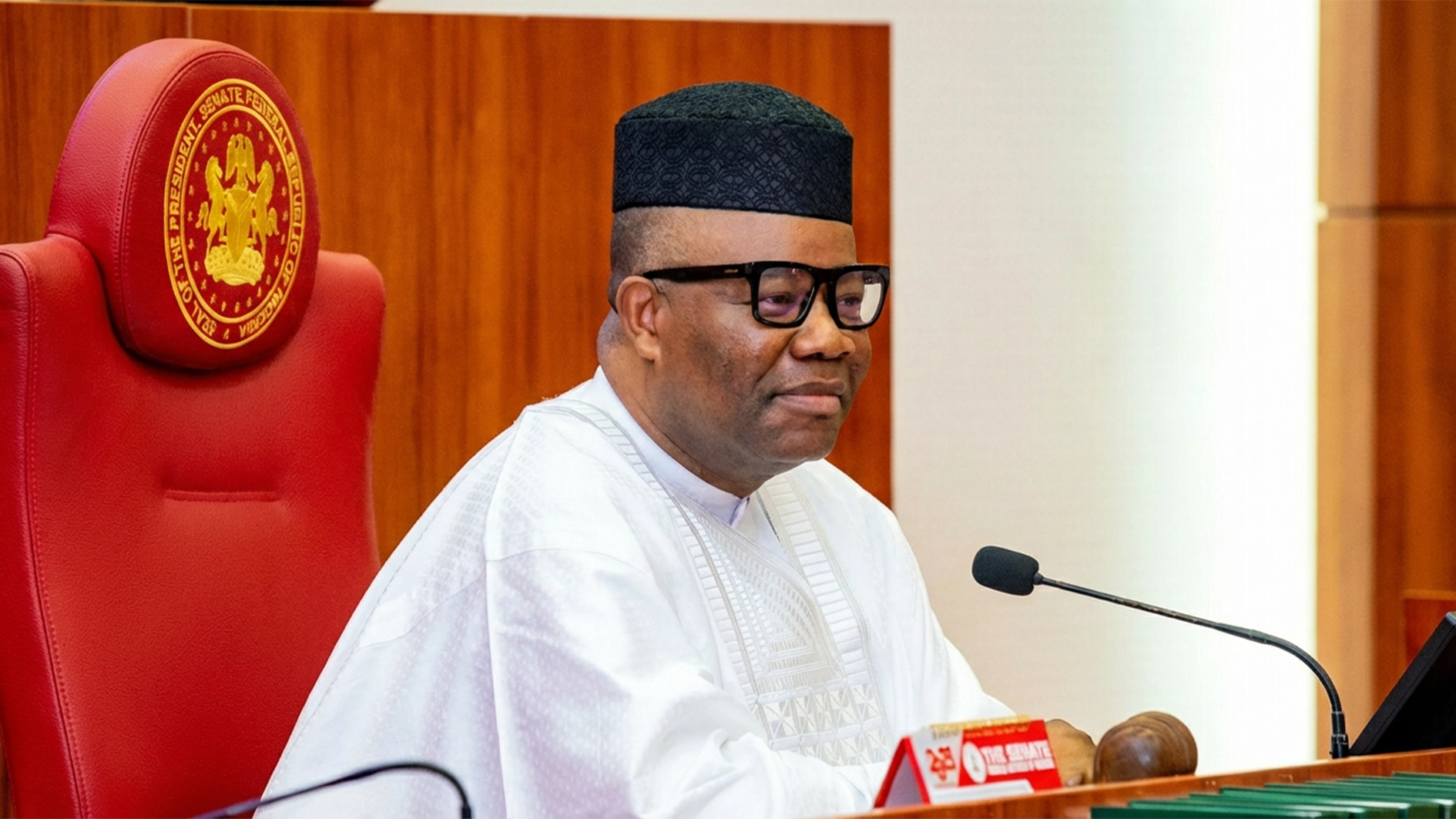
By Alade Rotimi-John
We open with a reported blistering castigation of the members of the U.S. Congress by a Mr Thomas Reed who as Speaker of the House of Representatives observed that members of Congress “…never open their mouths without subtracting from the sum of human knowledge.”
Mr Reed’s observation may have foreshadowed an upcoming Nigerian counterpart of the U.S. parliament especially the inanities of its titular head, Mr Godswill Akpabio who is constitutionally referred to as President of the Senate.
The grandiously-ornamental brooch as title on the lapel of Akpabio’s flowing gown makes him to revel in beatitudes of Mr Jones in George Orwell’s Animal Farm – pontifical, magisterial, Lord of the Manor.
Further, one is reminded of a self-denigrating remark of a character in a passage in Shakespeare’s The Tempest. The narrator therein speaks of the inequity or imbalance in shared values respecting the social and geo-political configuration of the British Isles. Said he:
“They say there’s but five upon this isle; we are three of them; if the other two be brain’d like us; the state totters.”

If the rest of Nigeria be brained like Akpabio’s National Assembly, the tottering Nigerian state would have further tottered into the brinks.
The reader is invited to note the upturned dramatic irony here.
Resplendent in his vintage expansive mood the other week, Dr Akpabio made a vacuous or unintelligible remark about the expected duration of the present eerie regime of insecurity involving insurgency, banditry, kidnappings, gangsterism, etc in Nigeria. Akpabio has announced excathedral and with an air mimicking a referee’s whistle to signal the end of a football match. At the close of a game, the umpire blows his whistle to declare an armistice. Akpabio has divined the end of the game of terrorism or insecurity to be by the end of the 2027 general elections.
Intoned the President of the Senate at the launch of the Nigeria Revenue Service corporate headquarters in Abuja: “Insecurity is increasing because election is coming … Two weeks after election, the insecurity will stop. The insecurity is being sponsored by people.” Immediately after the elections, insecurity will be a thing of the past, Akpabio has magisterially decreed.
Two or three deductions organically flow from Akpabio’s specious casuistry. His insult to our collective appreciation of the kinesis of the huge issue of insecurity is benumbing. One, Akpabio is saying politics and politicians are the cause or promoters of insecurity. Two, aggrieved politicians who look up to victory at the elections will withdraw their armed forces as soon as the election is over and the prize is won. Three, the election milieu is the fertile ground for unabating insecurity.
By the standards of ordinary scholarship, there is something unscholarly about the attempt to formulate the assumptions on which a serious study may be conducted regarding the genesis and modus of insecurity in Nigeria and elsewhere for us to arrive at the presumptuous conclusion of Akpabio’s nonsequitur.
The perceived enemies of the Tinubu government and party are obviously the target of Akpabio’s misfiring of the guns in his arsenal. Akpabio is not alone in their search for the fall guys who are identified as the ones making Tinubu’s governance of Nigeria difficult or unachievable. Tinubu himself shares of a large dose of the illogical thinking which foists his misgovernance policies and programmes on persons who bear the brunt of his rudderless administration.
Flippant or loquacious Akpabio is the administration’s equivalent of Squealer in the Animal Farm except that he glaringly lacks Squealer’s brilliance in speech or is bereft of his clarity of thought. Akpabio is neither doctrinaire nor eclectic. He is President Tinubu’s Man Friday, anyway. And, ironically so.
A functionary who is constitutionally empowered to exercise oversight functions over another has become the latter’s lame lapdog to the studied embarrassment of the larger society and the chagrin of the National Assembly that he leads.
The relation between politics and society is usually expressed to mean that politics is a reflection of society. It is to the effect that politics at any given situation mirrors the current social situation adequately or correctly.
Axiomatic as this truism may appear, it is false. Tinubu’s government bears out its falsity. This regime’s politics only depicts a microscopic aspect of our social reality. It does not truly reflect Nigeria’s geo-social reality as it neither appears to be aware of Nigeria’s dire specific social situations e.g. the general pitiable plight of the people nor does it share of the people’s specific attitudes and worldview pertaining, for instance, to corruption, poverty, hunger, inequity, privation, etc. For Tinubu, the heavens may fall. His government is on a roller coaster.
This government’s instincts and imagination are far more related to the whims of the acquisitive typology, the speculator, and the burgeoning tribe of nouveau riche much of whose source of wealth is dubious. The general outlines of the Tinubu presidency are too clear to be mistaken. His is the prototype of the political wayfarer, living on blackmail, feared rather than be respected or honoured.
The myth of the hope of the Tinubu master class performance has since assumed a pejorative connotation even as myth is a fiction – a historically or scientifically untrue conception. In the case of Tinubu, it is an anonymously concocted or composed story much of which is about an imagined Lagos superlative performance. His current stint at the presidency has deflated the myth of his touted uncommon genius.
Even as human beings cannot live by abstractions alone, they fill their voids with extemporised or conjured stories of some infinitely imagined greatness. In the end, they are left with a mere poetic metaphor – distant, unreal, mythical. So is the case with the Tinubu typology.
Thankfully today, many people are beginning to scrutinise the sometimes too easy presumptions of the Tinubu pundits.
By listening to Tinubu’s balabloo verbiage as political messaging that we do not understand at all, we are not hearing any comprehensible sound. We have just been imposing our phonetic habits on what hear just to make some sense of it. Tinubu’s political communication is peculiarly directed at befuddling simple issues. His pronouncements are divorced from the general conception of the meaning they should convey.
Another election cycle is here for us to be treated to the inanities inherent in the gibberish that politicians will dish out to us including the Bulaba prosody. The arrogance of an overarching incumbency may however restrain or prevent President Tinubu from granting media interviews or from participating in debates for laying bare his party’s social and economic programmes which in this first tenure have not rendered themselves tangible or intelligible. The electorate is encouraged to pay attention even to the vocalisation of programmes and policies put out this season so it may imagine the facility or otherwise of their visible performance in office.
We close with the scathing tongue of John Randolph (1773-1833) a member of the United States’ House of Representatives who pored through history and noted that:
“Never was ability so much below mediocrity so well rewarded; no, not even when Caligula’s horse was made a consul.”
Our standards of political reward need to be upscaled or upgraded.
Rotimi-John, a lawyer and commentator on public affairs, is the Deputy Secretary-General of Afenifere. [email protected]

