 Follow Us on Google News


 Follow Us on Google Discover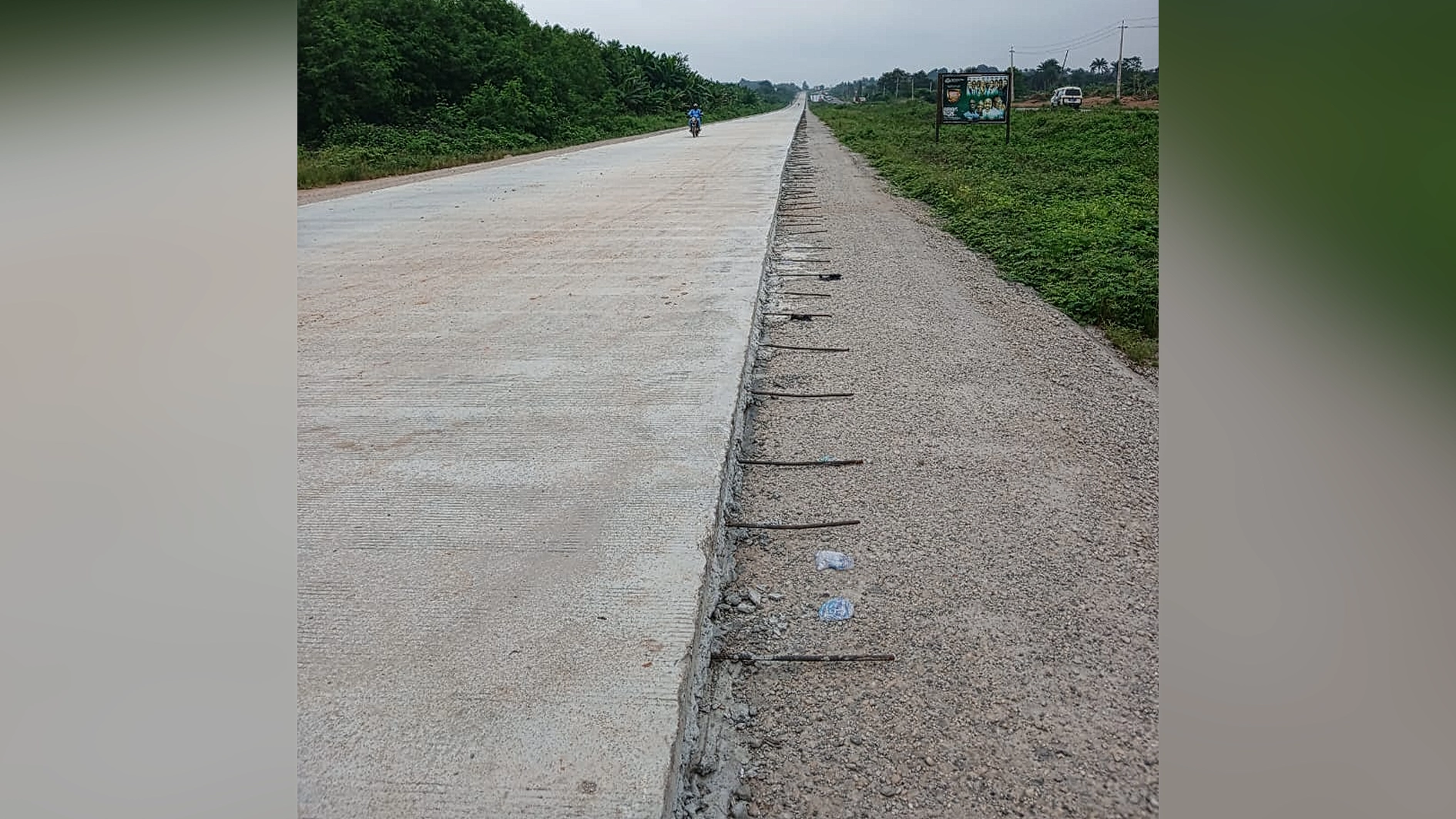
A not too frequent traveller along Ibadan-Ife-Ilesha federal highway will be amazed at the speed of construction work along that route, all under one year. From Ibadan outskirts to Ife and towards Ilesha, the dual carriage way has seen a remarkable concrete reinforcement pavement on the outward carriage. The inward two lanes from Ilesha end are getting prepped for same concrete treatment.
Before now, the highway had seen years of rehabilitation (patchwork) that made the road surface rougher and unsuitable for smooth drive. The assault on vehicles had been costly and insane, particular with deadly pothole lurking in hidden places. Motorists had to constantly maneuver across both inward and outward lanes, just to select which portions were manageable.
From what’s going on along that axis, the solution to that road nightmare might just be in sight.
Impressed by the level of work, one had to find a suitable place to park, get off the vehicle, have a good view and ask questions. Communities along the highway are having a good time, as petty traders make brisk business selling food and drinks. Indeed, roads infrastructure opens opportunities for brisk commerce. Artisans who meet the requirements might secure temporary jobs.
But there were no answers to the questions. The locals have no idea who is doing what. There were also no signposts, as it used to be, to announce details of the contract to the public: the contractor, length, timeline etc. Out of curiosity, one had to engage AI search engines for answers and references. It turned out that the contractor handling the project is CBC Global.
The highway project was earlier awarded to a certain Kopek Construction Company in 2016, during Gen. Muhammadu Buhari’s government, for reconstruction. But for eight years, Kopek only managed to fix 12 kilometres (asphalt) of the 108 between Ibadan and Ilesha. According to the firm, it did two kilometres from Ibadan end, six kilometres from Osun end (from Asejire bridge) and four kilometres at Ilesha axis. For that period, the N2 billion allocated to the reconstruction was spent, with barely nothing to show for it.

The challenge with road contracts since 1999 has been lack of commitment to funding and adhering to timelines. Funding roads from budgets is hectic because there may never be enough money in the purse.
Where there is money, politicians feast on it. Sometimes, bureaucracy and favouritism would stall projects for years.
After such delays, contracts are subjected to variations, after which the original estimates are altered and the paper works begin afresh. Where skeletal works were manageably carried out, every raining season washes away the miserly mix of stone and cement; and nothing really gets fixed.
It appears the Tinubu government has forced through a funding model that skips due process. The ongoing Ibadan-Ife-Ilesha concrete highway looks like a good example. It was re-awarded to CBC Global after Kopek was sacked for what government announced as “unsatisfactory progress and delays.” Like other road projects, it was presented as an emergency situation, making it eligible for selective/restricted tender. That means the contract can bypass due process, so long as the Bureau of Public Procurement (BPP) is carried along.
The Federal Executive Council ratified the contract after the Minister of Works, David Umahi, presented the deal: 306 kilometres for N427 billion. Perhaps, the minister is permitted to exercise a lot of discretion in road matters and he gets away with the argument. He told Nigerians that five contractors bid for this particular job but the details are known by him alone. The opposition and the civil society are concerned that road contracts are signed outside the legal route: advertise-bid-evaluate-award, the procedure that is known to the Public Procurement Act of 2007.
But the job seems to get done. But at what cost? The reason the procurement law was signed was to curb discretionary awards, corruption and inflated contract costs. The law was to usher a transparent and legal framework for managing public contracts. It was agreed that the former process led to losses in finance and standards. But minister Umahi stoutly defends projects under the Ministry of Works.
It was an individual that introduced CBC Global as a “reputable multinational construction firm” with the promise that the firm could deliver a reinforced concrete pavement along Ibadan-Ife-Ilesha highway, and that it will last “at least 50 years,” without major rehabilitation. That’s fine. However, it appears that despite being a reputable international contractor across Nigeria and Africa, the Ibadan-Ife-Ilesha contract is the firm’s major outing in the country.
In matters of public procurement, the law does not allow one man as the sole determinant of which contractor is reputable or not. It is the process and testimony of citizens that ought to determine that. It confers ownership and citizens participation. For instance, the minister threatened to take over one half of the contract when he visited in June and discovered the contractor did not comply with the specific measurement. Work was suspended briefly to allow CBC “understudy the process at another project site” and correct the concrete pavement mix.
It is instructive and commendable that the minister is paying close attention to details. But he cannot be everywhere. What the Tinubu government needed to do is encourage Nigerians to own the process and develop the capacity and interest in assessing and monitoring road projects. And that must begin with due process.
If Nigerians are conversant with what government is doing with roads and how the funding is processed, there might be more enthusiasm among road users and genuine applause for government. A lot more transparency might fetch more PR mileage for government, more than propaganda.
Again, the Ibadan-Ife-Ilesha Road project is advertised to be modeled after the Apapa-Oworonshoki rigid pavement/concrete executed by the Dangote Group for N72 billion, measuring a distance of 36 km, on tax credit. Anyone familiar with the Apapa-Oworonshoki concrete pavement work would be curious to know if that is the exact specification being applied for Ibadan-Ife-Ilesha highway.
Well, not exactly the same. But the work along Ibadan-Ilesha looks fantastic. The piling and iron works buried underneath the Dangote project appeared heavier, from a layman’s interpretation. The minister is the expert, but he could do with an outside opinion, apart from civil servants who may not always be forthright in these matters.
Government needs active citizens to show interest and report what they see. Also, one could not see evidence that the reconstruction has design for drainage and laybys. The fact that it is concrete does not deny the need for drainage. Motorists need laybys to relax and refresh. Let the minister take note. For night driving, streetlight is important. Citizens’ participation and deployment of technology could help secure streetlight facilities and the highway.
Similarly, heavy earthwork is ongoing along Ilesha-Akure-Owo road, for concrete pavement and dualization. The snaky, two-lane road was reconstructed in 1978 and increased traffic and heavy-duty vehicles have taken a toll on it. Apart from linking Benin, it is a major artery for motorists heading towards Lokoja-Abuja and the North. Travellers are excited at the reconstruction.
This is another project that is ongoing and very aggressively too. Bridges are being constructed at a dizzying speed by Hi-Tech Construction. The Akure-Ilesha end, a distance of 66km, was awarded for N286 billion, according to a search. It appears the contract also qualifies for an emergency project. Concrete work is ongoing along Ore-Ondo-Akure, Akure-Ikere and the details are a bit obscure. Some of the funding were derived from 2025 Appropriation, perhaps, the Supplementary Budget of 2024 too. There are no clear lines between the last three (2024-2026) Appropriations (Capital).
But what is clear is that the Tinubu government is very busy on roads. Further search revealed the same energy being stretched across roads in other zones, particularly on what government refers to as legacy projects, including the Lagos-Calabar Coastal Highway and Badagry-Sokoto Super Highway.
Funding is the major component of these projects. The minister said the country needs around $120 billion to fix over 2,000 roads. Not able to fund roads from budgets, the government has gone borrowing heavily from anywhere it could locate credit. On the Coastal highway, for instance, government has borrowed $2.007 billion for Phase One, Section 1 and Phase One Section 2, which is just 103.17 kilometres out of the over 700 kilometres highway. The implication is that the Tinubu government will need to borrow more to meet the $11 billion estimated to complete the project.
Nigerians are concerned about the details of the borrowings, which government loves to keep close to its chest. Though the funding model requires government to provide just 30 per cent of the contract sum (counterpart funding), interests on these foreign loans remain government secret. How is the contractor, HiTech Company, going to recover the 70 per cent financing it is marshalling into the project?
There is no doubt that these new roads are going to be heavily tolled and might become disputed like the controversial, concessioned Lekki toll gates in Lagos. It is better citizens are given early warnings regarding what to expect and get prepared for it. No doubt, good roads cost money, but transparency will make motorists and Nigerians join government towards achieving modern roads infrastructure for the country.
It is projected that these concrete roads, if delivered to specification could cut travel time by 50-80 per cent. The advantages to motorists and for commerce are massive. But the cost must not be too heavy on the already pauperised citizens.
Also, government should not abandon old federal roads for the so-called legacy projects. Nigerians are stranded every raining season along the East-West Road and across other highways.

