 Follow Us on Google News
 Follow Us on Google Discover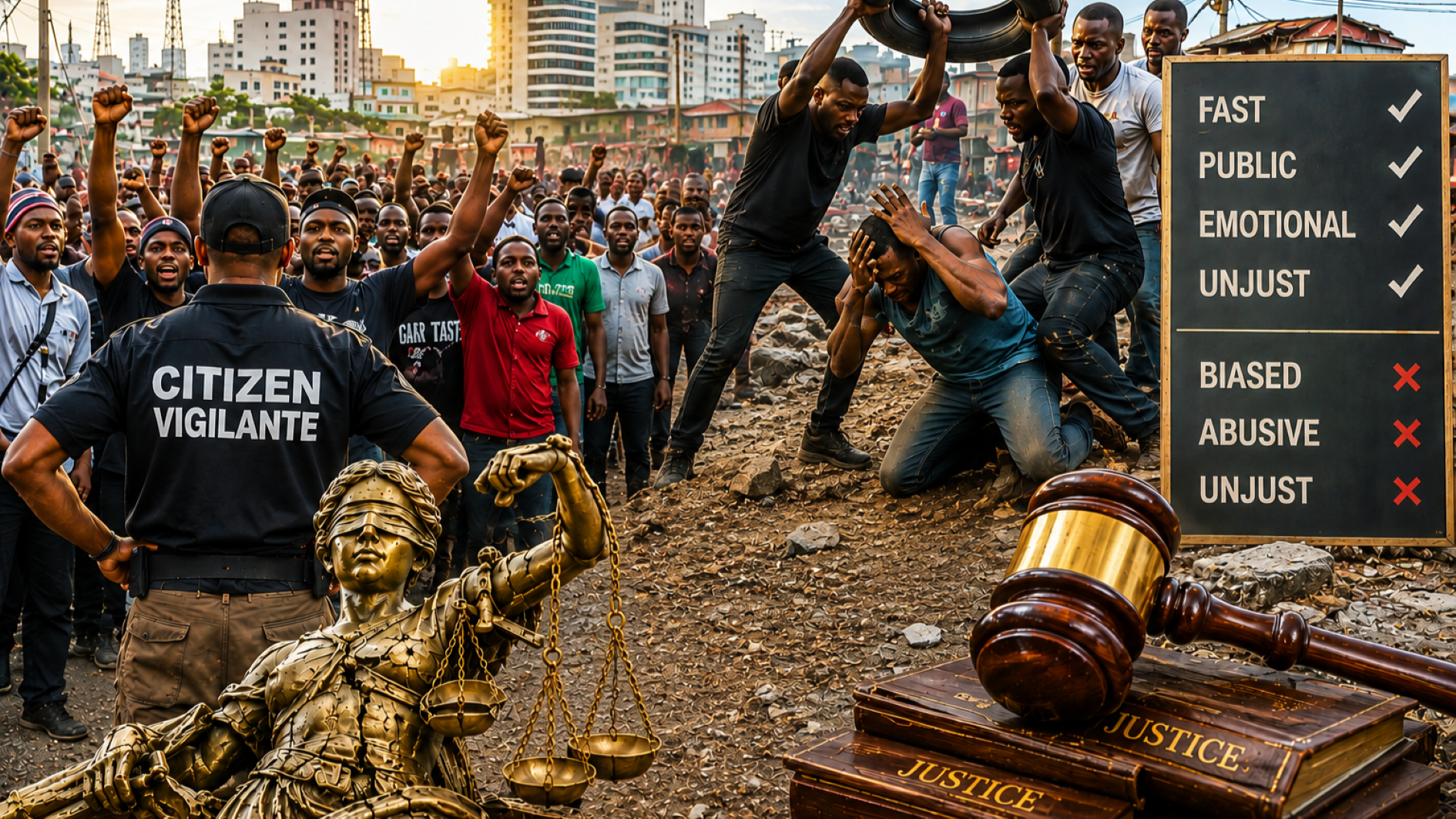
By Oluwafemi Adekoya
The 66th Nigerian Bar Association Annual General Conference (NBA-AGC) may have ended, but its ripple effects continue to expose deep fissures in Nigeria’s justice system. From controversy over the invitation of former Liberian President George Weah as keynote speaker to the post-event comments by social media influencer Martins Vincent Otse—popularly known as VeryDarkMan (VDM)—the conference sparked debates that transcended legal circles and entered the national consciousness.
One particularly troubling outcome of this discourse is the growing romanticisation of vigilante justice, fuelled by widespread belief that formal law enforcement is too slow, corrupt, or absent to deliver justice. The frustration encapsulated in the maxim “justice delayed is justice denied” has real-world consequences: citizens increasingly abandon the legal system in favour of extrajudicial remedies.
Despite the criticism of his invitation, Weah, in his keynote address, warned that democracy could be undermined not only by military coups but also by elected leaders who gradually weaken democratic institutions. He stated that democracy could not survive on elections alone, stressing that independent institutions, particularly the judiciary and legislature, were essential.
“Democracy does not survive on the strength of elections alone. Elections are neither the doorway into democracy nor the house itself. What holds the house up are institutions,” he noted. He warned that elected leaders could become authoritarian by bending the judiciary to their will and turning the legislature into an “echo chamber” instead of a check on executive power. “The true measure of a lawyer is not how many cases you have won, how many titles you hold, or how much you earn. It is this: when the country needs courage, do you have the courage to stand?” he asked.
A widely circulated social media commentary captured the sentiment of citizens increasingly abandoning the legal system in favour of extrajudicial remedies. According to one observer, reporting a scammer to the police often means facing demands for “mobilisation fees,” bribes, and endless delays—whereas a single viral video by VDM can secure swift restitution without legal costs or bureaucratic hurdles.

“Using the above,” the post concluded, “it’s easy to tell which option you will most likely go for.”
This analogy mirrors the premise of Citizen Vigilante, a 2026 action-thriller in which a former soldier hunts down criminals and corrupt officials after the legal system repeatedly fails victims. The film’s protagonist becomes a social media hero by executing those who escaped punishment—including a judge who released rapists on sympathetic grounds. While fictional, the narrative taps into a global anxiety: when institutions are perceived as captured or indifferent, the lone avenger feels like the only path to justice.
VDM’s recent critiques of the legal profession—framing the judiciary as a “nobility” that shields corruption while ordinary citizens suffer—resonated deeply with a public already disillusioned by judicial inefficiency. His remarks reflect a broader crisis: according to Afrobarometer’s 2024 survey, 54% of Nigerians believe most judges and magistrates are corrupt, and 80% say corruption has worsened over the past year. Only 10% believe they can report corruption without fear of retaliation.
Yet the solution cannot be to replace one form of lawlessness with another.
Democracy rests on the state’s monopoly of legitimate force, constrained by law and accountable institutions. When citizens assume the roles of judge, jury, and executioner, they bypass due process, negate the presumption of innocence, and normalise violence as a tool of dispute resolution. As research shows, “Rather than curb crime, vigilantes are exacerbating it.” The normalisation of mob justice weakens the social contract, encouraging citizens to distrust all institutions and resort to self-help—a dangerous trajectory in a fragile democracy like Nigeria’s, where ethnic and religious tensions already strain national cohesion.
In Nigeria, vigilante groups have emerged in response to police ineffectiveness, particularly in combating armed robbery and kidnapping. While some communities report short-term crime reduction, these groups often operate without oversight, leading to human rights abuses, mistaken identifications, and extrajudicial killings. Public support for vigilantes is contingent on their adherence to procedural justice—fairness, transparency, and accountability. When they violate these principles, they become part of the problem.
Vigilantism does not merely coexist with a failing justice system; it actively undermines efforts to reform it. First, it diverts attention from structural problems—such as underfunding, corruption, and procedural delays—by offering a false narrative of immediate justice. Second, it complicates prosecutions: evidence collected by vigilantes is often inadmissible, and witnesses may be intimidated or killed. Third, it can provoke state crackdowns that further erode civil liberties, as governments use the threat of vigilantism to justify expanded security powers and surveillance.
Finally, vigilantism corrodes public trust in the judiciary. When citizens see vigilantes as more effective than courts, they lose faith in legal institutions, making future reforms harder to implement. This is especially critical in Nigeria, where judicial independence is already compromised by executive interference and corruption.
The rage behind VDM’s outburst is real, but the remedy is not. Vigilante justice is a dead end for Nigeria’s democracy. It substitutes one form of lawlessness for another, deepening the crisis it claims to solve. The path forward lies in rebuilding institutions, not bypassing them. As the saying goes, “Justice delayed is justice denied”—but justice delivered by mobs is justice destroyed.
Vigilantism, though sometimes fuelled by understandable frustration, ultimately poses significant dangers by undermining the rule of law and escalating violence. It risks wrongful accusations and harm to innocent individuals, while further eroding public trust in legal institutions. The public’s resort to vigilantism and other extra-legal methods highlights a critical issue — the delays and inefficiencies within the justice system have serious consequences.
Nigeria stands at a crossroads. It can either succumb to the seductive simplicity of vigilante outrage or commit to the hard work of judicial reform, especially in the criminal justice system. The choice will determine whether the country remains a fragile democracy or descends into chaos.

