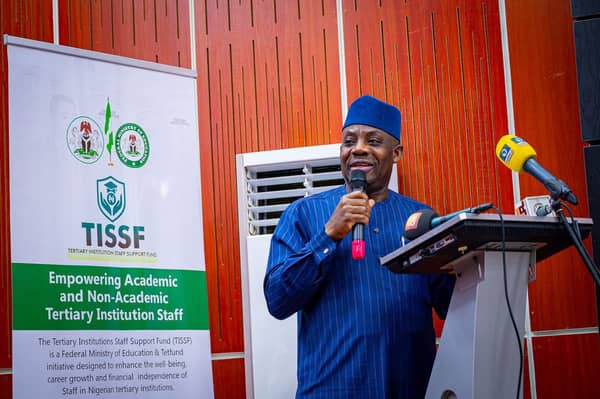
I have always believed that Nigeria is a country where even our arguments have dialects. If two Nigerians defend the same idea, give them five minutes and they’ll disagree on pronunciation. So when the Minister of Education, Dr Tunji Alausa, announced the reversal of the 2022 National Language Policy, restoring English as the sole language of instruction, I knew immediately that a national debate was loading, complete with hand gestures, WhatsApp broadcasts, and at least three professors quoting Chinua Achebe for moral authority.
But as I listened to the arguments, the outrage, and the nostalgia-soaked lamentations about “our dying mother tongues,” I found myself quietly siding with Alausa, not because I dislike our languages but because the man came armed with something Nigerians respect even more than culture: data. And honestly, when data begins to talk, emotion should sit down, drink water and stop crying.
The minister pointed out something many of us secretly know but never admit: the mother-tongue policy was simply not producing the outcomes its advocates promised.
Children were failing, teachers were scrambling and most schools were improvising translations for scientific terms that had never existed. I once overheard a teacher trying to explain “photosynthesis” in Yoruba and, I kid you not, the children left the class believing the sun was a hungry neighbour asking plants for food. That day, even the chalk was confused.
So yes, Alausa’s decision may feel abrupt, but it is rooted in reality. Nigeria has over 300 languages. Three hundred! That is not a policy problem, that is a Tower of Babel documentary waiting to happen. UNESCO can recommend mother-tongue education all day, but UNESCO does not have to train teachers in Eggon, Bassa, Kalabari, Tera, Bette, Ukwuani, or 250 other languages that don’t even have agreed spelling systems.
Even Ngugiĩ wa Thiong’o, the late Kenyan literary giant and champion of African languages, once admitted that language planning requires “a firm cultural centre.” Nigeria, meanwhile, has 300 centres, all of them firm, none of them agreeing.
Mother-tongue advocates often point to France, China, Japan, or South Korea, that is, countries where students learn in their native languages and excel. But comparing Nigeria to Japan is like comparing akara to sushi. They both taste good, but they are not made in the same pot. Japan is over 98 per cent linguistically homogenous. South Korea the same. Rwanda and Tanzania often come up too, but these are countries with essentially one national lingua franca, not 300. As the Ghanaian philosopher Kwasi Wiredu once wrote, “A multilingual society cannot operate on linguistic romanticism alone; practicality must guide policy.”
This is where Alausa’s logic shines. His position is simple: you cannot build a national education framework when children in the same state may speak five different mother tongues. The logistics collapse before the teaching begins. Teacher deployment? Impossible. Curriculum standardisation? A fantasy. Mobility? Try transferring a child from a Tiv-medium school in Benue to an Efik-medium one in Calabar and watch the parents weep like characters in an Achebe novel.
Professor Andrew Haruna of the Nigerian Academy of Letters has a point when he argues that the 2022 policy was backed by decades of research and consultation. Yes, the great Babs Fafunwa showed that Yoruba-medium instruction boosted cognitive development in the Ife study. Those findings are valid but context matters.
Fafunwa ran his experiment in a linguistically uniform environment, with trained teachers, controlled conditions, and a language with a full writing system and robust vocabulary. Now try replicating that in Jos North where fifteen languages can be spoken within a single market. It is not research, it is an extreme sport.
Alausa is not dismissing culture, he is confronting complexity. He insists that our children need a unified foundation that gives them access to global knowledge systems. And whether we like it or not, the global academic ecosystem is an English-speaking one. Most scientific literature? English. Online learning? English. International exams? English. Even many African scholars publish in English not because they hate their language, but because, as Ngugiĩ once lamented, “the world reads what English prints.”
But beyond our internal quarrels about identity and tradition, there is a global reality knocking on Nigeria’s classroom doors. The world is not waiting for Nigeria to harmonise 300 languages before entering the next phase of innovation. Countries that mastered linguistic cohesion early—Finland, Singapore, the Netherlands—are sprinting ahead in STEM education, digital literacy, and international competitiveness. Language is not just a medium, it is a passport.
China may teach in Mandarin, yes, but China also invests billions in global translation pipelines, research dissemination, and knowledge exportation. Meanwhile, Nigeria is still debating whether chemistry should be taught in Ikwerre or Urhobo. The world is sprinting; we are tying and untying our shoelaces.
This linguistic fragmentation also places Nigeria at a structural disadvantage in the global knowledge economy. Imagine a Nigerian child learning physics in Gbagyi, until Junior Secondary School, only to meet WAEC questions written in English.
Meanwhile, their counterparts in India, Kenya, and South Africa—countries with their own language debates—have streamlined systems that prepare students early for global competition. We, on the other hand, were preparing ours for confusion, then blaming them for low performance in STEM fields as though the problem was laziness and not linguistic whiplash. This is the deeper dilemma Alausa is confronting.
Across Africa, language has become a strategic instrument of geopolitical leverage. Rwanda’s swift rise from post-genocide reconstruction to a continental hub of innovation, governance reform and foreign investment was not accidental. It was fuelled in part by its decisive shift to English, which instantly plugged the country into regional trade blocs, global technology ecosystems and multinational partnerships.
South Africa, too, sustains its academic and scientific dominance because its linguistic coherence makes collaboration seamless: researchers abroad know exactly what to expect, and investors see a system aligned with global standards.
Nigeria, however, continues to punch below its weight. We cannot afford to keep drifting between pride and pragmatism. The world is moving with purpose. If Nigeria intends not just to join the conversation but to shape it, then we must decide, boldly and unapologetically, to speak in the language that positions our children, our research, and our future at the centre of global relevance.
Critics accuse the minister of intellectual surrender, of “throwing the baby out with the bath water.” But as I see it, the baby is drowning and the bath water has malaria. Should we keep the policy because it feels patriotic, or change it because outcomes matter?
It reminds me of Wole Soyinka’s famous quip: “A tiger does not proclaim his tigritude.” Likewise, a language does not survive by being imposed. ‘A tiger pounces’ says Wole Soyinka and language survives by being used, loved, written, and spoken, not forced as the medium for physics and chemistry when the vocabulary simply does not yet exist.
Now, let me be clear: I do not celebrate the decline of indigenous languages. I still believe that language is the soul of a people. But must the soul also solve quadratic equations? I think not. What Alausa proposes is more balanced than critics admit: teach in English, yes, but continue teaching mother tongues as compulsory subjects.
That means your child will learn English for math and Yoruba for proverbs, Igbo for folktales, Hausa for identity. This is not erasure. It’s more that, it is bilingual empowerment. Even African-American scholar James Baldwin once wrote that language is “a political instrument, means, and proof of power,” and in today’s world, English is a key that opens global doors—doors our children desperately need access to.
And what does this decision mean for Nigerians going forward? For parents, it means less confusion and more predictability. No more wondering whether your child’s transfer to another city will require a crash course in another language. For teachers, it means clearer training pathways and consistent curricula. For the education system, it means improved readiness for WAEC, NECO, JAMB, IELTS, and the alphabet soup of international exams waiting to ambush our teenagers.
For the nation, it means clarity. Mother tongues remain important, cherished and protected. But they do not have to carry a burden they are not yet equipped for. The goal is not to diminish heritage but to future-proof our children. Because let’s face it: in a world of AI, robotics, biotech, and global competition, language is more than just identity, it is currency. And refusing to equip Nigerian students with the currency of global discourse is not patriotism, it is sabotage.
I commend Alausa. Not because English is superior, but because English is practical. Not because mother tongues do not matter, but because they matter enough to be taught properly, not overloaded as the medium of instruction in a country with more languages than stars in Nollywood sky scenes.
If we truly want our indigenous languages to thrive, let them thrive where they are strongest—in culture, storytelling, community, heritage. And let English handle mathematics before a teacher accidentally translates “Pythagoras” as “Baba Triangle.”
Popoola is an educator and journalist. He can be reached via: [email protected]