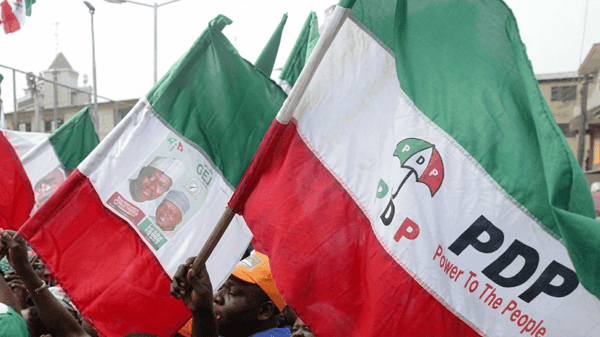
The seemingly intractable leadership crisis in the Peoples Democratic Party (PDP) may pass across as an event not unusual in politics. While it may sound plausible to infer that the PDP crisis is self-inflicted, the fact remains, however, that the impasse appears laced with an undercurrent that poses a danger to the ideal of a multi-party system.
To ignore the danger of one-party dominance without genuine opposition is to overlook the fact that democratic consolidation implies the existence and functionality of robust institutions. Political parties represent a critical institution of democracy, while a multiparty system is one of the pillars upon which popular democracy is anchored. That opposition parties are in disarray, as is currently the case in the country, cannot be an attribute befitting democracy.
There should be no denying, however, that the crisis in the PDP speaks inexorably to the danger of transactional politics that serves as impetus for the ascendancy of political actors bereft of the principle and honour expected of leaders who are genuinely committed to a cause rather than self-seeking motive. There is, therefore, a sense in which the protracted crisis in the PDP, Nigeria’s main opposition party, paints a picture of a setback in the country’s quest for democratic consolidation.
The health of democracy in Nigeria cannot be said to be in good shape, with the crisis in the main opposition, the PDP, simmering, and the likelihood that existing platforms, which are largely fragmented, will not pose a formidable challenge to the ruling All Progressives Congress (APC) in the next general election.
Democracy dies by instalments when opposition political parties fizzle or become impotent. To put it squarely, the demise of the opposition does not in any way advance the cause of democracy, but rather undermines pluralism and its attributes, exposing the system to one-party rule, and may ultimately lead to the rise of tyranny, even if presided over by the majority. Therefore, those who genuinely crave democracy anchored in popular participation should be concerned about the gradual drift prevailing in party politics.
Unless reasons prevail and without further delay, the PDP, which was the ruling political party nationally for 16 years, risks ineligibility to present candidates in future elections. It should be worrisome that the crisis in the PDP appears to be worsening while the Labour Party, which recorded considerable success in the 2023 General Election, is also enmeshed in crisis.
It is disturbing that the crisis in the PDP took a violent dimension in the aftermath of the controversial Ibadan convention held in November. Attempts by contenders within the party to assert authority at the party’s national secretariat in Abuja led to skirmishes, necessitating the police to seal off the premises.
As it stands, the only way out of the standoff in the PDP is for party stakeholders to sheathe their swords for an amicable resolution of the disputes. It is bad enough that events leading to the ugly show at the national secretariat have seen the party haemorrhaging as most of the party’s bigwigs have either abandoned or have been sacked in what now looks like a platform deemed to shipwreck, with only a faint hope of surviving the storm.
From all indications, the solution to the PDP imbroglio appears daunting, if not infeasible, considering that notable lead actors in the crisis appear not to be persuaded to let go, even when it is evident that their bodies and souls are wholly invested in the ruling party. The prevailing scenario in the PDP should serve as a valuable lesson in how political parties apply their rules and regulations. Political parties should create leveller for members without unnecessarily enthroning individuals who cannot defer to party leadership and its structures by virtue of their political offices.
It should be evident that the PDP encouraged the rise of monsters that became too difficult to tame. It reeks of perfidy that the struggle for party control has become a self-serving venture. It is increasingly becoming too obvious that some actors in the PDP crisis will stop at nothing to ensure the platform is rendered comatose rather than see it become a viable alternative for future elections, as preparations for the 2027 General Election are expected to gather momentum in the first quarter of 2026.
Politicians should be at liberty to either engage in disputes within their own political parties as genuine stakeholders or seek refuge elsewhere when and if that becomes an option. It is expected that political actors should be courageous enough to switch allegiance without destroying the platform that previously gave them the opportunity to attain visibility. Political actors should be content with membership of a party at a time, rather than take pleasure in perpetuating a crisis that erodes the institution of political platforms. Let there be a modicum of honour from politicians. Let their words and actions seek to edify rather than pollute party politics. It is regrettable that the PDP has become a shadow of what is expected of an opposition political party.
It cannot be overemphasised that what has become of the PDP largely symptomises the indiscipline of a political class whose survival depends on crass opportunism. It has therefore become imperative to demand that those who may wish to leave the PDP should do so and allow peace to reign. Those contending the control of the PDP should be those genuinely committed to seeing the party become a virile opposition party in the true sense of it. The PDP will only become redeemable when stakeholders within its fold are genuinely committed to seeing it survive beyond the present conundrum.