 Follow Us on Google News
 Follow Us on Google Discover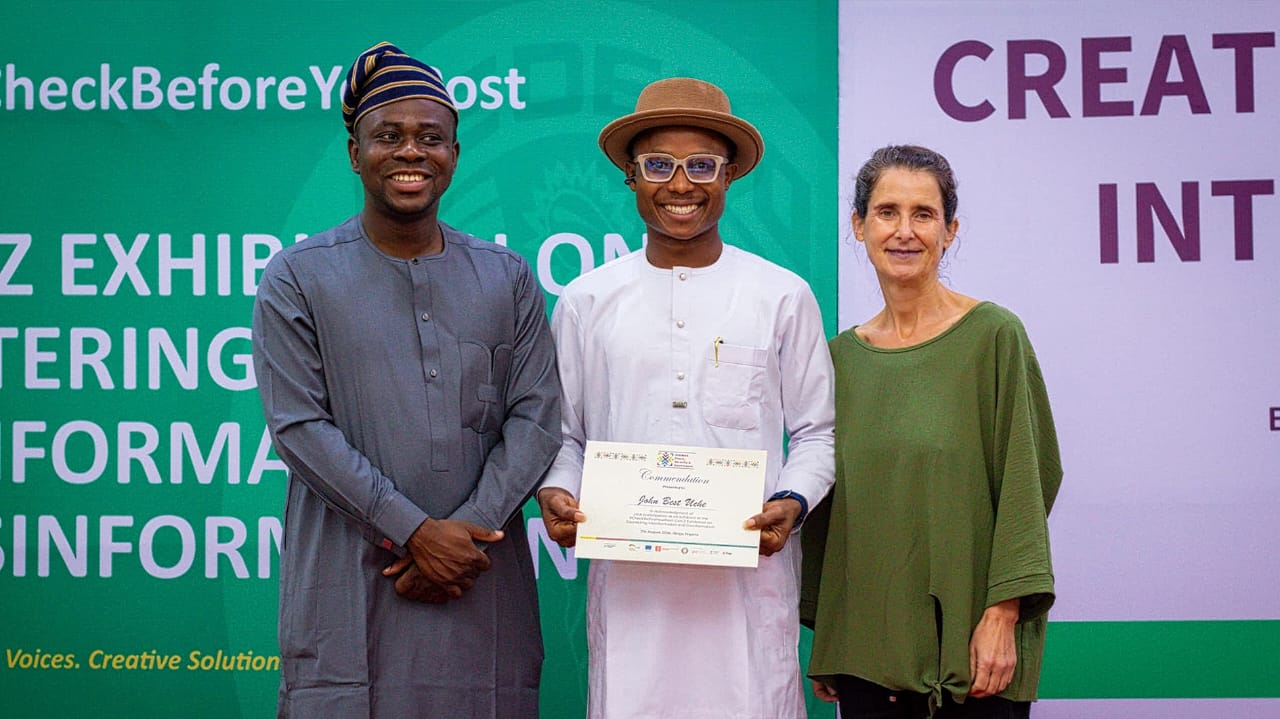
By John Best
Nigerian Development Communicator, Media and Public Relations Professional, John Best Uche, has received a formal commendation for his participation as an exhibitor at the #CheckBeforeYouPost: Gen Z Voices Against Disinformation Exhibition held in Abuja.
John Best, who represented Rivers State at the exhibition, was recognised for his participation in the initiative designed to showcase the creative works and civic communication interventions of young Nigerians working to counter misinformation and disinformation.
The commendation, dated 7 August 2026, was presented in acknowledgement of his participation as an exhibitor at the exhibition on Countering Misinformation and Disinformation, organised within the framework of the ECOWAS Peace, Security and Governance programme.
The recognition comes at a time when the integrity of information circulating within Nigeria’s digital ecosystem has become increasingly important to democratic participation, peaceful elections and public trust.
A MEETING POINT FOR DIPLOMACY, DEVELOPMENT AND DIGITAL CITIZENSHIP
The Abuja exhibition brought together young creatives, communication professionals and stakeholders from Nigeria’s democratic governance and development ecosystem.
The programme featured representatives and goodwill messages from major international and regional institutions, including the European Union, German Embassy, Embassy of Denmark, Spanish Embassy, ECOWAS and the Fundación para la Internacionalización de las Administraciones Públicas (FIAP).
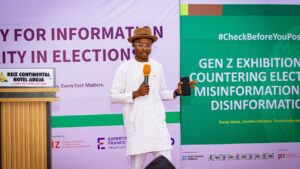
The exhibition was held at the Reiz Continental Hotel, Central Business District, Abuja, and featured creative works, digital content, campaign materials and interactive engagements focused on addressing the growing challenges posed by misinformation and disinformation.
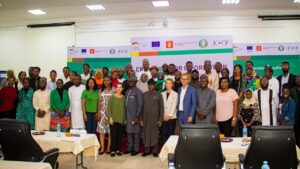
Among the high-level representatives listed in the programme were Ms. Maria Alvaro Sanchez, Project Coordinator, Fundación para la Internacionalización de las Administraciones Públicas (FIAP) and EPSG; Mr. Abideen Olasupo, Founder, FactCheck Africa; Mr. Capici Vittorio, Programme Officer, Regional Peace and Security Delegation of the European Union to the Federal Republic of Nigeria and ECOWAS; Ms. Jella-Charlotte Lemken, Deputy Head of Mission and Deputy Ambassador at the German Embassy in Abuja; His Excellency Mr. Jens Ole Bach Hansen, Ambassador of Denmark in Nigeria; Mr. Ormeño García Santiago, General Coordinator, Spanish Agency for International Development Cooperation (AECID); and Mr. Arthur Oghogho Obayuwana, Programme Expert, Political Affairs, Peace and Security (PAPS), ECOWAS; Mr. Ronald D. Kayanja, Resident Coordinator, United Nations Information Centre, Abuja.
The presence of these stakeholders highlighted the international and regional development dimensions of the campaign and its focus on peace, security, democratic resilience and responsible information sharing.
FROM TRAINING TO PRACTICAL ADVOCACY
John Best Uche’s recognition is particularly significant because it followed his participation in the three-day “Voices That Count: Training Camps for Social Media Influencers on Electoral Integrity”, held in Enugu from 6–8 July 2026.
The training was organised by FIAP in collaboration with FactCheck Africa under the European Union Support to ECOWAS in Peace, Security and Governance (EPSG) Project.
The programme was designed to strengthen the capacity of young creatives to identify, analyse and counter misinformation, disinformation, mal-information and hate speech in electoral contexts.
Participants were also trained in fact-checking, ethical and conflict-sensitive communication, content production, audience engagement, digital campaign design and responsible use of social media platforms.
Representing Rivers State, John Best Uche actively participated in the programme and subsequently began translating the knowledge acquired into public communication and advocacy.
His post-training engagements have included media appearances, digital campaigns, public education and national media publications focused on electoral integrity and responsible communication.
He appeared on Nigeria Info 92.3 FM and NTA, where he spoke on the role of responsible communication in protecting electoral integrity.
He has also deployed social media platforms including Facebook, Instagram, LinkedIn and WhatsApp Communities to amplify the #CheckBeforeYouPost campaign and encourage citizens to verify information before sharing it.
TAKING THE CONVERSATION BEYOND SOCIAL MEDIA
Uche’s advocacy has also extended into Nigeria’s mainstream media space.
His article, “Beyond the Share: Why Strengthening Electoral Integrity Begins with Responsible Communication,” was published by The Guardian, while BusinessDay subsequently featured his perspective on the relationship between responsible communication and electoral integrity.
His central argument has been that the fight against misinformation cannot be left exclusively to journalists, fact-checkers, technology companies or electoral institutions.
Every citizen who creates, receives or shares information is now part of the information ecosystem.
With the increasing influence of social media on political conversations, Mr. Uche argues that responsible communication must become a core component of democratic citizenship.
“In today’s digital environment, communication is no longer simply about transmitting information. It can shape public perception, influence behaviour, build trust or deepen conflict. That is why responsible communication must be treated as part of the infrastructure for democratic participation,” he said.
UCHE JOINS INTERACTIVE DIALOGUE IN ABUJA
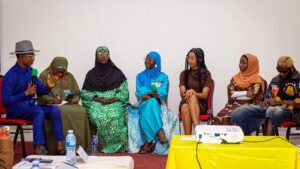
Beyond exhibiting his campaign and communication materials, Uche also participated as a panelist during the exhibition’s interactive discussion, contributing his professional experience to conversations around responsible communication, misinformation and the role of young people in protecting information integrity.
The programme’s emphasis on the period leading to Nigeria’s 2027 general elections reinforces the strategic importance of engaging young people and digital creators early in the electoral cycle.
COMMUNICATION AS A TOOL FOR PEACE AND DEVELOPMENT
For John Best Uche, the campaign represents more than electoral advocacy.
It reflects his broader professional interest in using communication as a tool for peacebuilding, development, democratic participation and public diplomacy.
His work as a Media and Public Relations Professional and his leadership of the Diplomacy and Corporate Communication Conference (DCCC) have consistently focused on creating platforms where young people can engage with diplomacy, leadership, communication, governance and international affairs.
Through DCCC, he has promoted the idea that communication professionals and young leaders should not only understand how to communicate effectively but should also understand the implications of their communication for society.
His involvement in the #CheckBeforeYouPost campaign therefore provides a practical extension of that philosophy.
“My professional journey has continued to reinforce one conviction: communication should create value beyond visibility. It should contribute to informed citizenship, stronger institutions, peaceful communities and sustainable development,” Uche said.
A GLOBAL DEVELOPMENT PERSPECTIVE
The issues addressed through the campaign also align with several of the United Nations Sustainable Development Goals (SDGs).
At the centre is SDG 16 — Peace, Justice and Strong Institutions, particularly its emphasis on inclusive societies, accountable institutions and peaceful participation.
The campaign’s focus on strengthening young people’s capacity to identify and verify information also connects with SDG 4 which focuses on Quality Education, through media and information literacy.
Its emphasis on collaboration among government, international organisations, civil society, media professionals and young people also reflects SDG 17 — Partnerships for the Goals.
For John Best Uche, this intersection demonstrates why communication professionals have an increasingly important role to play in the global development agenda.
“The future of development communication will require professionals who understand not only media and public relations but also governance, diplomacy, peace and security, digital technologies and the Sustainable Development Goals. That is the direction in which I am deliberately building my professional practice,” he said.
John Best Uche is a Media and Public Relations Professional, Development Communication practitioner, Convener of the Diplomacy and Corporate Communication Conference (DCCC), with professional interests spanning strategic communication, public diplomacy, democratic governance, electoral integrity and development communication. He is also the lead consultant at TSV Africa, a Media and Public Relations company.
BEYOND RECOGNITION
While the commendation represents a significant professional milestone, Mr. Uche describes it as a responsibility rather than an endpoint.
He believes that the real impact of the campaign will be measured by the extent to which young people and other social media users begin to pause, verify and critically assess information before amplifying it.
“The commendation is encouraging, but the bigger responsibility is what comes after it. If one person verifies information before sharing it, if one creator chooses not to amplify hate or falsehood, or if one young voter makes an electoral decision based on verified information rather than manipulation, then the work is already making a difference,” he said.
As Nigeria moves towards the 2027 elections, John Best Uche says he intends to continue collaborating with media organisations, civil society, development partners, government institutions and other stakeholders to advance responsible communication and electoral integrity.
His participation in the Abuja exhibition, he believes, is another step towards building a career at the intersection of media, public relations, diplomacy, governance and international development.
In an era where information travels faster than verification, the future of democracy may well depend on the choices we make before clicking the “Post” button.
From 6–8 July 2026, I had the privilege of representing Rivers State at the Social Media Influencers Training Camp for Electoral Integrity held in Enugu State. The three-day intensive capacity-building programme brought together carefully selected young voices, media practitioners, digital creators, and social media influencers from Nigeria’s South-South and South-East geopolitical zones to strengthen their capacity to counter misinformation, disinformation, mal-information, hate speech, and other emerging digital threats to electoral integrity.
The training was organised by Fundación para la Internacionalización de las Administraciones Públicas (FIAP), F.S.P. in collaboration with FactCheck Africa under the European Union Support to ECOWAS in Peace, Security and Governance (EPSG) Project.
While the invitation recognised my work within the communication ecosystem, the experience itself reaffirmed a conviction I have held throughout my professional journey: communication is not merely about visibility—it is about responsibility.
Participants in the conference
For years, I have worked across media, public relations, development communication and civic engagement, using communication as a tool for education, advocacy, institutional trust-building and social development. Through The Social Voice Africa (TSV Africa) and the Diplomacy and Corporate Communication Conference (DCCC), I have consistently championed conversations around ethical communication, public diplomacy, democratic participation, media literacy, youth leadership and responsible civic engagement.
Participating in this programme therefore was not simply attending another training. It was an opportunity to deepen practical knowledge, exchange ideas with some of Nigeria’s brightest digital communicators from the South and strengthen the capacity required to respond to one of democracy’s greatest emerging threats, the weaponisation of information.
Democracy in the Digital Age
The digital revolution has transformed every citizen into a potential publisher. With a smartphone and internet connection, anyone can shape conversations capable of influencing elections, public perception and even national stability.
Unfortunately, the same technologies that have expanded civic participation have also accelerated the spread of misinformation, disinformation, mal-information, manipulated media, hate speech and increasingly sophisticated Artificial Intelligence-generated content.
The consequences are significant. False narratives can suppress voter participation. Manipulated content can erode confidence in democratic institutions. Hate speech can deepen existing social divisions. Coordinated disinformation campaigns can distort electoral outcomes before citizens even arrive at polling units.
For democracies across Africa, these are no longer hypothetical concerns; they are present-day realities requiring coordinated action from governments, civil society, media organisations, technology platforms and citizens alike.
Learning to Protect Democracy Through Communication
Across the three days, the facilitators combined theory with practical application.
Discover more
Property listings
Insurance comparison tool
Maritime industry news
Education resources
Monitoring Federal Legislative Bills
The first phase focused on understanding Nigeria’s electoral ecosystem, identifying different forms of information disorder and appreciating the civic responsibilities of digital creators before, during and after elections.
We examined the ethical obligations attached to influence, conflict-sensitive storytelling, responsible amplification and the distinction between legitimate political expression and content capable of inciting violence.
A particularly defining moment was committing to the Charter of Principles for Electoral Integrity, reinforcing the responsibility every communicator bears in protecting democratic values.
The second phase explored audience behaviour within today’s digital ecosystem.
We gained a deeper understanding of online communities, audience segmentation, content ecosystems, algorithmic amplification and ethical approaches to maximising message visibility without compromising truth or professional standards.
The conversations around digital algorithms were especially insightful.
They demonstrated that successful communication is no longer measured solely by creativity, but by strategic understanding of how information travels across digital platforms while maintaining factual integrity.
The final phase shifted from learning to implementation.
Participants worked collaboratively to design practical #CheckBeforeYouPost campaigns, producing graphics, reels, short-form videos, creator templates, social media threads and audience-focused messaging capable of encouraging fact-checking and responsible online engagement.
It became evident that countering misinformation requires far more than correcting falsehoods after they spread.
It requires creating compelling, evidence-based narratives capable of reaching audiences before false information does.
Where Development Communication Meets Electoral Integrity
One of the strongest reflections I carried away from Enugu is that electoral integrity is fundamentally a development issue.
It is safe to say that peaceful elections strengthen governance. Credible information strengthens public trust. Responsible communication strengthens social cohesion.
Without these foundations, sustainable development becomes increasingly difficult.
This understanding aligns closely with several United Nations Sustainable Development Goals, particularly:
SDG 4 – Quality Education, through promoting media and information literacy.
SDG 5 – Gender Equality, by protecting women from targeted online political abuse and ensuring inclusive participation.
SDG 10 – Reduced Inequalities, by enabling equitable access to credible information.
SDG 16 – Peace, Justice and Strong Institutions, through promoting transparent elections, accountable institutions and informed civic participation.
SDG 17 – Partnerships for the Goals, demonstrated through collaboration among international development partners, civil society organisations, media professionals and youth leaders.
Development communication extends beyond awareness campaigns. It is about influencing positive behavioural change, strengthening institutions and empowering citizens to make informed decisions.
These principles have remained central to my professional work.
Whether convening the Diplomacy and Corporate Communication Conference (DCCC), producing civic education content, moderating national conversations, leading public relations initiatives or developing strategic communication campaigns, I have continued to advocate for communication that serves people before platforms and truth before trends.
The Responsibility of young communicators
Nigeria’s youthful population presents one of its greatest democratic assets. Young creators today possess unprecedented influence over public discourse. Their content shapes perceptions, influences civic behaviour and increasingly determines how democratic processes are understood.
This influence demands responsibility. Influence without ethics becomes manipulation. Reach without credibility becomes misinformation. Virality without verification becomes a threat to democracy.
As communication professionals, our responsibility extends beyond creating engaging content. We must create trustworthy content. Our credibility should never be sacrificed for engagement metrics. Our platforms should elevate informed conversations rather than amplify harmful narratives.
Looking Ahead
As Nigeria prepares for future electoral cycles, strengthening electoral integrity must become a shared responsibility. Electoral commissions cannot achieve this alone. Neither can civil society organisations, journalists or technology companies.
It therefore means that every communication professional, content creator, media practitioner and digital citizen has a role to play… #CheckBeforeYouPost
The three days in Enugu strengthened my conviction that communication remains one of society’s most powerful development tools.
When applied ethically, it educates. It builds trust. It promotes peace. It protects democracy. Most importantly, it empowers citizens to participate meaningfully in shaping their future.
As I return to my work through The Social Voice Africa (TSV Africa), the Diplomacy and Corporate Communication Conference (DCCC) and other civic and development initiatives, I do so with renewed commitment to advancing responsible communication, promoting electoral integrity, supporting fact-based public discourse and contributing to stronger democratic institutions across Nigeria and the African continent.
Because in today’s interconnected world, protecting democracy may begin with something as simple—and as powerful—as choosing to check before we post.
JOHN BEST UCHE
Media and Communication Professional+234 810 151 3195 [email protected]

