 Follow Us on Google News
 Follow Us on Google Discover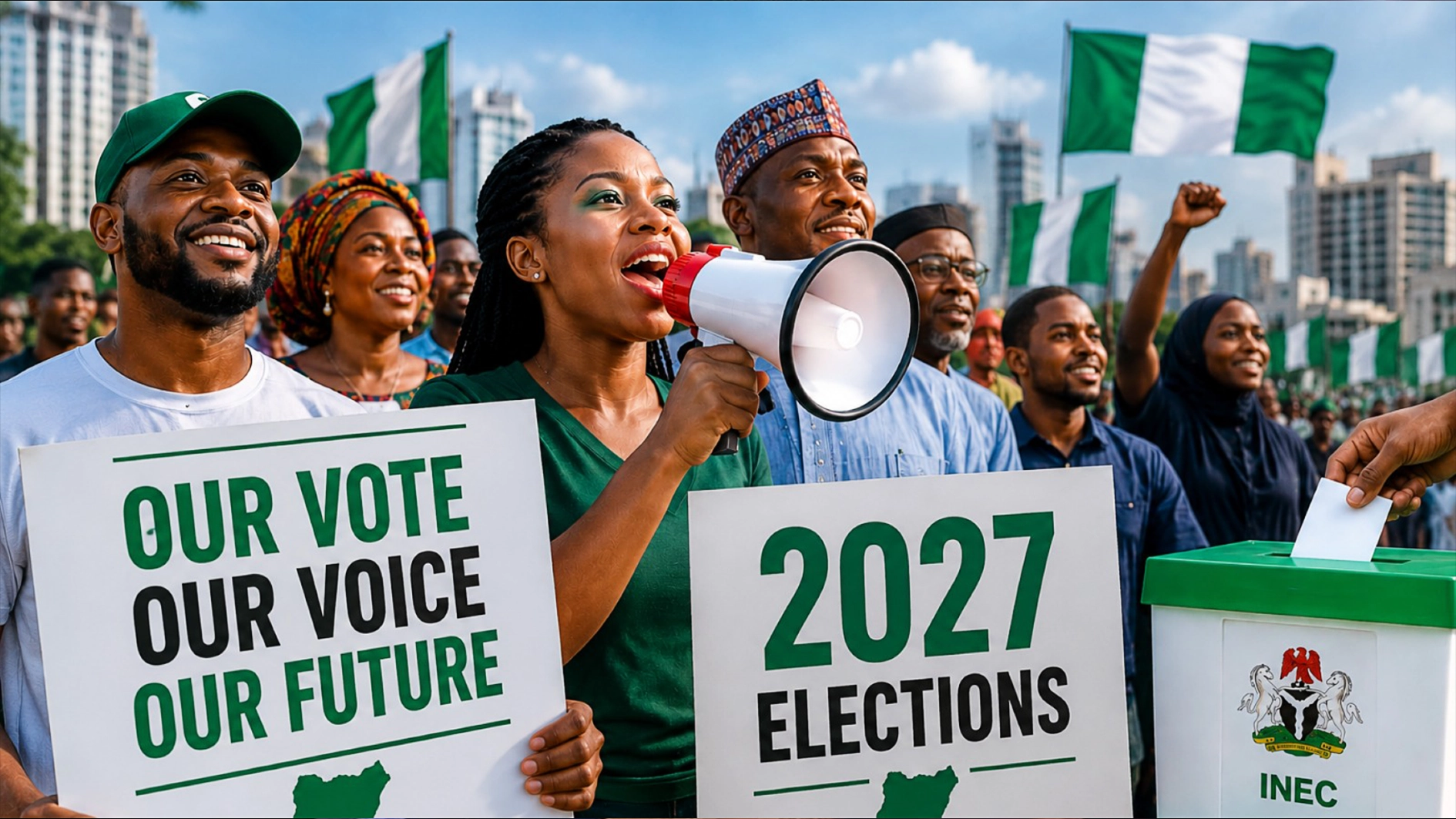
By Alabi Williams
Conversations around 2027 have gained speed, swifter than what many could track. Since the electoral umpire licensed parties and candidates to begin campaigns on August 19, the polity is fast dissolving into a din, more of brickbats among the major contenders and their overzealous disciples.
They’re frenzied because it’s time for accountability, and unfortunately for them, the people are no longer bystanders. Thanks to the social media, the campaigns are not going to be one-sided. The conversation is getting participatory and citizens are recalling their experiences of the last four years.
In earlier years of this Fourth Republic, citizens were not equipped, interrogate or to set the tone for campaigns. Political parties draw up their own issues, taking cue from repeated governance failures and deficits to cook up manifestoes.
They promised good roads, jumbo megawatts of constant electricity, free education and affordable housing. Nothing concrete gets done after four years. In their next campaigns, they make more promises.
The bigger parties exploit their massive resources and bandwagon effects to mobilise for campaigns. They take advantage of ignorance and hunger of the populace to rent hapless cheer groups around podiums, where they repeat previous failures and make empty promises to deliver a better future.

They formed bogus campaign rallies that are not accountable. Big for nothing ceremonies where monies are wasted and are not accounted. The electoral umpires are unable to track what is spent and from which account. The people are conned repeatedly and they cannot hold politicians to their words.
But technology changed that, and particularly towards the 2023 elections. Young Nigerians forced an alternative conversation in the open space. Lovers of then Labour Party (LP) mobilised to think outside the old box. They asked questions where the old order commanded acquiescence. They divided opinions in families and became active drivers of campaign issues.
The social media opened up the space for alternative discourse on how to move the country forward, different from what was handed down by tradition. Of course, they were countered by establishment politicians and their heirs who are beneficiaries of the foggy status quo. Nonetheless, it was electrifying for electioneering and the system was enlarged for participation.
In the build-up to 2027, there is already some vibrancy in the campaigns. But citizens must decide the issues and interrogate what the politicians say. It should no longer be vacuous handouts from dubious podiums. It should be about how policies impact the people and what alternatives are available.
That is the difference between democracy and military rule. Under the military, policies are hardly debated. Yet, remember that under the military, General Babangida’s Structural Adjustment Policy (SAP) was debated and contested. SAP was a rash of reforms that include currency devaluation, fuel subsidy removal, trade liberalisation, privatisation and commercialisation of government companies and wage freeze in the public sector.
Nigerians protested because of the hike in prices of fuel and food and the fact that SAP was IMF and World Bank imposed. It was a showdown between IBB and students/workers. Nigerians demanded SAP with a human face, not a murdering and soulless policy. Though SAP survived, IBB was forced to mitigate the impact. The point is, rational citizens must query policies of government. Democracy provides the opportunity for that to happen in a civil space, devoid of intimidation and violence.
The economy will form a major segment of the 2027 debate. The people must say how they’ve faired under President Tinubu’s economic reforms. The people’s welfare must be central to policies as it is in democracies that are accountable to the people. Prices of retail commodities (gasoline) and taxes are major drivers of campaigns in other climes.
That is happening here right now. Long before the candidate of the African Democratic Congress (ADC), Atiku Abubakar, showed courage to reopen the fuel subsidy debate, citizens had been reeling and cursing under the weight of unmitigated economic pains. The pains (also referred to as T-Pains for Tinubu Pains) were triggered by the rash of reforms being experimented by the Tinubu government, principal of which are fuel subsidy removal and currency devaluation.
It was not what Atiku said but a momentum that patiently gathered steam in the course of three years plus. Nigerians think it is time to revisit the subsidy policy that has advantages and disadvantages, but the disadvantages are made far obvious because of the lack of sincerity of the operators. Fuel subsidy is one debate that cannot be foreclosed by propaganda. The people who feel the heat are the ones to decide whether they can continue with it. And they can force the government to listen with their votes.
Perhaps, Atiku listened to the people and decided that the policy can be tinkered with. He must be in touch with his support base. Prior to 2023, the Petroleum Industry Act (PIA 2021) had prepared the legal framework for subsidy removal. The PIA signaled the deregulation of the downstream petroleum sector to be replaced with a free market regime.
The law provide a six-month moratorium to exit subsidy, sometime before mid-2022, but the government of Muhammadu Buhari was not ready to deal with the economic and social hardship the policy would visit on Nigerians. Buhari sought a postponement, even suggested amending the PIA. His government continued to pay the subsidy.
Both the World Bank and the International Monetary Fund (IMF) urged government to abandon subsidy payments for electricity and petrol. They campaigned for market-based pricing mechanism, as they cited fiscal deficit, debt overhang and funds misallocation.
Subsidy payments according to figures from NNPCL, the Central Bank and Finance Ministry were; 2021: N1.43 trillion; 2022: N4.39 trillion and 2023: N3.6 trillion (Jan-May). That was 213.5 per cent increase in three years. The point is that it had become unbearable for government to pay the subsidy claims. Some Nigerians suspected that the figures were manufactured. At the time, there were no agreeable data on the consumption patterns and numbers.
In addition to the PIA’s transition framework before deregulation, the law expected local refineries to commence production to reduce import dependency. The government promised to get the refineries working by the end of year 2022. Contracts were signed and massive funds were disbursed. Till date, no public refinery is producing. That’s incompatible with the PIA and the plan for deregulation.
To make deregulation easy on the people, the Buhari government proposed relief measures, including cash transfers, intervention in public transportation with CNG buses and others. The World Bank insisted that poor Nigerians do not benefit from subsidy, as it claimed 40 per cent poorest Nigerians consume less than 3 per cent of total PMS. The bank recommended payment of N5,000 grant to 30-40 million Nigerians to support their transportation needs and $800 million for 10 million households. Those numbers are disputed by the reality on ground. But they provided a basis for government action.
The Muhammadu Buhari government accepted the World Bank’s advice, but noted that removing subsidy would be gradual, while Nigerians needed to be educated on replacements. That was the situation before the elections. To survive before deregulation Buhari printed money.
At the time, the major presidential candidates had little choice but to agree on fuel subsidy removal. The law was set and the fiscal condition of the country made it convenient for candidates to agree to what appeared to be the popular choice. It would have been suicidal for any major candidate to propound another formula for the prostrate oil economy.
To appear politically correct, they all supported subsidy removal, without thinking through the implications. It was only revolutionary Omoyele Sowore, the candidate of African Action Congress (AAC), who countered what he feared would turn the people into guinea pigs for some economic experiment.
The business community was fully into subsidy removal, particularly the organised private sector, manufacturers and the political elite. They were convinced that subsidy payments were no longer sustainable because it took resources away from other social sectors-education, health and roads. They were also dissatisfied with the opacity in the sector, particularly NNPC’s failure to be accountable.
But Labour had their proposal regarding protection for workers and provision of social safety nets. The NLC and TUC opposed unilateral subsidy removal. They demanded that the refineries be fixed and more should be established. They wanted government to improve border policies to prevent smuggling of petroleum products. They also canvassed that government to reduced cost of governance.
Fixing the borders to make smuggling unprofitable to those who take products across the borders to make good profit had been an old headache. One of the arguments in favour of subsidy removal was that petrol was too cheap across the borders.
After subsidy removal, smuggling has reduced drastically, reports say, but black market still thrives because there is still a price margin of around 40-50 per cent in neighbouring countries. Government doesn’t seem distracted by that since Nigerians are made to pay market rates.
Essentially, the subsidy debate had not been concluded before President Tinubu announced the removal in May 2023. There is nothing wrong if it is interrogated, especially the implementation and why the revenues from petrol tax don’t work for the people.
In 2012, Tinubu kicked against subsidy removal under Goodluck Jonathan. He referred to it as Jonathan tax, an anti-people wickedness. He told the government that subsidy was good but what was wrong was the corruption.
Nigerians are asking Tinubu to account for subsidy savings. Government said it is paying state governments handsomely and they’re now able to pay salaries. What does that amount to in a population that is falling faster into poverty and depression? Are there better ways to manage the proceeds, so that living costs are mitigated for the people?
Let the candidates put their plans for the people to interrogate. The attempt to drown the subsidy debate in a torrent of sponsored propaganda will not work. Citizens who feel the pains say they want it revisited. Let subsidy be given a human face. Let governance be about the people!

