 Follow Us on Google News
 Follow Us on Google Discover
Since Nigeria gained her independence in 1960, empirical evidences have shown that democracy has not given the citizenry the desired dividends; instead, it has given rise to corrupt elements that are too powerful for the government to tackle. This untoward development is hinged on misplaced priority in the way too much attention, too many resources, and too much emphasis are devoted to the promotion of nascent democracy at the expense of nation building. A retired Professor of Islamic Education, University of Lagos, Bidmos Muritala Aderemi, expressed this view in his book – “Nigeria Project: The Foundation Question,” where he x-rayed the perennial delay of sustainable development as a real problem facing the country and the lack of a solid foundation, coupled with the mindset of the stakeholders as the factors responsible for the problem.
[ad]
“These two factors have combined to thwart recklessly and continuously all the developmental initiatives that have been laid out so far. A third factor is no less devastating than the two earlier stated is man’s non-recognition of the conflict between his activities and the assignment which was originally and divinely prescribed for him on earth.”
Prof. Bidmos said the country, having spent over 60 years on the project, the dream of stakeholders for an egalitarian society, democratic nation, a land full of opportunities, and a dynamic economy, remained in limbo.
He added that the series of agitations and propositions that are now ongoing following the elusiveness of the target project is a manifestation of a crossroad, dilemma, and confusion. “The irony of the case is that as agitators are, in unison, dreaming of peace and progress, they are physically on different pages regarding the right modus operandi.
“Tragically too, there are talkers without listeners, a case of someone not only claiming to know it all, but also considering his ideas the best. The scenario on display is a situation when someone places a proposal on the table, which may be very germane and central to the issue, but the next speaker, as characteristic of Nigerians, will rise to spend about one hour espousing the same idea as the one already on the table.”
While describing nation-building and democracy development as two different projects that must be put in the right order, he likened Nigeria’s case to that of a traveller who put the cart before the horse, noting, “he will, certainly, not reach his destination before sunset.”
“Our problem stems from the fact that as we adopted or borrowed the concept of democracy from another clime, apparently, we did not acquire the concept with all the nitty-gritty of its modus operandi. But it seems that the practice of borrowing is a tradition in Nigeria. It could be recalled that we once borrowed the American system of secondary school education, which we codified as the 6-3-3-4 system. But in content, the Nigerian version is significantly different from the American model.
“For example, the system was to promote vocational training for students who may not have the flair for academic stuff. Though the required equipment for proper implementation of the 6-3-3-4 system was imported, unfortunately, the volume imported wasn’t sufficient to go around all schools.
[ad]
“But then, the schools that were lucky to have a share of the equipment were not lucky to have requisite electricity to operate the equipment. The result is well known. The 1999 Constitution of Nigeria is also American in letter but Nigerian in spirit and implementation.”
Prof. Bidmos raised concern that as the country borrowed democratic rule, it did not pay attention to the context in which democracy is practiced in the donor country. “So, we placed the cart before the horse, a very wrong order.
“The right order is to start with development, which must be based on a solid foundation in accordance with international best practices, democracy, rule of law, constitution, constitutionality, transparency, fair play, equity, patriotism, etc are the final stuff (the fourth stage) that complete the circle, the stuff that we, unfortunately, started with.”
According to him, comparatively, in 1960, Nigerians started with governance, debate on rule of law, constitution, constitutionality and many more as they skipped Foundation building, development of infrastructure and ratification of constitution, but from all indications, the stakeholders before and immediately after independence till date have been concerned about who would be helmsman.
He said: “In other words, the tussle to grab power has defined the political landscape in Nigeria ever since. Nigeria’s project in terms of ensuring sustainable development has always taken the back seat. Suppose it is clear to us that we started wrongly, are we ready for retraction?
“Yes, retraction is inevitable, which means starting all over again by following the right order. In other words, any talk about the constitutional review is to miss the point completely. The earlier we realise that palliative measures such as constitutional review are like the ostrich burying its head in the sand the better.”
The Don said the politicians, since the pre-independence era to the contemporary key players, have placed emphasis on the development of democracy, the exercise that has gulped trillions of naira that could have been otherwise expended on the provision of infrastructure.
But the contrast between the American style and divine prescription of prioritisation between building infrastructure first and democracy later is instructive, according to him.
He noted that corruption in other climes is like a dirty foreign object that can be identified whenever it drops into a normal and clean system, as it is markedly different, and it is identifiable and removable. But the Nigerian situation is peculiar to the extent that whenever a dirty foreign object is dropped in the larger system, it is hardly identifiable because the larger system itself is colored and can absorb the dirty foreign object making it indistinguishable from the original object.
“In other words, the main system shares crookedness with the dirty object. Talking about corruption in Nigeria is akin to accusing a member in a zoological garden of behaving like an animal, how else is it expected to behave? We can illustrate with any system in Nigeria.
[ad]
“The anti-building activities that are vibrantly in operation are legion. For example, our resources groan under the heavyweight of keen competition between democracy management and nation-building. To date, we have not secured an enduring solution to the nagging problem of lack of infrastructure. A simple question, what is the proportion of the resources earmarked for democracy management compared to what is being spent on nation-building?
“How much mutual trust and affection are exchanged by the stakeholders in the Nigeria project? What lessons can we learn from the largest economies, as well as from those that are just showing signs of maturity,? he asked”
While noting that the book identifies that the factors have determined the preference scale of the politicians of all seasons, who have unduly paid special attention to power and resource control, Prof Bidmos said unfortunately, the social critics have treated them as problems and factors that are mere symptoms.
“For example, the book contends that issues such as pen robbery, armed robbery, padding of budget, commercialisation of religion, the current ineffective education system, multiplication of terrorist groups, moral bankruptcy at all strata of the society, etc are mere symptoms.
“The thesis of the book is that all the symptoms that some social critics ironically see as problems will fizzle out if the real problem and the three factors stated therein can be tackled frontally, as suggested in the book.”
[ad]
Nigeria’s wobbling democracy traced to a shaky foundation
Date: 30 April 2023 3:17am WAT
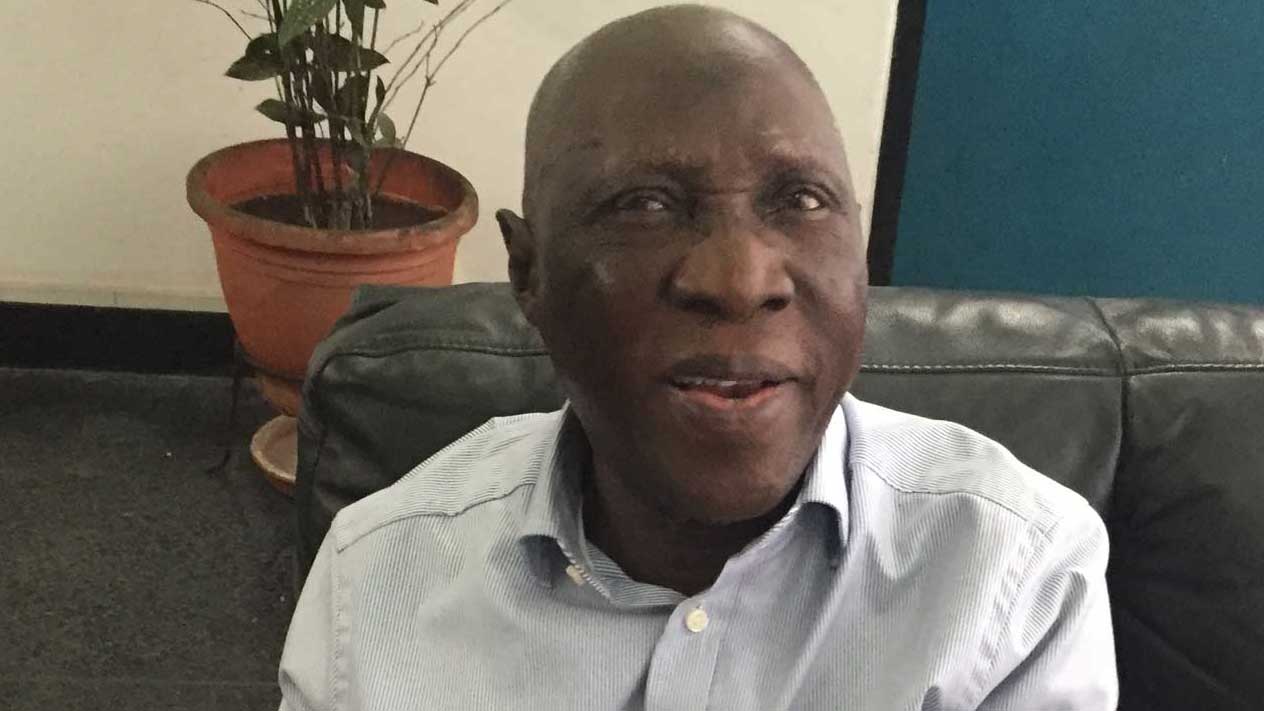
Bidmos Muritala Aderemi
Bidmos Muritala Aderemi

