 Follow Us on Google News


 Follow Us on Google Discover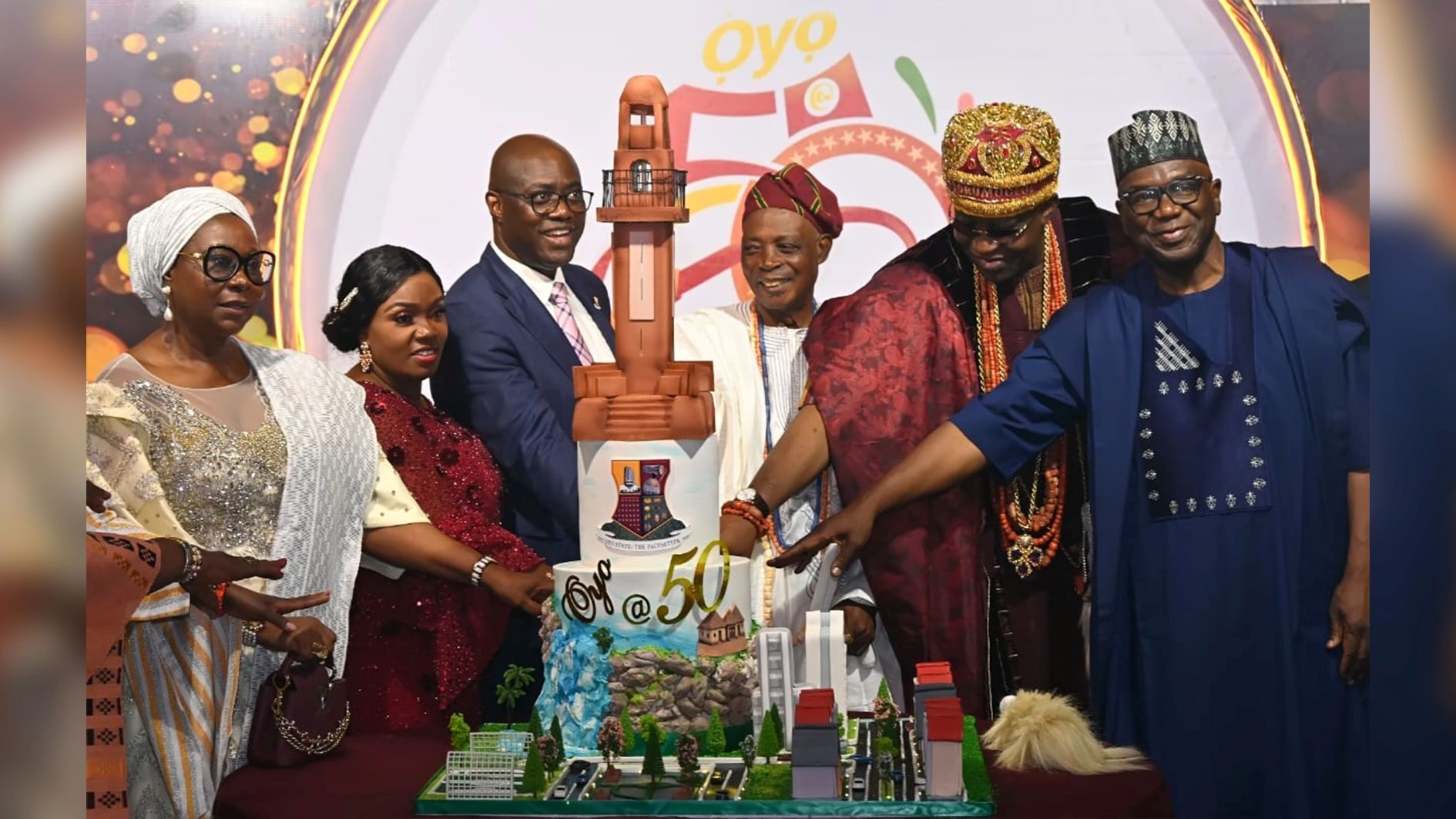
Fifty years after its creation on February 3, 1976, Oyo State did not merely mark an anniversary, it made a statement. The golden jubilee celebrations reached their crescendo on the final day with pageantry, reflection, and a forward-looking resolve that blended history with ambition,
ROTIMI AGBOLUAJE reports.
For a state long defined by firsts in education, broadcasting, infrastructure and public administration, the climax of its 50th anniversary was less about nostalgia and more about renewal. Kick-started on January 26, the golden jubilee culminated on February 3, 2026.
From the early hours of the final day, Ibadan wore a ceremonial air. Major roads were lined with commemorative banners bearing the familiar emblem of the “Pacesetter State.” Cultural troupes rehearsed under canopies, security formations stood alert, and dignitaries arrived in measured procession. Yet beneath the spectacle was something more enduring – a collective attempt to define what Oyo’s next half-century should represent.
Hence, the concluding events, which took place at the new Banquet Hall of Government House, Ibadan, drew an assembly of political leaders, traditional rulers, technocrats, captains of industry and citizens whose lives have intersected with Oyo’s evolution over five decades. The presence of former governors and elder statesmen reinforced the sense of institutional continuity; a reminder that the state’s growth has been cumulative rather than episodic.
In attendance was Governor Seyi Makinde, whose administration framed the golden jubilee as a bridge between legacy and transformation. Also present were former leaders, including Major General David Jemibewon (rtd), the Olubadan of Ibadanland, Oba Rashidi Adewolu Ladoja, who served as the 14th governor of Oyo State; family members of former governors Bola Ige, Omololu Olunloyo, Alao-Akala and Abiola Ajimobi, who were honoured at the event; as well as recipients of the state’s Merit Award.
The event also had in attendance former military administrator of Oyo State, General Oladayo Popoola (rtd); former governor of Edo State, Chief Lucky Igbinedion; former governor of Kano State, Mallam Ibrahim Shekarau; former governor of Akwa Ibom State, Deacon Emmanuel Udom; wife of the state governor, Tamunomini Makinde; former first lady of Oyo State, Chief (Mrs) Mutiat Ladoja, and deputy governor of the state, Abdulraheem Bayo Lawal.

Others were former deputy governor of the state, Hamid Gbadamosi; National Chairman of the Peoples’ Democratic Party (PDP), Dr. Kabiru Tanimu Turaki; former Deputy National Chairman (South), Chief Bode George and former Minister of Trade and Investment, Chief (Mrs) Onikepo Akande.
The gathering itself symbolised democratic maturity, with opponents of different eras seated within the same civic space, bound by shared history.
Traditional authority was equally visible, underscoring the cultural bedrock upon which modern Oyo stands. The presence reminded attendees that before statehood came civilisation, the old Oyo Empire, Ibadan’s warrior republic, and centuries of political organisation that predate colonial cartography.
The final day unfolded in carefully sequenced events, culminating in a Dinner and Awards Night that became the emotional high point of the celebration. The atmosphere inside the venue was dignified yet festive. Ambient lighting cast a golden hue across the hall, echoing the jubilee theme. A symphony orchestra interspersed classical pieces with indigenous rhythms, symbolising the fusion of heritage and modernity.
In his keynote address, Governor Makinde departed from rhetoric to reflection. The governor described the golden jubilee as “a moment of accounting,” insisting that celebration without introspection would be hollow.
The governor traced Oyo’s lineage from the old Western Region, whose policies shaped much of Nigeria’s developmental architecture, to its present structure as a multi-ethnic, economically diverse state.
But his emphasis was forward-looking. According to him, the task of leadership in the next 50 years will not be measured solely by monuments but by systems, institutions capable of outlasting personalities.
Makinde said: “As we draw the curtain on this 10-day celebration of Oyo State at 50, I am reminded of a simple but enduring truth: Government will come and go; administrations will begin and end, but Oyo State will remain.
“What we celebrate tonight is not the achievement of one government. It is not the achievement of one political party. It is not the celebration of one moment in time. We are celebrating a living state.
“From the foundational years, after Oyo State was created in 1976, when early administration, beginning with the military government of then Colonel David Jemibewon focused on establishing the structures of governance, to the Second Republic when the Chief Bola Ige administration placed emphasis on public service, education, and social development, our state continues to evolve through different national seasons.
“Subsequent military administration carried on with the task of developing Oyo State. With the return of democracy in 1999, attention shifted towards rebuilding democratic institutions, strengthening urban governance, and responding more directly to the expectations of our people.
“In the years that followed, infrastructure renewal, security reforms, and urban modernisation became defining priorities, reshaping how our cities function and how communities experience governance.
“Let us not forget that Oyo State has passed through moments of tension, transition, and institutional testing. And each time, we emerged stronger, wiser, and more committed to stability and progress. We honour our past, but we invest in our future.”
In his goodwill message, the Chairman, Nigerian Governors’ Forum and Governor of Kwara State, AbdulRahman AbdulRazak, commended Makinde for reclaiming the former glory of the state through various projects.
Also, a former military governor of the old Western Region, General Oluwole Rotimi (rtd), noted that history will continue to remember the state’s leaders for their uniqueness and contributions.
To former military governor of the state, Major General David Jemibewon (rtd), Oyo State is a pacesetter that has consistently remained at the forefront. He stressed the need to sustain this position to achieve even greater progress.
Wife of a former governor of the state, Chief (Mrs) Kemi Alao-Akala; and former governor of Akwa Ibom State, Emmanuel Udom, in their separate remarks, noted that unprecedented achievements in Oyo have significantly transformed the fortunes of the state.
In his welcome address, the Chairman of the Oyo at 50 Committee, Saheed Akinade-Fijabi, thanked Makinde for the opportunity to celebrate the state.
One of the defining moments of the night was the conferment of awards on 74 distinguished sons and daughters of Oyo State. The honourees spanned academia, medicine, public administration, commerce, arts, and community development. Some were globally recognised scholars; others were grassroots change-makers whose impacts rarely make headlines but sustain communities.
The awards were not ornamental plaques. Each citation recounted the honouree’s journey, struggles, innovations, public service and sacrifice. For many in attendance, the ceremony became deeply personal. Applause often rose, not merely out of protocol, but out of shared memory.
By foregrounding individuals rather than structures, the state sent a message – institutions thrive because people commit to excellence.
If history dominated the early segments of the celebration, policy was not left out. Makinde used the platform to highlight ongoing projects designed to shape Oyo’s next developmental arc.
Top among them is the upgrade of Ladoke Akintola International Airport into a modern aviation hub capable of handling increased passenger and cargo traffic. The Senator Rashidi Ladoja Circular Road project was presented as a catalyst for urban expansion and industrial clustering. Security architecture also featured prominently. The administration’s acquisition of surveillance aircraft and strengthening of local security networks were framed as prerequisites for investment and stability.
Electric buses introduced into the public transport system were cited as early steps towards sustainable urban mobility.
The governor said: “Today, we are building on all that has come before, delivering long-term, system-driven infrastructure, transport reforms, and economic projects that will be commissioned throughout this anniversary year. So, people may think this is the end of Oyo at 50. Well, it is just the beginning. We will celebrate throughout the year.
“We have projects to be commissioned, and we have structures to be built as well. So, this anniversary is not an isolated achievement; it is part of a continued promise to future generations. So, this celebration will continue with the steady commissioning of projects that reflect both continuity and progress.
“In the coming months, we will formally commission the completed Samuel Ladoke Akintola Airport. It has been upgraded to an international airport providing an important gateway to the world.
“We will also continue to work and commission key sections of the Senator Rashidi Ladoja Circular Road project, a transformational infrastructure that reimagines mobility, logistics, and urban growth across Ibadan and beyond. As a matter of fact, within this first quarter, the first segment of that road will be commissioned. That is before the end of March 2026.
“Beyond roads, the future we are building is already arriving. I spoke with my Chairman; the Chairman of the Nigerian Governors’ Forum. We spoke about the surveillance aircraft that we ordered. Well, as we speak, we are tracking the vessel. Three days ago, it was at Lome. Now, the vessel is at the port in Lagos. So, that is also being delivered. And it will help us, both Oyo and Kwara, to ensure that we can have surveillance across our common areas and deep into our states.
“Also, as part of this celebration, we have ordered modern electric buses. This will also be delivered later in the year. It will expand our transport infrastructure and ensure that our public transportation system becomes efficient and affordable for our people. So, we have a lot of projects in the pipeline because development is not a spectacle, it is a system, and systems endure when they are designed for people, not optics, not politics.”
By situating these initiatives within the golden jubilee narrative, the government sought to connect policy to heritage, suggesting that pace-setting in the 21st century demands technological foresight as much as historical pride.
Not all reflections came from the political class. Representatives of civil society and academia offered perspectives that broadened the conversation. Scholars traced Oyo’s influence on national education policy, pointing to the establishment of the University of Ibadan in 1948 as a watershed moment in intellectual history.
As the evening progressed, the atmosphere shifted from formal ceremony to reflective camaraderie. Tables once arranged in strict symmetry became spaces of animated conversation. Former public servants reunited with colleagues; young professionals networked with veterans; families posed before commemorative backdrops.
Outside, fireworks illuminated the Ibadan skyline, punctuating the close of formal proceedings. The bursts of colour seemed to mirror the multiplicity of stories converging that night – personal, political and cultural.
Yet the most enduring image was quieter: Elderly statesmen standing to sing the national anthem alongside students born decades after the state’s creation. In that shared moment, the abstract idea of “50 years” became tangible.
Anniversaries can be sentimental interludes, but Oyo’s final day suggested something more strategic. By centring its golden jubilee on continuity of institutions, values and aspirations, the state reframed celebration as commitment.
The Pacesetter identity, forged in the old Western Region and institutionalised in 1976, carries expectations. It demands leadership in policy innovation, fiscal discipline, cultural preservation and social investment. It demands that Oyo remains not merely part of Nigeria’s history but a shaper of its trajectory.
As dignitaries departed and ceremonial lights dimmed, a subtler work began – the work of translating anniversary rhetoric into measurable progress. The challenge for the next administration, and the next generation, will be to ensure that infrastructure projects are completed, educational standards sustained, and economic reforms inclusive.

