 Follow Us on Google News


 Follow Us on Google Discover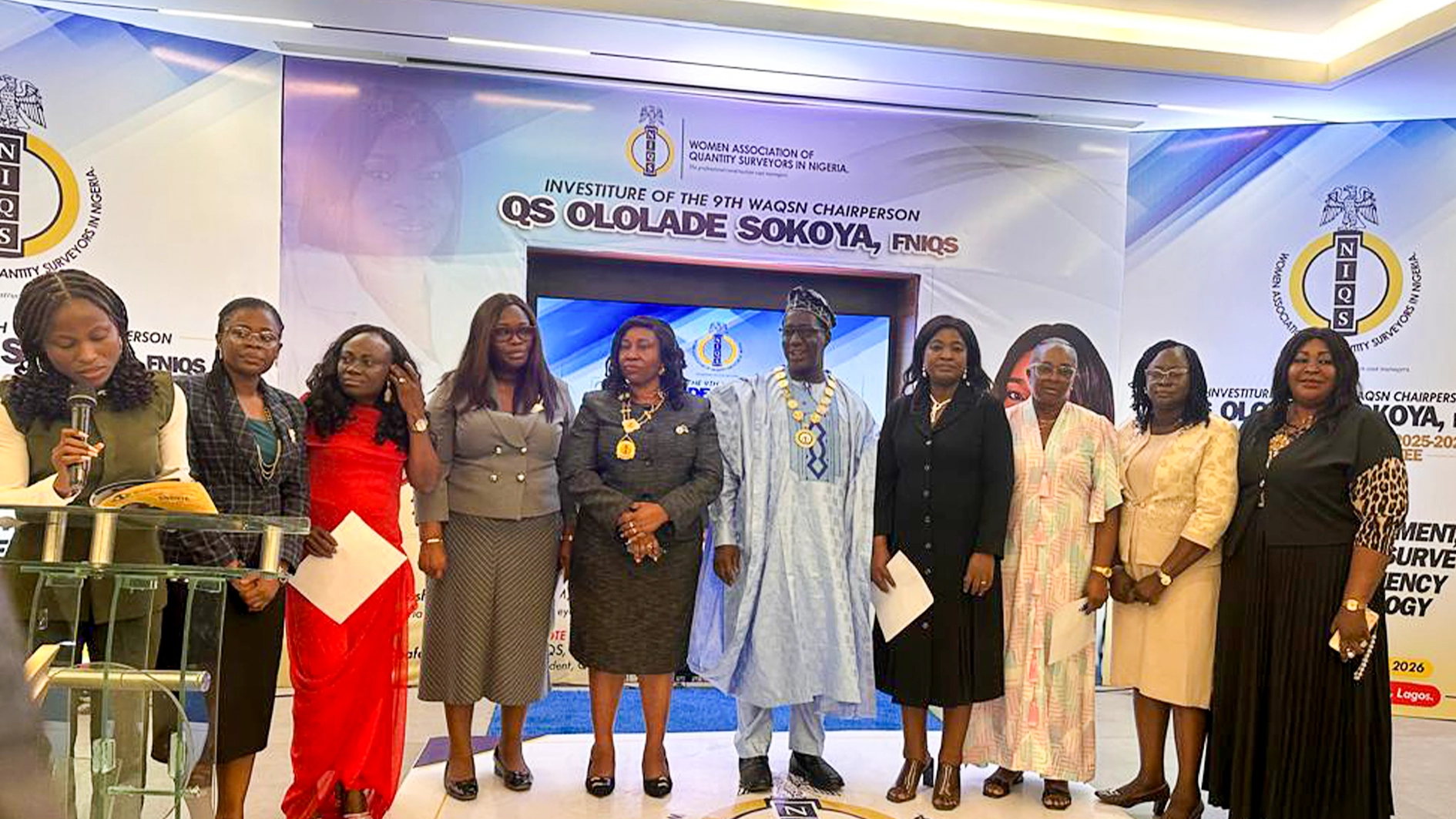
The Nigerian Institute of Quantity Surveyors (NIQS) has cautioned other built-environment professionals against encroaching on cost management practice, insisting that it remains the core responsibility of quantity surveyors.
Speaking at the seminar and investiture of Ololade Sokoya as the 9th Chairperson of the Women Association of Quantity Surveyors in Nigeria (WAQSN) in Lagos, NIQS President, Dr Aminu Bashir, said cost and procurement management of building and infrastructure projects fall squarely within the expertise of quantity surveyors.
“We respect the roles of engineers and architects in design and implementation. However, cost and procurement management expertise is the preserve of quantity surveyors by virtue of our training, from tertiary education through professional practice,” he said.
Bashir noted that the institute is intensifying advocacy to ensure that cost management is embedded in both public and private sector projects. According to him, this is essential to promote transparency, curb corruption and ensure value for money in project delivery.
He disclosed that the institute has signed a Memorandum of Understanding (MoU) with the Economic and Financial Crimes Commission (EFCC) to support property valuation, expert witness services and advisory roles in asset recovery and project evaluation. He added that the institute is also engaging other government agencies, including the Independent Corrupt Practices and Other Related Offences Commission (ICPC), as part of efforts to strengthen accountability in public projects.
Bashir identified low public awareness of the profession’s core competencies as a major challenge, noting that many abandoned projects across the country could be traced to the absence of proper cost management.

In her remarks, the newly inaugurated Chairperson of WAQSN, Ololade Sokoya, said the association is working to empower women to take on leadership roles in the male-dominated construction industry. She emphasised that women in the profession have demonstrated competence and should be encouraged to maximise their potential.
On the rising cost of building materials, Sokoya attributed the trend to global economic pressures, noting that fluctuations in international markets have impacted construction costs. She advised developers and project owners to adopt proper cost planning and management strategies to mitigate risks.
“Cost planning and cost management are critical. Stakeholders must plan adequately before embarking on projects to avoid cost overruns,” she said.
The outgoing Chairperson of WAQSN, Dr Bukola Aluko-Olokun, described her tenure as a period of growth and resilience, noting that the association expanded its presence within the Africa Association of Quantity Surveyors despite challenges. She highlighted the need for persistence in navigating a male-dominated sector.
Chairman of the occasion, Prof. Olubola Babalola, called for greater recognition of the role of quantity surveyors, urging professionals to strengthen collaboration and advocate the establishment of dedicated faculties for the discipline.
In his keynote address, Obafemi Onashile said the construction industry is becoming increasingly volatile, with emerging technologies such as artificial intelligence expected to reshape professional practice. He urged practitioners to adapt to evolving trends to remain relevant in a rapidly changing environment.

