 Follow Us on Google News


 Follow Us on Google Discover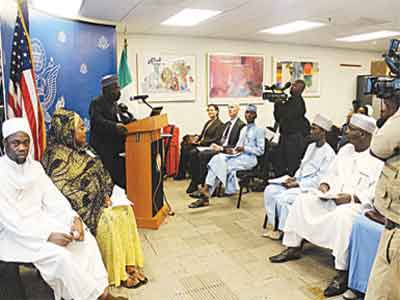

The Multipurpose Room of United States (US) Consulate General, Lagos was filled with Muslim and Christian clerics from across the country during a programme titled: “Diversity Forum on Politics and Religious Counter-Radical Narratives in Nigeria” that was organised by the Public Affairs Section of the consulate in collaboration with the Strength in Diversity Development Centre.
The forum addressed narratives of violent extremism, its multiple causes, complex processes, and growth over the years, while also analyzing the various channels and platforms through which religious leaders can communicate effectively messages of peace and non-violence to their followers.
Professor of History and Literature of Religion, Ahmadu Bello University, Zaria, Sani Umar, and Co-Executive Director Interfaith Mediation Centre, Kaduna among others spoke their minds during the occasion.
Umar said that Boko Haram members are not fighting jihad. “Scholars said it is not a legitimate jihad. Islamic scholars have spoken their minds on Qadiriya and Salafi radicalism in Nigeria.”
According to him the late Yusuf Mohammed, the founder of Boko Haram belonged to the Salafi radicalism group and some Islamic scholars said that what they are doing is a rebellion against God.
“Scholars had challenged their theological foundation. They challenged their social and political ideas. Popular songs have been composed in Hausa language against their operations.”
He said that the cause of terrorism was driven by personal, political and economic consideration. It requires scientific research to get to its root, noting that it is not caused by poverty.

Regarding the solution to female suicide bombers he said: “Cameroun and Chad had outlawed hijab (complete covering of the body by women in public). In Nigeria, it is not likely to work. We should focus on fighting Boko Haram, not fighting the dress itself as that can hit up the polity and take away attention on fighting terrorism.
“There is need for surveillance and more security to check suspects away from potential targets like church, mosque or market places and motor parks.”
Umar described the use of female suicide bombers as the final storm before the final collapse of a dying insurgency. “It is just to indicate that they are still relevant. We already have a religious preaching board to screen out wrong imams. What we need is enforcement.”
Co-Executive Director and Chief of Party (Tolerance Project Nigeria), Interfaith Mediation Centre, Kaduna, Pastor James Movel Wuye said that better strategies, superior arguments and the right legislation are needed to address the issue of hate speeches, unguarded utterances and name-calling by religions fanatics.
He noted that Nigerians witnessed ethno-religious and social-political violence which has threatened the corporate existence of the Nigerian state.
“These violence are fueled by individuals and collective unhealed memories from her colonial past and the sectorial tensions arising from sectarian violence and disputes.
He recalled that religious bodies could play a significant role in addressing the negative radical narratives through regulating and screening preachers and licensing them before they are allowed to preach sermons.
“In the late eighties Nigeria has had series of ethno-religious violence which gave credence to the narratives of the Christians radical groups. I was a victim of this phenomenon. Today, I wear an artificial arm.
Looking back at my experience as a young man, I have been engaged in negative ways of handling conflict which led to my losing an arm in an effort to protect the church against my Muslims colleagues and neighbours. Today, I will have responded differently, hence the imperatives of religious peace education to counter negative narratives with the view to re-humanizing the others.
A lecturer at Lagos State University, Professor Hamidu Tijani said that more has to be done on who nurtured and is feeding terrorism.
“If you train a tiger, it will come back to attack you. Nigeria conceived Boko Haram and the West nurtured it. Now we are all suffering from it. Those who manufactured the explosives for terrorists have sponsors. We have to stifle them of their oxygen of life and money.”
He said that the US should lead the world against the financiers of Boko Haram. “What could make a man love death; make people to love life, not death? Provide food, shelter, and education to ensure that people love life, not death. Address the problem of backwardness to make people fall in line. Promote inter religious dialogue.”
Tijani said that there is the need to teach authentic Islam and organize training for the local imams.
“There is need for periodic training of our imams. There should be a coalition of willing and unwilling to stifle our politicians of ammunition. The American government should lead the campaign against the sponsors of terrorism. Government should offer those things that Boko Haram offered to make life attractive.”
Co-Executive Director Interfaith Mediation Centre, Kaduna, Dr. Muhammad Nurayn Ashafa said that he totally disagreed that the wearing of hijab should be a challenge in combating Boko Haram.
“The Catholic nuns dress code has been used in some countries to commit atrocities. We see it in Hollywood and Bollywood movies. What need to be done is to attend to the root cause of Boko Haram, bad governance, misrepresentation of scriptural texts, influence of peer groups.
“Dress code is not really the problem. Those who threw the bomb in London were not wearing hijab. The man that threw the first bomb in Abuja was not wearing hijab. What we need is to change the mindset, give free education across the nation.”
Islamic scholar/proprietor/Imam, Al-Amani Islamic Centre Worldwide, Sheikh Farouq Sulaimon Onikijipa told The Guardian after presenting his paper that Islam does not support hooliganism and oppression.
He said that the female suicide bombers are not Muslims. “So there is no need to ban wearing of hijab. The government should fight the root cause of terrorism. We should concentrate on the homes. Islam says ‘Don’t kill, Don’t steal. People doing things contrary to Islam cannot be said to be true Muslims.”
Political Officer, US Consulate, Jessica Tesoriero said that the US supports Nigeria against radicalism and Boko Haram by providing platform as provided by the forum, building capacity, expertise, and promoting democracy.
“In democracy people have the power to speak against terrorism. Take the message of peace to the people that you know and it will spread,” he said.

