 Follow Us on Google News
 Follow Us on Google Discover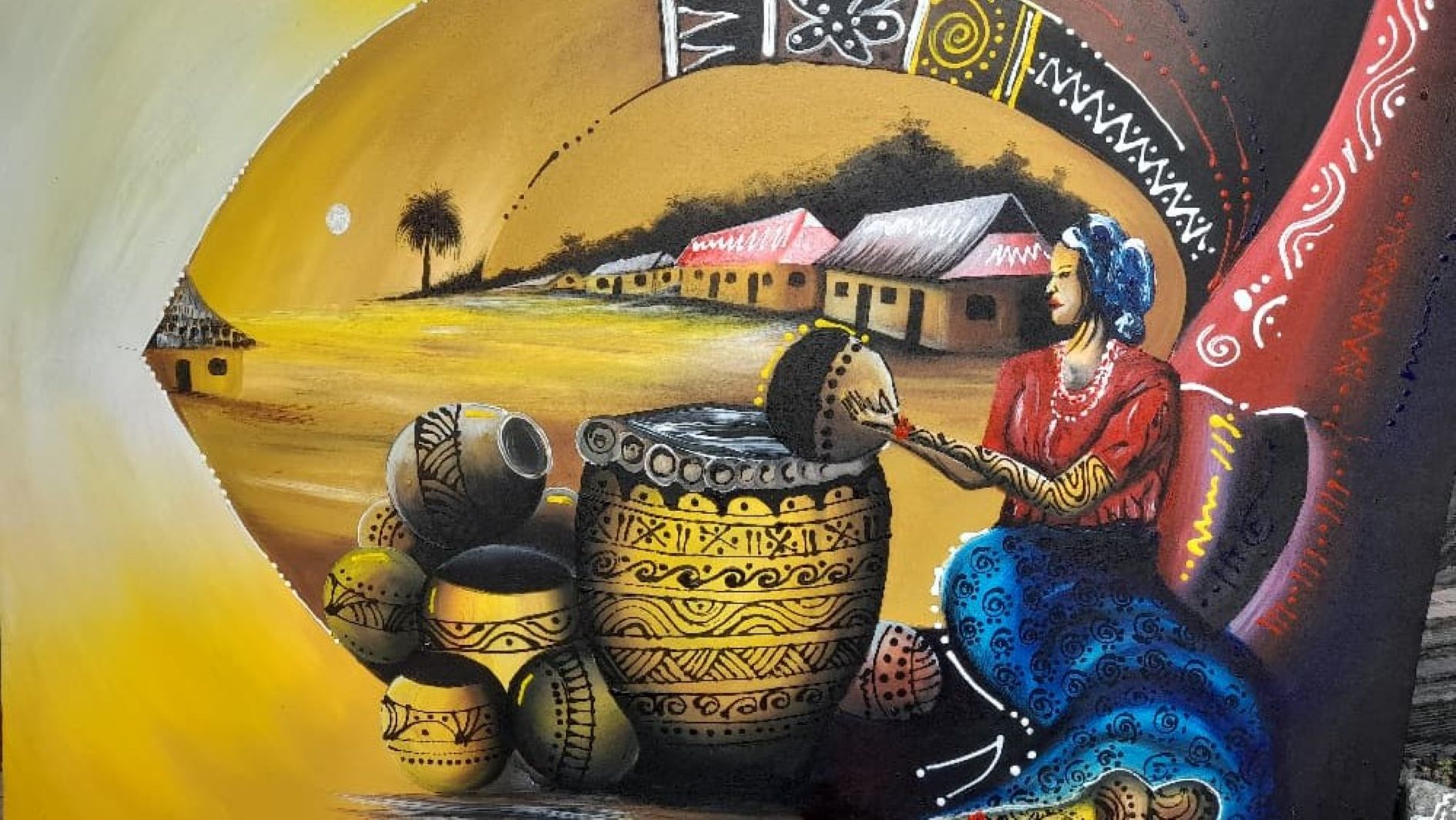
In a modest studio space in Manchester, surrounded by layered canvases and textured surfaces that carry echoes of distant streets, Olayinka Oronti is mapping the emotional and socio-economic terrain of two continents.
Oronti’s work sits at the intersection of identity, resilience and structure. Rooted in her Nigerian upbringing and shaped by her professional and cultural engagement in the United Kingdom, her art interrogates what it means to navigate systems, economic, social and psychological, while holding onto personal narrative.
“I see art as documentation,” she says. “Not just of faces or places, but of systems and survival.”
Oronti began her professional journey in Nigeria, first as a practicing visual artist producing commissioned and original works, and later within a gallery environment in Lagos. There, she was involved in exhibition production, client consultation and artwork presentation experiences that offered more than technical grounding.
Working inside the commercial machinery of a gallery sharpened her understanding of audience psychology and curatorial discipline. It exposed her to the realities of pricing, positioning and perception, the invisible architecture behind what the public eventually sees on white walls.
That early exposure shaped an artist who is as attentive to context as she is to craft.

Operating independently, Oronti managed the entire lifecycle of her practice: concept development, negotiation, pricing, production and delivery. It demanded fluency not only in composition and colour, but in contracts and cash flow.
She built a returning client base through digital visibility and consistency, thereby sustaining multiple commissions at once without compromising on narrative depth. For Oronti, creative freedom has always been tethered to strategic discipline.
Her academic background in International Fashion Business Management further refined that duality. Studying the mechanics of global creative industries allowed her to see art not simply as output, but as infrastructure. Market positioning, scalability and cross-border cultural exchange became integral to how she imagines her future.
“I don’t separate creativity from structure,” she says. “The most powerful art movements in history understood their systems.”
Beyond the studio, Oronti’s professional experience in public service and facilities operations has deeply informed her thematic lens. Working closely with diverse communities and vulnerable individuals has heightened her sensitivity to lived realities often absent from mainstream narratives.
Her canvases frequently explore labour, aspiration and the quiet endurance required to navigate modern bureaucratic life. There is an architectural quality to her compositions, ordered yet restless, reflecting the tension between structure and human agency.
The result is work that feels both intimate and systemic. Personal stories are rendered within broader social frameworks, asking viewers to consider not only the individual subject, but the environment that shapes them.
Now based in Manchester, Oronti positions her practice within a diasporic dialogue. African in origin, British in present engagement, and global in ambition. She seeks to contribute to the UK’s creative landscape with culturally informed, socially relevant work that resonates beyond national borders.
Exhibitions, commissions and collaborative projects form part of her expanding vision. The aspiration is not simply to exhibit internationally, but to build a sustainable cross-continental practice grounded in ethical professionalism.
For Oronti, the move represents more than geography; it is structural evolution. The UK’s diverse arts ecosystem offers new audiences and networks, while her Nigerian foundation provides a narrative depth that resists homogenisation.
As she looks ahead, she frames the next phase of her journey not merely as career progression, but as commitment to craft, to community and to cultural dialogue.
In Oronti’s hands, visual storytelling becomes both mirror and blueprint: reflecting lived realities while imagining what transformation might look like when resilience meets opportunity.

