 Follow Us on Google News


 Follow Us on Google Discover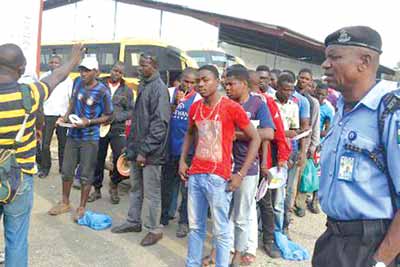
 It is becoming a recurring decimal for migrants from Nigeria, but also from Mali, Togo, Senegal, Niger Republic, Guinea Conakry and other African countries to be repatriated from Gabon to Nigeria for not having valid travelling documents and sundry reasons. Sometimes, even those with valid documents and without any criminal record are also bundled in and dumped in Nigeria. And this is done sometimes without them being allowed to retrieve their belongings. Over the last one month, so many such deportees have been dumped in Calabar Port in Cross River State, prompting the Federal Government to warn Gabon and other countries whose nationals are repatriated to desist from such acts. Non-Nigerians were transported in luxury buses, escorted by security agents to the nearest land crossing leading to their countries of origin after documenting and profiling, considering Nigeria’s current security challenges as a result of the Boko Haram terrorists activities.
LAST year’s Christmas Day was a bleak one for 958 passengers from different West African countries on board Emilians-Carneiro vessel, who were deposited at Calabar.
Some of them were genuine passengers with genuine documents from different countries on normal end-of-year trip to celebrate the Christmas with their loved ones.
But some others were actually deported from Gabon for sundry reasons.
For almost five days, the stranded passengers stayed at the Calabar Port waiting for rescue.
The 200 Nigerians on board the ship had disembarked and left by road to their various states, while the remaining 758 persons, comprising children and 690 adults, were evacuated to their various countries with the assistance of the Federal Government.

Some of the passengers said they were businessmen in Gabon and were coming back home for the Christmas holiday.
Mohammed Buhari, a 36-year-old from Niger Republic, said he has been in Gabon for over five years and “I do buying and selling business in Gabon and trade mainly on plastics.”
He said the five days at the port was disturbing, as he could not unite with his family, as planned, but commended the hospitality of Cross River State Government which he said was overwhelming and contrary to the negative pictures painted about Nigeria abroad.
He described Nigerians as friendly, accommodating and sensitive to the wellbeing of human beings, particularly fellow Africans.
Abdulsalam Isa, 69, said he was surprised that the state and federal governments could be so hospitable, against the wrong notion he had hitherto held.
He said even though it was not the fault of the Nigerian government that they made an emergency birthing in Calabar, it did not deter the government from showing humanitarian gestures and love by their approach.
Another passenger, Abdullsalamadu Harma, from Niger Republic, said that they were unhappy because they have been a break in communication between the passengers and the ship authorities.
Acheoukpa Parfait, from Benin Republic, said he had planned to celebrate the Christmas with his family back home, but briefly got stuck in Calabar.
Agouce-Kossi, a Togolese, said some people, especially children, were sick, but thanks to the state government that urgently attended to the situation, which saved the day, as no major incident was reported.
He bemoaned that the food and water given to them by individuals and philanthropists, managed by the Nigerian Immigration Service (NIS) officials were grossly insufficient.
Some of the stranded or deported passengers had told the Cross River State Emergency Management Agency (SEMA) that though they were angry with the development that caused them to miss the celebration of the Yuletide with their families, the action of the governments and people of Nigerian had calmed their nerves, as their interaction portrayed the people of Nigeria as wonderful, friendly and accommodating.
They said life in Gabon was simple, but one had to work hard. “Sometimes, the security agents tried to intimidate us because of travelling papers and resident permits,” on of them said.
The passengers, who were travelling from Gabon to Benin and other West African coastal countries, were nationals of Nigeria, Benin Republic, Congo, Togo, Burkina Faso, Senegal, Sierra Leone, Ghana, Mali, Niger and Guinea, languished at the Sea Port in Calabar following the breakdown of the vessel conveying them.
Top officials of the vessel said the breakdown of the ship on December 25 was caused by a leakage on the floor and malfunctioning of one of the engines which forced them berth in Calabar.
The passengers, who were kept at the facilities of Sureline Logistics Nigeria Limited, initially lacked food, water, sanitation and clothing for the children until the intervention of SEMA.
Director General of SEMA, John Inaku, and the South-South National Emergency Management Agency (NEMA) Zonal Coordinator, Ben Ogbenah, were on hand to ameliorate the situation before they were eventually evacuated.
Inaku described the situation as “pathetic” and assured that the Nigerian government would do everything possible to provide them with adequate security and necessary comfort.
Ogbenah, who was represented by an Assessment Officer, Abia Ufok, urged them to remain peaceful while awaiting interventions from relevant authorities.
He expressed gratitude to God for protecting them against mishap that would have sunk the ship on the high seas.
Captain of the ship, Manuel Uluaresma, who spoke through an interpreter, said: “The vessel was conveying passengers from Gabon to Benin Republic and other coastal West African countries when one of the engines malfunctioned on the high seas and a leakage on the floor of the ship was observed.”
He explained that due to the intensity of the situation, it became obvious that the vessel could not get to its destination and for reasons of safety and protection of the lives of passengers, they decided to berth at the Calabar Port.
The Federal Government has however warned Gabon and other Economic Community of West African States (ECOWAS) countries to stop forthwith, the habit of dumping deportees in Nigeria or the conveying vessel would be impounded.
Minister of Interior, Lt-Gen Abdulrahman Dambazau (rtd), represented by Comptroller of Immigration, Cross River State Command, Funke Adeuyi, warned that the Federal Government would not hesitate to impound any vessel that may, in the future, dump deportees in Nigerian seaports.

