 Follow Us on Google News


 Follow Us on Google Discover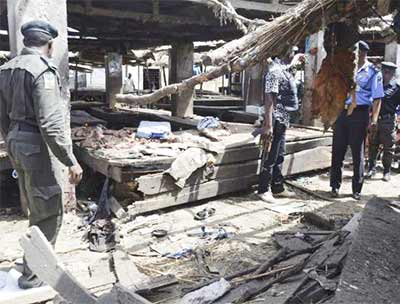

If the gory statistics of innocent Nigerians lives cut short by blood thirsty Boko Haram insurgents since 2009 is placed in the proper context, the Nigerian State will sure take the flak for failing to prevent the mindless murder of its citizens by terrorists.
In the first place, it was under the very nose of the state that the insurgency gather its life blood through the complex political alliances between rogue politicians and armed dregs in society. The dominant idea of capturing power in order to privatise the resources of the State saw the funnelling of arms and ammunitions from politicians to rag tag groups whose ranks were swelled by a pauperized and dehumanized army of unemployed youths.
Put in another way, the most plausible narrative on the origins of the Boko Haram insurgency is that functionaries of the State, in order to gain the upper hand in their malevolent political contests, armed various shades renegades, who then mutated into blood spilling machines, as soon as the evil alliances unravelled. However, instead of the monsters to turn their bombs towards the very rogue political elite that fed them halfway and then abandoned them when the bubble burst, they chose to vent their spleen on the innocent farmer, traveller, market, church and mosque. They suddenly came to the realisation that Western education, which produced the mobile technology, and the ease with which they detonate their gruesome bombs, is sinful.
As they spilled wave upon wave of Nigerian blood, everyone again looked up to the government. The government dithered and shuffled. There was no enduring interest in dealing with the insurgency. As the mindless spilling of Nigerian blood went on unabated, accompanied by the audacious capture of Nigerian territory, key functionaries of the government entrusted with monies to procure weapons to fight the terrorists chose to line their pockets. They cornered billions, and distributed to friends and cronies. They even voted some of the monies for ‘spiritual purposes.’ As people were being mowed down in the North East, government in a sense became an active participant in the unconscionable murder of the sleep of its citizens.
Consequently, on the part of the Boko Haram maniacs, the tendency in the light of publicized deadlines, is to hold on to any straw to prove they still have the capability to hurt the nation. This is where deft and prudent management of information comes to play. Everything does not have to be stated; for instance, the fact that the Federal Government is making progress in fighting the insurgents is apparent. The tendency to become boastful by going around to make loud proclamations about how the terrorists have been ‘technically defeated’ has its repercussions
In short, the hands of the government dripped with the blood of the thousands of innocent Nigerians who lost their lives to the terrorists. So as Nigerians went to the polls to vote in the March 28, 2015 Presidential election, one big question on their mind revolved around the choice they had to make in order to stem the tide of irreverent bloodletting by Boko Haram. In General Muhammadu Buhari, the then flag bearer of the All Progressives Congress (APC), they voted for a battle tested statesman whom they reckoned would deal a straight blow on the insurgency.
To be fair, the President hit the ground running by relocating the Command and Control Centre in the war against the insurgency to the epicentre in Maiduguri. Similarly, he tapped Lieutenant-General Tukur Buratai to lead the onslaught against the insurgents from the ground, while Air Vice Marshall Sadiq Abubakar was given the marching orders to pummel the recalcitrant terrorists from the air. In the area of intelligence, Boko Haram kingpins began to feel the heat as greater collaboration between the security forces and the civilian population began yielding a treasure trove of information. This resulted in a rash of arrests of bomb makers, fuel suppliers, as well as mid and top level commanders of the insurgency.

On top of this, gallant troops made further inroads in push to break the back of the insurgency by taking the fight to the hitherto dreaded Sambisa forest. Terrorists’ camps were routinely dismantled, just as troops continued to triumph in the encounters with the terrorists. On the other hand, the administration’s decision to pronounce a December deadline for the defeat of the insurgency while signposting some good intent, did not factor in some other realities. In the first place, insurgencies are not conventional conflicts wherein the capabilities of the enemy are readily amenable to such assured analysis. In an insurgency in which the adversary is dispersed both within population centres and in the countryside, it borders on being over ambitious to hand down a nationally publicized deadline for its defeat.
Within the realm of strategy and the psychology of the conflict, all the insurgents need to do is to detonate a few bombs here and there to show that they are still very much in business. Similarly, the danger that has become apparent from this deadline is that soft targets, villages around the centre of the conflict, which do not have the kind of military presence like Maiduguri and Bama have would bear the brunt of the frustrations of the terrorists.
It would have been better strategy for the government to keep the terrorists guessing about its overall intentions. That would have afforded the security forces the element of surprise because the terrorists would be forced to guess and speculate about the next steps of the security forces. As it stands now however, the maniacs still have a foothold in the ring since it appears they are re-organising with the singular intent of putting a lie to the government’s position that the insurgency would be defeated within a specified time.
Consequently, on the part of the Boko Haram maniacs, the tendency in the light of publicized deadlines, is to hold on to any straw to prove they still have the capability to hurt the nation. This is where deft and prudent management of information comes to play. Everything does not have to be stated; for instance, the fact that the Federal Government is making progress in fighting the insurgents is apparent. The tendency to become boastful by going around to make loud proclamations about how the terrorists have been ‘technically defeated’ has its repercussions. This would be gleaned from the response of the terrorists in recent weeks to the declaration by the Federal Government that the war has been technically won and lost.
That attempt to give the impression that Boko Haram is on the back foot has been met with yet another round of murderous response from the terrorists. Between Christmas day and December 28, 2015, the sect unleashed its agents of death to once again spill the blood of innocent Nigerians. Everyone knows that the sect has now been pinned to the wall. It is not until loud pronouncements that provoke attacks on soft targets are made before that information sinks in. The government information machine must therefore take full responsibility for all the lives, which were cut short as a result of what comes across as a narcissistic attempt to contextualize the war on terror with the intention of giving the government a good image, which it already, manageably has.
In this regard therefore, the Minister of Information, Alhaji Lai Mohammed must now come to terms with the fact that whatever he says as the spokesperson of the government has far-reaching impacts on the war against Boko Haram. What the country and the people of the North East, who have been repeatedly buffeted by the terrorists need is not the vainglorious declaration of victory. The Minister could focus the enormous machinery of his office on other thematic issues like the fate of the Internally Displaced People (IDPs) who are grappling with the painful reality of displacement inside their country.
The Ministry of Information and Culture could mobilize all the relevant agencies, including the National Orientation Agency to constantly reach out to the IDPs by letting them know what the government’s plans are for them. The Ministry has a huge role to play in deft information management to generate public support for various initiatives of the government, including the resettlement of the IDPs and the reconstruction of the devastated communities in the North East. Dissipating so much energy on debating an obvious fact with Boko Haram, about who is currently winning the war against terror, comes across as diversionary and counterproductive.
In the end, Alhaji Lai Mohammed should refrain from playing into the hands of those critics, who characterised him before his appointment as a propagandist, not a government information manager. Now that he is no longer opposition spokesman, Nigerians who overwhelmingly voted for change in March 2015, expect that the former opposition spokesman would have transitioned from that forceful and overtly assertive mould. The expectation is that he would be much more nuanced and reflective in speaking for the government.
The Information Minister is carrying the weight and expectations of the Nigerian government and its people in the critical sphere of information dissemination. It appears the minister is still struggling to make that transition. The recent bloody reactions of Boko Haram to his proclamation that the terror group has been technically defeated, should teach him vital lessons. The unfortunate thing however is that the preventable loss of precious Nigerian lives is underscoring this learning process. That is if there have been lessons learnt at all.

