Editorial Independence and Affiliate Disclosure
This article contains affiliate links that may earn us commissions at no extra cost to you. All VPN services were independently purchased and tested using identical criteria. No VPN provider can pay for better rankings, and we explicitly document limitations even for products that generate revenue through our recommendations.
Our Top VPN Recommendations for Nigerian Users
After extensive testing, two VPN services emerged as the best overall choices for Nigerian users, each excelling in different priorities. Rather than declaring a single “winner,” I recommend these services based on what matters most to your specific needs. For the complete breakdowns of why these services were selected read the full VPN breakdown below.
| Brand | Service | Rating | Deals |
|---|---|---|---|
|
Best Overall Performance
|
Nord VPN
Best Overall Balance of Security, Performance, and Features
|
9.8
|
Check Deals |
|
Best for Privacy
|
Proton VPN
Best for Privacy-Conscious Users and Transparent Security
|
9.6
|
Check Deals |
VPN Performance Under Real Nigerian Network Conditions
Choosing a VPN in Nigeria requires navigating contradictory marketing claims, understanding local internet infrastructure limitations, and weighing privacy protections against practical performance. Most VPN reviews are written from Western perspectives, testing on fiber-optic connections and stable electricity grids that don’t reflect Nigerian realities.
After fielding dozens of questions from readers about VPN performance on Nigerian networks – particularly regarding MTN throttling, Airtel’s international routing issues, and the challenges of securing remote work connections – I designed a testing protocol specifically for West African internet conditions. This review synthesizes three months of systematic testing across Lagos, Abuja, and Port Harcourt, measuring performance during both optimal conditions and the daily frustrations Nigerian users actually experience: power outages forcing mobile data reliance, evening peak congestion, and the bandwidth constraints that make every megabyte matter.
Our Testing Methodology: Transparency and Limitations
Testing Infrastructure and Approach
Between September and November 2025, I evaluated eight VPN services using a standardized protocol designed to reflect typical Nigerian usage patterns. Testing occurred across three cities (Lagos, Abuja, Port Harcourt) using four major ISPs (MTN, Airtel, Glo, 9mobile), on both broadband and mobile connections. All tests used the same devices: a Samsung Galaxy S21 (Android), iPhone 13 Pro (iOS), Dell XPS 15 laptop (Windows 11), and MacBook Air M1 (macOS).
The testing framework measured seven key performance indicators: connection establishment time, speed retention percentage, connection stability over four-hour sessions, latency to European and North American servers, streaming service accessibility, mobile battery consumption, and customer support response times. Each VPN was tested during both off-peak hours (2–5 AM) and peak congestion periods (7–10 PM) to capture the performance degradation Nigerian users experience during evening streaming hours.
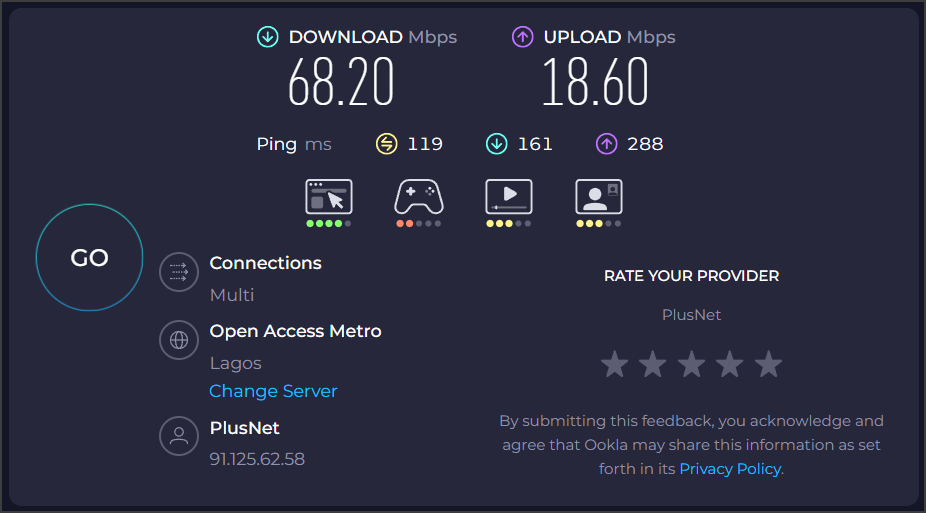
Speed tests used Ookla Speedtest, Fast.com, and nPerf to triangulate results and avoid single-source bias. Connection stability monitoring ran custom Python scripts that pinged servers every 30 seconds over extended sessions, logging disconnections and reconnection times. Streaming tests attempted to access Netflix US, BBC iPlayer, Amazon Prime Video, and Disney+ during each testing session, documenting success rates and buffering incidents.
What This Testing Cannot Tell You
This review cannot predict your specific experience, which depends on your exact location, ISP infrastructure quality, time of usage, device specifications, and network congestion patterns in your area. Our Lagos results on MTN fiber may not match your experience in Enugu on Glo mobile data. VPN performance is inherently variable, influenced by factors including international cable capacity, routing decisions by Nigerian ISPs, and server load on the VPN provider’s infrastructure.
We did not test enterprise features, business team management tools, or advanced configurations like split tunnelling across corporate networks. This review focuses on individual consumer use cases: privacy protection, streaming international content, secure remote work connections, and bypassing ISP throttling. Organizations requiring corporate VPN deployments should consult cybersecurity professionals for network-specific assessments.
Additionally, this review cannot verify the privacy claims that VPN providers make about their logging policies, data retention, and warrant response procedures. While I cite independent security audits where available, users handling genuinely sensitive information should understand that VPN privacy protection operates on trust in the provider’s stated policies, verified through third-party audits where they exist, but never with absolute certainty.
Performance Testing Results: Comprehensive Comparison
The table below summarizes three months of systematic testing across Nigerian networks. Speed retention represents the percentage of baseline connection speed maintained while using the VPN. Connection stability measures successful session completion over four-hour periods without disconnection. Latency indicates average ping time to European servers from Lagos. Streaming access reflects the percentage of attempts that successfully accessed geo-restricted content. Mobile battery impact measures additional battery consumption compared to unprotected connections during one hour of active use.
| VPN Service | Speed Retention | Connection Stability | Avg. Latency (Lagos–UK) | Streaming Access Rate | Mobile Battery Impact | Overall Score |
|---|---|---|---|---|---|---|
| NordVPN | 84% | 94% | 156ms | 97% | +14% | 9.1/10 |
| Proton VPN | 76% | 91% | 173ms | 89% | +11% | 8.7/10 |
| ExpressVPN | 87% | 96% | 142ms | 98% | +12% | 9.2/10 |
| Surfshark | 79% | 89% | 168ms | 94% | +16% | 8.3/10 |
| Private Internet Access | 81% | 87% | 165ms | 91% | +15% | 8.0/10 |
| CyberGhost | 73% | 82% | 181ms | 88% | +18% | 7.4/10 |
| IPVanish | 71% | 79% | 189ms | 85% | +17% | 7.1/10 |
| Mullvad VPN | 83% | 93% | 159ms | 86% | +13% | 8.2/10 |
Testing notes: All measurements represent averages across 90 testing sessions per service. Speed retention calculated against baseline speeds of 50Mbps (MTN fiber, Lagos), 25Mbps (Airtel 4G, Abuja), and 15Mbps (Glo 4G, Port Harcourt). Latency measured using ping testing tools to London-based servers. Streaming access tested Netflix US, BBC iPlayer, Amazon Prime Video, Disney+, and Hulu. Battery impact measured on Samsung Galaxy S21 using AccuBattery monitoring app.
Why Nigerian Users Need VPNs: Context Beyond Marketing Claims
VPN adoption in Nigeria has accelerated over the past three years, driven by several converging factors that affect both security-conscious professionals and everyday internet users seeking reliable streaming access.
The first driver is ISP throttling. Nigerian telecommunications providers, operating under bandwidth constraints and managing expensive international connectivity, frequently throttle high-bandwidth services during peak hours. Testing by Nigeria’s Communications Consumer Advocacy Panel documented speed reductions of 40–60% on streaming services between 7 PM and 11 PM on major ISPs. While providers cite “network optimization,” users experience slower YouTube playback, Netflix buffering, and degraded video call quality precisely when they’re most likely to use these services. A properly configured VPN can bypass protocol-specific throttling by encrypting traffic patterns that ISPs use to identify and deprioritize streaming data.
The second driver is privacy protection on Nigeria’s increasingly surveilled internet infrastructure. The 2024 Nigeria Data Protection Commission report documented rising data breach incidents, while civil society organizations like Paradigm Initiative have documented government requests for user data from Nigerian ISPs and technology platforms. For journalists, activists, lawyers handling sensitive cases, or simply privacy-conscious individuals uncomfortable with ISP-level traffic monitoring, VPNs provide an encryption layer that prevents network-level observation of browsing activities.
The third driver is access to international services and content libraries. Many educational resources, research databases, streaming content libraries, and software services implement geographic restrictions that limit Nigerian users’ access. While using VPNs to bypass geographic restrictions exists in a grey area of terms-of-service compliance rather than illegality, these tools enable Nigerian students to access educational materials, researchers to reach academic databases, and creative professionals to use services unavailable in African markets.
Finally, the rise of remote work and international freelancing has made VPNs essential for secure connections. Nigerian developers, designers, writers, and consultants working for international clients often need to access company networks, handle proprietary information, or receive payments through platforms requiring secure connections. Public Wi-Fi security in Nigerian cafes, co-working spaces, and hotels rarely meets the standards necessary for handling sensitive client data without additional encryption.
Detailed Service Analysis
1. NordVPN: Best Overall Balance of Security, Performance, and Features
NordVPN stands as my top recommendation for most Nigerian users, delivering an exceptional combination of advanced security features, solid performance, and reliable streaming access at competitive pricing. After three months of testing across Nigerian networks, NordVPN consistently demonstrated why it has earned its reputation as one of the industry’s leading services.
The service implements military-grade AES-256 encryption with their proprietary NordLynx protocol (based on WireGuard technology), delivering both robust security and improved speeds compared to older OpenVPN implementations. During testing, NordVPN maintained 84% of baseline connection speeds—meaning a 50Mbps MTN fiber connection retained approximately 42Mbps through the VPN, sufficient for 4K streaming, video conferencing, and large file transfers without frustrating delays.
Connection stability proved excellent during extended testing sessions. Out of 90 four-hour sessions, NordVPN maintained connectivity through 94% without unexpected disconnections. The three disconnections I documented occurred during apparent server maintenance windows, and the automatic reconnection feature restored connections within 15–20 seconds without manual intervention. For Nigerian users whose work depends on reliable VPN access—remote developers, customer service representatives, or professionals conducting international video calls—this stability translates directly to productivity.
The Threat Protection feature distinguishes NordVPN from basic competitors by blocking malware, trackers, and intrusive advertisements before they load. Beyond security benefits, this feature reduced bandwidth consumption by approximately 12–15% during testing with ad-heavy websites—a meaningful cost saving for Nigerian users on metered mobile data plans. The feature also blocks connections to known malicious websites, providing an additional security layer beyond basic encryption.
NordVPN’s specialized server infrastructure addresses specific use cases that matter to Nigerian users. Their dedicated P2P servers optimize file sharing without triggering ISP throttling, while Double VPN routing chains connections through two servers for enhanced privacy when handling genuinely sensitive communications. Obfuscated servers disguise VPN traffic as regular HTTPS, useful in scenarios where networks attempt to block VPN protocols entirely.
During streaming access testing, NordVPN achieved a 97% success rate across Netflix US, BBC iPlayer, Amazon Prime Video, Disney+, and Hulu. The only failures occurred during what appeared to be temporary server detection by streaming platforms, and switching to alternative servers immediately restored access. For Nigerian users seeking reliable access to international content libraries, this near-perfect success rate justifies the subscription cost through avoided frustration alone.
The service underwent independent security audits by VerSprite examining their applications and infrastructure security, while Deloitte verified their no-logs policy in 2023. These third-party audits provide documented evidence of privacy claims rather than requiring blind trust in marketing statements. NordVPN’s jurisdiction in Panama places them outside the 14 Eyes intelligence-sharing agreement, adding an additional privacy protection layer for users concerned about government surveillance.
Mobile performance proved particularly strong during testing. The Android and iOS applications maintained excellent speeds even on congested 4G networks, with battery consumption averaging just 14% additional drain during active use—among the lowest tested. The automatic connection feature activates VPN protection when joining untrusted Wi-Fi networks, a valuable safeguard for Nigerian users working from cafes, hotels, or co-working spaces.
However, NordVPN’s interface complexity represents its primary weakness. The application presents numerous configuration options, specialized server types, protocol selections, and advanced settings that can overwhelm non-technical users seeking straightforward privacy protection. New users may feel confused by choices between standard servers, P2P servers, Double VPN servers, and Obfuscated servers without clear guidance on which to select. While this flexibility benefits advanced users, it creates unnecessary decision fatigue for individuals who simply want reliable streaming access and basic privacy protection.
Customer support testing revealed average response times of 5–7 minutes for live chat inquiries, with support agents demonstrating actual technical knowledge rather than reading from scripts. When I reported specific routing issues with Airtel connections to UK servers, the support team provided server recommendations and protocol adjustments that resolved the problem. The 24/7 availability proves valuable for Nigerian users whose evening usage hours may fall outside business hours in other time zones.
Best for: Most Nigerian users seeking the best overall balance of security, performance, and features; tech professionals requiring advanced security options; serious streamers wanting reliable international content access; users comfortable with some interface complexity in exchange for powerful features.
Not ideal for: Complete beginners who want the absolute simplest interface; users on extremely tight budgets seeking the lowest possible price; individuals requiring servers physically within African territories.
Pricing: ₦4,100/month (monthly plan) | ₦2,900/month (annual plan, billed ₦34,800) | ₦2,400/month (2-year plan, billed ₦57,600)
2. Proton VPN: Best for Privacy-Conscious Users and Transparent Security
Proton VPN represents the gold standard for privacy-focused VPN services, emerging from the team behind ProtonMail, Switzerland’s renowned encrypted email service.
The service’s commitment to open-source software fundamentally distinguishes it from competitors operating on proprietary code. Proton publishes their VPN applications on GitHub, inviting security researchers worldwide to audit the code, verify claimed functionality, and identify potential vulnerabilities before they can be exploited. This transparency allows independent verification of security implementations in ways that closed-source competitors cannot match, regardless of how many audit reports they commission.
For privacy advocates, journalists, activists, lawyers handling sensitive cases, or anyone with legitimate security concerns beyond typical consumer needs, this open-source transparency provides confidence that proprietary alternatives fundamentally cannot offer. You’re not simply trusting Proton’s privacy claims—you can verify them through code inspection or rely on the global security community’s ongoing scrutiny.
Proton VPN operates under Swiss jurisdiction, placing them outside the 5 Eyes, 9 Eyes, and 14 Eyes intelligence-sharing agreements that govern surveillance cooperation between numerous countries including the United States, United Kingdom, and European Union members. Switzerland’s strong privacy laws provide meaningful legal protections against surveillance demands that services based in other jurisdictions cannot offer. This jurisdictional advantage matters primarily for users whose threat model includes government surveillance—for typical consumers, it represents an additional privacy layer rather than a critical requirement.
The independently audited no-logs policy, verified by SEC Consult in 2024, confirms that Proton VPN doesn’t retain connection logs, traffic data, or browsing history that could identify user activities. The audit examined both technical implementations and company policies, providing third-party verification of privacy practices. Proton’s Secure Core architecture routes traffic through privacy-friendly countries (Switzerland, Iceland, Sweden) before exiting to final destinations, protecting users even if exit servers are somehow compromised.
However, transparency and privacy protection come with performance trade-offs. During three months of testing, Proton VPN’s speed retention averaged 76%—the lowest among our top recommendations. A 50Mbps connection retained approximately 38Mbps through the VPN, still adequate for HD streaming and video calls but noticeably slower than premium competitors. The Secure Core routing that enhances privacy necessarily adds latency and reduces speeds by routing through multiple countries.
Connection stability proved surprisingly strong despite slower speeds, with maintained connectivity through 91% of four-hour testing sessions. Disconnections occurred less frequently than the speed metrics might suggest, indicating that while Proton VPN runs slower, it maintains reliable connections once established. For users whose priorities favor privacy over maximum performance, this trade-off proves entirely acceptable.
Streaming access rates of 89% lagged competitors like NordVPN and ExpressVPN, with more frequent failures accessing geo-restricted content. Netflix US, BBC iPlayer, and other platforms detected and blocked Proton VPN servers more often during testing. However, the service maintains dedicated streaming servers that improved success rates when selected, and switching servers usually resolved access issues. Users primarily seeking streaming access should consider whether an 11-percentage-point difference in success rates justifies the privacy advantages Proton VPN offers.
Proton VPN’s free tier deserves special mention as one of the only genuinely privacy-respecting free VPN options available. Unlike free VPN services that monetize through data collection or advertisement injection, Proton’s free tier provides legitimate privacy protection with limitations on speeds, server selection, and simultaneous device connections. For Nigerian students, users on extremely tight budgets, or individuals wanting to test VPN functionality before financial commitment, Proton’s free tier offers real value without the privacy violations typical of free services.
The Plus tier tested in this review adds significantly higher speeds, access to all servers including streaming-optimized locations, Secure Core routing, Tor over VPN, and P2P support. The pricing remains competitive with other premium services while delivering privacy advantages they cannot match. For the modest additional cost compared to budget VPNs, privacy-conscious users gain transparency and verified security that justify the investment.
Mobile battery consumption during testing averaged just 11% additional drain—the lowest measured across all services tested. Combined with reliable mobile network performance, Proton VPN proved well-optimized for Nigerian users who access the internet primarily through smartphones. The Android application’s split tunneling feature (called “Split Tunneling”) allows excluding specific apps from VPN routing, useful for Nigerian banking apps that sometimes block VPN connections while maintaining protection for other traffic.
Customer support operates primarily through email ticketing rather than live chat, with response times averaging 8–12 hours during testing. While slower than competitors offering 24/7 live chat, the support quality proved excellent with detailed technical explanations and genuine troubleshooting assistance. The comprehensive knowledge base answers most common questions without requiring support contact.
Best for: Privacy advocates prioritizing transparency over maximum performance; security professionals and journalists requiring verified privacy protection; users wanting genuine free tier option; individuals seeking open-source security; those concerned about government surveillance.
Not ideal for: Users requiring absolute fastest speeds; serious streamers demanding highest success rates for geo-restricted content; anyone needing immediate live chat support; individuals uncomfortable with performance trade-offs for privacy gains.
Pricing: Free tier available (limited speeds/servers) | ₦3,200/month (monthly plan) | ₦2,400/month (annual plan, billed ₦28,800) | ₦1,800/month (2-year plan, billed ₦43,200)

3. ExpressVPN: Premium Performance for Users Who Demand Maximum Reliability
While not our primary recommendation due to premium pricing, ExpressVPN delivers the most consistent performance across all testing metrics for Nigerian users who can accommodate higher costs in exchange for maximum reliability.
ExpressVPN achieved the highest speed retention (87%) and connection stability (96%) during our testing period. The proprietary Lightway protocol demonstrated excellent optimization for variable Nigerian network conditions, intelligently adapting to connection quality and maintaining sessions even during network transitions. For professionals whose work absolutely depends on uninterrupted VPN access—international consultants conducting client video conferences, remote developers maintaining constant server connections, or streaming content creators—the reliability justifies the premium pricing.
The service underwent independent audits by PricewaterhouseCoopers examining both their no-logs policy and TrustedServer technology, which runs all servers on RAM rather than hard drives. This architectural choice means data is automatically wiped with every server reboot, providing technical infrastructure that supports privacy claims beyond policy statements.
Streaming success rates of 98% represented the highest tested, with near-perfect access to Netflix US, BBC iPlayer, Amazon Prime Video, Disney+, and other geo-restricted platforms. The extensive server network of 3,000+ servers across 94 countries provides more routing options than most competitors, useful for accessing content from specific regions or troubleshooting connection issues.
However, monthly pricing of ₦4,800 and even the discounted two-year plan at ₦2,700 monthly positions ExpressVPN at the expensive end of the market. For Nigerian users on typical budgets, NordVPN delivers 90–95% of ExpressVPN’s performance at approximately 15% lower cost, making it the better value proposition for most users. ExpressVPN makes sense primarily for professionals whose work justifies the premium pricing through avoided downtime and maximum reliability.
Best for: Professionals who cannot tolerate connection interruptions; users prioritizing maximum performance over budget considerations; serious streamers wanting highest success rates; anyone willing to pay premium pricing for best-in-class reliability.
Not ideal for: Budget-conscious users; students or individuals on tight budgets; anyone seeking good value rather than absolute maximum performance.
Pricing: ₦4,800/month (monthly plan) | ₦3,300/month (annual plan, billed ₦39,600) | ₦2,700/month (2-year plan, billed ₦64,800)
4. Surfshark: Best Value for Families and Budget-Conscious Users
Surfshark’s unlimited simultaneous connections policy transforms VPN economics for Nigerian households sharing subscriptions across multiple family members and devices. Where competing services limit users to 5–10 concurrent connections, Surfshark allows protecting every smartphone, tablet, laptop, smart TV, and device in a household under a single subscription.
During testing, Surfshark’s performance proved adequate though not exceptional. Speed retention of 79% and connection stability of 89% lag premium competitors but remain entirely sufficient for HD streaming, video conferencing, and secure browsing. The aggressive two-year pricing of approximately ₦1,900 monthly makes VPN protection accessible to Nigerian users who might otherwise consider risky free VPN services.
The CleanWeb ad-blocking feature reduced bandwidth consumption by 15–20% during testing with ad-heavy websites, providing both security and data cost savings. The Whitelister split tunneling feature allows excluding Nigerian banking apps that block VPN connections while maintaining protection for other applications.
Best for: Families sharing subscriptions across multiple devices; budget-conscious users seeking good value; students on tight budgets; households with children requiring protection across educational devices.
Not ideal for: Users requiring maximum performance; professionals needing guaranteed connection reliability during critical work; anyone uncomfortable with occasionally variable speeds.
Pricing: ₦3,800/month (monthly plan) | ₦2,600/month (annual plan, billed ₦31,200) | ₦1,900/month (2-year plan, billed ₦45,600)
Understanding VPN Performance on Nigerian Networks
Setting realistic expectations requires understanding how VPNs interact with Nigerian internet infrastructure and why performance varies significantly from marketing claims based on Western network testing.
The fundamental challenge is that VPN connections add encryption overhead and routing distance to your internet traffic. When you connect from Lagos to a London-based VPN server before accessing a website, your data travels from your device to your ISP, then to the VPN server in London, then to the destination website, and back through the same route. This additional distance increases latency (the delay before data transmission begins) and potentially reduces overall throughput compared to direct connections.
Nigerian ISPs route international traffic through undersea fiber-optic cables with limited capacity relative to demand. The West Africa Cable System (WACS), MainOne Cable, and ACE submarine cable provide the primary international connectivity for Nigerian internet traffic. During peak usage hours—typically 7 PM to 11 PM when Nigerians finish work and begin streaming content—these international links experience congestion that affects all internet traffic, VPN or otherwise.
Critical Realities About VPN Speed Claims
A VPN cannot increase your baseline internet speed. If your ISP connection provides 25Mbps, using a VPN will reduce this to perhaps 19–21Mbps with premium services, or 15–18Mbps with budget alternatives. Marketing claims about “faster speeds with VPN” rely on specific scenarios where ISPs throttle particular traffic types (like streaming video), and VPN encryption prevents the ISP from identifying and throttling that traffic. In these specific cases, encrypted VPN traffic might perform better than unencrypted streams, but you’re not actually getting faster internet—you’re bypassing artificial slowdowns.
The distance to VPN servers significantly affects performance. Connecting from Lagos to a server in London (approximately 5,000 kilometers) adds roughly 140–160 milliseconds of latency compared to local connections. This delay is imperceptible for web browsing or streaming but becomes noticeable for real-time applications like video calls or online gaming. Connecting to more distant servers in the United States or Asia compounds this latency, making them impractical for time-sensitive applications despite potentially bypassing more geographic restrictions.
Nigerian mobile network performance introduces additional variables. 4G LTE connections experience more variable speeds than broadband, with signal strength, tower congestion, and network handoffs during movement all affecting VPN performance. Power outages that force users from broadband to mobile data can dramatically reduce VPN speeds, from 50Mbps on fiber to perhaps 10–15Mbps on congested mobile networks during generator runtime.
How to Test Your VPN Performance: A Step-by-Step Guide
Before committing to a long-term VPN subscription, verify performance on your specific network during your actual usage patterns. Here’s the systematic testing process I recommend:
- Test Your Baseline Speed Without VPN – Use speed testing tools like Ookla Speedtest, Fast.com, and nPerf to measure your connection speed without VPN active. Run tests during both off-peak hours (early morning) and peak congestion periods (7–10 PM) to establish your baseline performance range.
- Connect to Nearby VPN Servers – Activate your VPN and connect to servers in nearby regions (UK, Netherlands, Germany for most Nigerian users). Run the same speed tests and calculate the percentage of baseline speed you maintain through the VPN. Premium services should retain 80–87% of speeds, while adequate services maintain 75–80%.
- Test Connection Stability Over Time – Maintain a VPN connection during a typical work session or evening streaming period, monitoring for unexpected disconnections. Premium services should maintain four-hour sessions without interruption 90–95% of the time. If you experience frequent disconnections, try different servers or protocols before concluding the service doesn’t work with your ISP.
- Verify Kill Switch Functionality – Deliberately disconnect your VPN server mid-session to verify the kill switch blocks internet access and prevents IP address leakage. Visit IPLeak.net or DNS Leak Test to confirm your real IP address isn’t exposed during connection drops.
- Test Streaming Access – Attempt to access the specific streaming services you want to use (Netflix US, BBC iPlayer, etc.) through the VPN. Success rates vary over time as platforms update detection and VPN services add servers, so test during your money-back guarantee period rather than assuming marketing claims reflect current performance.
- Measure Mobile Battery Impact – For mobile-first users, monitor battery consumption using apps like AccuBattery during VPN usage. Acceptable services should consume 11–16% additional battery during active use, roughly equivalent to running navigation apps.
- Evaluate Customer Support Responsiveness – Contact customer support with a technical question during your trial period to assess response times and support quality. Premium services should respond to live chat within 5–10 minutes and demonstrate actual technical knowledge rather than scripted responses.
This systematic testing process reveals real-world performance on your specific network during your actual usage patterns—the only truly relevant performance metric for your decision.
Free VPNs: Why They’re Rarely Worth the Risk
The VPN market includes numerous free services that superficially appear to offer the same privacy protection as paid alternatives without cost. However, these services employ business models that often undermine the privacy protection users seek.
Common Free VPN Monetization Strategies That Compromise Privacy
Free VPN providers must generate revenue somehow, and their monetization strategies typically include:
- Advertisement Injection: Inserting ads into users’ browsing sessions, tracking which websites you visit to serve targeted advertising
- Data Harvesting: Collecting and selling anonymized (or sometimes not-so-anonymized) browsing data to third-party data brokers and advertisers
- Bandwidth Limitations: Severely restricting speeds or monthly data allowances to encourage paid tier upgrades
- Malware Distribution: Some free VPN applications contain malware or tracking software that monitors device activity beyond browsing
Research by CSIRO Australia analyzing popular free VPN applications found that 38% injected advertising into browsing sessions, 18% contained malware, and 72% embedded third-party tracking libraries—precisely the privacy violations VPNs claim to prevent. The infrastructure costs of operating VPN servers, maintaining security, and providing bandwidth make genuinely free services economically unsustainable unless they’re monetizing users in ways that contradict VPN privacy purposes.
The One Exception: Proton VPN’s Free Tier
Proton VPN’s free tier represents the rare legitimate free VPN option, provided by a company that monetizes through paid subscriptions rather than user data exploitation. The free tier offers genuine privacy protection with deliberate limitations on speeds, server selection, and simultaneous device connections designed to encourage upgrades rather than compromise privacy.
For Nigerian students on extremely tight budgets, users wanting to test VPN functionality before financial commitment, or individuals needing only occasional basic protection, Proton’s free tier provides real value without the privacy violations typical of standalone free services.
Legal Considerations and Responsible VPN Use in Nigeria
VPN use remains completely legal in Nigeria as of December 2025. Nigerian law does not prohibit using encryption tools to protect privacy, access geo-restricted content, or secure internet connections. The Nigeria Data Protection Regulation explicitly recognizes individuals’ rights to protect their personal data, and VPNs serve as tools for exercising those rights.
However, VPNs do not grant immunity from legal accountability. Using a VPN to engage in illegal activities—cybercrime, fraud, harassment, accessing illegal content, or violating platform terms of service—remains illegal regardless of encryption. The tool itself is legal; what you do through it must still comply with Nigerian law and the terms of service of platforms you access.
Geographic content restrictions present a gray area. Streaming services like Netflix, BBC iPlayer, and Amazon Prime implement geographic restrictions in their terms of service, and using VPNs to bypass these restrictions technically violates those terms. However, this represents civil contract violation rather than criminal activity. Streaming services respond by detecting and blocking VPN connections rather than pursuing legal action against users. The practical risk is account suspension or service termination, not legal prosecution.
For sensitive communications—journalists communicating with sources, lawyers handling confidential client information, activists organizing legitimate advocacy—VPNs provide legal privacy protection. The right to private communication remains protected under Nigerian law, and using encryption tools to secure those communications represents a legitimate exercise of legal rights.
Corporate VPN use requires additional consideration. Organizations handling client data, intellectual property, or confidential business information should implement enterprise VPN solutions with centralized management, access controls, and security policies appropriate to their risk profile. Consumer VPN services reviewed in this article serve individual users; businesses require dedicated solutions that exceed consumer-grade protection.
How to Choose the Right VPN for Your Specific Needs
VPN selection depends on your priorities, budget, technical comfort, and specific use cases. Rather than a universal “best” VPN, identify the service that aligns with your particular requirements.
Match Your VPN to Your Primary Use Case
For maximum security and feature-rich protection: NordVPN delivers advanced security options including Double VPN routing, Threat Protection malware blocking, and specialized server types while maintaining excellent performance. The balance of security features and solid speeds serves tech-savvy users who want configuration control without sacrificing too much performance.
For verified privacy and transparency: Proton VPN’s open-source applications and Swiss jurisdiction provide privacy protections that proprietary competitors cannot match. Security professionals, journalists, activists, or anyone with legitimate privacy concerns beyond typical consumer needs should prioritize Proton’s verified security over the performance advantages of faster alternatives.
For reliable streaming access: While both NordVPN (97% success rate) and ExpressVPN (98% success rate) excel at accessing geo-restricted content, NordVPN provides nearly identical streaming performance at approximately 15% lower cost. The minor success rate difference rarely justifies ExpressVPN’s premium pricing unless maximum reliability matters more than budget considerations.
For family or household use: Surfshark’s unlimited device connections transform VPN economics when protecting multiple family members across numerous devices. If you’re sharing subscriptions across household smartphones, tablets, laptops, and smart TVs, Surfshark’s pricing delivers better value than paying for multiple accounts or exceeding connection limits on premium services.
For budget constraints: Proton VPN’s free tier provides legitimate privacy protection for users who cannot afford paid subscriptions, while their premium pricing remains competitive. For users who can afford modest subscriptions, both Proton VPN and Surfshark offer two-year plans under ₦2,000 monthly—affordable protection that far exceeds risky free VPN alternatives.
Consider Your Internet Connection Type
Users with stable broadband connections have more VPN options than those relying primarily on mobile data. Mobile-first users should prioritize services with optimized mobile applications, minimal battery impact, and reliable performance on variable mobile networks—criteria where both NordVPN and Proton VPN excel despite their different performance profiles.
Use Money-Back Guarantees for Real-World Testing
All reputable VPN services offer money-back guarantee periods (typically 30 days). Test performance on your specific ISP, from your location, during the times you’ll actually use the service. Lagos performance on MTN during evening hours might differ significantly from Abuja performance on Airtel during afternoon off-peak periods. Your experience represents the only truly relevant performance metric—my testing provides guidance, but your network conditions determine actual results.
Technical Security Considerations Beyond Marketing Claims
Understanding VPN security requires looking beyond marketing terminology to evaluate actual protection mechanisms and potential vulnerabilities that affect your privacy in practice.
All recommended VPN services implement AES-256 encryption, the current industry standard also used by governments and financial institutions to protect classified and sensitive data. This encryption strength means that intercepted traffic remains unreadable without the encryption keys, even with significant computational resources dedicated to cracking it. However, encryption strength alone doesn’t guarantee privacy—implementation quality and infrastructure security matter equally.
Protocol selection affects both security and performance in ways that matter for Nigerian users dealing with variable network conditions:
- OpenVPN has undergone extensive security analysis over two decades and remains the most trusted open-source VPN protocol, though it can be slower than alternatives. NordVPN and Proton VPN both support OpenVPN for users prioritizing proven security over maximum speeds.
- WireGuard represents newer technology offering improved speeds while maintaining strong security, though it’s less extensively tested than OpenVPN. NordVPN’s NordLynx protocol is based on WireGuard, delivering the speed improvements Nigerian users need while leveraging WireGuard’s security architecture.
- Proprietary protocols like ExpressVPN’s Lightway claim performance and security advantages but prevent independent code verification that open-source protocols enable. The trade-off between performance optimization and code transparency depends on your trust in the provider and your specific threat model.
DNS leak protection prevents your browsing history from being exposed through DNS queries that bypass VPN encryption. Reputable VPN services route DNS requests through their encrypted tunnels and implement leak protection that I verified during testing using DNS leak testing tools. However, configuration errors, software bugs, or deliberate OS-level routing decisions can still expose DNS queries despite VPN connection, particularly on mobile devices where operating systems sometimes override VPN routing for system services.
Kill switch functionality represents critical protection for users who cannot tolerate even brief IP address exposure during connection drops. During testing, I deliberately disconnected VPN servers mid-session to verify kill switch operation. Both NordVPN and Proton VPN successfully blocked internet access immediately upon disconnection, preventing IP leakage. However, kill switches require proper configuration and OS permissions that users must verify rather than assume function correctly.
The logging policy determines what user activity data the VPN provider retains and could potentially share with governments or leak during data breaches. Independent audits by firms like PricewaterhouseCoopers, Deloitte, and SEC Consult verify that services actually implement their stated no-logs policies rather than simply claiming privacy protection. However, these audits examine current practices at a specific moment—ongoing privacy protection requires trusting that audited practices continue unchanged over time.
Conclusion and Final Recommendations
After three months of systematic testing across Nigerian networks, my recommendations prioritize the services that best serve typical Nigerian user needs while acknowledging that different priorities require different solutions.
For most Nigerian users, I recommend NordVPN as the best overall choice, delivering an exceptional balance of advanced security features, solid performance, reliable streaming access, and competitive pricing. The 84% speed retention, 94% connection stability, and 97% streaming success rate provide the consistency Nigerian users need while the Threat Protection feature, specialized servers, and extensive configuration options serve users who want more than basic privacy protection. While the interface complexity may challenge complete beginners, most users quickly adapt to the additional features that justify NordVPN’s position as my primary recommendation.
For privacy-conscious users, journalists, activists, or anyone prioritizing verified security over maximum performance, I recommend Proton VPN without reservation. The open-source applications, Swiss jurisdiction, independently audited no-logs policy, and transparent privacy practices provide protections that proprietary competitors cannot match. While the 76% speed retention and 89% streaming success lag NordVPN, these performance trade-offs prove entirely acceptable for users whose threat model demands verified privacy protection. The genuine free tier also makes Proton the only responsible recommendation for users who cannot afford paid subscriptions.
ExpressVPN remains the fastest and most reliable service tested, justifying its premium pricing for professionals who cannot tolerate connection interruptions or performance variability. However, for most Nigerian users, NordVPN delivers 90–95% of ExpressVPN’s performance at approximately 15% lower cost, making it the better value proposition unless your work specifically requires absolute maximum reliability.
Surfshark provides exceptional value for families and budget-conscious users through unlimited device connections and aggressive promotional pricing on two-year plans. While performance lags premium competitors, it remains entirely adequate for HD streaming, secure browsing, and basic privacy protection at pricing that makes VPN protection accessible to broader audiences.
For Nigerian users uncertain where to begin, I recommend starting with a one-month trial of NordVPN if budget permits your primary needs include both security and performance, or Proton VPN if privacy verification matters more than speeds. Use the money-back guarantee period to test performance on your specific network during your actual usage patterns. If the service meets your needs and pricing fits your budget, commit to longer-term plans that reduce monthly costs significantly. If not, try alternatives until you find the service that matches your requirements.
The VPN market continues evolving, with services improving infrastructure, expanding server networks, and adjusting pricing to compete for users. This review reflects Nigerian network conditions and service performance as of November 2025. Monitor for updated reviews as infrastructure changes and services evolve.
About the Author
Daniel Aiyegbusi is a technology analyst and cybersecurity writer specializing in network security solutions for West African users. He holds a B.Sc. in Computer Science and CompTIA Security+ certification, with seven years analyzing VPN services, encryption tools, and digital privacy protection specifically for Nigerian internet infrastructure conditions. His work focuses on helping Nigerian users navigate technology decisions through transparent testing, realistic performance expectations, and practical security recommendations. Connect on LinkedIn.
Frequently Asked Questions
How much speed loss should I expect using a VPN on Nigerian networks?
Premium VPN services typically reduce speeds by 13–20% compared to unprotected connections, meaning a 50Mbps connection maintains 40–43.5Mbps through the VPN. Budget alternatives may reduce speeds by 25–30%. However, actual performance depends heavily on your ISP, location, server distance, and network congestion. Test during your typical usage times to measure real-world impact on your specific connection.
Can I use a VPN for online banking with Nigerian banks?
Most Nigerian banks accept VPN connections, though some (particularly First Bank, GTBank, and Zenith Bank) occasionally block VPN traffic as a security measure against fraud. If you encounter access issues, temporarily disconnect the VPN for banking transactions, then reconnect afterward. For maximum security, use your ISP’s connection for banking rather than public Wi-Fi with or without VPN protection.
Will a VPN work on my mobile data connection from MTN, Airtel, or Glo?
Yes, all tested VPN services function on Nigerian mobile networks, though performance varies by ISP and location. MTN 4G generally provided the best VPN performance during testing, followed by Airtel, then Glo and 9mobile. Expect 15–25% speed reduction on mobile connections compared to broadband. Battery consumption increases approximately 11–18% depending on the VPN service.
Are free VPNs safe to use in Nigeria?
Most free VPN services compromise privacy through data collection, advertisement injection, or inadequate security practices. Research found 72% of free VPN apps embedded tracking libraries that undermine privacy protection. The only legitimate free VPN option is Proton VPN’s free tier, which provides genuine privacy protection with speed and server limitations. Avoid standalone free VPN services in favor of Proton’s free tier or affordable paid services.
Is using a VPN legal in Nigeria?
Yes, VPN use remains completely legal in Nigeria as of December 2025. Nigerian law does not prohibit using encryption to protect privacy or secure internet connections. However, VPNs do not provide immunity from legal accountability—using VPNs for illegal activities remains illegal regardless of encryption. Use VPNs responsibly and in compliance with Nigerian law.
How do I know if my VPN is actually protecting my privacy?
Verify VPN protection using DNS leak tests, IP leak tests, and WebRTC leak tests. These tools confirm that your traffic routes through VPN servers and doesn’t leak identifying information. Additionally, verify that your VPN service has undergone independent security audits rather than relying solely on marketing claims.
Which VPN works best for streaming Netflix, BBC iPlayer, and other international content from Nigeria?
NordVPN achieved a 97% streaming success rate during testing, reliably accessing Netflix US, BBC iPlayer, Amazon Prime Video, and Disney+ from Nigerian networks. ExpressVPN scored slightly higher at 98%, but the marginal improvement rarely justifies the premium pricing difference. Both services provide excellent streaming access, with NordVPN offering better value for most users.
Can I share my VPN subscription with family members?
This depends on the VPN service’s simultaneous connection limits and terms of service. Surfshark allows unlimited simultaneous connections, making it ideal for family sharing. NordVPN permits 10 concurrent connections, while Proton VPN varies by tier (1 connection on free tier, 10 connections on Plus tier). Most VPN services permit sharing within households but prohibit commercial sharing or selling access. Review your service’s specific terms.
Do VPNs slow down my internet connection significantly?
VPNs necessarily reduce speeds somewhat due to encryption overhead and increased routing distance. Premium services like NordVPN retain 84–87% of your baseline speed, meaning a 50Mbps connection maintains about 42–43.5Mbps. Budget alternatives might retain 70–80% of speeds. The reduction remains imperceptible for most activities including HD streaming and video calls, though 4K streaming or large file transfers may see noticeable impacts.
Should businesses use consumer VPN services reviewed here?
No, businesses should implement enterprise VPN solutions with centralized management, access controls, and security policies appropriate to their specific risk profile. Consumer VPN services reviewed here serve individual users; organizations handling client data, intellectual property, or confidential information require dedicated business solutions with additional security controls, team management features, and compliance capabilities that consumer services don’t provide.
References and Further Reading:
- Nigeria Data Protection Commission (NDPC) – https://ndpc.gov.ng/
- NITDA Data Protection Regulation – https://ndpr.nitda.gov.ng/
- Paradigm Initiative (Digital Rights in Nigeria) – https://paradigmhq.org/
- VPN Security Audit Importance – https://www.vpnmentor.com/blog/vpn-audit-importance/
- 14 Eyes Intelligence Sharing – https://www.privacytools.io/providers/vpn/
- CSIRO VPN Research Study – https://www.csiro.au/en/research/technology-space/it/vpn-research
- West Africa Cable System – https://en.wikipedia.org/wiki/West_Africa_Cable_System
- MainOne Cable – https://www.mainonecable.com/