 Follow Us on Google News
 Follow Us on Google Discover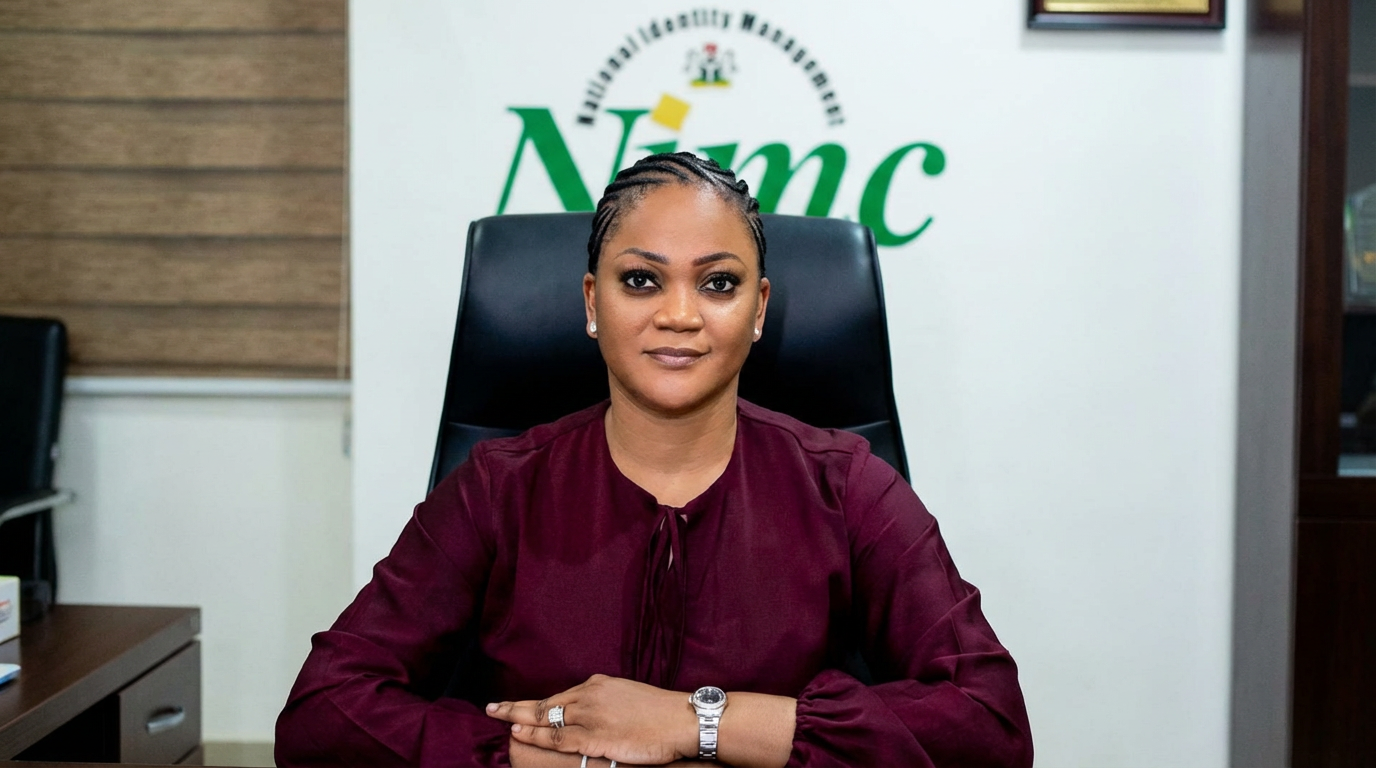
For millions of Nigerians, identity is more than a card or an 11-digit number; it is the gateway to modern life.
From opening a bank account to accessing government services, identity has become the invisible key that unlocks opportunity. Yet for years, distance, insecurity and weak infrastructure have left many citizens outside that gate.
This reality was addressed head-on by the Director-General of the National Identity Management Commission (NIMC), Engr. Abisoye Coker-Odusote, during a recent prime-time interview on ARISE Television in Abuja, where she outlined a renewed strategy to take national identity enrollment directly to Nigeria’s communities.
Speaking with clarity and urgency, Odusote said NIMC’s mandate goes far beyond the familiar image of registration centres and long queues.
“At the heart of what we do is the issuance of an 11-digit unique identifier, the National Identification Number (NIN), for every citizen and legal resident,” she said. “But that is only one part of a much broader mandate.”
According to her, NIMC operates on five key pillars: issuance of the NIN; development and protection of a secure national identity database; issuance of the General Multi-Purpose Card (GMPC); harmonisation of identity data across Ministries, Departments and Agencies (MDAs); and provision of authentication and verification services.

Of these, she noted, verification remains the most misunderstood—and arguably the most critical.
“A lot of people think our work is just about enrollment,” she explained. “But authentication and verification are central. That is what allows identity to function across banking, telecommunications, healthcare and governance.”
NIMC currently maintains about 1,200 offices nationwide, with state offices in every state, presence in most local governments, and co-location centres with sister agencies such as the Federal Road Safety Corps (FRSC). The Commission also operates within several ministry headquarters where public services are concentrated.
However, Odusote acknowledged that physical presence alone does not guarantee access.
“In parts of the country, particularly the North-East, travelling from one local government to another can take four to six hours,” she said, citing Borno State. “It is unacceptable that a Nigerian could be excluded from modern life simply because our system has not reached their community.”
This challenge underpins NIMC’s latest strategy: a deliberate shift from local-government-based enrollment to ward- and community-level access.
Backed by a presidential directive under President Bola Tinubu’s Renewed Hope Agenda, the Commission has been mandated to ensure universal enrollment without exclusion.
To achieve this, NIMC has partnered with the World Bank through the Identification for Development (ID4D) initiative. The collaboration allows vetted front-end partners to operate within Nigeria’s digital identity ecosystem, significantly expanding enrollment capacity.
“We do not have the capacity to reach every ward on our own,” Odusote admitted. “So we are partnering to take enrollment services directly into communities.”
She stressed that enrollment remains completely free.
“No one should pay to be enrolled. Nigerians should not have to spend money just to obtain an identity,” she said.
Beginning February 16, NIMC will roll out a six-week intensive community-level enrollment drive aimed at reaching previously unreached populations nationwide. Although permanent ward offices are not yet fully operational, the exercise is expected to significantly close access gaps.
To strengthen grassroots engagement, the Commission is collaborating with the National Orientation Agency (NOA), using translated materials in multiple local languages to communicate effectively with communities.
For Odusote, the goal is simple yet ambitious: to make identity universal, portable and functional.
“Identity should not be a privilege of geography,” she said. “Every Nigerian, regardless of where they live, deserves to be seen, recognised and included.”
She also highlighted reforms surrounding the NINAuth App and Nigeria’s legal identity framework. According to her, the NIMC Act of 2007 has been repealed and reenacted to reflect modern realities, incorporating provisions from the Cybercrimes Act and the Data Protection Act of 2023, which has already been signed into law.
These reforms, she explained, enable NIMC to operate in line with global best practices in cybersecurity, privacy and digital governance.
On verification, Odusote disclosed that over 2.2 billion identity verifications have been conducted since inception, largely driven by government and private-sector usage. However, the new focus is empowering individuals to control how their data is used.
This is where the NINAuth App comes in.
Designed under her leadership, the app serves as NIMC’s official digital identity authentication platform, allowing citizens and legal residents to securely manage consent-based verification of their NIN.
Rather than submitting photocopies or repeatedly sharing personal details, users can approve real-time verification requests directly through the app. NIMC says this significantly reduces identity fraud and unauthorised data access.
The app also restores data autonomy by allowing users to decide what information is shared, with whom, and for how long—aligning Nigeria’s digital identity system with global data-privacy standards.
With NINAuth, verified credentials can be reused across multiple sectors, including telecommunications, banking, education, immigration and government services, reducing delays and administrative costs.
As Nigeria advances toward digital governance and economic inclusion, NIMC’s community-focused approach signals a quiet but transformative shift—one that recognises national development begins with recognising every individual, one doorstep at a time.

