 Follow Us on Google News
 Follow Us on Google Discover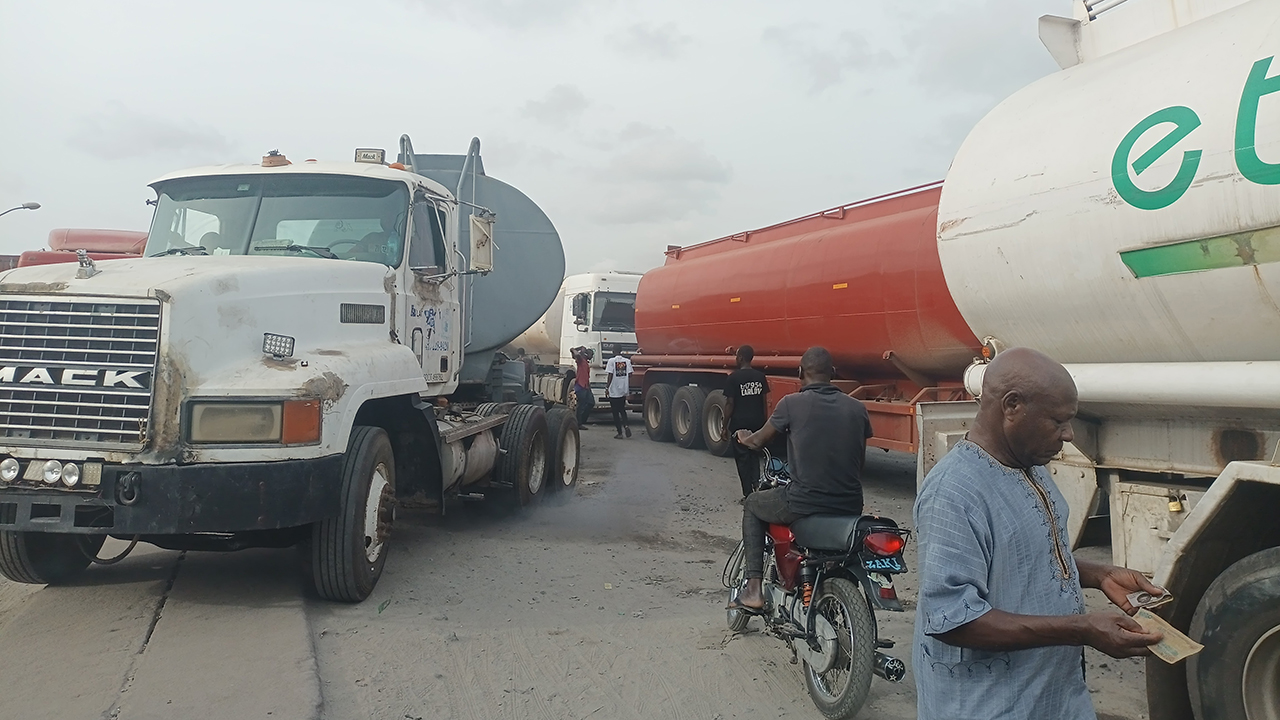

• Operators seek holding bay, electronic call up to address issue
Attempts to free the port corridors for seamless passage of import and export cargoes have remained futile owing to the indiscriminate parking of petroleum containers along the Lagos ports’ access roads. Checks by The Guardian showed that petroleum tankers parked indiscriminately in their large numbers from Mile 2 to the Coconut end of the Tin Can Island port on the expressway down to Apapa.
[ad]
This parking has, however, prevented import and export containers with their electronic call up numbers from accessing the ports on time, thereby frustrating the government’s effort at making the nation’s port viable for global trade after addressing container trucks’ illegal parking.
Government has implemented several interventions to free the ports’ corridors to allow seamless passage of cargoes.
Also, to address the obstruction of tankers, the Governor of Lagos State, Babajide Sanwo-Olu issued an ultimatum to tanker drivers to vacate the Oshodi-Apapa Expressway, but the drivers have remained defiant to the order.
Port users are lamenting that the obstruction is causing them financial losses to the tune of N450, 000 daily. The General Secretary, Association of Bonded Terminal Operators of Nigeria, Haruna Omolajomo, said the tankers are causing delay of cargoes entering the ports or getting to the owners, noting that a trip of just three hours now takes two or more days because of this obstruction.
He said this delay has caused great loss to importers, agents and transporters, adding that due to this obstruction on a daily basis, the loss can be between N100 million to N450 million.
Omolajomo said importers would be made to pay for unnecessary demurrage for both terminal and shipping companies as well as lose their container deposits worth millions of Naira due to inability to return containers on time to the shipping companies.
He also added that many valuable jobs, employment and services are lost because of this obstruction, especially when agents, importers and transporters cannot meet up with the expected timeframe or deadline given.
[ad]
“It also makes the tariff for hiring trucks to be on the higher side. Can you imagine a truck that ought to be hired at N250, 000 ordinarily for a journey from one point to another can now be N550, 000 due to fuel consumption. All these unnecessary demurrage and expenses will be added to the clearing cost and passed to the end users who are the consumers. This is one of what is responsible for the high cost of living in the country,” he explained.
On factors leading to the obstruction, Omolajomo listed human factors such as excessive recklessness of the drivers who are highly intoxicated, influential or powerful owners or cabals, road construction and the unnecessary extortions by the taskforce area boys.
He said it is very painful that despite traffic laws to have free road movement there is still very poor enforcement, noting that all hands must be on deck to ensure free access of roads in these corridors.
The Administration Secretary, Association of Maritime Truck Owners of Nigeria (AMATO), Mohammed Sani, stressed that the activities of tanker drivers is causing serious obstruction to free movement of port-bound containerised trucks.
He said this is really affecting their seamless movement because the tanker owners do not have a call-up system to plan and schedule their movement to their respective depots.
“They will just come and park on the road and cause obstruction and at slight provocation, they will start fighting and threatening to embark on strike. Due to all these blockades, trucks with Eto call up that are released from pre-gate cannot access the port on time. In the course of struggling to access the port due to blockade by tanker drivers, the importer’s Terminal Delivery Order (TDO) will expire. That is the loading paper.
“At some point, the owner of the TDO of the jobs will not be patient with the delay and withdraw their TDO from these containerised truck drivers, which causes serious financial loss” he said.
Speaking on the financial loss, Sani explained that if a container truck driver is dispatched to the port with the high cost of diesel and then given N60, 000 or N80, 000 to buy a ticket, it would be a waste by the time the import withdraws his TDO.
[ad]
“You book your electronic call up for N21, 000 and spend about N130, 000. At some extortion point you settle people, you spend close to N150, 000 to get to the port and activities of all this tanker driver blocking the road will just come and frustrate the movement plan,” he stated.
Sani said there is a need for the government to provide satellite parks or truck transit parks for all tankers where the movement will be managed into their respective depots rather than park on the roads.
The Executive Secretary of the National Association of Road Transport Owners (NARTO), Aloga Ogbodo, explained that there were underlying reasons for the presence of tankers on Lagos roads, noting that the drivers were not at fault, but were operating in response to the prevailing circumstances.
Ogbodo lamented that the major challenge faced is the non-functionality of many depots due to pipeline vandalism, stressing that if these depots were operational, tanker trucks would not need to cover long distances and pay higher transportation costs.
According to him, there are approximately 30 petroleum product depots scattered throughout the country. Ogbodo highlighted that the government’s regulations required depots to have adequate truck-holding bays, which many depots lacked. He said this has contributed to the parking challenges on Lagos highways.
The Chairman of the Nigeria Union of Petroleum and Natural Gas Workers (NUPENG), Tayo Aboyejo, denied allegations that tanker drivers are responsible for the road blockage, stating that those on the road were going to depots to pick products.
He also disclosed ongoing discussions with the government about implementing an electronic call-up system to regulate depot access, which he said could potentially alleviate future traffic congestion caused by unregulated tanker access.
[ad]

