 Follow Us on Google News
 Follow Us on Google Discover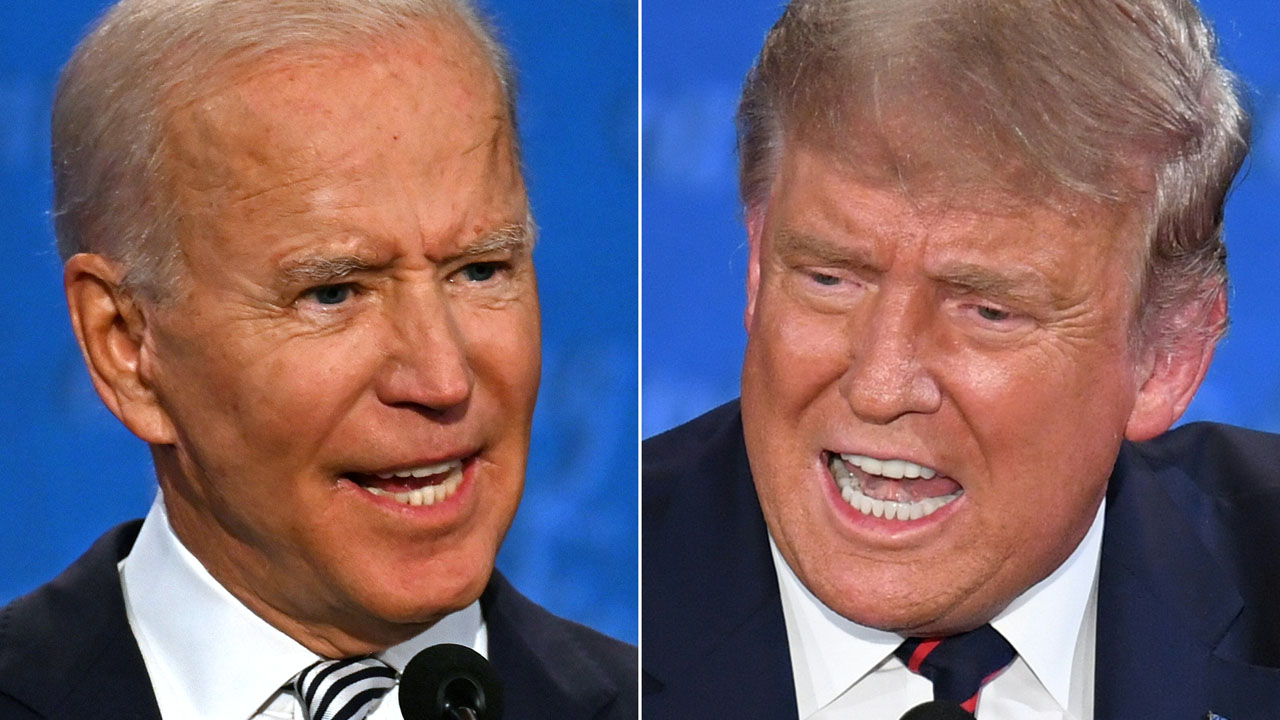

The ongoing trial of former American president, Donald Trump and the attempt to impeach President Joe Biden over litigation involving his son, Hunter, illustrates how important accountability and equality before the law is critical to good governance. This is at variance with the sacred cow mentality that obtains in Nigeria and the rest of Africa, NGOZI EGENUKA reports.
Former American president, Donald Trump, has in recent times been facing a series of legal examinations relating to his political and business careers, at both state and federal levels.
[ad]
These investigations have now led to him being sued by the New York attorney general and indicted in four separate cases: two brought by the special counsel, Jack Smith, one by the Manhattan district attorney, and the latest coming from local prosecutors in Georgia.
These legal scrutinies imply that Trump will be on trial for much of next year, in the thick of the presidential campaign, an election he intends to contest.
Recently, America’s Supreme Court was asked to decide whether the former president can be prosecuted for crimes he allegedly committed while in office.
Smith, the special counsel overseeing two criminal investigations into Mr Trump, asked the court for a quick ruling on whether he is immune from federal prosecution.
The court later agreed to consider his request and asked Mr Trump’s legal team to file a response by December 20. The judge, however, gave no indication of how, or when the court would ultimately rule on the matter.
Trump is scheduled to stand trial in March on federal charges relating to an alleged plot to overturn the 2020 election results. But his lawyers have repeatedly argued that the former president cannot face criminal charges for conduct relating to his official responsibilities.

That argument, however, was rejected by a lower court judge earlier last month who ruled that the case could go ahead as planned. Mr Smith’s rare direct request to America’s highest court on Monday was an attempt to leapfrog the lower courts and avoid any delays to the scheduled March 4 trial date.
The trials began in October, with the civil action filed by the New York attorney general, Ms Letitia James, which is the culmination of a four-year battle between the Trump family, and the attorney general, who sued Mr. Trump, his adult sons, and their company, accusing them of fraudulently inflating the former president’s net worth by more than $2 billion to suit the needs of their business.
[ad]
This case might have the capacity to hinder his ability to do business in the state, as Ms James is seeking $250 million in penalties, and a ban on Trump doing business in his home state.
Trump is the first former American president to be charged with a criminal case. The criminal cases carry even more serious repercussions as he could face years behind bars.
The Georgia case, filed on August 14, leveled the most extensive accusations yet against the former president, who was charged with orchestrating a “criminal enterprise” to reverse Georgia’s results in the 2020 election, and subvert the will of voters. He was charged alongside 18 of his lawyers, advisers and supporters as part of a sweeping racketeering case.
The election interference case, which Judge Tanya S. Chutkan would oversee, is set to go to trial in March next year at the Federal District Court, Washington.
The case, brought by the Fulton County district attorney, Fani T. Willis, was the fourth and perhaps final indictment of Mr. Trump.The indictments began in March, when the district attorney, Alvin L. Bragg, filed 34 felony charges against Mr. Trump, relating to what prosecutors described as a hush-money scheme to cover up a potential sex scandal and clear his path to the presidency in 2016.
The first federal case came in June as part of the special counsel’s investigation into Mr. Trump’s handling of classified documents and whether he obstructed the government’s efforts to recover them after he left office.
In that case, Mr. Trump faces 40 criminal counts: 32 related to withholding national defence information, five related to concealing the possession of classified documents, one related to making false statements and two related to an effort to delete security camera footage at Mr. Trump’s Mar-a-Lago estate, where he stored the documents.
INTERESTINGLY, incumbent president, Joe Biden, also has his travails to contend with as Republicans in September led an impeachment inquiry on him, detailing foreign payments to members of his family in their first hearing. They did not, however, provide any evidence that the Democratic president had personally benefited.
The initial impeachment hearing by the U.S. House of Representatives Oversight Committee served as a review of evidence that Republicans have gathered so far about foreign business ventures by Biden’s son, Hunter, 53, which they say shows that Biden’s family members were selling access.
[ad]
Recently, Chairman, House Oversight Committee, Rep. James Comer of Kentucky, subpoenaed Hunter Biden. In response, Hunter refused to give closed-door testimony but said he would answer any pertinent and relevant question in front of the Committee.
These trials are a testament to the fact that there is a system of accountability in America. However, this can’t be said of African countries, which have been experiencing various coups in recent times as the people revolt against bad governance while demanding accountability, including Nigerians.
The American system seems to be a worthy example for nations like Nigeria to learn from, especially if it intends to play the right political game, which would lead to its development.
One thing is sure from these trials. The place of accountability and rule of law in democracy cannot be separated. Nigerian leaders need to draw lessons from the ongoing trials to implement at all levels of governance. With such systems in place, Nigeria can surely become the giant of Africa, which it claims to be.
Speaking on the lessons of these trials, Professor of International Relations and Strategic Studies, David Aworawo, said democracy and the rule of law go together, as having democracy without rule of law would be greatly diminished and its essence lost.
“That has played out in the trial of Trump. Trump is rich, influential, and a former president, yet Americans had to allow rule of law to take its course. There are many who think that bringing Trump to justice is stirring the hornet’s nest, trying to disrupt the system, but Americans insist that everyone should be equal before the law. They would investigate the case and if they establish anything against him for which he needs to face justice, he will face justice,” he said.
According to him, powerful people in Nigeria tend to be above the law and authorities do not bring them to justice. Aworawo emphasised that while the nation is trying to consolidate its democracy, it must allow the rule of law to take its course such that nobody should be above the law.
“If anybody has committed an offence against the state or infraction, the fellow must be brought to justice,” he said. Nneka Chris-Asoluka, a lawyer, said that the existence of strong institutions in America is the major factor that makes their systems work.
“This is unlike Nigeria, where we have weak institutions, and the ruling party has the judiciary, legislature and even security forces in its whims. Britain and America exemplify democracy, which Nigeria is not practicing,” she said.
For Research Professor of International Relations and Strategic Studies at the Nigerian Institute of International Affairs (NIIA), Lagos State, Prof. Femi Otubanjo, the trial shows that no one is above the law, which is a testament to what a society should be – where the rules and laws protect everybody and manage relations among people to prevent conflict, where one person’s action does not take away the other person’s opportunities.
“The lessons to learn from this is that our leaders and everyone must be accountable. Nobody is above the law. The fact that Biden is president does not exonerate his son or himself from criminal liability and that is what we should be doing,” he stated.
According to him, the story about the Nigerian president’s son flying a jet in the Presidential Fleet to watch a polo match in Kano is not the kind of story that should happen in the kind of society that we want, neither is it what the masses expect from the government. It is “scandalous to do so in the country where people are struggling. We expect a more sober approach to governance, and we want discipline, transparency, and honesty,” he added.
[ad]
Foreign Affairs Analyst, Henry Ugwu, said the cases involving the former and present American presidents are an indication that in any democracy where the rule of law is sacrosanct, nobody is above the law.
He, however, lamented that such occurrences would not likely happen in Nigeria since no concrete steps have been taken to properly investigate and prosecute former presidents that have had series of alleged corrupt practices leveled against them over the years. He explained that such actions show that the criminal justice system in Nigeria is inferior to certain highly placed individuals in the country.
“This manifestly blemishes the principle of rule of law in Nigeria, as all individuals are not subject to the same law. This is why the numerous calls from many quarters for a reform of the criminal justice system are imperative. A system where it is believed that certain individuals are superior to the law cannot build credible institutions that enhances justice. There is a dire need for critical reforms in the Nigerian criminal justice system,” Ugwu argued.
A former president, Chartered Institute of Bankers of Nigeria (CIBN), Mazi Okechukwu Unegbu, insisted that in Nigeria, there is no difference between a sitting and ex-president, where none of them faces disciplinary action on failures during their administration.
“If it were in Nigeria, Trump would have walked away freely. Also, if it were Biden’s son that used the presidential jet for personal purposes like Seyi Tinubu did, there would have been repercussions, which would even affect the Biden Presidency,”
Unegbu said, adding that the media also aids such malpractices when it becomes manifestly partisan.
[ad]

