 Follow Us on Google News
 Follow Us on Google Discover
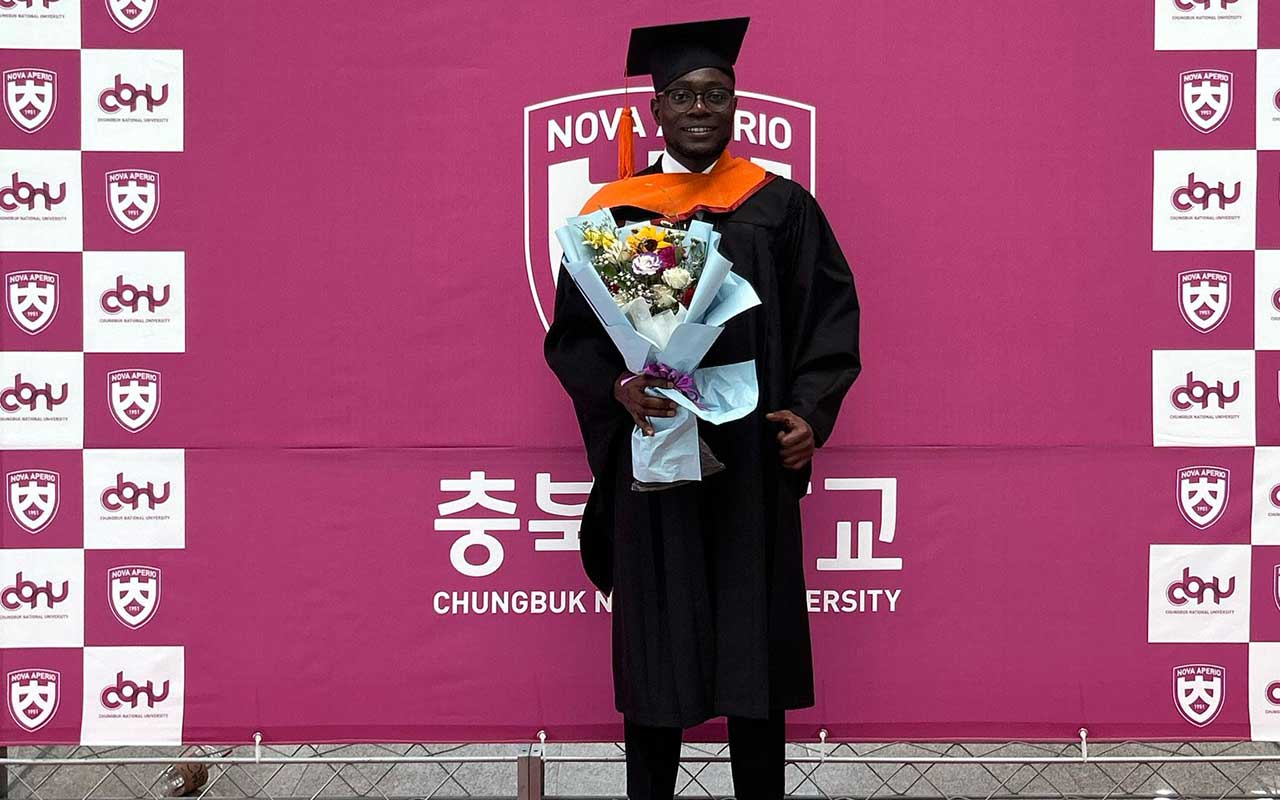 As the global construction industry embraces digital transformation, Samuel Olatunbosun is at the forefront of pioneering safety and automation solutions.
With a strong academic foundation in Architectural Engineering and Quantity Surveying, Olatunbosun’s research bridges the gap between human cognitive performance and construction safety.
[ad]
His work in neuroergonomics, construction automation, and extended reality is shaping modern safety protocols, making construction sites safer and more efficient.
Olatunbosun, who earned a Master of Science in Architectural Engineering from Chungbuk National University in South Korea, specializes in construction informatics, safety analytics, and digital construction technologies. His academic journey also includes a Bachelor of Science in Quantity Surveying from Obafemi Awolowo University, Nigeria, and an Associate Degree from The Polytechnic, Ibadan, where he graduated as the best student in his department.
“My passion has always been to ensure that construction workers operate in the safest conditions possible,” Olatunbosun said. “By leveraging physiological monitoring, artificial intelligence, and immersive virtual environments, we can enhance safety training, predict hazards, and ultimately save lives.”
His research has significantly contributed to understanding the cognitive and physiological responses of construction workers to high-risk site conditions.
As a researcher at Sungkyunkwan University’s College of Engineering for Built Environment Research Center, he has explored how sounds from safety hooks can determine the safety status of workers, an innovative approach to real-time hazard detection.
Olatunbosun’s work on fall-risk prediction using multi-physiological signals has gained attention in the academic and professional construction communities.
By using electroencephalography (EEG) to monitor workers’ cognitive performance, he has developed new ways to assess mental workload and fatigue, reducing the likelihood of accidents on construction sites.
His contributions have been published in leading journals such as Applied Acoustics, where his studies on noise frequency effects on mental workload have provided data-driven insights into workplace stressors. His research into virtual reality (VR)-based safety training has also demonstrated how immersive simulations can enhance workers’ decision-making skills in hazardous environments.
[ad]
Beyond research, Olatunbosun has played a crucial role in mentoring students and professionals.
As a teaching assistant and research mentor, he has guided undergraduate students in research projects, data analysis, and technical writing, fostering the next generation of construction safety experts.
His expertise extends to industry applications, having worked as a Quantity Surveyor at Adron Homes & Properties and as an intern with KOBO Quantibuild & Partners in Nigeria.
Olatunbosun’s dedication has not gone unnoticed. He has received numerous scholarships, research grants, and academic excellence awards, including the prestigious Graduate Student Research Challenger Grant of $4,600. He is also a member of the Korea Institute of Construction Engineering and Management (KICEM), where he actively contributes to global discussions on construction innovation.
“My goal is to integrate cutting-edge technology into the construction industry in a way that prioritizes worker safety,” he said. “The use of AI-driven safety analytics, neuroergonomics, and extended reality will redefine how we monitor and mitigate risks in construction.”
His research into EEG-based cognitive monitoring has been particularly groundbreaking. By measuring brain activity, he has developed models that predict when workers are at higher risk of making errors due to fatigue or stress, offering a proactive approach to accident prevention.
With the increasing adoption of automation and digital tools in construction, Olatunbosun believes that technology should be leveraged to not only enhance efficiency but also protect the workforce. His research has highlighted how integrating biometric sensors with safety gear can provide real-time insights into a worker’s physical and mental state, paving the way for smarter and safer construction sites.
Looking ahead, Olatunbosun aims to expand his research into artificial intelligence-driven safety protocols and the role of human-robot collaboration in construction. “The industry is on the brink of a major transformation,” he said.
“By combining AI, robotics, and physiological monitoring, we can create a construction environment that is not just efficient, but truly safe.”
[ad]

