 Follow Us on Google News
 Follow Us on Google Discover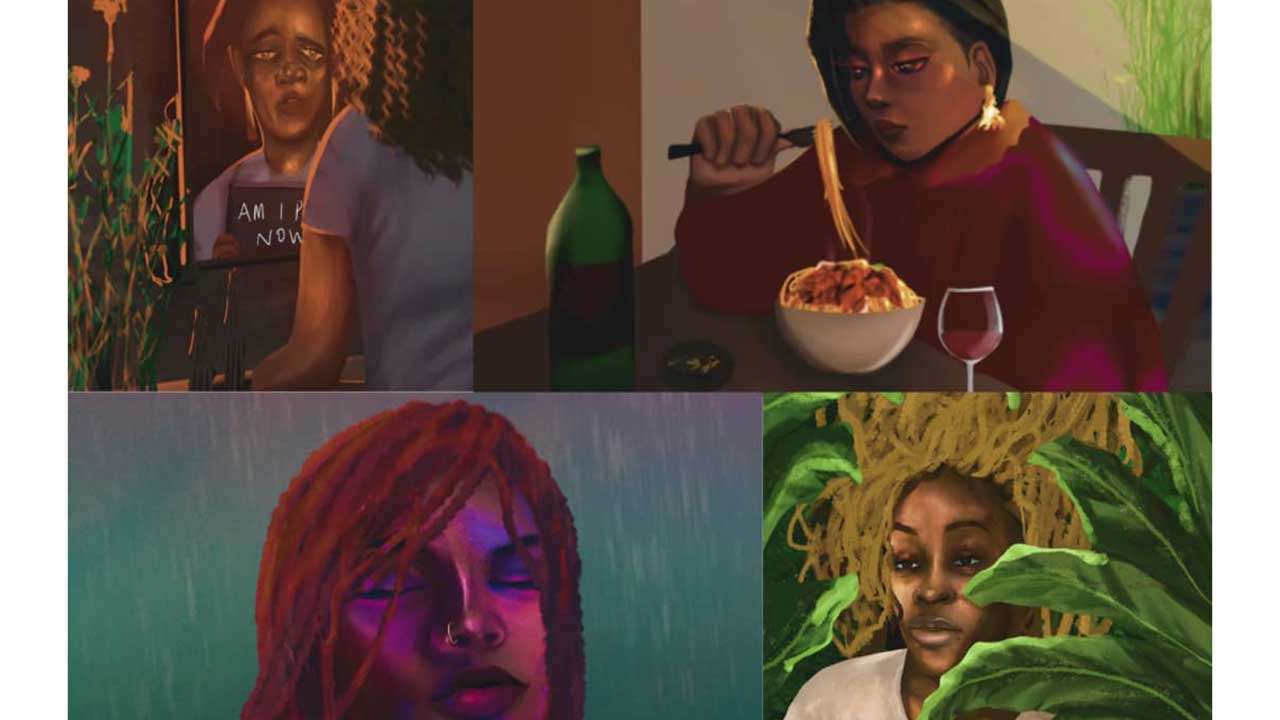
Balafaama Princewill’s paintings are dispatches from the frontlines of modern youth, a sentiment first captured with aching clarity by art critic Oyedele Alokan. Through her work, Princewill speaks on behalf of a generation raised on individuality, hashtags, and the quiet terror of never being enough. There’s an intimacy to her art that never turns inward too far, a refusal to indulge even as she lays bare the raw pathologies of our era: body dysmorphia, algorithmic loneliness, the ceaseless labour of becoming and creating.
Alokan described her portraits as “fever dreams,” and it’s true, they shimmer with a haunting beauty, confessional yet composed. Her technique slips between mediums like her subjects slip between selves: ink and charcoal sketches that tremble with life, oils that glow like backlit screens, digital renderings so tactile they invite you to reach out, to smudge the pixels, to prove they’re real.
These works form part of Balafaama Princewill’s 2024 exhibition ‘Good Things Take Time,’ a deeply introspective body of work that debuted in Lagos. The exhibition chronicles a journey of self-discovery through a series of digital paintings that explore beauty standards, emotional resilience, and the quiet rebellion of self-acceptance. Each piece builds upon the last, presenting vulnerability not as weakness, but as an act of resistance.
‘Good Things Take Time’, takes on the necessary human journey of self-acceptance. This series, created digitally yet retaining the careful finesse of hand-drawn works, employs overwhelmingly deep hues to create stark contrast. The subject in the series undergoes self-hate and negative self-talk within “Am I Pretty Now”, which portrays a morose young woman applying makeup in front of a mirror. This particular work serves as a commentary on social beauty standards and the apparent caste system that seems to dictate favour and opportunities as a direct result of pretty privilege and sex appeal.
The next image in the series is ‘Lingering Solace’, a painting that portrays a young woman alone in her room. She eats noodles and has a glass of half-drunk wine right beside her. Just by the plate is an ashtray with cigarette stubs. The room is barely lit, with only natural light coming from outside; yet, there is an intense golden glow in the lady’s outline, as well as in her earring. “I depict a moment of weariness and resignation, where I’m just existing, feeling exhausted and overwhelmed by societal expectations,” Balafaama reveals in her artist statement. Good things take time; every rebirth is time-conscious, and one should be able to experience and live through the process.
Balafaama’s third painting, Harmony Hues, is a breathtaking visual allegory for transformation and self-discovery. The imagery of a long-haired woman emerging from the water during rainfall evokes themes of rebirth, fluidity, and the merging of elemental forces, water and sky. The interplay of violet and purple light on her face suggests introspection, mysticism, and the awakening of higher consciousness. At the same time, the green aurora-like mist on the horizon symbolises growth, renewal, and the vast, uncharted potential of the self.

The description of the piece as ethereal and otherworldly reinforces the idea that authentic self-exploration transcends the mundane; it is a cosmic journey, as deep as the ocean’s abyss and as infinite as the void of space. The notion that self-discovery is a lifetime journey mirrors the philosophy that art, like identity, is never static; it evolves, shifts, and reshapes reality.
Most striking is the assertion that becoming is the only way to change the world. Implying that transformation is not just personal but universal. The painting, then, is not just a depiction of a woman rising from water, but a manifesto: to embrace the unknown within oneself is to alter the fabric of existence.
Balafaama’s final painting in the ‘Good Things Take Time’ series, aptly titled ‘I Like Myself Now,’ is a powerful, introspective conclusion to her journey of self-discovery, one that resists the grand narrative of “changing the world” and instead lands on the quiet, radical act of self-acceptance.
The composition, a woman lying in a field of green grass, hands resting on her chest with a thousand-yard stare, captures a moment of exhausted relief. She is not triumphant, nor is she performatively joyful. Instead, there’s a rawness to her expression: she seems traumatised yet resolved, as if the journey to self-love was less a euphoric revelation and more a hard-won survival. The absence of a smile tells this isn’t a fairytale ending; it’s real.
Balafaama’s statement “I’ve learned to love and accept myself unconditionally” frames the work as a testament to patience and perseverance, yet the subject’s gaze suggests something unresolved. Is she plotting her next move? Is she simply too tired to celebrate? Or is she realising that self-acceptance is not the end, but the foundation for something greater?
The ambiguity here challenges the viewer to question whether true transformation ends with the self or if it’s merely the first step toward broader change. The grass beneath her, lush and alive, could symbolise rebirth but also the cyclical nature of growth. Balafaama’s presence in major exhibitions from Dak’Art Biennale to NFT showcases and Afrofuturist collections positions her as a vital voice in contemporary art, particularly in narratives around Black womanhood, digital identity, and introspection. Her work bridges the personal and the collective, making private struggles universal through evoking imagery.
Writer’s bio: Oyedele Alokan is passionate about culture and the arts. He uses his thoughts on artworks to draw attention to larger socio-economic phenomenon. He’s an editor at TheBlotted.com

