 Follow Us on Google News


 Follow Us on Google Discover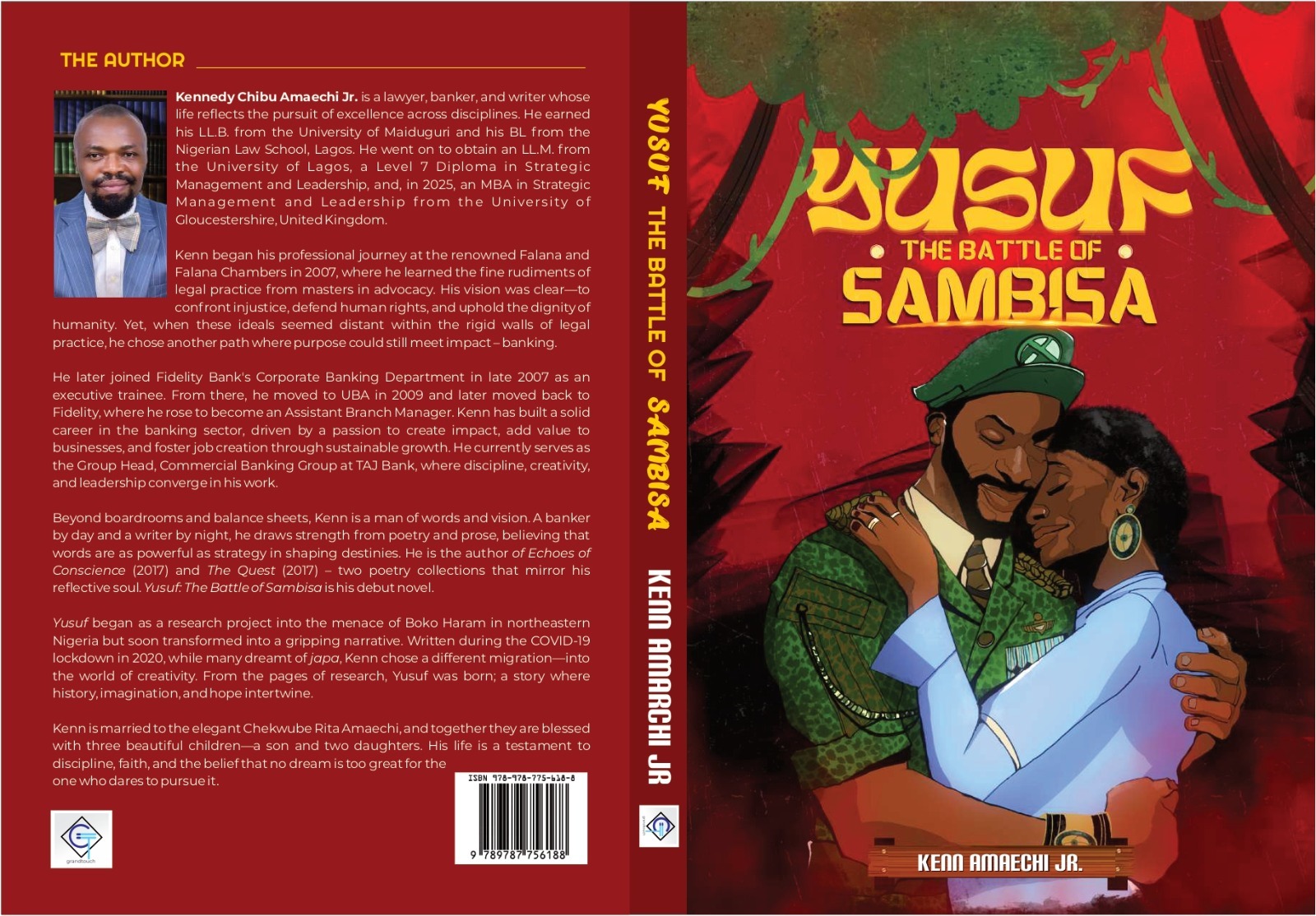
Love survives insurgency in Amaechi’s Yusuf, yet its politics of hero-worship risks oversimplifying Nigeria’s hardest questions.
Nigeria today feels trapped in a cycle of corruption, insecurity, and longing for saviours. Citizens distrust politicians, grow weary of hollow promises, and cling to the fantasy of incorruptible leaders. Kenn Amaechi’s Yusuf enters this atmosphere with striking relevance. Yusuf is an ambitious novel that mixes romance, faith, and insurgency with a grand vision of redemption. It traces the rise of Yusuf Nehemiah, a principled soldier who rises from personal loss and political betrayal to national leadership. On the surface, the novel reads like a patriotic anthem; beneath, it is an uneasy negotiation between idealism and reality, often faltering under the weight of its own ambitions.
At its core is the love story of Yusuf and Maryam. Their university romance, portrayed with a deep understanding of Nigerian campus life, grounds the narrative in intimacy. Maryam’s devotion, throughout Yusuf’s abduction, injury, and near death, provides the book with its tenderest moments. On one hand, Yusuf contemplates the loss of his leg while on the other, Maryam clings to the hope of his survival. Amaechi captures their vulnerability with tenderness, showing love not as a distraction from politics but as an act of quiet resistance. These sections are powerful, and they prevent the novel from being swallowed by its darker themes.
As the novel shifts from personal affection to public turmoil, the ideological seams become evident. Amaechi shows how corruption is more than bribery. It is the infection of conscience that eats away at institutions and people alike. Yusuf’s refusal to falsify the story of his captivity demonstrates the courage the author wants us to admire. Here, the book touches something raw and true. Within a narrative that mirrors reality, the reader recognises the cowardice of leaders who profit from disorder while citizens bleed. Amaechi captures this mood of distrust with sharpness and sincerity.
The problem emerges when the narrative simplifies the political landscape. Corruption is drawn as absolute. The elites fund terrorism. The soldier is incorruptible. The story then rests on a binary that flattens reality. Nigeria’s insurgency is fed by poverty, ideology, and foreign interference as well as elite manipulation. To imagine that one man could rescue the nation by sheer virtue turns a complex struggle into myth.
This oversimplification is most troubling in the climax. The coup that delivers Yusuf to power is presented as redemptive. Yet in a country scarred by military interventions, this is reckless. The suggestion that democracy is beyond saving and only a soldier-saint can cleanse it is seductive but dangerous. Amaechi is not wrong to capture the public disillusionment with democracy, but to present a coup as the path to justice erases the need for institution-building and civic responsibility.
Religion adds another dimension. Yusuf’s personal struggle with faith and his uncle’s push toward conversion could have been the ground for a rich and unresolved exploration of identity in northern Nigeria. Instead, the novel slips into moral instruction. Characters speak in neat resolutions rather than wrestling with uncertainty.
This weakens narrative tension and risks alienating readers who expect fiction to inhabit ambiguity. Nigeria’s religious life is messy, contradictory, and full of friction. The novel gestures toward this but too often retreats into closure.
The prose itself reflects this unevenness. At times, it is lyrical and evocative. At others, it lapses into sentimentality. For example, the repeated declarations of Yusuf and Maryam’s love drag across pages and dull the emotional impact. In contrast, when Amaechi writes about the political economy of terror, his language sharpens.
A passage describing insurgents as tools in the hands of cynical politicians has more bite than the love story ever achieves. The imbalance suggests a writer torn between romantic melodrama and political critique, unsure which should carry the greater weight.
Yet the book resonates. It taps into the yearning for a Nigeria freed from deceitful elites, for leaders who embody honour, for justice that feels possible. The final vision of Yusuf reunited with Maryam and crowned as a fair leader is stirring. It will appeal to readers who want literature to offer hope. But literature also thrives on unsettlement. In choosing to give us a saviour, instead of a system, Amaechi risks reinforcing Nigeria’s dangerous appetite for messiahs.
Bold, heartfelt, and flawed, Yusuf reflects our deepest hopes yet avoids our hardest realities. The question it leaves behind is one Nigeria must face: does the nation need saints, or does it finally need systems?
* Zainab is a lawyer and the author of a poetry collection, ‘Sycamore’.

