 Follow Us on Google News


 Follow Us on Google Discover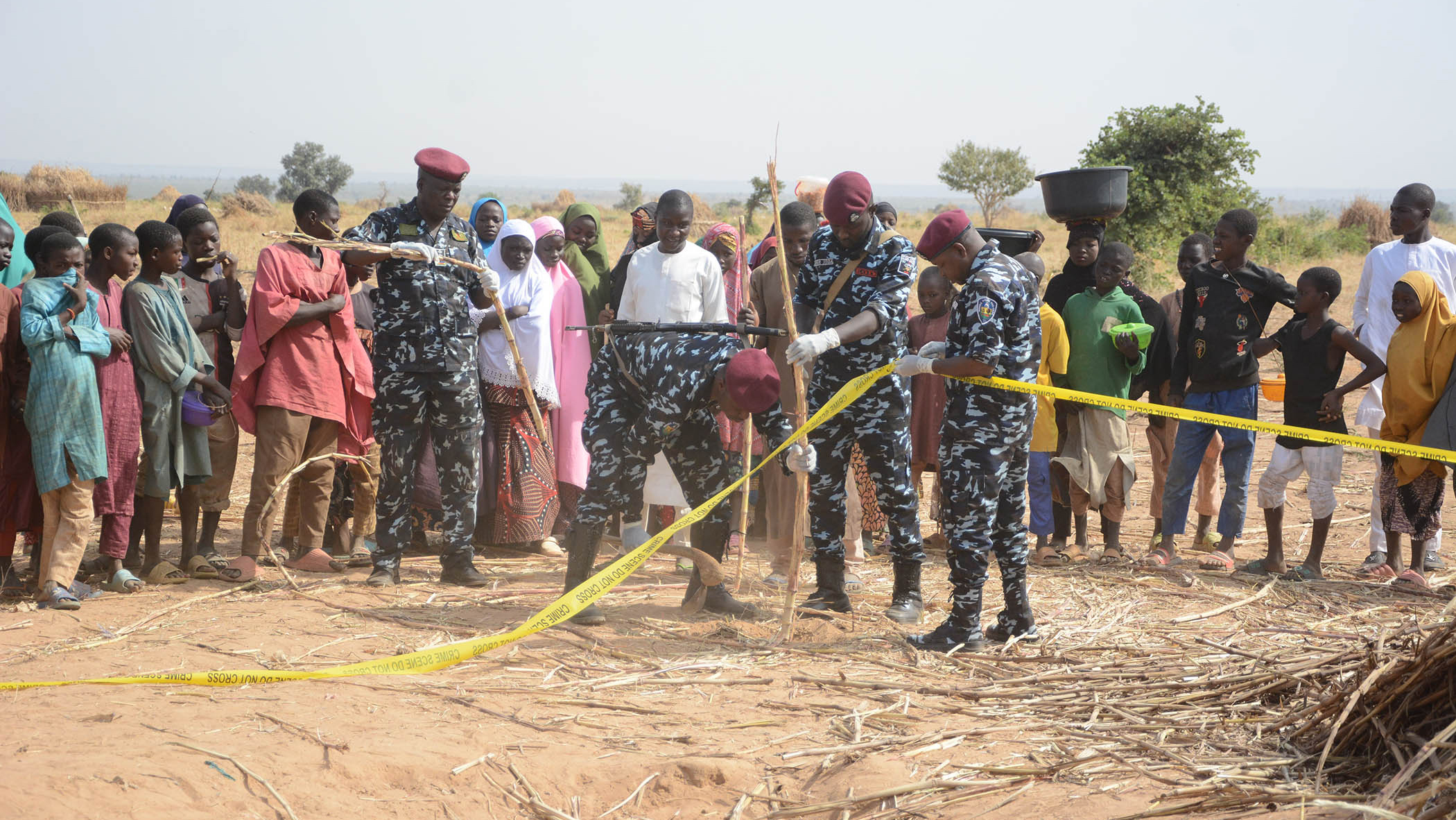
• Residents Say No History Of ISIS In Their Homeland
A day after part of a missile fired by the United States dropped unharmed in his village, HRH Garba Aliyu, the paramount leader of the Jabo community in Tambuwal Local Council of Sokoto State, sat on a cushion-covered chair at his palace alongside his subjects.
For a moment, he joined his traditional council to reflect on the incident that caused confusion and panic among residents and on how the community would adopt safety measures in the aftermath.
The meeting was part of marathon consultations with his subjects on how to address the fears and tensions that have gripped the community since the US-backed airstrike landed on their soil the previous night.
The Guardian’s visit to the community revealed that a projectile struck a field approximately 400 metres from the Primary Health Centre. While there were no casualties, the incident caused fear and panic among residents.
Aliyu, while narrating the incident, said the news of the deadly airstrike on the peaceful community, coupled with President Donald Trump’s Christmas genocide narratives, has affected the community’s image and future perception on the global scene.

“My community is still struggling to make sense of the explosion on that fateful night. We have always lived a quiet existence. We are predominantly Muslims but accommodate all religious faiths, including Christians,” he told The Guardian.
Accounts of the Aftermath
At about 10:00 p.m., Abubakar Nasiru, a resident of Jabo in Tambuwal Local Council of Sokoto, Northwest Nigeria, was preparing to lie down after a stressful day at work when he suddenly heard a blast, followed by flames as a projectile flew overhead. Soon after, it crashed and exploded on a vast farmland, sending villagers fleeing in fear. “We’ve never seen anything like this before,” Nasiru told The Guardian during a visit to the community the penultimate week.
Many residents who interacted with The Guardian said they are yet to recover from the loud bang caused by the explosion. Sani Jabo, a 35-year-old who witnessed the explosion, said his house is just a few kilometres from the scene of the explosion. He described the scene as terrifying. “As it approached our area, the heat became intense. Our rooms began to shake, and then fire broke out.”
Nuhu Umar Jabo, who cultivates the farmland where the explosion occurred, said the global attention drawn to the Jabo community saddened him deeply. “My town has always lived in peace and harmony, and unfortunately, such an incident occurred in our community and has drawn global attention,” he said.
Residents turn explosive site into mining
Amid the shock expressed by residents, many were seen scavenging fragments of the explosive debris as valuable scrap. Some villagers admitted that the fragments were being hidden in homes with plans to sell them later to scrap dealers.
“Unfortunately, I have seen pictures showing that some people had already come into close contact with the debris,” said Sani Jabo, a resident of the community. He said the practice reflects a deeper crisis rooted in poverty, lack of awareness, and the absence of immediate government intervention following the explosion.
“Despite the risks, our young people still picked through the debris without protective gear, unaware that unexploded or contaminated fragments could still pose danger.”
A community leader, Garba Jabo, said ignorance plays a major role. “With no clear communication on the hazards associated with explosive remnants, people were treating the debris as if it were gold.
“My major concern is for those who picked up the scraps. Their identities are still unknown to us, and they are not supposed to have such materials. These remnants may still contain chemical substances hazardous to human health.”
Nura Jabo believes health risks are associated with exposure to explosive debris, especially for women and pregnant persons. “Such exposure is unsafe, and experts should handle the situation,” he said.
The Lakurawa emergence
Before the US airstrike that targeted the terrorists in the Tangaza forest, believed to be the Lakurawa’s den, previous media reports were often awash with reports of bandits’ attacks in the communities alongside two local councils of Isa, Sabon Birnin, and all of the border communities with the Niger Republic on the eastern part of the state.
While both Isa and Sabon Birnin were reigned and terrorised by armed bandits, Tangaza, a predominantly Fulani extraction with a population of roughly 10,000, is controlled by Lakurawa insurgents.
According to residents’ accounts, the insurgents were earlier known as herdsmen believed to be Malians who reside in a forest in the Niger Republic, sharing a border with the Gudu and Tangaza local councils of the state.
“They were herdsmen who are annual visitors to the nearby forest bordering the two local governments with their cattle and always stay in the forest in the Niger Republic.” Nura Tangaza explained.
A few years later, the number of their cattle increased exponentially this year to about 3,000 from the usual figures of less than 1,000. It was discovered that they are not known to be violent.
Residents interviewed by The Guardian say that in the early years, the Lakurawa members occasionally go into the communities to procure food and other essentials and returned to the forest. In 2018, disturbing reports had broken out in some communities across Tangaza, suggesting that certain armed group carrying sophisticated weapons is currently in control of the council and applying ‘strange laws’ and punishing defaulters. But police command in Sokoto, the state capital, was quick to dispel the development despite it being widely reported in the media.
Mutual accords that went sour
Multiple accounts from the residents say the armed group was invited by their leaders after experiencing multiple cattle rustler attacks on their livestock by armed bandits. They recount how only ten members of the armed group were invited for security purposes, but they ended up mobilising others to terrorise the communities.
“What actually happened was that our communities were infringed upon by the activities of armed bandits from Zamfara State; we were inundated with cases of kidnappings, cattle rustling, and our Nigerian security forces were not doing much to curtail the situation,” Nura Tangaza said.
“So, our people were fed up and decided to contact these people, whom we all know as a vigilance group. “The invitation became necessary when some armed bandits kidnapped our community leader (village head).
Another account from a community leader, Abubakar Dangaladima, recounts how the Lukurawa had solved the persistent banditry activities in the communities that were vulnerable to attacks.
He said the group was invited after police failed to rescue the victims. “Our leader was rescued alive, and we also recovered all our cattle and sheep stolen earlier by these bandits.
“Along the line, we accommodated them and even gave out our daughters to them in marriage. We also agreed to contribute some stipends for their welfare since they are now our guests as security guards.”
Residents say all these were pre-arranged on just mutual understanding and in appreciation of their defence drive. But suddenly, they broke this understanding and started going beyond their mutual agreement with their host communities by becoming violent. Now, they are forcing us to pay some levies without our volition. People with cows pay as high as N500, and those with rams pay N200,” Sani Usman, another resident, explained.
Currently, the Lakurawa members have continued to reign in the nearby forest and occasionally move from home to home preaching Islamic teachings, forcefully collecting alms (Zakat), and killing any defaulters.
‘No history of ISIS activities in our community’
On claims of Christian genocide, the traditional ruler said that there are no such claims in the community, and was surprised when the target hit his community.
“We don’t have such. Jabo is a place where we have been living in peace and harmony. We have Christians who have lived here for decades, raised families, married their children here, and even retired here. We have never had any religious crisis, neither between Muslims and Christians nor even among Muslims themselves. We have always lived peacefully.”
“I was surprised when I heard claims that a Christian genocide is taking place in northern Nigeria, particularly in Sokoto State. That does not apply to Jabo. Such reports are very unfortunate and appear to be a miscalculation, as our community has always lived in peace and harmony.”
To collaborate with the monarch, Nura Jabo said, “Christians have lived here for decades, many were born here, raised families here, and even chose to remain here after retirement. We have never had conflicts between Christians and Muslims, nor even among Muslims of different sects. Despite diverse ideologies, we have always lived together peacefully.”
Former Senator, Engr. Ibrahim Abdullahi Gobir, however, criticised the United States for promoting what he described as misleading allegations of a “Christian genocide” in Nigeria.
He faulted Nigeria’s designation as a country of particular concern over religious persecution, calling it inaccurate and harmful. Gobir urged the US to support Nigeria with advanced technology to track terrorist and bandit enclaves rather than amplify false narratives. “There is confusion being created where none exists,” he said. “Bombs do not discriminate between Muslims and Christians.”
But the monarch said that as a community, efforts are ongoing to ensure all stakeholders work together to maintain peace and harmony, regardless of religious, cultural, or ethnic differences. “We also intend to establish a sensitive community committee to further promote unity.”

