GDN SIDEBAR
The Africa Soft Power Summit 2026 closed in Nairobi with a clear message: African influence has entered its value-capture era.
Across two days of conference sessions and a wider four-day Summit programme, ASP brought together leaders across finance, policy, technology, culture, media, investment, women’s leadership and the creative economy to examine how Africa’s global visibility can translate into ownership, capital, market power and durable economic value.
Held at the Hyatt Regency Nairobi under the theme “Africa’s Compound Interest: Aligning Ecosystems of Finance, Creativity and Human Capital for Growth,” the Summit moved beyond the familiar celebration of Africa’s cultural visibility. Its central argument was sharper: Africa does not lack creativity, talent, innovation or ambition. The harder question is whether the value created by those assets will compound for the continent.
Now in its seventh edition, the Summit convened dignitaries and guests including H.E. Zainab Hawa Bangura, Under-Secretary General and Director-General of the United Nations Office at Nairobi; Ms. Ummi Bashir, Principal Secretary, State Department for Culture, the Arts and Heritage, Kenya; and His Majesty Alfred Nnaemeka Achebe, the Obi of Onitsha, alongside founders, investors, policymakers, creative leaders, media executives and delegates from across Africa and the diaspora.
Welcoming participants to Nairobi, Dr Nkiru Balonwu, Founder of the Africa Soft Power Group, said Africa’s growth story had too often been discussed in fragments, with finance in one room, creativity in another, technology elsewhere, and talent “everywhere and nowhere at once.”
“Serious economies do not develop in fragments,” she said. “The countries and regions that shape the world align their capital with their culture, their talent with their markets, their innovation with ownership. That alignment is what creates compound interest.”

For Balonwu, the Summit’s task was not simply to ask how Africa grows, but to interrogate who captures the value of that growth, who owns the platforms, who controls the narratives, who finances ideas early enough, and who benefits when African culture, talent and innovation become globally valuable.
“African influence is not the question. The question is whether that influence will translate into enduring economic power,” she said.
That question ran through the Summit’s major conversations, from women’s leadership and the female economy to artificial intelligence, diaspora capital, creator economics, investment agendas and cultural ownership.
Delivering the keynote address, H.E. Zainab Hawa Bangura said Africa’s creative, technology, finance and knowledge industries are no longer peripheral sectors, but “powerful engines of growth, drivers of innovation and instruments of global influence.” She argued that Africa is already reshaping global culture and commerce through Nollywood, Afrobeats, fintech, fashion, climate leadership and digital entrepreneurship, but must now convert that influence into sustainable economic power through stronger intellectual property protection, finance access, market access, digital infrastructure and strategic partnerships.
In her welcome remarks, Ms. Ummi Bashir placed culture at the centre of development. “Culture is not a backdrop of development. It is the very foundation,” she said, calling for the conversations and partnerships formed at the Summit to translate into lasting collaboration across Africa and the diaspora.
The first full day of the Summit focused on Leadership, Inclusion and Market Power, examining who holds power, who accesses it, who builds with it, and how it shapes Africa’s economic future.
Powered by African Women on Board, the day positioned inclusion not as a side issue, but as part of the architecture of growth. Across sessions, speakers examined how capital is allocated, how markets function, how creative and digital sectors expand, and how women’s demand, enterprise and purchasing power are reshaping industries.
In the session “Designing Power: Women’s Leadership as Economic Infrastructure,” speakers including Uche Ofodile, CEO of MTN Benin; Joyce-Ann Wainaina, Managing Partner at Chui Ventures; Geoffrey Odundo, GMD and CEO of Nation Media Group; and David Kinyua, Chairman of Renaissance Capital, argued that women’s leadership should be treated as a systems issue with direct implications for institutional performance, investment decisions and market outcomes.
Wainaina said Africa’s problem is not the absence of capital, but the way capital is allocated. Through Chui Ventures, she noted, the firm applies a gender-equity lens to investment decisions, with 45 percent of its portfolio companies led by female founders.
That same argument carried through discussions on beauty, wellness, fiscal participation and the female economy. Rather than treating women as a demographic category, the Summit framed women-led demand and production as core growth infrastructure across media, fashion, beauty, retail, entertainment, digital commerce and enterprise.
The clearest expression came during “The Female Economy: Africa’s Most Undervalued Growth Engine,” featuring Mapula Bodibe, Rukky Ladoja, Rita Dominic, Wandia Gichuru and Fiona Kemigisha. The panel examined how female consumers, entrepreneurs and creative operators are shaping markets that remain undercapitalised, under-measured and often undervalued by investors and policymakers.
Speaking from her experience across the DVD, production and streaming eras, Rita Dominic, Co-Founder of The Audrey Silva Company and award-winning actor, drew a distinction between being seen and owning the value of that visibility.
“What I have learned from the era of DVD movies to the streaming era is that visibility is like currency; you spend it, but ownership, owning your craft, you save it,” Dominic said.
“Visibility gets you hired, but ownership gets you paid for life,” she added, noting that her response to limited opportunity was to build. “I said to myself, if they do not give me work, I will give myself work.”
The second conference day turned to Creativity, Innovation, Capital and Commerce, asking how African ideas, creators, technologies and brands can shape markets, influence global narratives and generate competitive advantage.
The session “The AI Scramble: Who Owns Africa’s Data, Talent and Digital Future?” placed Africa’s digital future within an ownership question. Speakers including Alex Okosi, Managing Director, Africa, Google; Snehar Shah, CEO of iXAfrica Data Centres; Kate Kallot, Founder and CEO of Amini; Birju Sanghrajka of Standard Chartered Bank Kenya; and Carol Abade of EXP argued that Africa must not only consume AI tools, but participate in the data, infrastructure, talent and governance systems that determine who captures value.
That ownership question extended into diaspora finance. In “From Remittances to Power: How the African Diaspora is Rewiring Global Influence,” speakers from Safaricom, LemFi, Sparkle MFB and the Central Bank of Kenya explored how remittances can move beyond simple transfers into savings, investment, identity, platforms and structured diaspora capital.
The capital conversation continued in “Soft Power and Capital: Who Shapes Africa’s Investment Agenda?”, where speakers examined how Africa can move from receiving capital to shaping the terms on which capital lands. The discussion reflected a recurring Summit theme: capital is never neutral. It follows narratives, relationships, risk perceptions and institutional confidence.
The creator economy session brought the Summit’s central argument into one of Africa’s most visible global sectors. In “Creators as Economic Power: How Influencers, Artists and Storytellers Are Shaping Africa’s Global Position,” Bolanle Austen-Peters, D’banj, Brian Mogeni, Ken Osei and Njoki Muhoho examined how African creators can move from visibility into intellectual property protection, catalogue valuation, licensing, platform economics and institutional capital.
Austen-Peters challenged financial institutions to better understand the industries built around creative production.
“I just came back from Cannes. The entire 800 million euros that is generated annually in Cannes is from the film industry that they all support. Every single sector, from restaurants to fashion, are all embedded within the filmmaking space,” she said.
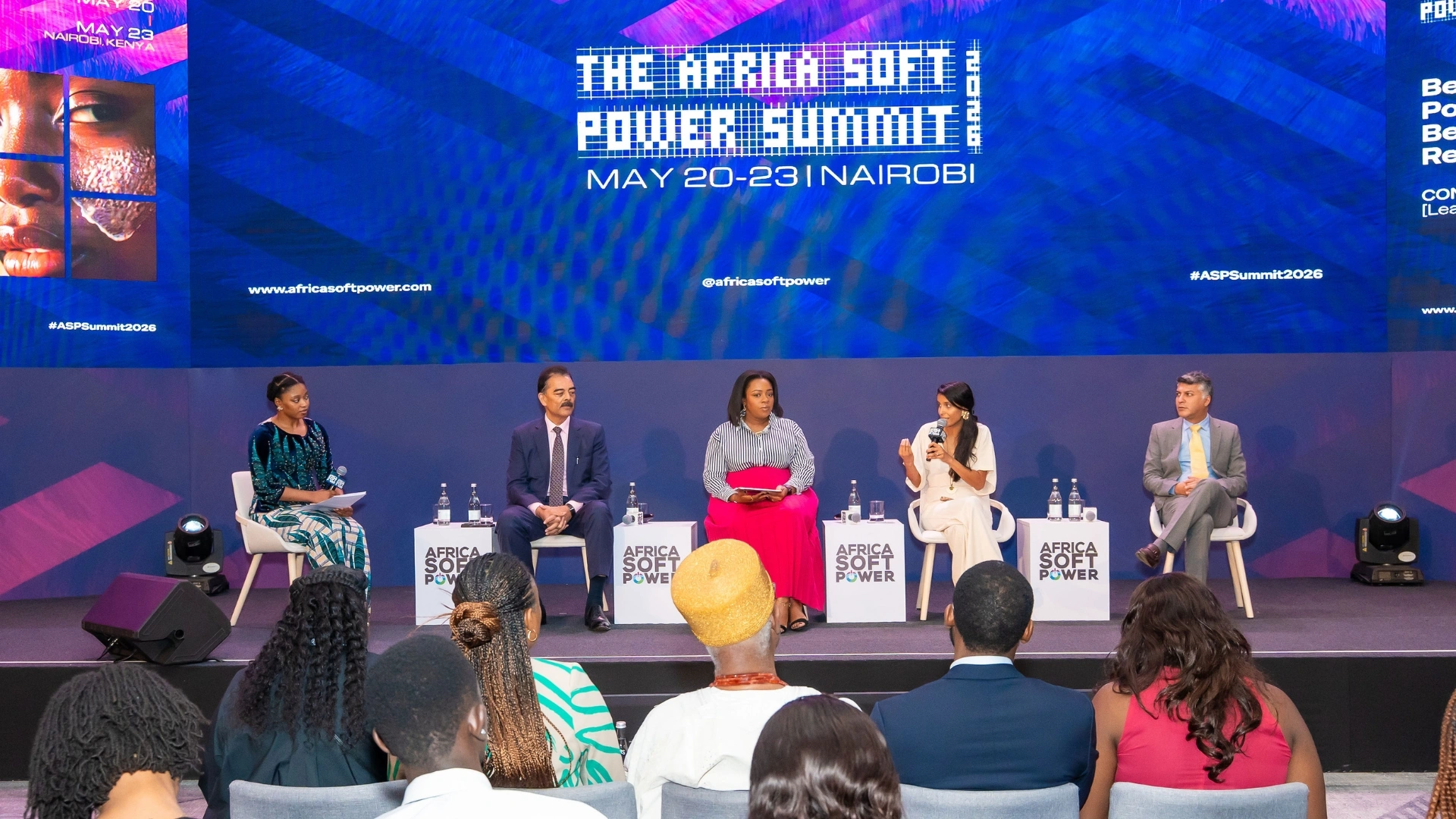
D’banj, speaking from his experience as an entertainer and CEO of The C.R.E.A.M Platform, said creators are often celebrated socially but questioned commercially when they seek funding.
“When they now say, ‘what?’ and I now say, ‘I want to do this,’ they say, ‘where is your collateral?’ What of the picture? Our biggest collateral is our IP,” he said.
He added that The C.R.E.A.M Platform had secured equity investment from Afreximbank, showing how creative platforms can attract institutional capital when properly structured.
“It was not a loan; it was equity. They bought equity in my company,” he said.
Across the Summit, Nairobi functioned as more than a host city. It became part of the argument: a meeting point for Africa’s creative, commercial, technological and institutional power. The conversations moved from leadership to market access, from inclusion to capital allocation, from cultural influence to ownership, and from visibility to systems.
Following the conference sessions, delegates continued into curated #MagicalKenya tour experiences, offering a deeper view of Nairobi’s culture, tourism, conservation and destination appeal. The Summit closed with the ASP Gala and Awards Night, a red-carpet finale celebrating the talent, enterprise, leadership and vision shaping Africa’s creative economy and global influence. Honourees included Koyo Kouoh, Faith Kipyegon and Bolanle Austen-Peters, recognised for championing African excellence across culture, sport and creative enterprise.
The Gala extended the Summit’s argument into culture itself, turning recognition, performance, fashion and public visibility into a final statement on the people and institutions shaping Africa’s global influence.
By the end of the Nairobi edition, one conclusion had become difficult to ignore: Africa’s next task is not to prove that it has influence. That has already been settled by its music, film, fashion, technology, sport, enterprise and diaspora networks.
The next task is to build the systems that allow that influence to become durable value.
ASP Summit 2026 did not settle that question. It placed it where it belongs: in the same room as capital, policy, technology, culture, media and markets.