 Follow Us on Google News
 Follow Us on Google Discover
Welcome, and thank you for being here. If you have ever sat across a table from a Nigerian colleague, navigated a Lagos market, or tried to follow a family WhatsApp group that somehow conducts itself in three languages simultaneously, you already know that answering the question “how do Nigerians communicate?” is not quite as simple as it might appear. I have spent months pulling this piece together, drawing on years of personal observation, cultural research, and more than a few entertaining misunderstandings that taught me far more than any textbook could.
Nigerian communication is a layered, dynamic, and frankly exhilarating subject. It encompasses hundreds of indigenous tongues, a thriving creole language, inherited colonial English, a rich tradition of proverbs, and a whole universe of physical gestures that can say as much as any spoken word. So let us get into all of it, piece by piece.
The Nigerian Way of Talking: Layer Upon Layer
Nigeria is not a monolingual country, and any attempt to describe how Nigerians talk as if there is a single uniform style will miss the point entirely. According to the Federal Ministry of Arts, Culture and Creative Economy, Nigeria is home to three major indigenous languages alongside hundreds of smaller ones. Hausa serves approximately 50 million speakers predominantly in the north, Yoruba reaches around 30 million in the southwest, and Igbo is spoken by roughly 25 million people in the southeast. That alone is an extraordinary linguistic portfolio, before we even begin to account for the official English layer or the unofficial but wildly popular Nigerian Pidgin.
What this means in practice is that the average Nigerian navigates communication across at least two or three distinct registers every single day. I remember accompanying a business associate from Kano to a meeting in Lagos. Over the course of that one afternoon, she greeted our driver in Hausa, negotiated a printing job in Yoruba (imperfectly but warmly received), switched to crisp formal English for the boardroom, and then slipped into Pidgin the moment the meeting ended. It was genuinely impressive. And completely normal.
The Ministry of Foreign Affairs notes that English functions as the primary lingua franca across formal contexts, while Pidgin fills the crucial everyday spaces where ethnic languages might not overlap. Religion also threads itself into daily talk in ways that are hard to overstate. You will hear “God willing,” “by His grace,” and “in Jesus name” woven naturally into ordinary conversations about bus routes and dinner plans. This is not performative; it is simply how many Nigerians speak.
Oral tradition remains a vital pillar of Nigerian communication, particularly in communities where spoken wisdom carries more authority than written documentation. As Guardian Nigeria has explored in its analysis of how traditional and new media intersect, oral communication shaped by history, cultural values, and heritage passed down through generations continues to sit alongside digital modernity in a distinctly Nigerian way.

The result is a communicative style that is warm, community-oriented, often indirect in ways that matter deeply, and richly contextual. You cannot fully understand what a Nigerian is saying without understanding who they are saying it to.
What Is the Communication Style in Nigeria?
Nigerian communication style is shaped above all by hierarchy, relationship, and context. These three factors interact to determine not just what is said, but how, when, and in which language or register. Understanding this framework is probably the single most useful thing you can do if you want to communicate effectively with Nigerians, whether in a business setting, a social gathering, or a family home.
Respect for elders and authority figures is expressed through both language and body language. Younger people typically initiate greetings, and those greetings are elaborate by Western standards. You do not just say “hi.” You ask about the person’s health, their family, their journey. You take time. Skipping this process is considered not just rude but a signal that you lack proper home training, which is one of the more serious informal criticisms in Nigerian social life.
The Federal Ministry of Information and National Orientation has acknowledged the importance of language in shaping identity and unity, noting that indigenous languages carry cultural meaning that formal English cannot always replicate. This policy recognition matters because it confirms what any observer already suspects: the language someone chooses in a given moment is itself a communicative act, signalling belonging, respect, warmth, or authority.
Indirect communication is common in many contexts, particularly around sensitive topics. A Nigerian professional might say “we will see” rather than a flat “no,” not out of deception, but out of a cultural preference for preserving the relationship and allowing the conversation to close gracefully. Once you understand this, a lot of seemingly ambiguous responses become clearer.
Direct expressions of admiration, on the other hand, are absolutely the norm. If someone likes your outfit, your cooking, or your car, you will hear about it. Nigerians are generous with compliments and equally generous with good-natured teasing among close friends. The warmth is genuine and often immediate.
Physical gestures carry significant weight. Using the left hand to pass something, point, or eat is considered disrespectful across most Nigerian cultures. Eye contact norms vary by ethnic group and context; sustained eye contact with an elder can read as confrontational in some communities. These physical dimensions of communication are not optional extras. They are part of the language.
Nigerian Communication Styles by Context and Language
| Context | Primary Language Used | Communication Style | Key Protocols |
|---|---|---|---|
| Government and formal offices | English | Formal, written, structured | Titles always used |
| Lagos or urban markets | Nigerian Pidgin / local language | Casual, fast-paced, expressive | Bargaining expected |
| Northern business dealings | Hausa / English | Relationship-first, indirect at times | Greetings are extended |
| Yoruba family gatherings | Yoruba | Warm, proverb-rich, hierarchical | Prostration for elders |
| Igbo community meetings | Igbo / English | Direct, achievement-oriented | Kolanut ceremony |
| Social media and youth spaces | Pidgin / Slang / English | Playful, punchy, highly creative | Emoji and acronyms common |
| Christian religious settings | English / local language | Devotional, expressive | Frequent God-references |
| Inter-ethnic urban settings | Nigerian Pidgin | Inclusive, relaxed | Informal titles used |
The table above reflects a clear pattern: the more formal the setting, the more English dominates; the more communal or inter-ethnic the setting, the more Pidgin steps in to do the bridging work. In family and ethnic-community settings, indigenous languages carry the emotional and cultural load that neither English nor Pidgin can fully replicate.
How Nigerian Pidgin Works: Why “Eh, Eh” and Other Expressions Mean So Much
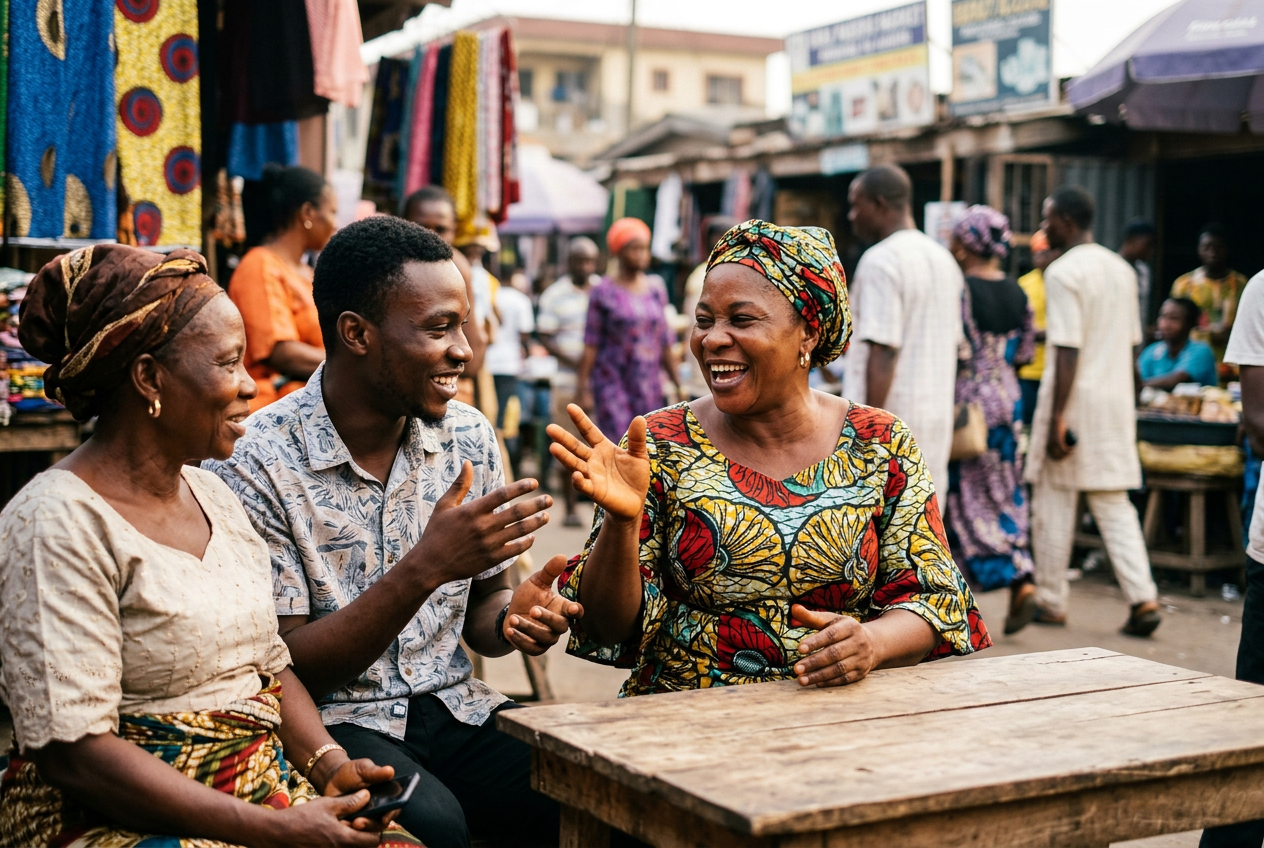
Perhaps no feature of Nigerian communication puzzles international observers more than the vocal cues and expressions that Nigerians use in everyday conversation. Chief among these is “eh, eh” (sometimes rendered “ehn ehn”), which you will hear constantly across the country. So what does it actually mean?
“Eh, eh” (or “ehn”) functions as a multi-purpose confirmation and engagement signal. It is not a single fixed meaning but a contextual expression that listeners use to signal they are following along, that they agree, that they are surprised, or even that they find something funny. Think of it as the Nigerian equivalent of “mmhmm” or “right” in British English, but significantly more expressive and tonally variable. A short, flat “ehn” means agreement. A rising, elongated “ehhhhh?” signals surprise or disbelief. A rapid “ehn-ehn-ehn” conveys understanding and impatience rolled into one.
This kind of back-channel communication is deeply important in Nigerian conversation. Unlike some Western conversational models where the listener stays quiet until their turn arrives, Nigerian conversations are often participatory, with the listener vocally affirming and responding throughout. Silence during someone’s story is not neutral; it can actually read as disengagement.
Other common vocalisations you will encounter include:
“Chai!” (an expression of shock, sympathy, or dismay) “Tufiakwa!” (an Igbo exclamation of rejection or horror, now widely understood across ethnicities) “Oya!” (a Yoruba-origin expression meaning “come on,” “let’s go,” or “hurry up” that has spread into Nigerian Pidgin) “No wahala” (Pidgin for “no problem” or “it’s fine”) “Abeg” (Pidgin for “please” or “I beg you,” often used to soften requests or express exasperation) “Sabi?” (Pidgin for “do you understand?” or “do you know?”)
As Guardian Nigeria’s coverage of language preservation efforts has highlighted, these expressions represent living vocabulary that crosses ethnic lines and carries cultural weight that straightforward English translations rarely capture. They are not just colourful additions to conversation; they are the texture of it.
Nigerian proverbs form another crucial layer. Across ethnic groups, proverbs (owe in Yoruba, ilu in Igbo, karin magana in Hausa) are used to add weight to an argument, offer gentle correction, or express a truth that would seem blunt if stated plainly. An elder might say “the elder who stays in the house does not hear what the young hear in the street” to acknowledge a gap in their own knowledge without losing face. Proverbs do a kind of communicative work that no single sentence can.
The academic and media analysis of how language, culture, and development intersect in Nigerian society confirms that these communication patterns are not incidental. They are the architecture of social life.
How Do I Say “I Love You” in Nigerian Pidgin and Other Languages?
Romantic and affectionate language in Nigeria is its own wonderful study, spanning Pidgin, the three major indigenous languages, and the particular warmth that Nigerians bring to personal relationships. The short answer to “how do I say I love you in Pidgin?” is simple: “I love you” works just fine in Pidgin, though Nigerians often say it as “I dey love you” or simply “I love you wella,” with “wella” meaning “very much” or “deeply.”
But knowing the fuller landscape is more satisfying.
In Yoruba, “I love you” is “Mo ni fe re” (pronounced moh nee feh reh). In Igbo, it is “A huru m gi n’anya” (ah-hoo-roo m gee n-ahn-yah). In Hausa, you would say “Ina son ki” to a woman or “Ina son ka” to a man. These are phrases that, when used even imperfectly by a non-native speaker, tend to produce genuinely delighted reactions.
Affection in Nigerian communication is expressed through more than words, however. Nicknames are a significant love language in Nigerian culture. Close friends and partners give each other names that reflect personality, appearance, or inside jokes. Calling someone “my person,” “boo,” or “oga mi” (my boss, used affectionately) signals intimacy and warmth. Teasing is another expression of affection, particularly among the Yoruba and in Pidgin-speaking contexts. If a Nigerian is ribbing you mercilessly, that is usually a sign they like you rather a lot.
Here is a practical step-by-step guide to navigating affectionate and everyday communication in Nigerian contexts:
- Start with greetings, always. Before any conversation begins, greet properly. Time-of-day matters in Yoruba (morning, afternoon, evening each have different greetings). In Hausa, “Sannu” works at almost any time.
- Use the right title. “Uncle,” “Aunty,” “Mama,” “Oga,” and “Sir/Ma” are not just titles; they signal respect and set a warm relational tone immediately.
- Learn at least one Pidgin phrase. “How far?” (how are you?) and “I dey” (I am fine) will open more doors than you expect. People respond with genuine delight.
- Match your register to the setting. Formal English in offices and government spaces. Pidgin in markets, social gatherings, and inter-ethnic friendships. Indigenous languages at home and in community settings.
- Listen for tone, not just words. “Ehn” said flatly means agreement. Said with a rising tone, it means surprise. Context and vocal pitch carry enormous meaning.
- Use proverbs carefully but confidently. If you can drop a relevant Yoruba, Igbo, or Hausa proverb at the right moment, the effect is wonderful. Ask a Nigerian friend to teach you one or two.
- Express affection directly and physically. Nigerians tend to hug, touch shoulders, and hold hands with friends (regardless of gender) as normal expressions of warmth. Warmth expressed is warmth returned.
How Do Nigerians Communicate? The Full Picture Brought Together
So how do Nigerians communicate? The most accurate single answer is: with extraordinary richness, informed by community, shaped by respect, and carried across multiple languages and registers simultaneously.
Nigerian communication operates across at least four distinct layers in most people’s daily lives: formal English for institutional and professional contexts; at least one indigenous language (Hausa, Yoruba, Igbo, or one of hundreds of others) for ethnic and family community life; Nigerian Pidgin for cross-ethnic informal settings; and a rich tradition of proverbs, vocalisations, and physical gestures that carry meaning no written word captures perfectly. Most Nigerians move between these layers without thinking about it, code-switching mid-sentence as naturally as breathing.
The closely related entities and concepts that define Nigerian communication include the role of elder-respect in shaping conversational tone, the function of back-channel vocalisations like “ehn” in keeping conversations participatory, the geographic and ethnic variation between north and south communication norms, the unifying power of Nigerian Pidgin English across 60 million speakers, and the spiritual dimension of conversation that surfaces constantly in everyday religious references. Understanding Nigerian communication means understanding that language and culture are inseparable here. The words are always pointing somewhere beyond themselves.
For anyone arriving in Nigeria for the first time, or reconnecting with Nigerian colleagues, community, or family, the practical starting point is always warmth and patience. A genuine attempt at a greeting, even an imperfect one, lands better than polished silence. That is perhaps the most Nigerian thing I can tell you: effort, expressed with warmth, is the communication that matters most.
Related Articles
If you enjoyed this piece and want to explore the linguistic and cultural landscape of Nigeria further, I recommend two earlier articles I wrote for this publication. The first takes a close look at the full scope of Nigerian languages from Hausa and Yoruba to the role of Pidgin as a national unifier: What Languages Do Nigerians Speak? And if you want to understand which cultural forces exert the greatest influence on Nigerian daily life, including in communication, this piece examines the question in depth: What Is the Dominant Culture in Nigeria?
Key Takeaways
- Nigerian communication draws on at least four registers simultaneously: formal English, indigenous languages, Nigerian Pidgin, and a rich tradition of proverbs and vocal expressions. Understanding which register fits which context is the core practical skill for anyone navigating Nigerian social or professional life.
- Expressions like “eh, eh,” “chai,” “oya,” and “no wahala” are not filler words. They are tightly contextual signals that carry specific emotional and relational meanings, and learning them will transform how you connect with Nigerians across ethnic and social lines.
- Affection, respect, and relationship-building in Nigerian communication are expressed as much through proper greeting, title-use, and well-timed proverbs as through direct statements. The form of communication is itself the message in many situations.
Frequently Asked Questions About How Nigerians Communicate
How do Nigerians communicate in daily life?
Nigerians communicate daily through a combination of English, their indigenous mother tongue, and Nigerian Pidgin, often switching between all three within the same conversation depending on the setting and the person they are speaking to. Greetings, titles, and physical gestures form a crucial layer of communication that runs beneath and alongside the spoken words.
What languages do Nigerians most commonly speak?
The three most widely spoken indigenous languages are Hausa in the north, Yoruba in the southwest, and Igbo in the southeast, alongside English as the official language and Nigerian Pidgin as the most broadly used informal lingua franca. Most Nigerians are effectively multilingual, navigating two or more of these every day.
What is Nigerian Pidgin English?
Nigerian Pidgin English is a creole language that draws vocabulary primarily from English but structures itself according to patterns influenced by Yoruba, Igbo, and other Nigerian languages, resulting in a distinct tongue with its own grammar and expressive range. It is spoken by an estimated 60 to 75 million Nigerians and functions as a unifying language across ethnic divides.
Why do Nigerians say “eh, eh”?
“Eh” or “ehn” is a back-channel vocalisation that functions as a multi-purpose engagement signal, conveying agreement, surprise, understanding, or impatience depending on tone and repetition. It is how a listener shows they are actively engaged in the conversation rather than simply waiting for their turn to speak.
How do you say “I love you” in Nigerian Pidgin?
In Pidgin, you can say “I dey love you” or “I love you wella,” with “wella” intensifying the meaning to something like “I love you deeply” or “very much.” Nigerians also use affectionate nicknames and playful teasing as parallel love languages in close relationships.
How do you greet someone in Nigeria?
Greetings vary by language and time of day, but a safe and universally appreciated approach is to say “Sannu” in Hausa, “E ka aro/san/irole” in Yoruba depending on the time, or “Kedu?” in Igbo. In informal cross-ethnic settings, Pidgin’s “How far?” is the most broadly understood greeting and generates genuine warmth.
Do Nigerians use a lot of proverbs?
Yes, proverbs are a central feature of Nigerian communication across all major ethnic groups, used to convey wisdom, soften criticism, or give weight to an argument in a way that direct speech sometimes cannot achieve. An elder dropping a well-chosen proverb mid-conversation is exercising a form of rhetorical authority that everyone in the room understands immediately.
Is Nigerian communication more indirect or direct?
It depends significantly on the context and the relationship. Nigerians can be extremely direct with close friends and in commercial settings, but more indirect in situations involving hierarchy, disagreement, or sensitive personal matters, often using proverbs, gentle deflection, or the offer to “see about it” rather than a flat refusal.
What role does religion play in Nigerian communication?
Religion is deeply woven into everyday Nigerian speech, with phrases like “God willing,” “in Jesus name,” “Alhamdulillah,” and “by His grace” appearing naturally in ordinary conversations about work, travel, or daily plans. This is not formulaic; it reflects a genuine integration of faith into the rhythm of daily life that cuts across ethnic and social lines.
How do Nigerians communicate affection?
Affection is communicated through nicknames, generous compliments, physical warmth (touching arms, hugging, hand-holding among friends of any gender), and good-natured teasing that signals belonging and trust. Saying “I love you” in the person’s indigenous language, even imperfectly, has a particularly strong emotional effect.
How does code-switching work in Nigerian conversations?
Code-switching refers to the practice of moving between two or more languages or registers within a single conversation or even a single sentence, and it is entirely ordinary in Nigerian daily life. A Nigerian might begin a sentence in English, continue it in Yoruba, and conclude it in Pidgin without anyone in the conversation finding this unusual or disruptive.
What are the key rules of Nigerian communication etiquette?
The most important rules are: greet first and greet properly, use appropriate titles for anyone older or in authority, never use your left hand for giving, receiving, pointing, or eating, show patience with extended greetings rather than rushing to the point, and match your language register to the context you are in. These are not optional niceties but the basic grammar of Nigerian social interaction.

