 Follow Us on Google News
 Follow Us on Google Discover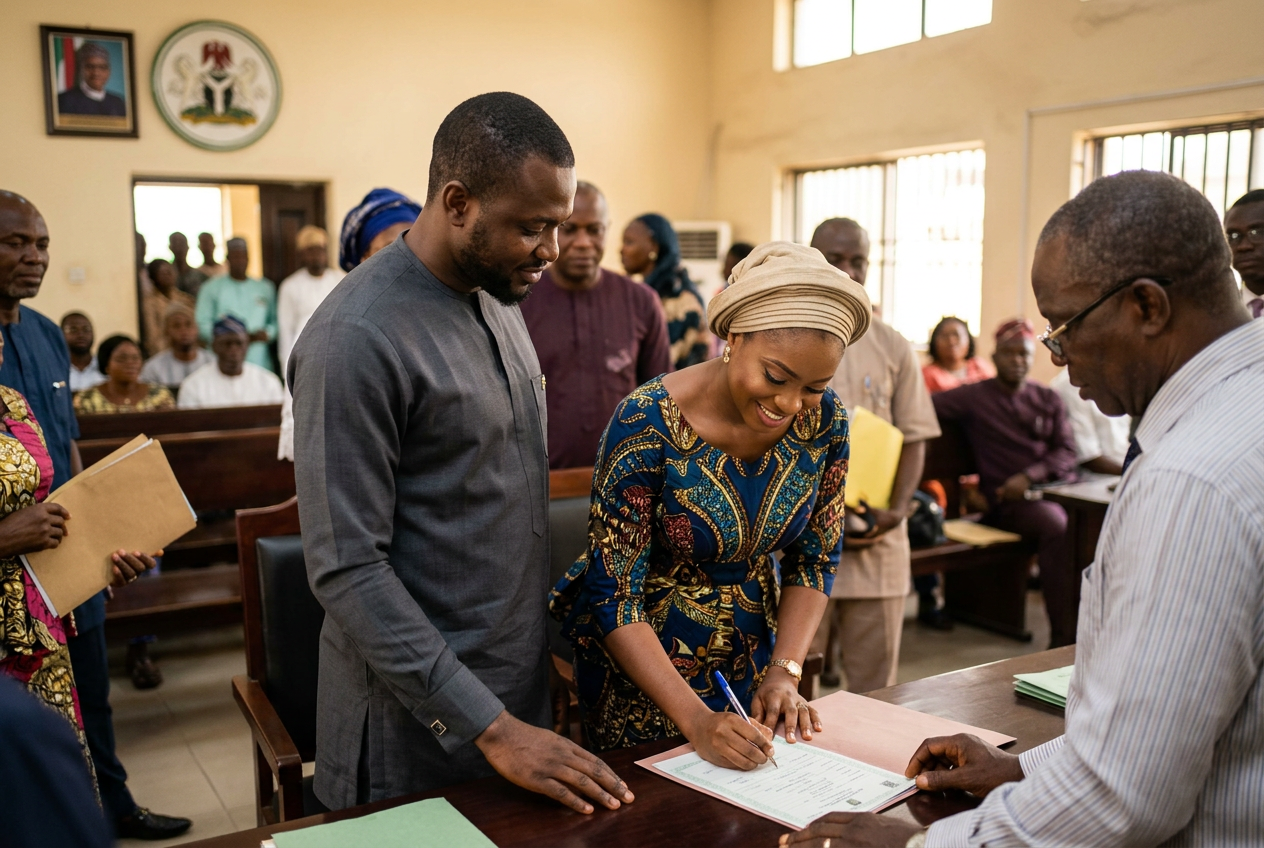
Welcome, and thank you for pulling up a chair. If you have landed here, you are probably trying to work out what it truly means to be legally married in Nigeria, and you would not be the first person to find the whole thing a little confusing. Perhaps you are planning your own wedding. Perhaps you have fallen for a Nigerian and are squinting at the paperwork. Perhaps you are simply curious about how a country of more than 200 million people organises something as personal as marriage.
Whatever brought you here, you are in good hands.
This article is the fruit of months of research and years spent writing about Nigerian family life, and I have done my best to answer every question I have ever been asked on the subject. I will keep it warm, I will keep it honest, and I promise not to bury you in legalese.
Let us begin where most Nigerian love stories actually begin, long before any certificate is signed.
How Long Do Nigerians Date Before Marriage?
Here is the honest answer: it varies enormously, and anyone who gives you a single tidy number is fibbing.
In my experience, urban, university-educated couples in Lagos or Abuja often date for one to three years before anyone mentions rings. They want time to build careers, save money, and be sure. A friend of mine courted his wife for nearly four years (much to his mother’s exasperation, who reminded him at every family gathering that she was “not getting any younger”).

Contrast that with more traditional settings, particularly in the north, where courtship can be remarkably brief. As documented in Guardian Nigeria’s lovely piece on traditional marriage rites in Nigeria, the process among many ethnic groups moves quickly from a formal introduction to the payment of bride price, sometimes within a few months. The families do a great deal of the vetting, so the couple does not always need years to decide.
There is also the money question, which nobody likes to admit but everybody feels. Nigerian men are widely expected to be financially settled before they propose, because a wedding here is rarely a quiet affair. Between the traditional ceremony, the bride price, the white wedding, and the reception, costs can climb from a modest ₦500,000 into the tens of millions of Naira. So the “how long” often depends on the “how much.”
Rather like planting yam, timing matters. Marry too early without preparation and you struggle; wait forever and the season passes you by.
What Does It Mean to Be Legally Married in Nigeria?
Right, this is the heart of it, so let me answer plainly.
To be legally married in Nigeria means your union is recognised under one of the country’s three parallel legal systems: statutory law (marriage under the Marriage Act), customary law (the traditional marriage of your ethnic group), or Islamic law (marriage under Sharia in the states that apply it). Each one is a genuine, valid marriage in the eyes of Nigerian law, yet they carry very different rights, obligations, and paperwork. A statutory marriage is monogamous by definition, famously described in old English case law as the union of one man and one woman to the exclusion of all others, whereas customary and Islamic marriages can permit more than one wife. In short, “legally married” is not one thing in Nigeria; it is three closely related things, and which one you choose shapes everything from inheritance to immigration.
The closely related entities worth knowing here are the Marriage Act (the federal law governing statutory marriage), the Matrimonial Causes Act (which handles statutory divorce and maintenance), the Federal Marriage Registry, the bride price, and the marriage certificate known officially as Form E.
Statutory marriage is the one people mean when they say “court marriage” or “registry marriage.” It is conducted under the authority of the Federal Ministry of Interior, which, as the ministry itself confirms in its official statement on the conduct of statutory marriages, is the only body empowered to issue the legally recognised Form E certificate.
If you want that statutory certificate, here is the path most couples walk:
- Give a formal notice of marriage (Form A) at the marriage registry for your district.
- Wait while the registrar publishes your notice publicly, so anyone with a lawful objection can raise it.
- Collect your Registrar’s Certificate (Form C) once the waiting period passes with no valid objection.
- Hold the ceremony within three months of the notice, because the notice expires after that and you must start again.
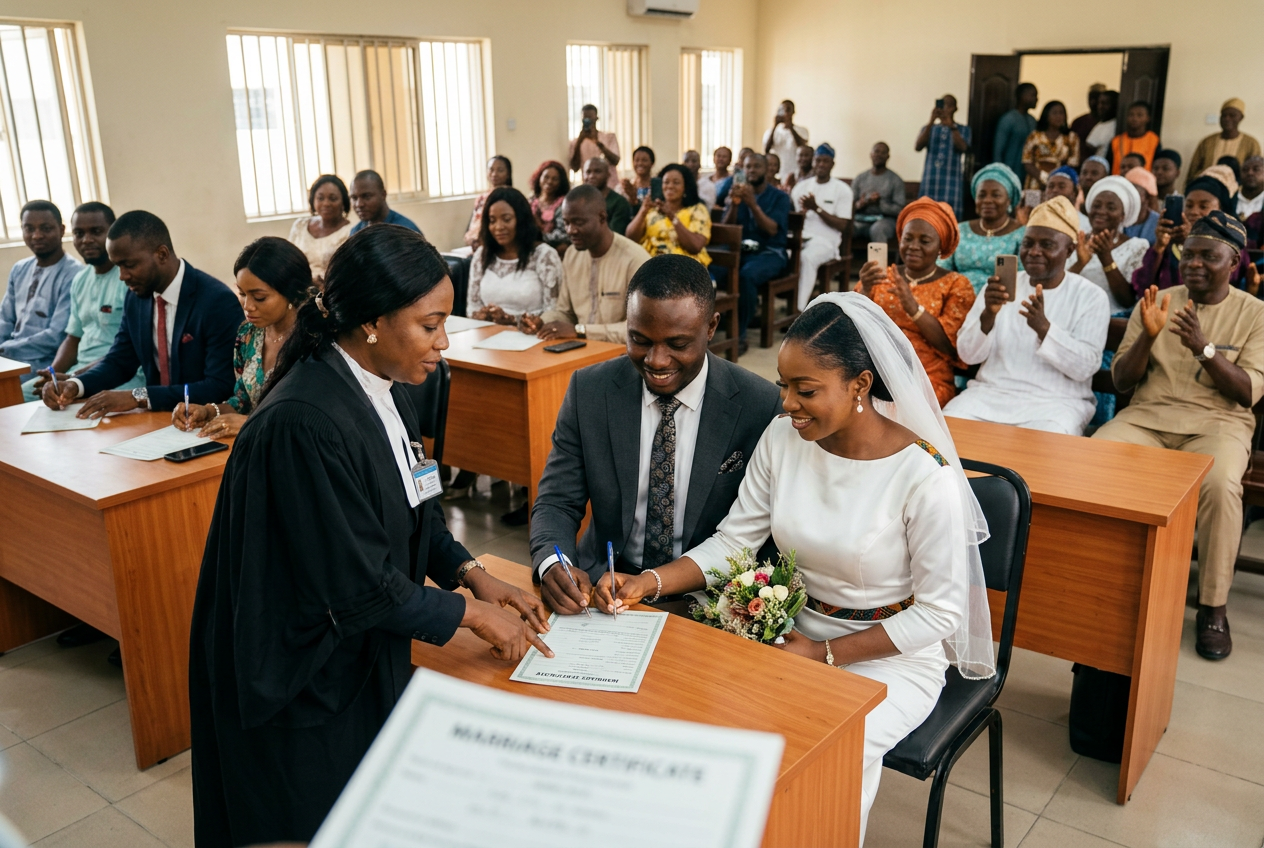
- Exchange your vows at the registry or a licensed place of worship, before a registrar or a recognised minister, with at least two witnesses present.
- Receive your marriage certificate (Form E), the only certificate the Ministry of Interior recognises as valid.
A quick word of practical advice from someone who has watched couples stumble here: keep every receipt, photograph your certificate the moment it is issued, and store a scan in the cloud. Nigerian bureaucracy has a long memory for fees and a short one for your documents.
How Nigeria’s Three Legal Marriage Systems Compare
The table below sets the three systems side by side so you can see, at a glance, how differently they treat the same institution.
| Marriage Type | Governing Law | Spouses Allowed | Certificate Issued | Recognised for Immigration |
|---|---|---|---|---|
| Statutory | Marriage Act (CAP M6) | One only (monogamous) | Form E (Ministry of Interior) | Yes, widely accepted abroad |
| Customary | Ethnic customary law | Multiple wives permitted | Customary Court Declaration | Sometimes, often needs extra proof |
| Islamic | Sharia law | Up to four wives | Islamic marriage record | Varies by receiving country |
What the table makes clear is that only statutory marriage comes with automatic, internationally trusted documentation, the very kind the United States Department of State expects when it processes a spouse immigrant visa. That is precisely why so many couples who marry traditionally later add a registry marriage for legal certainty.
How Many Wives Can You Legally Marry in Nigeria?
Ah, the question everyone secretly wants answered.
The plain reply is that it depends entirely on which system you marry under. Under statutory law, the answer is one, full stop. A statutory marriage is strictly monogamous, and taking a second wife while a statutory marriage still stands is the crime of bigamy, punishable by imprisonment.
Under customary law, the picture changes completely. Most Nigerian customary traditions permit a man to marry more than one wife through successive traditional ceremonies, with no fixed legal cap beyond what his standing and his purse can support. Under Islamic law, a man may marry up to four wives, provided he can treat them equitably, a condition the faith takes seriously even if human beings do not always manage it.
Now, a caution I feel obliged to add, because I have seen the heartache it causes. The bride price and the ceremonies attached to each additional wife are not trivial. Guardian Nigeria’s reporting on the real cost of bride price lays bare how these payments, ranging from tens of thousands into the millions of Naira, place real financial and emotional pressure on families. And as a separate Guardian investigation into high bride price and the dignity of Igbo women in marriage shows, some communities have even legislated caps to stop the practice from spiralling out of reach.
So yes, you can legally marry more than one wife in Nigeria, but only outside the statutory system, and only if you are prepared for what each union genuinely demands.
Does Marrying a Nigerian Make You a Citizen?
I wish I could give you a simple yes, but the truth is more nuanced, and unfortunately less equal than it should be.
Marrying a Nigerian does not automatically hand you a Nigerian passport. What it can do, in one specific case, is make you eligible to apply for citizenship by registration. Under Section 26 of the 1999 Constitution, as set out by the Senate Committee on the Constitution Review, any woman who is or has been married to a citizen of Nigeria may be registered as a citizen. Notice the wording carefully. It is not automatic, you still have to apply, prove your marriage is genuine, show good character, and take the oath of allegiance.
Here is the part that stings. The Constitution extends this route only to foreign women married to Nigerian men. A foreign man who marries a Nigerian woman gets no such pathway and must instead pursue the far longer road of naturalisation, which typically requires fifteen years of residence. A 2022 bill that would have closed this gender gap was rejected, then hastily reconsidered after public outcry, and the debate rumbles on today.
For the eligible foreign wife, the practical process runs through the Ministry of Interior, usually takes six to twelve months, and carries fees that have hovered in the region of ₦150,000 to ₦350,000. And your statutory marriage certificate matters enormously here, because it is exactly the kind of document foreign and Nigerian authorities alike trust. It is the same certificate the United States Department of State relies on when it processes a spouse visa, which brings us neatly to a question I am asked constantly.
What Happens When a Nigerian Marries an American?
This is one of the most common cross-border scenarios I encounter, and it deserves a clear-eyed answer.
When a Nigerian marries an American, nothing magical happens to their nationality overnight. Neither spouse loses or gains citizenship simply by saying “I do.” What changes is that a legal door opens: the American spouse can sponsor the Nigerian spouse to live permanently in the United States, and a properly documented statutory marriage is the key that fits the lock.
The process begins when the American citizen files a petition (Form I-130) for their spouse. Once it is approved, the case moves to consular processing at the United States Embassy, usually the one in Abuja for Nigerian applicants. If the couple has been married for less than two years when the Nigerian spouse enters America, they receive a conditional two-year residency (the CR1 route); if longer, they receive the immediate-relative version (IR1) that grants ten-year permanent residency straight away. Either way, the couple must convincingly prove the marriage is real, not a paper arrangement, through joint accounts, photographs, communication records, and the like.
My honest advice? Marry properly under the Marriage Act, gather your evidence from day one, and expect the process to take many months rather than weeks. Immigration officers on both sides have seen every trick, so genuine couples do best when they simply tell their true story with good paperwork behind it.
Final Thoughts: Understanding What Being Legally Married in Nigeria Really Means
If you take one thing away from all this, let it be this: being legally married in Nigeria is less a single event and more a choice between three genuine systems, each with its own rules, rights, and paperwork.
Statutory marriage gives you monogamy, the trusted Form E certificate, and the smoothest path through immigration and inheritance. Customary and Islamic marriages honour tradition and faith, and remain fully valid under Nigerian law, though they ask more of you when you step onto the international stage. Marriage does not automatically confer citizenship, and it treats foreign wives and foreign husbands unequally, a reality worth knowing before you plan your life around it.
So what should you actually do? Decide which system fits your life and values. If legal certainty or travel matters to you, add a statutory marriage to whatever traditional ceremony your family holds dear. Keep your certificate safe, understand your rights, and never sign anything you do not fully grasp.
Marriage here is warm, communal, and gloriously complicated. Go into it with your eyes open, and it can be one of the great joys of a life lived in Nigeria.
Related Articles
If this has sparked your curiosity, I have explored the subject from two other angles you may find useful. My piece on how many marriages are allowed in Nigeria digs deeper into the polygamy question across our different legal systems, unpacking exactly where the limits lie and why they differ. And for a broader look at how common monogamy actually is across the country, my article on whether Nigerians are monogamous walks through the statistics and the cultural forces behind them. Both sit comfortably alongside this one.
Key Takeaways
- Being legally married in Nigeria means recognition under one of three systems: statutory, customary, or Islamic law, each with distinct rights and paperwork.
- Only statutory marriage is strictly monogamous and comes with the internationally trusted Form E certificate, so add it if legal certainty or immigration matters to you.
- Marriage does not grant automatic citizenship; a foreign wife may apply to register as Nigerian, but a foreign husband must pursue lengthy naturalisation instead.
Frequently Asked Questions About Being Legally Married in Nigeria
What does it mean to be legally married in Nigeria?
Being legally married in Nigeria means your union is recognised under statutory, customary, or Islamic law, each of which is genuinely valid but carries different rights and documentation. The system you choose affects everything from how many spouses you may have to how your marriage is treated abroad.
How much does a statutory marriage cost at a Nigerian registry?
Registry fees for a statutory marriage generally fall between ₦50,000 and ₦200,000, depending on the location and whether you marry at the registry or a licensed place of worship. Special licences and certified copies add modest extra charges, so budget a little above the headline figure.
Is a traditional marriage legally recognised in Nigeria?
Yes, a customary marriage is fully valid under Nigerian law once the required rites, including bride price and community witnessing, are properly performed. Many couples still obtain a Customary Court Declaration afterwards to give themselves documentary proof for visas, pensions, or inheritance claims.
How many wives can a man legally marry in Nigeria?
Under statutory law a man may have only one wife, since statutory marriage is strictly monogamous and a second union would be bigamy. Under customary law he may take multiple wives, and under Islamic law up to four, provided he can support and treat them equitably.
Does marrying a Nigerian automatically make you a citizen?
No, marrying a Nigerian does not grant citizenship automatically, and you must formally apply for it. A foreign woman married to a Nigerian man becomes eligible to register as a citizen under Section 26 of the Constitution, subject to proving her marriage and good character.
Can a foreign man gain Nigerian citizenship through marriage?
No, the Constitution does not offer foreign husbands of Nigerian women a citizenship-by-registration route, which many criticise as unequal. Such a man must instead pursue naturalisation, a much longer process that generally requires around fifteen years of residence in Nigeria.
What documents do you need for a statutory marriage in Nigeria?
You typically need valid identification, passport photographs, birth certificates or age declarations, and, if either party is under twenty-one, written parental consent. Anyone previously married must also provide proof that the earlier union ended, such as a divorce decree or death certificate.
Can a Nigerian marry an American and move to the United States?
Yes, an American citizen can sponsor their Nigerian spouse for permanent residency by filing an I-130 petition followed by consular processing at the United States Embassy. The couple must prove their marriage is genuine, and a documented statutory marriage certificate makes that far easier to establish.
How long does it take to get married at a Nigerian registry?
After giving formal notice, couples usually wait a matter of weeks before the registrar issues the certificate that clears the marriage to proceed. The ceremony must then take place within three months of the notice, or the notice lapses and the process restarts.
What is the difference between statutory and customary marriage?
Statutory marriage is monogamous, conducted under the Marriage Act, and produces a federal certificate recognised worldwide. Customary marriage follows ethnic tradition, may permit polygamy, and is validated by community recognition rather than a government certificate, though declarations can be obtained.
Can you convert a customary marriage into a statutory one?
Yes, couples who married traditionally can subsequently register a statutory marriage to gain full legal recognition and the Form E certificate. Doing so is common among couples who want the inheritance, immigration, and legal protections that statutory marriage provides.
How long do Nigerians usually date before marriage?
Courtship length varies widely, from a few months in more traditional and northern settings to two or three years among urban, career-focused couples. Financial readiness often drives the timeline, since the cost of ceremonies and bride price weighs heavily on when couples feel able to marry.

