 Follow Us on Google News
 Follow Us on Google Discover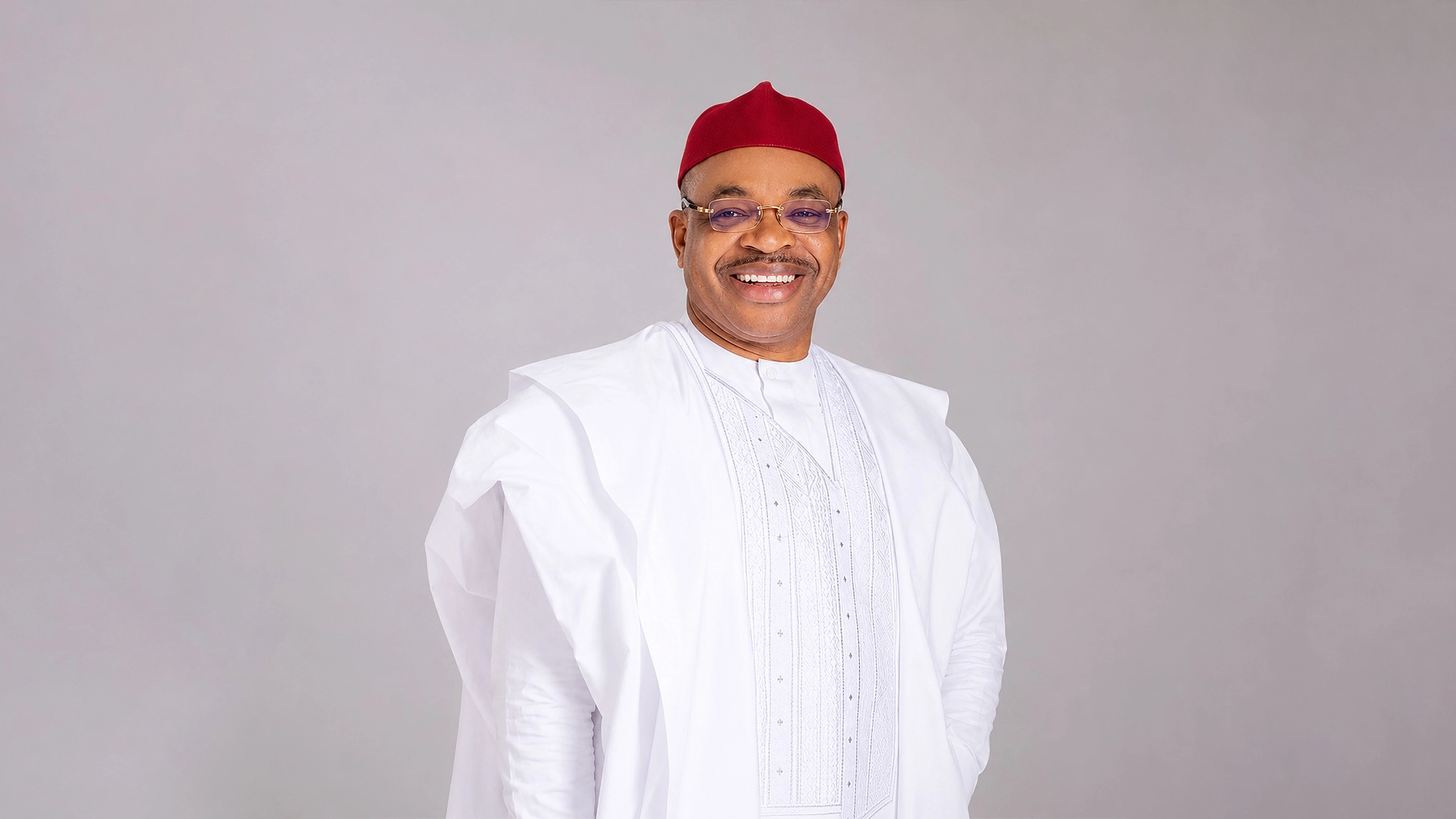
By: Peter Adobamen
There is a particular kind of leader who governs by ledger — who treats a state budget the way a careful banker treats a balance sheet, and who measures success not in applause but in outcomes that can be counted, built, or boarded. Udom Emmanuel, who turns sixty on July 11, is that kind of leader.
And as Nigerians, and Akwa Ibom people especially, mark the occasion, the tribute that fits him best is not eulogy but audit: a plain accounting of what was promised, and what got done.
Sixty is an age that invites reflection whether or not one has held power. It is old enough to have made real mistakes and young enough to still answer for them. For a man who spent eight years as governor before that, and a career in banking before that, the reflection this birthday invites is less sentimental than most — it is a question of arithmetic. Did the promises equal the results? By the account of a great many Akwa Ibom people, they came remarkably close.
Emmanuel arrived in government the way accountants arrive in a boardroom: with a spreadsheet, not a slogan. Before politics, he had climbed the ranks of Nigerian banking, earning a name as a disciplined administrator with a financial expert’s instinct for risk and return. That instinct followed him into Government House when he was sworn in as governor of Akwa Ibom State on May 29, 2015. He treated the office less like a political inheritance and more like an institution with a mandate to deliver — and delivery, not rhetoric, became the organizing idea of his tenure.
The clearest expression of that idea was industrialization. Rather than lean on federal allocations, his administration bet on production: factories for syringes, electric meters, fertilizer, paint, timber, rice, cassava, and flour rose across the state, an unglamorous but deliberate wager that a state’s wealth should be made, not merely received. Historians will argue, as they should, about which of those plants reached their full promise. Few will argue that industrial policy was anything but the backbone of his governance.
Aviation supplied the more visible proof of concept. Ibom Air, launched under his watch, became one of the most audacious bets any Nigerian state government has placed on a public enterprise — and one of the rare ones that paid off, distinguishing itself for punctuality and service in a sector littered with cautionary tales. Around it, the administration expanded the Victor Attah International Airport and built out maintenance and overhaul capacity, quietly positioning Akwa Ibom as an aviation hub rather than an aviation footnote.
Infrastructure told a similar story in a lower key. Roads, bridges, power projects, and public buildings reached communities that had long done without them, and connectivity turned out to be an economic policy in its own right — farmers reached markets, businesses reached customers, and mobility widened the map of what was possible. Concrete and asphalt were the material; opportunity was the point.
Human development ran alongside the concrete. Thousands of teachers were hired into public schools.
Government paid examination fees for eligible students, year after year, removing one of the quieter barriers to a child’s future. Hospitals were upgraded, specialist facilities strengthened, and medical equipment modernized — investments that proved their worth when COVID-19 tested public health systems everywhere and found Akwa Ibom more prepared than most had reason to expect. Entrepreneurs received grants, interest-free loans, and training; farmers received improved seedlings, mechanization support, and market access. And in Uyo, the Dakkada Tower rose as the physical signature of all of it — proof, in glass and steel, that a state government could build something an investor might actually want to look at twice.
None of this immunizes eight years of governance from criticism, nor should it. Every administration makes calls that divide opinion, and Emmanuel’s was no exception; that friction is democracy doing its job. But the broader verdict — offered by allies and skeptics alike — is that he pointed the state consistently toward the same horizon: industry, infrastructure, and human capital, pursued by a man colleagues describe as measured, methodical, and allergic to acting before he had thought a thing through.
At sixty, the balance sheet Emmanuel leaves behind is no longer just about projects finished or offices held. It is about a teacher who got hired, a student whose exam fee was already paid, an entrepreneur who got a loan instead of a lecture, a farmer whose produce finally had a road to travel on, an investor who found a reason to believe in the state. It is, in short, a legacy measured in other people’s lives — which is the only kind of legacy that was ever worth building.
For those of us who covered his administration closely, argued with its choices, and watched it evolve across eight years, this birthday is a chance to take the full measure of one chapter in Akwa Ibom’s story — not to inflate it, but to record it honestly.
Sixty is not merely a number of years survived. It is a record of years spent, and by that harder standard, this one reads well.
To His Excellency, Udom Emmanuel: may the decade ahead be as productive as the ones behind you, and may whatever you build next serve Nigeria as faithfully as the last chapter served Akwa Ibom. Happy sixtieth birthday.

