 Follow Us on Google News


 Follow Us on Google Discover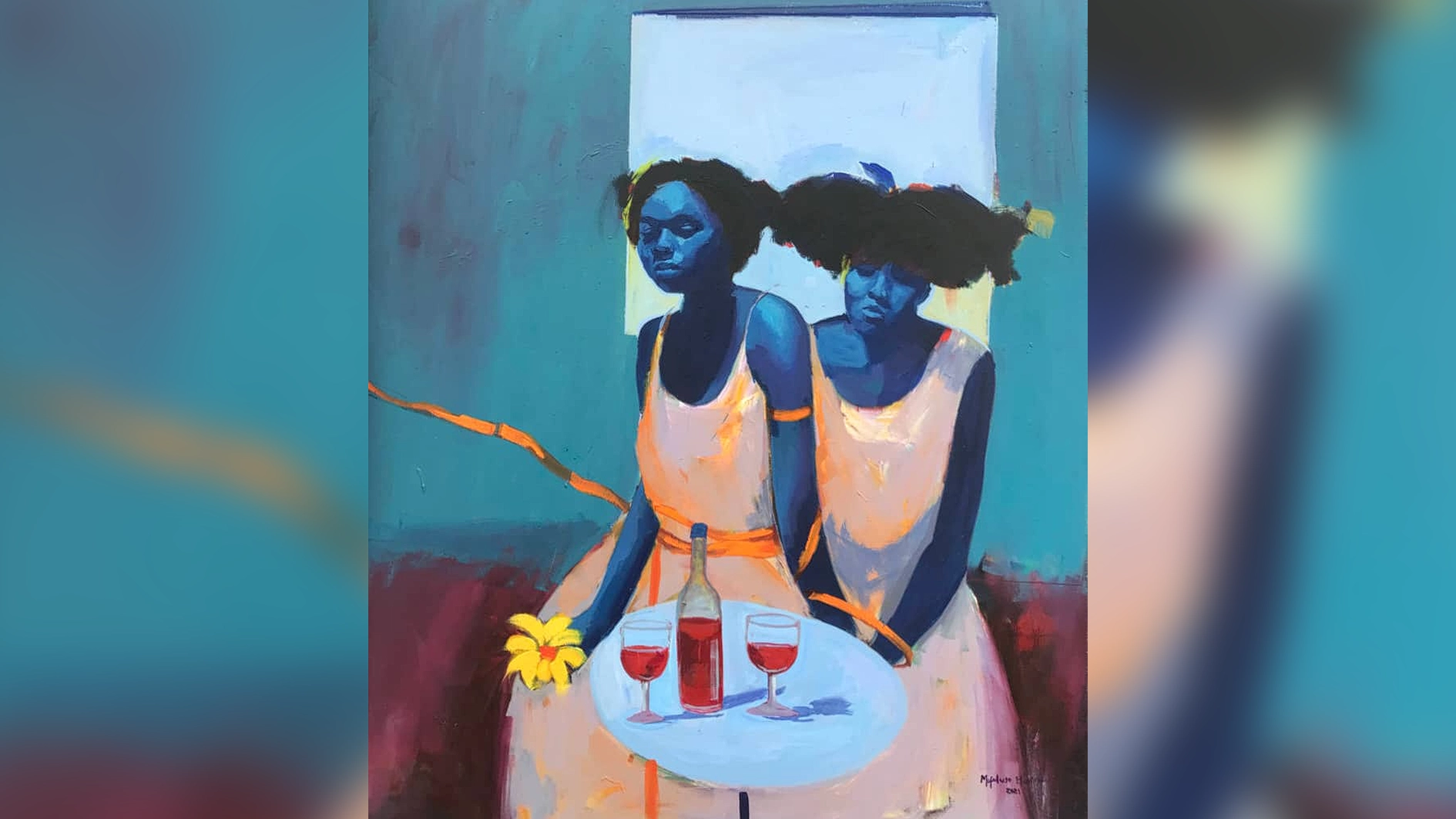
Mofoluso Eludire’s figurative paintings prioritise personal experience over external influence. They read as attempts to tame fleeting feelings and ideas into work that can connect with a world outside herself that likely feels the same way. Two bodies of work from the first half of this decade, “Same Vine” and “Safe Spaces,” turn that inward method toward one recurring subject: how women hold each other up, and what that holding looks like once it’s stripped of performance.
Given Eludire’s own wish to paint women outside the pressure of perfection, the two series feel like companion pieces on sisterhood in general. They look to interrogate what support actually does to the people inside it rather than simply celebrating that it exists. True companionship, in both series, looks less like a fixed role than a continuous exchange, giving support when it’s needed, receiving it when it isn’t, an unending dance of doing life together rather than a position either woman holds for good.
In “kainene, my backbone,” two women stand in a field of grass and small flowers under a wide, cloud-stacked sky. The one in white is upright, providing the support, but she slouches just enough to let the weight of the other pour into her, head thrown back, mouth slightly open, arm hanging loose and useless at her side. Her posture has none of the poise usually expected of a painted figure. No straight spine, no composed expression, nothing arranged to look good. That looks like exactly the point.
“In the same vein” reverses the exchange. The woman in black is now the one holding, and she isn’t merely keeping the woman in white upright, she looks to be in the act of lifting her back onto her feet, both arms wrapped fully around her from below, cheek pressed into her hip. Where the first painting shows a body bending to absorb weight, the second shows support as active effort, one woman doing the work of restoring the other rather than simply catching her. Both paintings come across as vulnerability given permission, first as a body allowed to go slack because someone else is holding it, then as a body being actively brought back upright by that same care.
Another project of hers, called “Safe Spaces,” makes its argument through a different visual choice entirely. In “of wine?,” “What comes a little later,” and “What comes naturally,” the women are painted in a near-uniform blue skin tone, set inside saturated, theatrical interiors, turquoise walls, basically a comfortable, homely setting.
“What comes a little later” reads as a kind of sequel to “What comes naturally,” moving the series from one woman in solitude toward the ease of shared company, a narrative arc that runs quietly underneath the shared color palette.
Where “Same Vine” strips a woman of composure through the body, “Safe Spaces” strips her of individual distinction through color. The women remain distinct in feature and expression, but the shared blue tone flattens the usual visual cue that separates one person from another, and this appears to be an intentional choice, representing closeness through color rather than resemblance.

What both series share, once looked at closely, is the evolving dynamic of lasting relationships. “Same Vine” doesn’t show the same support held twice, it shows support changing hands entirely, the one who gave it becoming the one who needs it lifted back up. “Safe Spaces” doesn’t show the same closeness three times either, it moves a woman from solitude into company, tracing how companionship arrives rather than simply depicting that it exists.
Eludire has described roles that shift, strength that moves in a different direction than expected, and both series reflect that shift directly, one through a literal reversal of who is held and who holds, the other through a quiet narrative arc from being alone to being accompanied.
If we look at the paintings from this perspective, the two bodies of work aren’t parallel studies of the same idea from different angles, they’re the same claim made twice, in two different registers, that women’s support for each other is not static. It bends, reverses, and grows, rather than staying fixed in one direction. What they share, underneath the reversal and the arc, is a refusal to let any single moment of need or dependency define a woman completely. She gives support, then needs it. She is alone, then she isn’t. Neither state is treated as more true than the other, and that refusal to fix her in one position may be the quieter argument running under both bodies of work.
Mofoluso Eludire’s work has been shown at Christie’s, London, as part of Jendaya: Migration & Memories in 2024, and at Bloom Art Gallery, Lagos, across multiple exhibitions including Art X Lagos in 2022 and Bloom & Beyond in 2023.

