 Follow Us on Google News
 Follow Us on Google Discover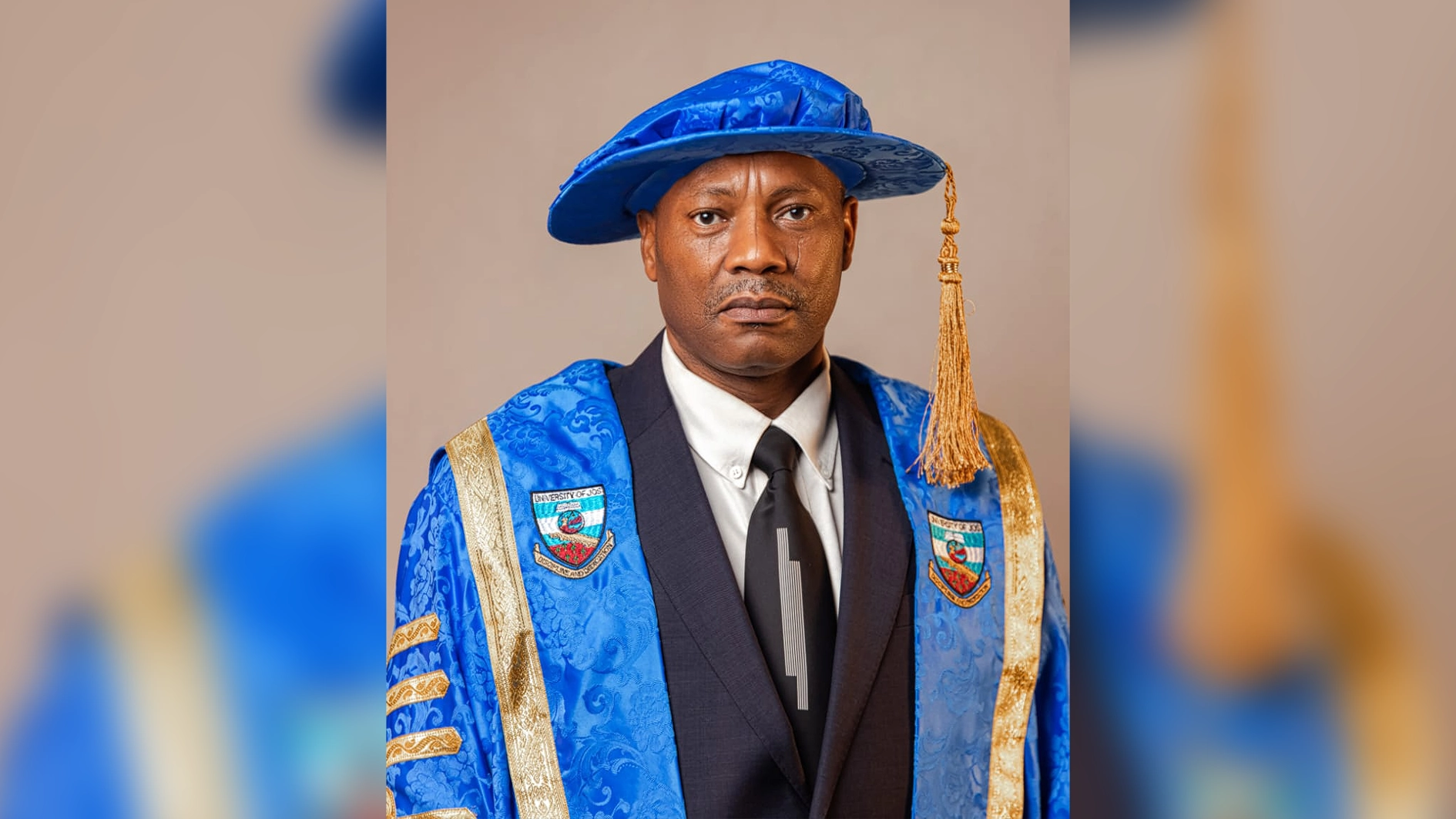
When nations look to technology to solve their most urgent problems, they turn to minds that understand both code and consequence. Professor Tanko Ishaya occupies that space. As the 10th substantive Vice-Chancellor of the University of Jos, he arrived with more than thirty years of immersion in enterprise Information Technology, from architecture to governance. He is not a caretaker of systems; he is a designer of them. Through discipline, diligence and an unwavering commitment to due process, his name has come to sit among the most consequential scholars and administrators steering Nigerian universities today, and his voice now carries weight in national conversations on data, artificial intelligence and the ethics of secure digital infrastructure for public good.
By training, he is a Professor of Computer Science. By practice, he is a specialist in Data Science, Artificial Intelligence, eHealth, Security and Trustworthy Computing, Forensics and Cyber Security. That range is matched by rigour. He has conceived, built and managed large-scale IT infrastructure with the exactness of an engineer and the curiosity of a researcher. An internationally recognised scholar, his leadership rests on a record of scholarship, academic management and institutional reform. Under his watch, the University of Jos has advanced on several fronts, a reflection of innovation tempered by integrity and service. In him, the university has found a leader who treats transformation not as rhetoric but as engineering.
His academic foundations mirror the precision of his engineering work. He earned a BSc in Mathematics/Education from the University of Jos before proceeding to the University of Manchester, where he completed an MSc in 1997 and a PhD in Computation in 2001. That grounding in algorithms, modelling and formal systems gave him a method he still applies to institutions.
Outside the university, the reform-oriented academic has shaped ICT policy and research at national and continental levels. He chaired the Committee of Directors of ICT, ComDICT, for Nigerian universities and served on the Education and Manpower Development Committee of the Computer Professional Registration Council of Nigeria from 2015 to 2017. He co-convenes the African Translational Research Group, ATReG, contributes to the TETFund Technical Advisory Group and sits on the French Government-funded Nigeria-France Adaptation to Climate Change Research Group. Across these platforms he has worked to close the gap between research findings and deployable systems for education, health and security.
Challenge-driven and visionary, he returned to the University of Jos in 2012 at the institution’s invitation to serve on two fronts at once as Director of the Information and Communication Technology Center and pioneer Head of the Department of Computer Science. He restructured the Center into a Directorate and built the University of Jos website, establishing the institution’s first central digital presence. On 10 December 2018 he was appointed Deputy Vice-Chancellor, Academic. As Principal Investigator and co-investigator he has led multiple nationally and internationally funded research projects, and in the UK he supervised five PhD candidates to completion, four MSc candidates by research and over fifty taught MSc dissertations across specialist areas of computing.
Prof. Tanko Ishaya’s record in research funding and scholarship reflects the same exactness he brings to systems. He has secured over Three Million US Dollars in competitive grants, resources he has directed toward projects that move from lab to field. His teaching and research in Computer Science have fed directly into policy conversations at national and global levels, particularly where data, security and digital infrastructure intersect with public service. He publishes regularly in peer-reviewed journals and conferences, reviews for outlets including the IEEE Journal of Computers and Security as well as for international funding bodies, and keeps current through professional and technical training at home and abroad. At present his funded R&D focuses on integrating space technology with artificial intelligence and data science to strengthen practical applications such as surveillance systems, with the goal of improving safety and quality of life through better information.

Since 1 November 2021 he has served as the 10th substantive Vice-Chancellor of the University of Jos and now chairs the Committee of Vice-Chancellors of Federal Universities. The twin responsibilities place him at the intersection of institutional reform and national policy. Within the University of Jos he has prioritised the modernisation of academic processes, the expansion of research capacity and the strengthening of digital infrastructure to support teaching, learning and administration. At the national level, as Chairman of the Committee of Vice-Chancellors, he coordinates positions on funding, governance and quality assurance across federal universities and engages government, regulatory bodies and development partners on reforms that affect the sector. Through both roles he has advanced the argument that universities must build systems that are secure, accountable and directly responsive to public need, and he has pushed for data-driven decision making and ethical deployment of technology as core to that agenda.
Between December 2021 and December 2025, that agenda translated into measurable gains across teaching, skills and administration. At UNIJOS, the SIWES Directorate sustained annual placements for over 2,500 students in 25 departments, with hitch-free orientations and ITF verifications that reinforced the University’s 2017 recognition as the best-performing SIWES institution in North Central Nigeria and later underpinned NUC approval for new engineering programmes. The Centre for Entrepreneurship and Innovation was re-engineered into a practical hub, rolling out CISCO training, replacing GST 223 with experiential ENT 211, and launching short courses in AI, automation, digital entrepreneurship and design thinking. The Centre earned NUC commendation as a regional pacesetter, deepened outreach through GIZ-backed ICSS workshops, and funded its own infrastructure repairs from IGR. Meanwhile, the Centre for Postgraduate Studies streamlined supervision and records, shortened completion times, and expanded collaborations, strengthening UNIJOS’s standing as a credible destination for postgraduate training.
That operational discipline has lifted UNIJOS onto the global stage. In the Times Higher Education World University Rankings for 2026, Unijos was listed among Nigeria’s top 10 universities and placed in the 1201-1500 global bracket alongside Ahmadu Bello University, the University of Ilorin, the Federal University of Technology Minna and the University of Nigeria Nsukka. THE evaluated 2,191 institutions across 115 countries using 18 performance indicators covering Teaching, Research Environment, Research Quality, Industry Engagement and International Outlook. The methodology drew on 174.9 million citations from 18.7 million research publications and survey inputs from over 108,000 scholars. Within Nigeria, 51 universities made the ranking, with Unijos standing in the top nine while 14 others fell into the 1501+ band and 27 remained unranked.
That global recognition did not happen by chance. His administration restructured how research is planned, funded and tracked. Departments were required to link projects to measurable outputs, graduate supervision was tightened, and partnerships with industry and international bodies were pursued with clear deliverables. The result is a university that now competes not only on tradition but on performance data. The THE result validates a strategy built around accountability, transparent governance and investment in people, and it signals to funders and collaborators that Unijos can deliver at scale.
The same managerial logic is driving specialized growth. In 2025 the Federal Ministry of Education designated UNIJOS as one of 10 Nigerian universities to host a Centre of Excellence in Sports. The Centre is designed to produce the next generation of sports professionals by combining the university’s academic framework with elite training, sports science, and performance analytics. It positions Unijos to contribute directly to national talent development while creating research pathways in physiology, biomechanics, sports medicine and event management. For a university in the Middle Belt, it also opens new avenues for community engagement and regional tournaments that feed into academic programs.
Parallel to that, Prof. Ishaya has been central to establishing the UNIJOS Centre of Excellence in Artificial Intelligence, Digital Forensics and Cybersecurity, in collaboration with the Federal Ministry of Communications, Innovation and Digital Economy. The mandate is explicit: advance research, education and innovation in AI, digital forensics and cybersecurity, and translate them into workforce capacity and usable tools. The Centre is structured to bridge academia, industry and government agencies, so that curriculum tracks, lab projects and policy pilots evolve together. Its focus areas map directly to national needs — secure digital infrastructure, fraud detection, incident response, and the ethical use of AI in public services — and it leverages the Vice-Chancellor’s own background in computation to ensure technical depth from the start.
Taken together, these moves illustrate a leadership style that treats a university as an operating system. He sets targets, installs the right structures, measures outcomes and scales what works. The THE ranking, the sports centre and the AI, forensics and cybersecurity centre are not isolated wins. They are components of a broader effort to make Unijos more competitive, more relevant and more useful to Nigeria. By tying academic excellence to infrastructure, policy and partnerships, he has positioned the university to train professionals who can solve real problems and to produce research that informs decisions far beyond Nigeria.
In November 2025, Prof. Tanko Ishaya guided the UNIJOS into uncharted territory by hosting the 27th edition of the Nigerian Universities Games Association competition. It was the first time NUGA was staged in the North Central zone and the first time in UNIJOS’ history. The scale set it apart immediately. Organizers recorded the highest athlete turnout in the games’ history, and the logistics demanded coordination across security, health, transport, ICT and accommodation at a level the campus had never managed before. Under his administration, facilities were upgraded, volunteer systems were professionalized, and digital platforms were deployed for registration, fixtures and live results. When the final tally came in, UNIJOS finished second overall, a result that reflected both athletic preparation and institutional planning.
The scorecard in May 2026 told a different kind of story about UNIJOS — one measured not in citations or medals, but in process. At the 6th National Tertiary Admissions Performance-Merit Awards, organized by JAMB, the University emerged the overall prize winner for strict adherence to admission guidelines. The recognition came with the top cash award of ₦500,000,000.00, drawn from a ₦750,000,000.00 prize pool shared among nine institutions. The citation singled out UNIJOS for transparency, full compliance with the Central Admissions Processing System, and disciplined record-keeping across faculties. It also flagged a milestone few Nigerian universities have matched: the admission of over 300 international students, the highest in the country. That number was not an accident. Under Prof. Ishaya, the admissions office was restructured to run CAPS without manual bypasses, applicant data was audited in real time, and international outreach was tied directly to academic programs with capacity. The same month, TELL Magazine named him among Nigeria’s 20 Best Performing Vice Chancellors, citing integrity, effective leadership and measurable impact on tertiary education. The profile credited him with positioning UNIJOS for global visibility, driving the creation of specialized Centres of Excellence, and rebuilding the university’s competitive edge in sports.

