 Follow Us on Google News
 Follow Us on Google Discover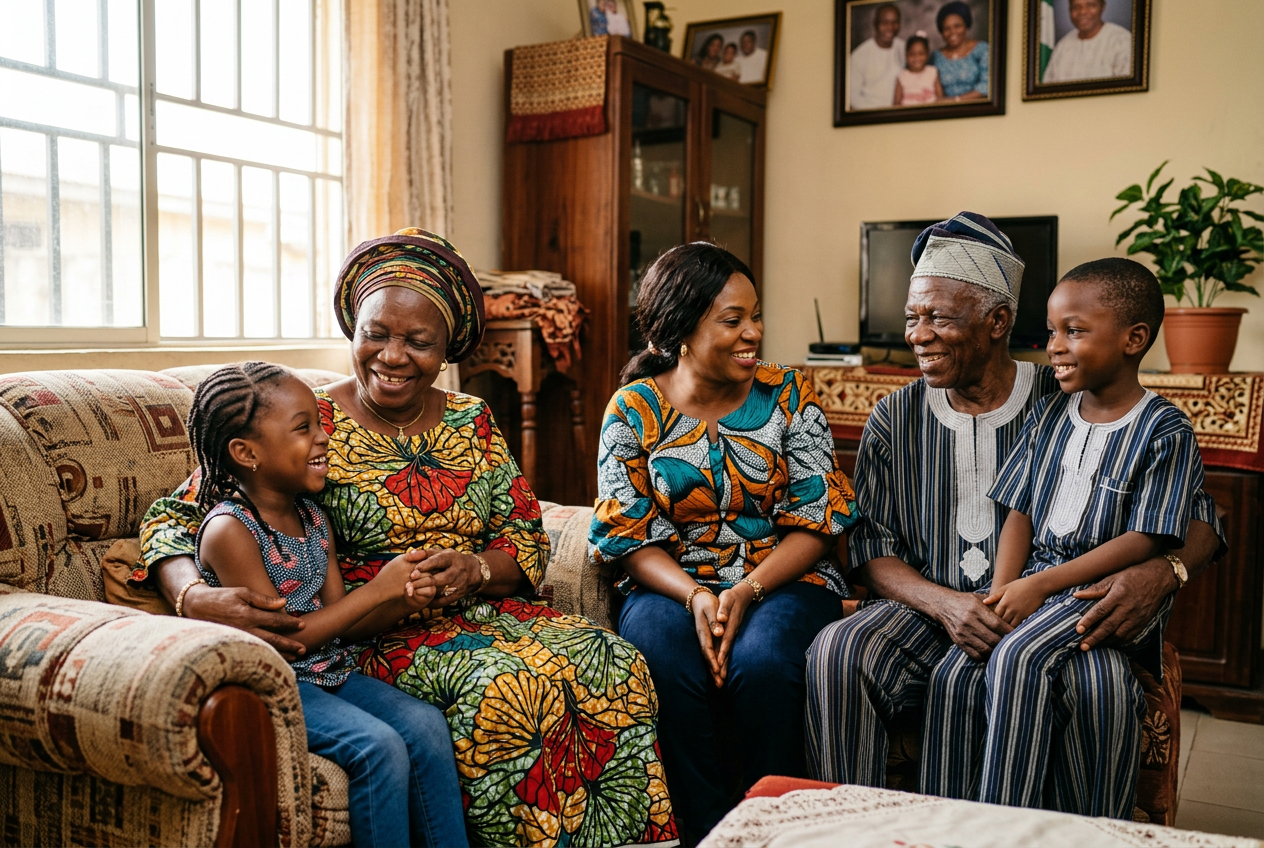
Welcome, and do pull up a chair, because this one took me somewhere I genuinely did not expect.
I have spent months on this question, working through constitutional text, household survey data and a great many long, circular, wonderful conversations with my own relatives. After years of writing about how this country actually lives rather than how it photographs, I can tell you that most people asking what are Nigerian family values want a tidy list. Ten bullet points. Something to print and pin above a desk. What you find instead, once you look properly, is a kinship arrangement that anthropologists file under a rather dry technical name and that quietly performs the job a welfare state performs elsewhere.
That is the thesis of this whole piece, so let me say it plainly at the start.
Nigerian family values are not decorative. They are load bearing. Remove them and a very large number of Nigerians would have nothing underneath them at all.
You can see why in the numbers. The National Pension Commission had roughly 10.9 million retirement savings accounts on its books by late 2025, against a working population that most estimates put above 70 million people. Fewer than one worker in six is inside the formal pension system. So who looks after the other five? Their children. Their nephews. The cousin who did well in Lagos.
That is not sentiment. That is arithmetic.

And it is arithmetic that is shifting. The National Population Commission reported that Nigeria’s total fertility rate has fallen from 5.3 children per woman in 2018 to 4.8 in the most recent national survey, drawn from more than 40,000 households across all 36 states and the Federal Capital Territory. Smaller families mean fewer shoulders carrying the same weight. Every value described below is being tested by that single statistic.
What are the types of family values found in Nigerian homes?
Before we get to any list, it helps to sort values into categories, because “family values” as a phrase collapses about four quite different things into one bucket.
Think of it rather like a house. Some values are the foundation, invisible and non-negotiable. Some are the load-bearing walls. Some are the furniture, which people rearrange constantly and argue about at Christmas.
Moral values are the foundation. Honesty, integrity, the sense that a person’s word should mean something. In Nigerian households these are usually taught through proverbs rather than lectures, which is why so many of us can recite our grandmother’s warnings verbatim decades later without ever having been sat down for a formal lesson.
Relational values are the walls. Respect for elders, deference in speech, the obligation to greet properly, the expectation that you will show up. These govern how people stand in relation to one another, and they are where Nigerian practice diverges most sharply from Western norms.
Religious and spiritual values run through everything. Whether a household is Muslim, Christian or holds to traditional practice, faith supplies the moral vocabulary. A Nigerian parent correcting a child rarely says “that is inefficient”. They say “God is watching you”.
Economic and communal values are the ones nobody writes on a poster but everybody feels in their bank account. The expectation that success is shared. That school fees travel sideways through a family. That nobody eats alone while a relative goes hungry.
Ceremonial values are the furniture. Naming ceremonies, weddings, funerals, the aso ebi that binds a hundred people into a single visual family for one Saturday.
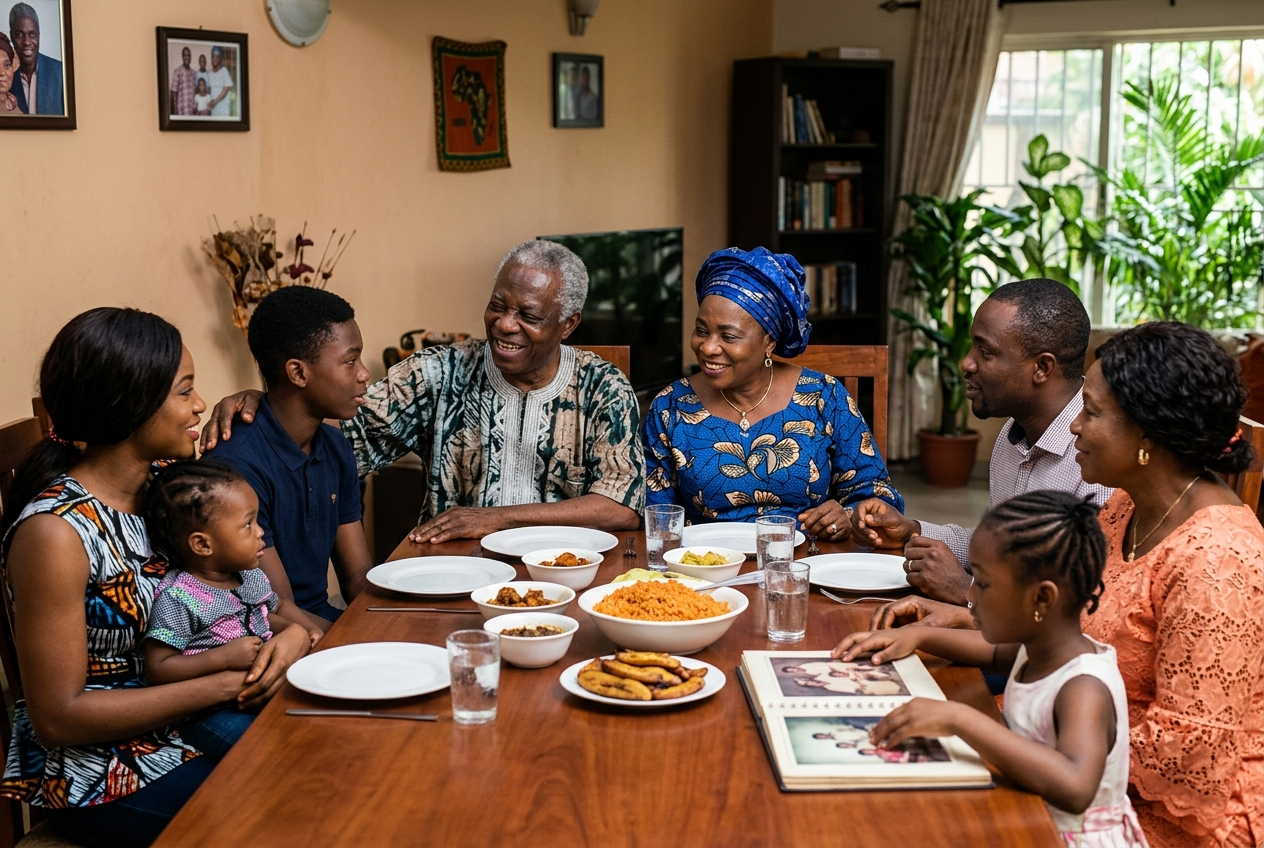
That last category matters more than it sounds. Nigerian families communicate belonging visually, and the design choices are not casual. A family choosing burgundy and gold aso ebi for a burial is making a statement about dignity and seniority. The seating arrangement at a traditional wedding, elders at the front, age grades behind them, children on mats at the edges, is a diagram of the family’s own value system rendered in plastic chairs.
Walk into a Nigerian family home and you can read the same thing in the furniture. The largest chair belongs to the eldest, and no one sits in it casually. Framed photographs run in generational order along the corridor. The parlour is kept formal for visitors even in a flat where space is precious, because hospitality outranks convenience.
Design, in a Nigerian home, is a moral statement.
The economic category is where these values are currently under the most strain, and government has started to notice. The Federal Ministry of Women Affairs used the 2026 National Care Summit to argue that caregiving should be treated as a proper professional sector rather than an invisible domestic obligation, noting that raising children, supporting relatives with disabilities and caring for the elderly has fallen disproportionately on women and adolescent girls. That is a policy sentence describing something every Nigerian family already knows in its bones.
Somebody is always carrying it. Usually she is not being paid.
What are Nigerian family values at their core?
Right. We are roughly at the halfway point, so let me answer the question directly rather than circling it.
Nigerian family values are a system of mutual obligation built on eight interlocking commitments: respect for elders and age-based seniority, the primacy of the extended family over the individual, communal responsibility for children, collective financial support of relatives, hospitality extended to guests and strangers, religious devotion as a shared household practice, the preservation of family name and reputation, and marriage understood as a union of two families rather than two people. These are not aspirations. They are enforced by social consequence, which is why a Nigerian who abandons a struggling parent faces a form of community judgement that carries real weight, and why “he has no home training” remains one of the most damaging things that can be said about an adult.
The related entities worth knowing, because they come up constantly in any honest discussion of this topic, are the extended family network, the age grade system, the concept of home training, communal child-rearing, black tax, aso ebi, the bride price negotiation, and the compound as a physical structure. Each one is a value made concrete.
Notice what is absent from that list. Individual self-determination does not appear. Personal privacy does not appear. Neither does the idea that an adult’s finances are their own business.
This is the part that trips up returnees and foreign partners most often, and I have watched it happen more times than I can count. A Nigerian professional who has spent eight years in Manchester comes home for a wedding, and within a fortnight is fielding requests for money from relatives whose exact position on the family tree they cannot immediately place. They experience this as an intrusion. Their family experiences their reluctance as a betrayal.
Both readings are internally consistent. That is what makes it painful.
The Guardian has explored this tension in some depth, including a considered look at the entitlement dynamics that grow up around a family’s most successful member, which drew on the footballer Mikel Obi’s account of relatives he had never met treating his earnings as a shared resource. The honest position is that both things are true at once. The system is a genuine safety net and it is genuinely exhausting.
The state has tried to formalise some of this. The National Orientation Agency spent the last two years building a National Values Charter, a framework of civic promises and citizen commitments approved by the Federal Executive Council and intended to sit alongside the constitutional ethics we will come to shortly. Whether a charter can shift behaviour is a fair question. What it does tell us is that Nigerian officialdom regards values as national infrastructure, not private preference.
How family values vary across Nigeria’s major traditions
The table below compares how the same underlying commitments express themselves differently across five of Nigeria’s traditions, based on the customs most consistently reported across each region.
| Tradition | Typical greeting to an elder | Naming ceremony timing | Who decides on marriage | Elder care expectation |
|---|---|---|---|---|
| Yoruba | Boys prostrate, girls kneel | Eighth day after birth | Both families, elders lead | Eldest son bears primary cost |
| Igbo | Bow or kneel, hands clasped | Eighth day, ancestral rites | Umunna consulted formally | Sons expected to build at home |
| Hausa Fulani | Lowered gaze, soft voice | Seventh day, Suna and Aqiqah | Parents and religious guardians | Household absorbs elders directly |
| Ijaw and Niger Delta | Verbal deference, seniority order | Seventh or eighth day | Wider kin group consulted | Shared across siblings |
| Tiv and Middle Belt | Kneeling, formal salutation | Varies by clan practice | Elders and clan heads | Compound based, collective |
What the table shows is that the surface rituals differ enormously while the underlying commitments barely move at all. Seniority, formal consultation and the assumption that elders remain the family’s responsibility hold across every one of these traditions, which is precisely why Nigerians from very different backgrounds can recognise one another’s family logic immediately even when the specific customs are unfamiliar.
What are the 10 family values Nigerian households live by?
If you press a Nigerian family to name its values, you tend to get some version of the following. I have set them out as a list because that is genuinely how people recite them, though the ordering varies by household and, frankly, by who is speaking.
- Respect for elders. The single most non-negotiable value in Nigerian life. Age confers authority automatically, and the physical gestures that go with it, kneeling, prostrating, lowering the voice, are not performances but statements of position.
- Loyalty to the extended family. Your father’s brother is not an uncle in the distant Western sense. He is a second father, and his children are your siblings.
- Communal responsibility for children. Any adult may correct any child. Orphaned or displaced children are absorbed into households without ceremony and, in daily life, rarely distinguished from biological children.
- Hospitality. No visitor leaves without being offered something, even if it is only water. Refusing food in a Nigerian home is a small insult, whatever your reasons.
- Religious devotion. Shared prayer, shared observance, and the assumption that moral instruction comes with divine backing.
- Hard work and the dignity of labour. Nigerian parents are relentless about effort, and there is little patience for the idea that any honest work is beneath a person.
- Education as a family investment. School fees are the single most common form of intra-family transfer, and a child’s academic success is understood as belonging to the whole household.
- Protection of the family name. Reputation is collective property. A scandal attaches to everyone who shares the surname, which is both a powerful deterrent and, at times, a mechanism for silence.
- Obedience and deference in speech. Children do not contradict adults in public. Disagreement is expressed privately, later, and carefully.
- Generosity and sharing. Success that is not shared is not fully legitimate. This is the value that produces both extraordinary kindness and considerable financial strain.
Ten values, and if you look closely, nine of them point outward. Only hard work points at the individual, and even that is framed as an obligation to others.
Is that list universal? No. A Lagos household where both parents work in tech and the children attend an international school will hold these values in a lighter grip than a compound in rural Ebonyi. But the vocabulary persists even where the practice softens, and that persistence is the interesting part.
The Guardian ran a lovely short reflection some years ago on why deference to those older than us survives generational change, built around the proverb that if a child shoots an arrow to the top of a palm tree, an elder must have carved it. That is the emotional logic underneath the whole list. Nothing you achieve is entirely yours.
What are the 7 core values of Nigeria as a nation?
Here is where private family values meet public national ones, and the overlap is more deliberate than most people realise.
Section 23 of the Constitution of the Federal Republic of Nigeria states that the national ethics shall be discipline, integrity, dignity of labour, social justice, religious tolerance, self reliance and patriotism. Seven values, written into the founding document, sitting in Chapter Two among the Fundamental Objectives and Directive Principles of State Policy.
Seven. Not a coincidence that the number keeps recurring in Nigerian civic life.
Let me take them briefly in turn, because the gap between text and practice is where the real story lives.
Discipline means self control, punctuality and respect for rules. Anyone who has driven in Lagos will recognise that this remains aspirational. Integrity means honesty and transparency, and it faces the widest gap of the seven, for reasons that require no elaboration to a Nigerian reader.
Dignity of labour recognises that all honest work deserves respect. This one, interestingly, does survive strongly at family level even where it fails at national level. Nigerian parents genuinely do drum into their children that no legitimate work is shameful, and the market trader funding a child through medical school is close to a national archetype.
Social justice holds that all citizens deserve access to opportunity. Religious tolerance recognises that all faiths merit equal respect, and in a country almost evenly split between Christianity and Islam, this is not an abstraction but a daily practical necessity. Self reliance encourages individual initiative and independence. Patriotism asks for loyalty to the nation above ethnic or regional attachment.
Now notice something. Those seven national values are, almost without exception, values a Nigerian family already teaches.
Discipline is home training. Integrity is protecting the family name. Dignity of labour is the parent insisting a child learns to sweep. Religious tolerance is the Muslim neighbour who sends food at Christmas and receives it at Sallah. The Constitution did not invent Nigerian values. It transcribed them, scaled them up to the level of the state, and then, one might argue, struggled to enforce them there.
Which raises the awkward question that hangs over this entire subject.
If Nigerian family values are so strong, why is public life so frequently the opposite? My own answer, after months of turning it over, is that the values are intensely strong and intensely local. Obligation runs deep within the kin group and thins rapidly outside it. Discipline towards your father is absolute. Discipline towards a stranger in traffic is optional. That is not hypocrisy so much as a moral system with a defined radius, and the national project has always been the attempt to widen that radius.
What are the three most important family values in Nigeria?
Press hard enough and most Nigerians converge on three.
Respect, particularly for elders. Ask a hundred Nigerians which value matters most and respect wins comfortably. A person who disrespects their elders is considered morally deficient regardless of their achievements, wealth or education. Everything else is built on top of this.
The extended family bond. Not merely affection for relatives but the operational reality that your relatives are your insurance, your credit facility and your emergency accommodation. In a country where formal social protection reaches a minority, this is the value with the highest practical stakes.
Communal generosity. The obligation to share what you have. This is the value that costs the most in cash and returns the most in security.
Those three, taken together, explain nearly every Nigerian family behaviour that puzzles outsiders. Why a graduate delays marriage to fund a sibling’s degree. Why a family business appoints a nephew over a better qualified stranger, a practice The Guardian has examined thoughtfully in a column on why Nigerian family enterprises now need formal governance structures rather than relying on kinship alone. Why a Lagos professional earning ₦900,000 a month can find close to ₦340,000 of it committed to relatives before the month begins, a ratio that recent household research suggests is far from unusual.
Roughly four in five Nigerian income earners contribute something to extended family in a typical year, and more than half do so every single month. That is not a fringe behaviour. That is the default.
So how do you actually live inside this system without being crushed by it, or without abandoning it entirely? Here is the approach I have watched work, in families who manage the balance well.
- Decide your annual family commitment as a fixed percentage of income before the year starts, rather than responding request by request. Ten to twenty per cent is a range many households find sustainable.
- Separate recurring obligations from emergencies, and keep a small dedicated buffer for the second category, because the emergencies will come and they never arrive at a convenient moment.
- Say yes to school fees before you say yes to almost anything else. Education transfers compound across generations in a way that consumption spending does not.
- Communicate limits early and in person, ideally through an elder who can carry the message with authority. A refusal delivered through the right channel is heard as prudence rather than pride.
- Fund capacity rather than dependency where you can, meaning a sewing machine, a market stall or a training course instead of an indefinite monthly transfer.
- Keep a written record of what you have given, not to shame anyone, but because memory in large families is selective and disputes are easier to defuse with facts.
- Protect your own retirement deliberately, since the generation you are supporting will be smaller than the one that supported your parents, and the arithmetic no longer works on goodwill alone.
That seventh point is the one I would underline twice. Fertility is falling, urban migration is scattering families across continents, and the ratio of earners to dependants is tightening. The values will survive. The old delivery mechanism might not.
Final Thoughts on Nigerian Family Values
So, what are Nigerian family values in the end? They are a functioning social technology, developed over centuries, that redistributes risk across a kin network in the absence of reliable formal institutions. They are also, and I want to be careful not to lose this in the analysis, a genuine source of joy.
There is nothing quite like the noise of a Nigerian compound on a Saturday.
I did not expect to end these months of research feeling protective of a system I began by wanting to critique. But when you sit with the numbers, when you understand that a majority of Nigerian elders have no pension and that the family absorbs what the state does not, the moral picture changes shape. What looks like burden from one angle looks like solidarity from another. Both descriptions are accurate. The trick, for anyone navigating this personally, is to hold on to the solidarity while negotiating the burden honestly rather than resentfully.
If you are Nigerian and feeling stretched, the work is not to reject these values but to structure them. If you are marrying into a Nigerian family, the work is to understand that you are marrying a network and to stop experiencing that as an imposition. And if you are raising children abroad, the work is to transmit the reasoning behind the values, not merely the rituals, because rituals without reasoning do not survive a generation.
Three things to take away and act on:
- Put a number on your family obligation this month rather than leaving it open ended, because undefined generosity is what breeds resentment on both sides.
- Teach your children the reasoning behind kneeling, greeting and sharing, not just the actions, since values that are explained survive relocation and values that are merely enforced do not.
- Start a pension or savings plan in your own name today if you have not already, because the most respectful thing you can do for the next generation is to avoid becoming an unplanned obligation.
Related Articles
If the communal dimension of Nigerian life interests you, my earlier piece on what actually makes Nigerians report high wellbeing despite genuine hardship tackles the same underlying question from the opposite direction, and lands on family and community as the explanation more often than income does. And for the practical end of all this, particularly the elder care obligations discussed above, I looked at whether growing old in this country is a realistic prospect for returning Nigerians and their parents, including what the absence of broad pension coverage means for families planning ahead.
Key Takeaways
- Nigerian family values form a mutual obligation system covering respect for elders, extended kinship, communal child-rearing, shared finances, hospitality, faith, reputation and marriage as a union of families.
- The Constitution’s seven national ethics in Section 23 are essentially household values scaled up to the state, which is why the gap between family conduct and public conduct is best understood as a question of moral radius rather than hypocrisy.
- Falling fertility and scattered urban families mean the traditional delivery mechanism is under real pressure, so structuring family support deliberately now matters more than it did for the previous generation.
Frequently Asked Questions About Nigerian Family Values
What are Nigerian family values?
Nigerian family values are a system of mutual obligation centred on respect for elders, loyalty to the extended family, communal responsibility for children, shared finances, hospitality, religious devotion, protection of the family name and marriage as a union of two families. They function as a practical social safety net in a country where formal social protection reaches only a minority of households.
What are the 10 family values?
The ten most commonly cited Nigerian family values are respect for elders, extended family loyalty, communal child-rearing, hospitality, religious devotion, hard work, education as a shared investment, protection of the family name, deference in speech, and generosity towards relatives. Nine of the ten point outward towards the group rather than inward towards the individual.
What are the 7 core values of Nigeria?
Section 23 of the Constitution names seven national ethics: discipline, integrity, dignity of labour, social justice, religious tolerance, self reliance and patriotism. These sit in Chapter Two of the Constitution and closely mirror the values most Nigerian households already teach at home.
What are types of family values?
Family values in Nigeria sort broadly into moral values such as honesty, relational values such as respect and deference, religious values shared across the household, economic values around collective support, and ceremonial values expressed through naming ceremonies, weddings and funerals. Sorting them this way makes it much easier to see which values are shifting and which are holding firm.
What are three most important family values?
Most Nigerians converge on respect for elders, the extended family bond and communal generosity as the three that matter most. Respect is usually named first because a person who disrespects elders is judged morally deficient regardless of their other achievements.
Why is respect for elders so central in Nigerian families?
Age confers authority automatically in almost every Nigerian tradition, and elders historically held the knowledge, land and dispute resolution power that a community depended on. The physical expressions of respect, kneeling among the Igbo and prostrating among the Yoruba, are statements of social position rather than empty ritual.
Is the extended family still important in modern Nigeria?
Yes, and arguably more so as economic pressure has increased, because the extended family remains the main source of emergency support for most households. Urban migration has changed how it operates, with mobile transfers replacing physical proximity, but the underlying obligations have not weakened much.
What is black tax and how does it relate to family values?
Black tax is the regular financial support that earning Nigerians provide to parents, siblings and wider relatives, and it is the communal generosity value expressed in naira. Household research suggests roughly four in five Nigerian income earners pay it in some form, with more than half contributing every month.
How do Nigerian family values differ between ethnic groups?
The surface customs differ considerably, with variations in greeting gestures, naming ceremony timing and who holds formal authority over marriage decisions. The underlying commitments to seniority, extended kinship and elder care are remarkably consistent across Yoruba, Igbo, Hausa Fulani, Ijaw and Middle Belt traditions alike.
Are Nigerian family values changing among young people?
Younger urban Nigerians increasingly question the financial obligations while retaining the relational values almost intact. Falling fertility and international migration are reshaping how the values are practised, though the vocabulary and expectations persist even where the practice has softened considerably.
How do Nigerian families teach values to children?
Values are transmitted mainly through proverbs, correction by any available adult, observation of how parents treat their own elders, and participation in ceremonies from a young age. The phrase home training captures the whole package, and a person said to lack it carries that judgement into adulthood.
Do Nigerian family values still work for families in the diaspora?
They travel better than most people expect, particularly respect, hospitality and educational ambition, though the daily reinforcement of a compound is impossible to replicate abroad. Diaspora families who explain the reasoning behind the rituals tend to transmit the values successfully, while those who enforce the rituals alone often lose them within a generation.

