 Follow Us on Google News
 Follow Us on Google Discover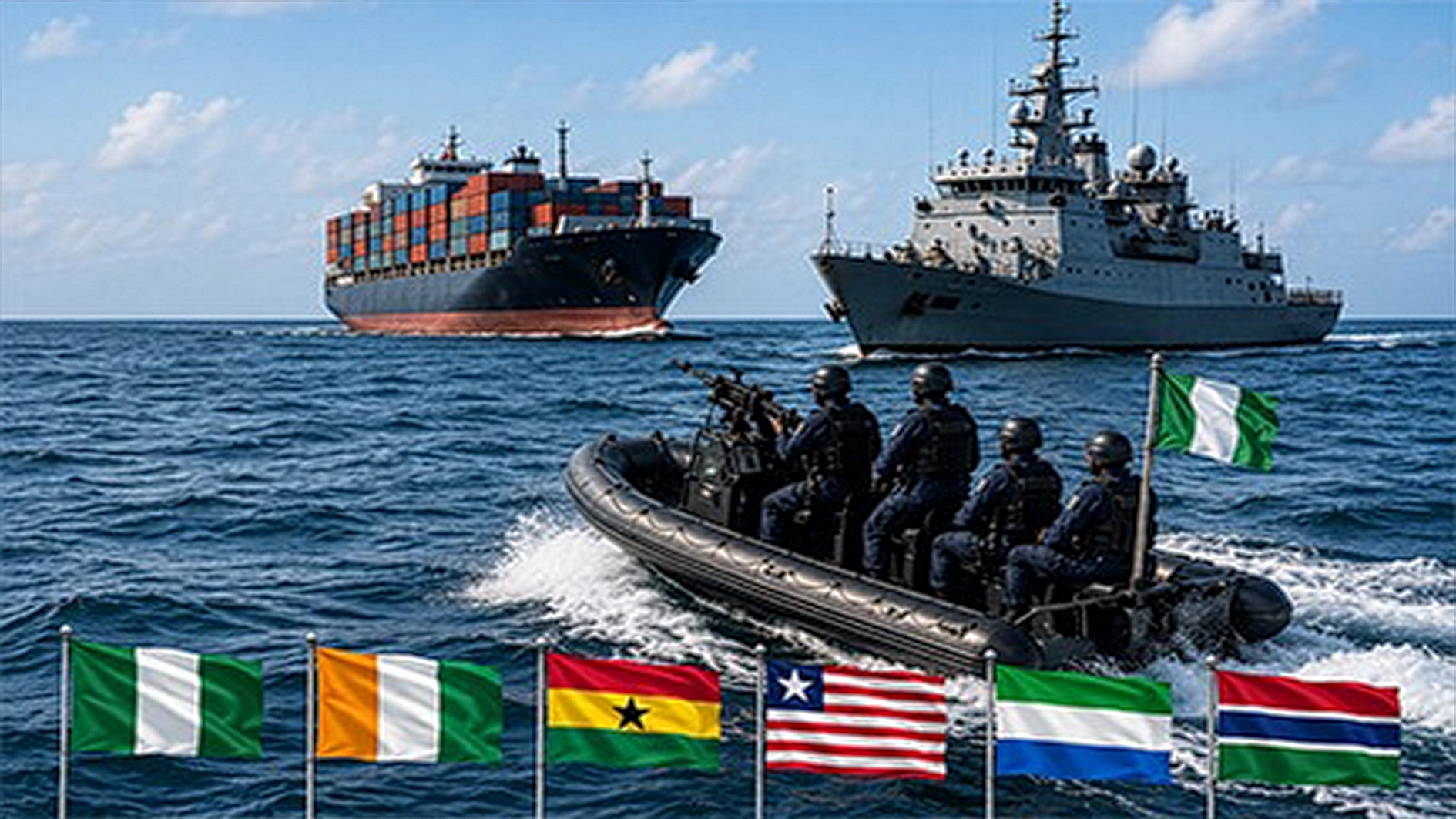
While the launch of the Combined Maritime Task Force marks a major security milestone for the Gulf of Guinea (GoG), its enduring value will be measured not by the number of patrols at sea but by its ability to unlock trade, attract investment and transform maritime security into sustainable economic growth, AMEH OCHOJILA reports.
For decades, the Gulf of Guinea (GoG) has been defined by an unfortunate reputation as piracy, crude oil theft, armed robbery at sea and other forms of maritime crime.
While the threats remain real, the dominant security narrative has often obscured a more profound reality that extends beyond naval operations and criminal prosecutions.
Maritime insecurity is, no doubt, a fundamental economic challenge. Every pirate attack delays commerce.
Every stolen cargo increases the cost of international trade. Every barrel of crude siphoned from offshore facilities weakens national revenues. Every incident of illegal, unreported and unregulated fishing erodes livelihoods, threatens food security and deprives governments of valuable income.
It is against this backdrop that the unveiling of the Combined Maritime Task Force (CMTF) Gulf of Guinea by Nigeria, Côte d’Ivoire, Ghana, Liberia, Sierra Leone, and The Gambia, under the command of Commodore Mohammed Shettima, represents far more than another multinational security arrangement.

Ultimately, the long-term success of the initiative will depend not solely on the number of pirates arrested or vessels intercepted, but on whether safer waters translate into lower shipping costs, stronger investor confidence, expanded maritime commerce, and a more competitive blue economy across the region.
That distinction is significant because the GoG is one of Africa’s most strategic maritime corridors. It serves as the export gateway for crude oil, liquefied natural gas, agricultural commodities and manufactured goods while supporting some of the continent’s busiest ports.
Millions of people also depend directly on fisheries, offshore energy, maritime transport and coastal trade for their livelihoods. When insecurity persists in such an environment, the consequences extend well beyond the shipping industry.
According to industry observers, shipping companies adjust routes, investors reconsider expansion plans, and importers and exporters absorb additional costs that are ultimately passed on to consumers.
The cumulative effect is slower economic growth and reduced competitiveness.
The effectiveness of the task force will ultimately depend on whether participating countries successfully harmonise command structures, communication systems, operational procedures and legal frameworks.
Without genuine interoperability, even sophisticated naval assets may struggle to deliver meaningful regional impact.
Surviving on an institutional framework
The CMTF provides the action arm to ensure the long-term sustainability and prosperity of the waters of West and Central Africa.
In practical terms, the CMTF is the most effective means of guarding the GoG.
Experts believe the success of the CMTF would ultimately depend on concrete action rather than policies or declarations.
President of the Auxilium Maritime Institute and a globally recognised maritime security expert, Dr Ian Ralby, stressed that no amount of legislation, policy or goodwill can transform maritime security in the Gulf of Guinea without an operational mechanism to implement them.
He said Nigeria, as the host nation of the task force, has a dual responsibility of building regional consensus around the initiative and removing operational obstacles that could hinder its effectiveness.
Ralby stressed that Nigeria must continue to remind governments and citizens across the region of the strategic importance of maritime security, noting that about 90 per cent of international trade moves by sea, around 20 per cent of food supplies come from fisheries, while approximately 99 per cent of global internet traffic depends on submarine cables.
“If the maritime domain is not secure, life on land suffers. For that, the CMTF needs the laws, policies, procurement and funding to make sure it can not only operate but operate as effectively as possible to safeguard the future of the region,” he added.
According to an Oceans Governance and Maritime Security expert at the University of St Andrews, Dr Ifesinachi Yarwood, the significance of the CMTF lies not simply in its establishment but in the institutional framework supporting it.
She explained that the GoG is not beginning from scratch because the Yaoundé Architecture already provides mechanisms for intelligence sharing, joint patrols and regional cooperation.
In her assessment, the new task force seeks to transform those existing arrangements into a more permanent operational mechanism capable of deploying multinational maritime assets faster and more effectively than the largely ad hoc responses that previously existed.
Yarwood also argued that the initiative enjoys greater legitimacy because it is African-led and has received endorsement from the African Union Peace and Security Council.
That political ownership, she noted, strengthens regional commitment while reducing dependence on external actors.
However, she warned that symbolism alone will not guarantee success.
According to her, the initiative’s durability will depend on whether member states consistently provide financial resources, operational assets, and sustained political commitment after the initial enthusiasm surrounding its launch subsides.
She further maintained that maritime insecurity cannot be defeated through naval deployments alone.
Effective maritime governance, she argued, requires stronger legal institutions, coordinated law enforcement, efficient prosecution, effective judicial systems and meaningful engagement with coastal communities if the region intends to address the structural drivers of maritime crime rather than merely responding to its manifestations.
Leading with Nigeria’s security framework
Nigeria was elected to host the task force headquarters, following the experience gained through the Deep Blue Project and sustained anti-piracy operation
Yarwood described the decision as strategically justified, noting that leadership inevitably attracts greater scrutiny.
According to her, Nigeria must provide consistent logistical, financial and political support while ensuring that the task force is perceived as a genuinely multinational institution rather than an extension of Nigeria’s own maritime strategy.
The balance between leadership and inclusiveness, she suggested, will significantly influence the initiative’s credibility.
Need for new measures
Experts believe the CMTF represents a significant evolution from previous regional arrangements.
They argued that while the 2013 Yaoundé Architecture substantially improved information sharing, it remained constrained by fragmented command structures, limited enforcement authority and operational coordination that was often activated only during specific incidents.
National Security Analyst, Dennis Amachree, said the new task force seeks to bridge those deficiencies through a unified operational command headquartered in Lagos, allowing participating countries to combine naval and aerial assets to counter piracy, crude oil theft, illegal fishing, arms trafficking, and other transnational maritime crimes.
Amachree believes the initiative begins with notable institutional advantages.
He pointed to its endorsement by the African Union Peace and Security Council, its alignment with the African Standby Force framework and Nigeria’s comparatively advanced maritime capabilities as important strengths that could enhance operational effectiveness.
He, however, cautioned that military capability alone cannot guarantee long-term success.
According to him, member states must establish predictable funding arrangements, harmonise maritime legislation, strengthen extradition mechanisms and ensure that arrests at sea consistently lead to successful prosecution.
Without legal coordination and sustained diplomatic commitment, operational achievements may fail to produce lasting deterrence.
While experts continue to debate the initiative’s institutional design, Shettima believes the CMTF introduces several innovations absent from previous regional arrangements.
He explained that it is the first initiative of its kind in Africa and only the second globally after the multinational CMTF operating around the Horn of Africa.
According to Shettima, one of its defining characteristics is the integration of military personnel with civilian law enforcement institutions, including the National Drug Law Enforcement Agency (NDLEA), the Nigeria Immigration Service (NIS), and representatives of participating member states, all of whom operate within the same command structure.
That multidimensional and multi-agency composition, he argued, provides a more comprehensive response to increasingly sophisticated maritime threats.
Another important innovation, according to the Force Commander, is the establishment of a Mission Support Component that formally incorporates organised private sector participation into maritime security operations.
Shettima observed that businesses dependent on secure shipping routes are among the principal beneficiaries of maritime security, yet bear enormous financial losses when insecurity disrupts maritime commerce.
Their participation, he said, recognises that sustainable maritime security requires collaboration between governments and the commercial sector.
He also highlighted the inclusion of Ministries of Justice and Foreign Affairs within the task force framework.
According to him, their involvement will strengthen diplomatic coordination, facilitate cross-border legal cooperation and simplify the prosecution or transfer of suspects arrested during multinational operations. For many years, jurisdictional complexities have undermined successful maritime enforcement despite operational successes at sea.
Beyond operational coordination, Shettima believes the initiative reflects Africa’s evolving appreciation of the maritime domain’s strategic importance.
He pointed to Nigeria’s establishment of the Federal Ministry of Marine and Blue Economy, along with endorsements from the African Union, ECOWAS Heads of State and Government, and the Gulf of Guinea Commission, as evidence that maritime security is increasingly viewed as an economic development priority.
On Nigeria’s leadership role, Shettima argued that the country’s provision of naval platforms, air assets, logistics and headquarters facilities demonstrates its commitment to creating secure maritime corridors capable of attracting investment, facilitating commerce and restoring confidence among international shipping operators.
Yet even the strongest institutional framework cannot escape a practical reality.
According to Victor Idajili, a development expert, history demonstrates that many regional security initiatives begin with considerable political momentum before gradually losing effectiveness as governments confront competing budgetary pressures.
He said that makes sustainable financing one of the greatest tests facing the CMTF.
Nigeria’s decision to host the headquarters and provide substantial operational assets, therefore, represents more than symbolic leadership. It also places considerable responsibility on the country’s shoulders to sustain confidence in the initiative during its formative years.
He said the credibility of the task force will depend on whether every participating country perceives itself as an equal stakeholder committed to protecting shared maritime interests, rather than as a supporter of a predominantly Nigerian initiative.

