 Follow Us on Google News
 Follow Us on Google Discover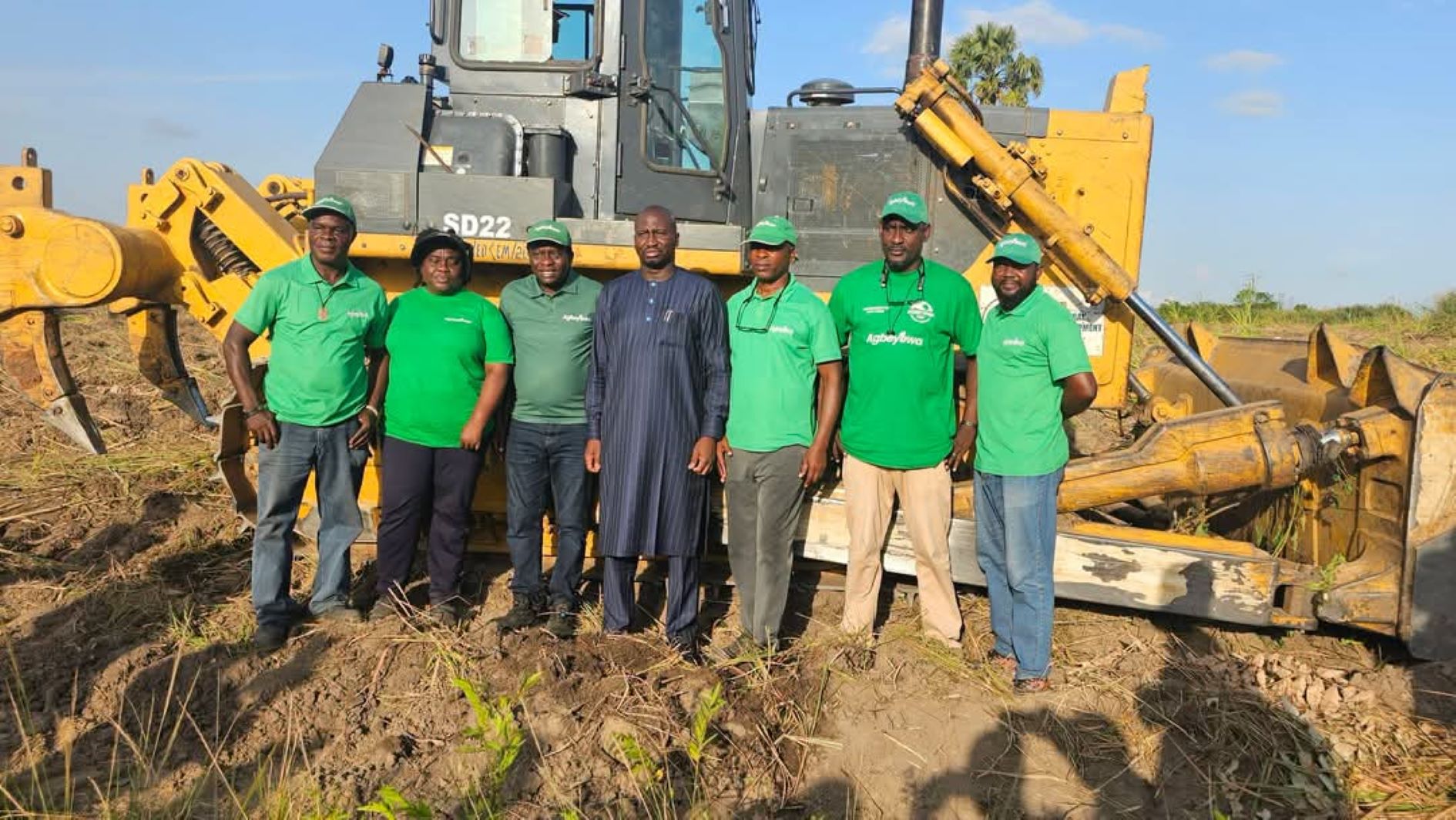
By Sunday Kayode
The countries getting the most from agriculture have long moved beyond seeing the farm merely as a place where food is grown. Across successful agricultural economies, the land increasingly connects with science, technology, industry and markets, creating value long after harvest. For Nigeria, a country of vast arable land still grappling with food security and low productivity, that lesson has assumed a new urgency.
Nigeria has never been short of agricultural ambition. Governments have launched programmes, opened intervention windows and repeatedly placed food security at the heart of national policy. The more difficult task has been turning those opportunities into productive farms, higher yields, viable businesses and stronger rural economies. That requires government to create the right conditions, while serious private operators bring capital, technology, knowledge and the discipline of execution.
It is within that space that the Agbeyewa Farms story in Ekiti becomes interesting. Rather than viewing government principally as a source of intervention, the company is plugging an expanding commercial operation into public agricultural platforms that can help it scale. By late 2025, Agbeyewa had cultivated more than 3,000 hectares of cassava and was working towards a 5,000-hectare target, with mechanisation, improved varieties and productivity increasingly defining its approach.
The Federal Government took notice. In February 2025, the Minister of Agriculture and Food Security, Senator Abubakar Kyari, visited Agbeyewa’s operations at Ipao-Ekiti. After seeing the scale of activity, he declared that the government had “no option than to collaborate” with Ekiti and Agbeyewa on food production and wealth creation. In time, that remark would amount to more than a passing ministerial endorsement.
By November 2025, the relationship had acquired an institutional framework. The National Agricultural Land Development Authority (NALDA) entered into a formal partnership with Agbeyewa. Its Executive Secretary, Cornelius Adebayo, linked the authority’s interest partly to what he had encountered during an earlier visit to the company’s operations, particularly the scale and efficiency of the farming activities he saw.
The sequence is instructive. Agbeyewa did not arrive at the Federal Government’s door with little more than a proposal. An operating agricultural platform was already taking shape. For government, the partnership offered an opportunity to build on demonstrated private capacity. For Agbeyewa, it opened another route through which its production and agronomic ambitions could be extended.
That relationship acquired a physical footprint by May 2026, when 1,200 hectares at NALDA’s Oke-Ako Farm Estate in Ekiti were earmarked for cultivation by Agbeyewa as anchor operator. The roles are reasonably clear. Public land development creates room for expansion, while the private operator brings investment, technology, management, agronomic expertise and a route to market.
That division of responsibility speaks to an old problem in Nigerian agriculture. Government has the institutional reach to unlock land and address some structural constraints, but running commercial farms is a different undertaking. Private businesses may execute more efficiently, yet land preparation, infrastructure and the cost of expansion can limit their reach. Partnership provides a bridge when both sides bring something useful to the field.
But expansion, in itself, is hardly enough. The more compelling part of the Agbeyewa proposition is its emphasis on productivity. The company has reported cassava yields of up to 32 tonnes per hectare and starch content of 27.7 per cent. Such figures matter because Nigeria’s agricultural future will depend increasingly on how much value comes from each hectare, not simply how many hectares are cultivated.
That thinking is reflected in the varieties grown across the company’s Ekiti operations. AYAYA, White Lion, Dixon and TME 419 are cultivated with attention to maturity, yield potential and starch content. The principle is straightforward. Land becomes more economically useful when decisions about what goes into the soil are connected from the outset to productivity, quality and the requirements of the market.
Modern farming is also increasingly a knowledge business. In 2025, Brazilian cassava specialists visited Agbeyewa’s operations in Ipao, Gede and Iyemero, exchanging ideas on mechanisation, cultivation techniques and production efficiency. Their visit reflected a wider reality. Land remains fundamental, but science, machinery and technical knowledge increasingly determine what that land can produce and whether the output can compete commercially.
Seen from that perspective, the Federal Government partnership becomes more than a land story. Developing additional hectares without improving what each hectare produces merely expands acreage. The greater opportunity lies in combining land development with better agronomy, mechanisation, technology and dependable markets. That is how public support can contribute to commercially sustainable production rather than another agricultural programme remembered mainly for its launch.
The ambition does not end at the boundaries of Agbeyewa’s directly cultivated fields. Its in-grower and out-grower model envisages cooperatives of between 100 and 150 farmers managing production clusters of about 500 hectares. Properly implemented, participating farmers could gain access to improved planting materials, mechanisation, technical support, aggregation and more predictable markets, bringing smaller producers into a better organised production system.
The smallholder connection could prove crucial. Nigeria cannot transform agriculture through large commercial farms alone. Neither can millions of small farmers, working individually with limited machinery, finance and market certainty, easily drive the transformation required. An anchor investor offers a middle ground, allowing commercial knowledge, technology and market access to travel beyond the boundaries of a company’s own farms.
Then comes the question every successful agricultural expansion must eventually confront: who buys the additional output? Growing more crops without creating sufficient demand can ultimately hurt the farmer. Agbeyewa’s acquisition of Matna Foods Company Limited in January 2026 strengthened its connection with industrial cassava processing, bringing production closer to value addition and creating another destination for agricultural output beyond the traditional raw commodity market.
Once crops begin feeding industry, the economic picture changes. Processing creates demand for engineering, energy, packaging, storage, transportation and distribution. More value can remain within the economy before the final product reaches the market. Seen this way, the journey from farm to factory becomes almost as consequential as the journey from planting to harvest.
There is also a partnership closer to home. A May 2024 agreement with the Ekiti State Government set an ambition of 100,000 hectares through an out-grower programme. Taken alongside the federal engagement and NALDA arrangement, it reveals an expansion strategy built around collaboration across different levels of government, while leaving responsibility for commercial execution largely with private enterprise.
For Ekiti, the implications reach beyond the fortunes of one company. Larger and more productive farms need machinery operators, technicians, transporters, input suppliers and service businesses. Processing widens that circle further. If smallholders are successfully integrated, the benefits reach more households. Agriculture then begins to function not as an isolated sector, but as an economic platform around which other activities can grow.
Still, partnership with government brings responsibility as much as opportunity. The Agbeyewa experience will ultimately be judged not by hectares announced, agreements signed or official visits recorded, but by what happens afterwards. Sustained yields, productive farms, farmers integrated, jobs created, processing supported and communities able to identify tangible economic gains will provide the more meaningful measure of success.
From the global movement towards technology-driven agriculture to Nigeria’s search for food security and Ekiti’s effort to turn agricultural endowment into enterprise, the lesson is remarkably consistent: land fulfils only part of the promise. What matters is what knowledge, capital and organisation can make of it. The growing partnership between the Federal Government and Agbeyewa is putting that proposition to the test. If it succeeds, its more enduring harvest may be the demonstration that when public opportunity meets private enterprise on the farm, better agronomy can grow into something much larger than food.
• Kayode, PhD writes from Ado Ekiti

