 Follow Us on Google News


 Follow Us on Google Discover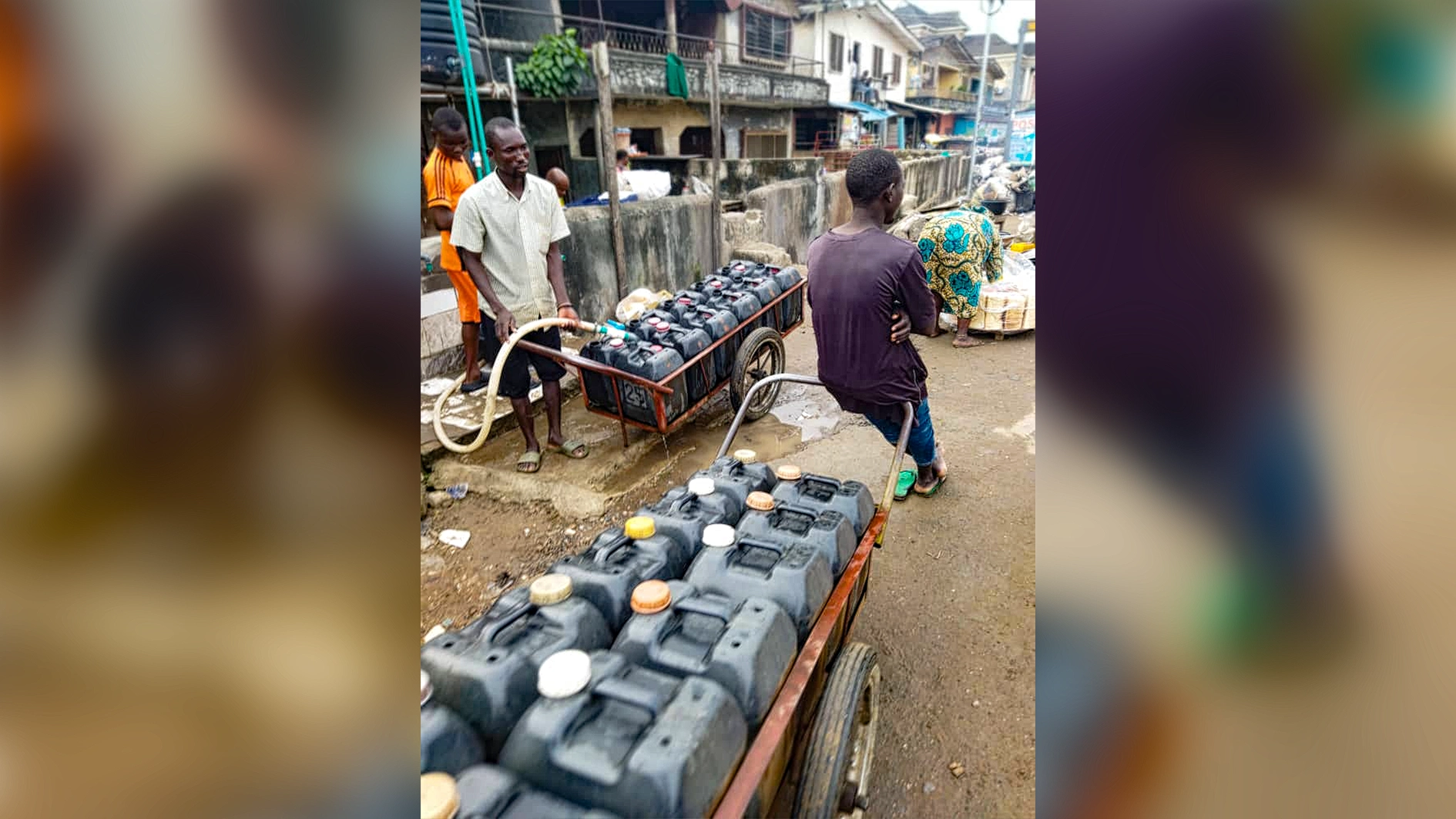
Across Lagos State, the search for water begins long before many residents start their daily routines.
In Shogunle, Helen Paul, a teacher and resident of Saka Street, recently joined a queue of about 20 people beside a private building, each waiting for a chance to fill their containers from a tap. They were not waiting for the Lagos Water Corporation (LWC).
In fact, Helen said many residents in the area barely know what the corporation does.
“We don’t even know about the Lagos Water Corporation. We are just hearing that they exist. They have not supplied water to this part of Lagos in any way. Not at all,” she said.
For Helen and thousands of other residents across Shogunle and neighbouring mainland communities, access to water has become a daily struggle. Instead of relying on public water infrastructure, residents depend largely on boreholes operated by private individuals, homes, hotels and community groups.
The problem extends far beyond Shogunle. Across Lagos State, from densely populated mainland neighbourhoods to communities on the Island and in the outskirts of the metropolis, residents increasingly rely on private boreholes, water vendors, wells, streams and other informal sources to meet their basic needs.

Even public boreholes can become useless when electricity fails. “So we run to private buildings, houses or hotels that have boreholes. That’s the only way we get water here,” Aisha, another resident, explained.
For some residents, the crisis has also created a thriving informal water economy.
Amiru Rufai, 34, pushes a wheelbarrow loaded with 10 black 25-litre jerrycans through the streets of Shogunle. He buys water from private buildings that sell it for N50 a jerrycan when electricity is available and N100 when there is a power outage.
He then sells each one for N250 to residents who have no other option.
A full load of 10 jerrycans earns him N2,500, leaving him with about N1,500 in profit after purchasing the water.
“Business booms most when there is no electricity supply for weeks and those private buildings and public taps that give water for free cannot pump,” Amiru said. “So I go to private buildings that sell water, buy it and sell it back to people in this area.”
There is little room for questions about where the water comes from, whether it has been tested or whether it meets safety standards. For many residents, the priority is simply getting enough water to cook, bathe, wash clothes and flush toilets, despite the heavy financial burden.
For instance, a household that might otherwise spend about N2,000 a month on water supplied by LWC can now spend between N10,000 and N15,000 buying from vendors, depending on the frequency of power outages and the availability of borehole water.
For low-income families, the additional cost is not insignificant. Money that could have gone towards food, transport, school expenses or healthcare is increasingly being spent on water.
Yet, while residents across the mainland struggle with jerrycans and wheelbarrows, the LWC continues to announce infrastructure upgrades and projects aimed at improving water supply in different parts of Lagos.
The corporation, in a recent statement issued in August 2026, said it commenced the strategic installation of new pumps at the Iju Headworks and Akute Intake Stations as part of an eight-month rehabilitation programme funded by the Lagos State Government under Governor Babajide Sanwo-Olu.
In June, councillors on Lagos Island also commended the corporation’s Managing Director, Mukhtaar Tijani, for improvements in water supply and the consistent Sunday water distribution initiative on the Island.
The corporation has also announced plans to concession facilities in Lekki, Victoria Island Annex and Magodo through public-private partnerships as part of efforts to expand access to potable water.
But for residents of Shogunle and several other communities across Lagos State, such announcements have become difficult to distinguish from previous promises.
The corporation itself acknowledges the scale of the challenge. In one of its public-private partnership statements, LWC said that, even at full capacity, it currently serves only about 35 per cent of Lagos households.
It has said it is rehabilitating the Iju and Adiyan waterworks to improve operational efficiency and expand access. It is also working with Julius Berger to minimise project conflicts and deliver what it describes as durable infrastructure solutions.
However, as of press time, the corporation had not indicated when Shogunle and other underserved communities would begin receiving regular piped water.
For residents, the repeated announcements of new pumps, rehabilitation programmes and partnerships have offered little relief. Each promise raises expectations, but the taps in many homes remain dry. Over time, the gap between official assurances and daily experience has created a growing sense of hopelessness about whether the corporation can actually solve the crisis.
Meanwhile, residents are increasingly turning to boreholes and informal vendors to survive the shortage. LWC has itself raised concerns about uncoordinated borehole drilling and its potential impact on Lagos’ groundwater resources.
Public health experts have also warned that untreated or poorly monitored water from informal sources could expose residents to waterborne diseases, including cholera and typhoid.
For people like Helen, the debate over pumps, rehabilitation and public-private partnerships feels distant from the immediate reality of finding water every day.
Her experience reflects what appears to be a statewide water crisis: infrastructure upgrades and new investment projects are repeatedly announced, while residents in many communities continue to queue for water, buy from vendors and depend on unreliable boreholes.
As Amiru pushes his wheelbarrow through another street, the question from residents is simple but increasingly urgent: if Lagos is investing in improving water supply, when will the water reach them?
For mainland families and households across Lagos already spending heavily to buy what should be a basic public service, the answer cannot come soon enough.
Across the state, the same question is becoming harder to ignore. From urban neighbourhoods to rural communities, residents are increasingly forced to depend on boreholes, water vendors, streams and other informal sources as public water systems fail to meet demand.
The crisis is no longer confined to Lagos Island or defined by the contrast between the Island and the mainland; it is a statewide challenge, compounded by years of unmet promises and with no clear respite in sight.

