 Follow Us on Google News
 Follow Us on Google Discover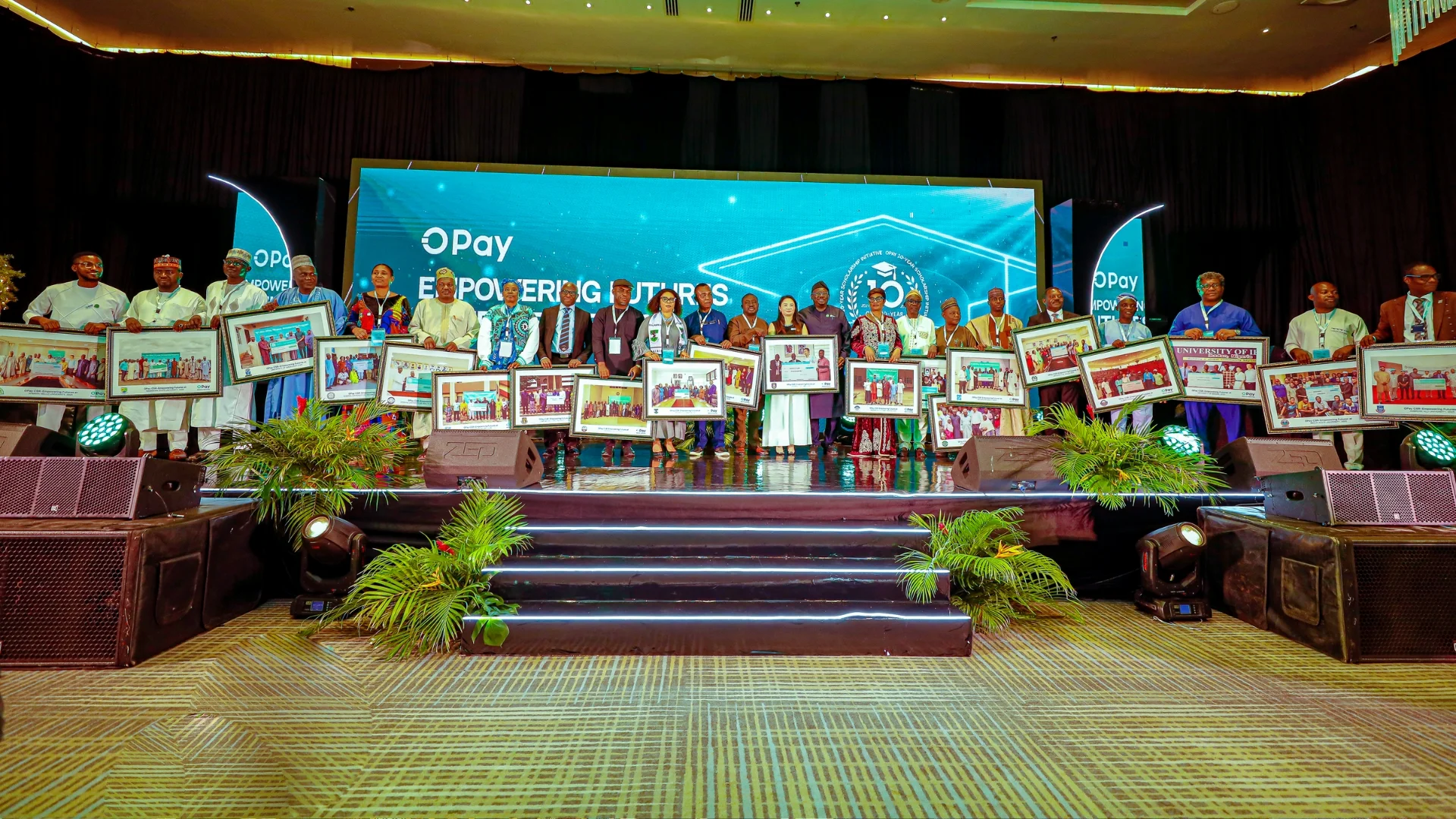
From supporting children in school to helping young Nigerians develop new skills and providing women with tools to improve their livelihoods, OPay is directing part of its corporate social responsibility efforts towards investment in people.
That distinction matters.
Building a better Nigeria is not only about roads, buildings, power plants or technology. Infrastructure is essential, but development is ultimately about people and what they are equipped to do.
When a child has the materials needed to learn, when a young person gains access to relevant skills or when a woman receives support to establish a source of income, the potential impact can extend beyond one beneficiary to families and communities.
This is the context in which OPay’s education, youth development, women’s empowerment and community programmes should be considered.
At the centre of much of that work is education.

Investing in the next generation
In 2026, OPay expanded its ₦1.2 billion, 10-year scholarship commitment into a broader OPay Scholars Programme.
According to the company, the programme now brings together three major initiatives: its original ₦1.2 billion scholarship commitment, the National Innovation Challenge and OPay Futures.
OPay says more than 1,200 people have directly benefited from the Scholars Programme.
Numbers alone, however, are not the most important part of the story.
The larger question is what access to education and skills can enable young Nigerians to do.
Financial pressures remain one of the obstacles confronting many students. Support with education can reduce some of that burden and potentially allow beneficiaries to devote greater attention to completing their studies and preparing for employment.
Skills development is equally important.
Nigeria has a large youth population entering an economy in which technology is reshaping how people work, communicate, build businesses and access opportunities.
Young Nigerians are therefore not simply future participants in the economy. They are already entrepreneurs, employees, creators, developers and consumers shaping it today.
Giving them access to relevant education and skills is consequently not just philanthropy. It can contribute to developing the human capital the country needs.
The National Innovation Challenge extends this thinking into technology and problem-solving.
Delivered through a partnership involving OPay, Google and the Federal Government’s 3 Million Technical Talent programme, the initiative is designed to give young Nigerians an opportunity to develop technology-driven ideas and demonstrate how those ideas could address real-world problems.
The more useful objective is not merely teaching people how to use technology.
It is helping them understand how technology can be applied to create value.
Helping children learn
Investment in human capital has to begin long before university or employment.
OPay’s Play4aChild initiative focuses on younger beneficiaries through the provision of educational materials and other forms of support.
The company says the initiative has reached more than 14,000 direct beneficiaries since it began.
It can be tempting to regard educational materials as a relatively modest intervention when compared with scholarships or major infrastructure projects. But for the child who lacks basic learning resources, seemingly small interventions
can affect the everyday experience of education.
A child who can participate properly in lessons has a better opportunity to learn.
The long-term effect of programmes such as Play4aChild will ultimately depend on factors including continuity, targeting and the quality of support provided.
That is why measuring social investment should extend beyond counting how many items were distributed or how many people attended an intervention.
Companies should increasingly be asking what changed for the beneficiaries afterwards.
Did educational participation improve? Did beneficiaries remain in school? Did their learning outcomes change?
Those are more difficult questions, but they are also where corporate social responsibility begins moving from activity to impact.
Giving women the tools to build
OPay’s social investment programmes also extend to women’s economic empowerment.
Through its Women Empowerment Programme, the company says more than 100 women have received support involving skills development, capacity building and assistance to start businesses.
The economic reasoning behind programmes of this kind is straightforward.
Skills are valuable, but skills alone do not always translate into income.
A woman may learn how to produce a product or deliver a service but still lack the business knowledge, equipment, capital, networks or market access required to turn that skill into a sustainable livelihood.
This is why effective empowerment programmes should go beyond training.
They should consider the pathway from learning to earning.
When a woman establishes a sustainable source of income, the benefits can extend beyond her personal finances. Household income can improve, businesses can employ others and spending can circulate within communities.
Women already play a significant role in Nigeria’s micro, small and informal business economy. Expanding their access to skills, finance and commercial opportunities should therefore be viewed not only through the lens of gender inclusion, but also as part of economic development.
From CSR activity to measurable impact
OPay’s reported figures provide an indication of the scale of its programmes.
The company says more than 1,200 people have benefited directly from the OPay Scholars Programme, more than 14,000 beneficiaries have been reached through Play4aChild, while more than 100 women have received support through its empowerment programme.
Those figures are useful.
But corporate social responsibility in Nigeria should increasingly be judged by more than the number of beneficiaries announced in press releases.
Companies should be encouraged to measure outcomes.
For scholarship recipients, this could include graduation rates, employment outcomes or further education.
For skills programmes, it could mean tracking how many participants subsequently secure jobs, create businesses or improve their earnings.
For women’s empowerment initiatives, measurements could include business survival, income growth and employment created after receiving support.
This distinction between outputs and outcomes is important.
Distributing 10,000 educational materials is an output. Demonstrating that an intervention improved educational participation or learning is an outcome.
Training 100 entrepreneurs is an output. Establishing how many are still operating sustainable businesses two years later brings us closer to understanding impact.
As corporate social investment becomes more sophisticated, Nigerian companies should be willing to make that transition.
Another useful feature of OPay’s approach is its use of partnerships.
The company’s involvement with Google and 3MTT illustrates how private-sector organisations can combine resources and expertise with other institutions rather than attempting to address complex social problems independently.
Nigeria’s development challenges are too extensive for government alone to solve.
But they are equally too large for individual companies, foundations or civil society organisations to address in isolation.
Partnerships can bring together funding, technology, institutional reach, technical expertise and community knowledge.
The important question is whether those partnerships produce sustainable outcomes.
Building Nigeria one person at a time
There is another reason investment in people matters.
Nigeria’s development conversation often focuses understandably on physical deficits: inadequate electricity, roads, schools, hospitals, housing and other infrastructure.
Yet a country can build infrastructure and still struggle if it does not simultaneously develop the people who will operate, maintain, improve and ultimately benefit from it.
Human capital is therefore infrastructure too.
A child who receives a better education may become tomorrow’s engineer, teacher, entrepreneur or healthcare professional.
A young person who develops relevant technical skills may create a product, secure employment or build a company that employs others.
A woman who develops a sustainable business can strengthen her household while contributing to economic activity in her community.
None of those outcomes is guaranteed merely because a programme exists.
That is why OPay and other companies investing in social programmes should continue to measure not only what they spend and how many people they reach, but what happens to those people afterwards.
Technology companies are often judged by the speed of their products, their customer numbers, transaction volumes and commercial growth.
But their broader contribution can also include how they deploy resources, expertise and partnerships within the societies from which they grow.
OPay’s education, youth and women’s programmes represent one approach to that responsibility.
The next stage should be increasingly rigorous measurement of their long-term outcomes.
Because ultimately, building a better Nigeria is not only about what gets built.
It is also about who gets the opportunity to learn, participate, build, grow and succeed.
And that is where investing in people becomes an investment in the country itself.

