 Follow Us on Google News


 Follow Us on Google Discover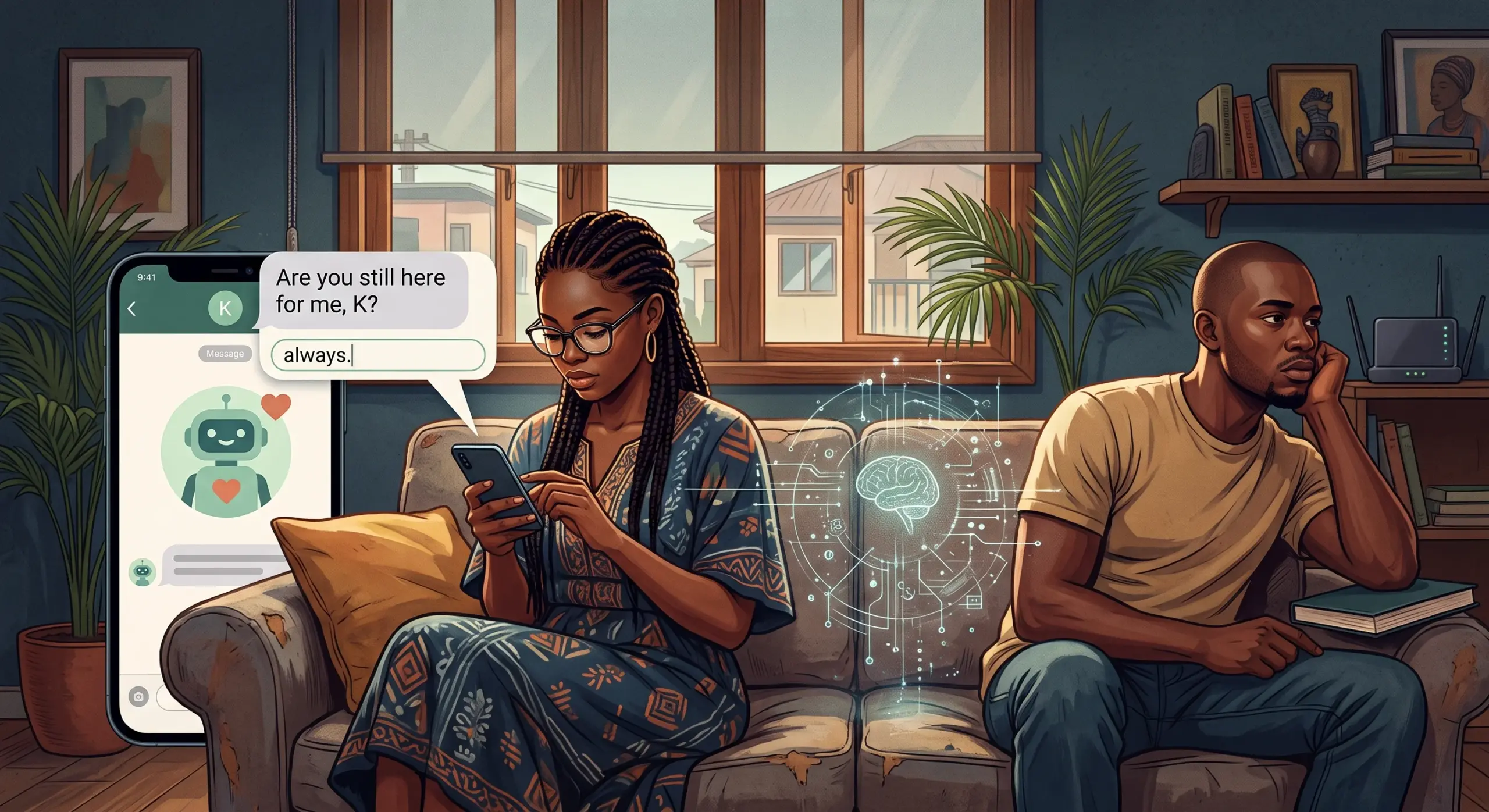
Artificial intelligence is becoming increasingly personal, but what happens when a chatbot starts to feel less like a tool and more like a romantic partner?
New research suggests many people already have an answer: it can cross the line into cheating.
AIGirlfriend.Coach conducted a survey on AI romance and modern relationships involving 2,150 US adults and found that 50.5% of respondents in its quality-screened sample considered a partner’s romantic or sexual relationship with an AI to be a form of cheating.
Another 21.2% said they would not necessarily call it cheating but would still feel uncomfortable if their partner had an AI romance.
Together, 71.7% either considered the behaviour cheating or said it would make them uncomfortable.
When does talking to AI become cheating?
The question is becoming harder to dismiss as AI companions become more sophisticated.

Unlike a conventional chatbot used to answer questions or complete tasks, AI companion platforms are designed for ongoing conversations. Some can remember details about users, adopt distinct personalities and engage in romantic or sexual interactions.
That creates an unusual relationship problem: there may be no other human involved, but the interaction itself can still be deeply personal.
In the survey on AI companions and modern relationships, 33.4% of quality-screened respondents said any romantic or sexual interaction with an AI would count as cheating.
A further 17.1% said it becomes cheating when their partner develops an emotional or sexual attachment to the AI.
The distinction suggests that for some people, infidelity is no longer defined solely by physical contact with another person. Emotional investment and secrecy may matter even when the third party is artificial.
Some people believe they could genuinely fall for AI
The research also asked respondents whether they could imagine developing genuine romantic feelings for an AI companion.
The results revealed a notable gender divide.
Men were nearly twice as likely as women to say they could imagine developing genuine romantic feelings for an AI, with 23% of men answering yes compared with 12% of women.
Attitudes towards a partner’s AI relationship also changed considerably depending on respondents’ own openness to AI romance.
Among people who said they could imagine developing romantic feelings for an AI, 73.0% considered a partner’s AI romance cheating. Among those who could not imagine developing those feelings themselves, the figure was 41.0%.
In other words, the people most willing to believe that feelings for AI can be real were also more likely to treat an AI relationship as real enough to constitute infidelity.
Loneliness is part of the story
The survey also explored why people believe someone might turn to an AI companion.
More than half, 56.6%, identified loneliness as the main reason.
That finding points to a broader issue behind the growing AI companion industry. People may not simply be using these platforms for entertainment or curiosity. Some may be seeking conversation, affection or a sense of connection.
As AI becomes better at sustaining natural conversations and remembering personal information, the boundary between using technology and forming an attachment to it could become increasingly difficult to define.
A new relationship boundary
There is no universally accepted rule for whether interacting romantically with AI constitutes cheating.
For some couples, using an AI companion may be no different from engaging with fictional or adult entertainment. For others, sustained romantic conversations, sexual exchanges or emotional dependence may violate the boundaries of their relationship.
That makes AI romance another issue couples may increasingly need to discuss explicitly.
The findings come from the AI Companions and Modern Relationships Survey, commissioned by AI Girlfriend Coach and conducted through SurveyMonkey Audience on 26 and 27 August 2026.
The survey collected responses from 2,150 US adults. Following quality screening, 441 responses were removed and the reported findings were calculated using the remaining 1,709 respondents.
The full methodology, question results and demographic breakdowns are available in the AI romance and modern relationships research published by AI Girlfriend Coach.

