 Follow Us on Google News
 Follow Us on Google Discover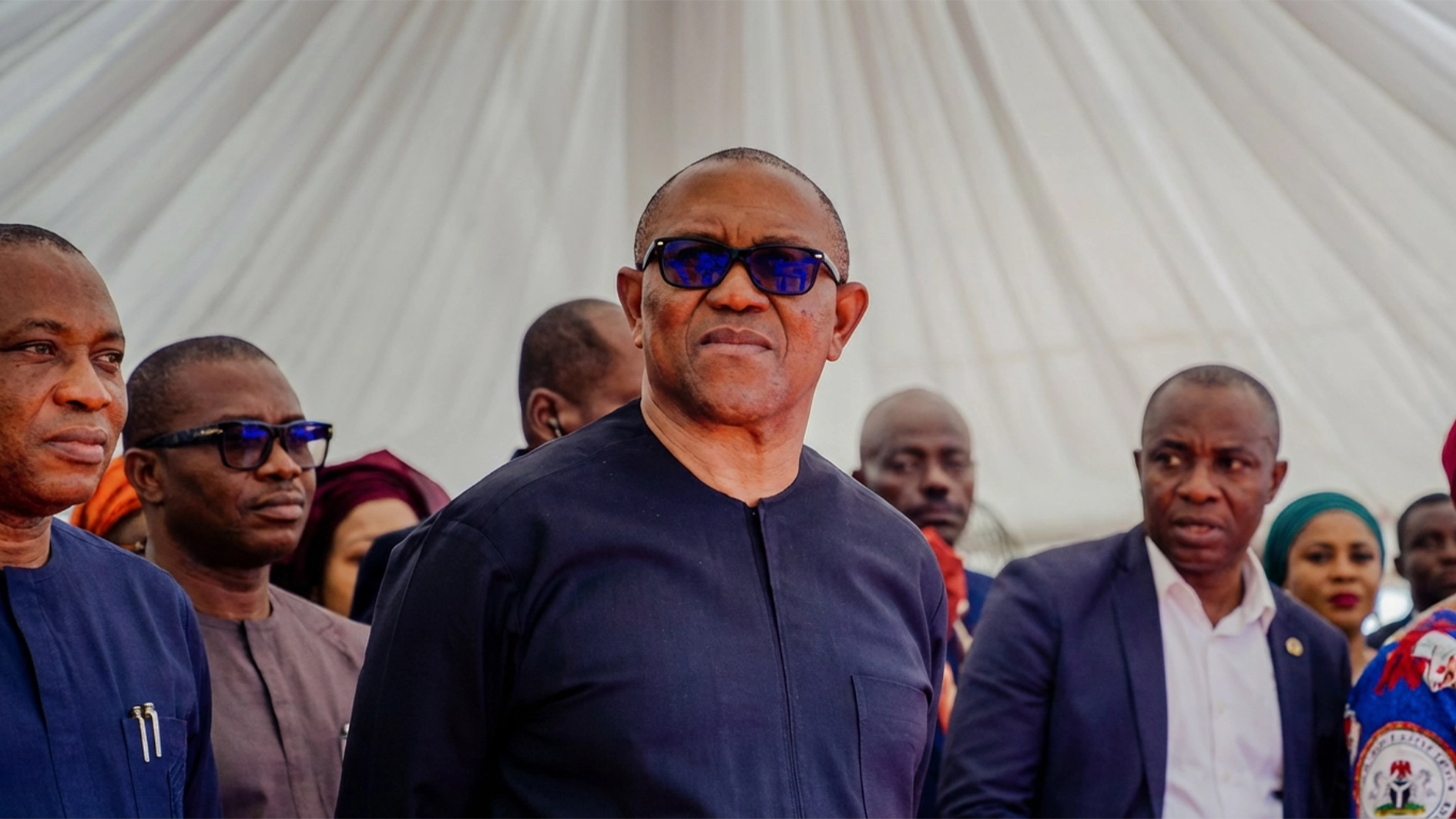
The presidential candidate of the Nigeria Democratic Congress (NDC), Peter Obi, has a herd following that rarely extends to the South-East – his home turf. At least, five of the six governors in the region have aligned with President Bola Tinubu ahead of the 2027 general election. However, some regional stakeholders are upbeat of Obi’s chances outside of South-East governors’ votes, SEYE OLUMIDE and LAWRENCE NJOKU report.
For Peter Obi, the 2027 presidential election presents both an opportunity and a formidable challenge in the South-East.
But as the 2027 contest gathers momentum, much of the region’s political establishment is moving in the opposite direction.
Four of the five serving governors have publicly aligned with President Bola Tinubu, while Abia Governor Alex Otti has maintained a more cautious position. Former governors and senior political figures have also increasingly joined the Tinubu camp.
Anambra Governor Chukwuma Soludo has openly backed Tinubu and repeatedly argued against what he considers the futile deployment of South-East votes behind Obi. Minister of Works David Umahi has gone further, urging Ebonyi people not to vote for Obi and arguing that the South-East cannot produce a president through its votes alone.
Enugu Governor Peter Mbah and Ebonyi Governor Francis Nwifuru have also aligned with the All Progressives Congress (APC), while Imo Governor Hope Uzodimma has led mobilisation for Tinubu. In July, Uzodimma said all five South-East governors had resolved to support Tinubu.
Otti rejected the claim, insisting that Uzodimma could speak only for himself and that no governor could determine how the region would vote. He also said the Labour Party would field its own presidential candidate, whom he intended to support.
That distinction is important. Otti should not be placed in the same category as Soludo, Umahi, Mbah, Nwifuru and Uzodimma. His cordial relationship with the Federal Government and cooperation with Tinubu do not, on the evidence available, amount to an endorsement of the President’s re-election. Still, the wider political movement around Tinubu is unmistakable.
In January, South-East APC governors and leaders endorsed Tinubu as their “sole candidate” for 2027, arguing that the region’s interests would be better served through engagement with the centre. In April, former South-East governors formed a forum and endorsed his re-election. Those present included Sullivan Chime, Ifeanyi Ugwuanyi, Chris Ngige, Okezie Ikpeazu and Martin Elechi.
Obi’s challenge, therefore, is no longer merely a contest against Tinubu’s party structure. It is increasingly a contest between a grassroots movement associated with Obi and an established political class that sees proximity to the Federal Government as the more practical route to regional development and influence.
Umahi has made the most direct case against Obi. The Works Minister said the South-East should recognise that its votes alone could not make Obi president. He urged the region to support Tinubu, citing infrastructure projects and Federal Government engagement. He later told Ebonyi people not to vote for Obi and challenged the assumption that it was automatically the South-East’s turn to produce the president.
Mbah has similarly advocated “strategic politics”, while the pro-Tinubu camp points to Federal Government projects, appointments and infrastructure as evidence that cooperation with Abuja can produce tangible benefits.
But does the political establishment speak for the electorate? This is where the 2027 calculation becomes complicated.
The South-East political class may be moving towards Tinubu, but voters demonstrated in 2023 that they could move in a different direction. Obi’s campaign generated grassroots mobilisation that was not entirely dependent on governors, traditional structures or established party hierarchies. His supporters built a political movement around his candidacy.
That experience means the governors’ alignment with Tinubu does not automatically determine how the electorate will vote. Retired Catholic Archbishop of Abuja, John Onaiyekan, recently captured the tension by arguing that South-East voters should be free to choose their preferred candidate rather than have governors make the decision for them.
The divide was also reflected by former National Chairman of All Progressives Grand Alliance (APGA), Maxi Okwu, who said political interests had always shaped the positions taken by leaders. While acknowledging that the South-East could not secure the presidency through its votes alone, he argued that this made alliances beyond the region necessary, not a reason to abandon Obi’s bid.
“You do not expect the South-East to speak in unison in matters of this nature, especially when there are interests to protect. Anybody who is already benefiting from the current arrangement would not see the need for change,” Okwu, who coordinates the OK Village Boys Movement, said.
He maintained that the Obi-Rabiu Kwankwaso ticket remained a strong alternative, citing their antecedents and what he described as widespread dissatisfaction with the current administration.
For Chekwas Okorie, a founding National Chairman of APGA, the bigger question is whether Obi’s personal influence and the NDC can translate into electoral victory. He answered in the affirmative, describing Obi as the most successful opposition politician in the country so far.
“His support base is organic. If you watch the barrage of attacks against him, it is because he has something to offer. He remains the greatest headache of the ruling party and its candidate in the 2027 general elections,” Okorie said.
Okorie described the Obi-Kwankwaso ticket as “the most formidable combination in any presidential election in Nigeria after the Shagari-Ekwueme ticket” of the Second Republic.
The former APGA chairman said the NDC’s growing followership was not accidental, but the result of sustained engagement with youths and the masses.
“The mass followership of the NDC today did not fall from the sky. It is the outcome of genuine, sincere and consistent engagement of the youths and the masses by Obi and Kwankwaso over the years,” he said.
The argument for an Obi presidency is also framed in terms of regional justice. National Chairman of the Igbo socio-political group, Njiko Igbo Forum (NIF), Okechukwu Obioha, said fairness demanded that the South-East produce the president, arguing that the region had not controlled executive power at the federal level since independence.
Obioha attributed dissent against Obi within the region to competing political interests and said the region was seeking only a four-year presidential tenure to restore balance to the country’s informal power-sharing arrangement.
“Give us four years. We don’t want to stop the cycle—the North and the South sharing the power formula,” he said.
He also identified Obi’s “organic” support among youths and older voters as his strongest political asset, arguing that the attacks against him reflected the perception that he posed a serious challenge to the ruling party.
Yet the APC’s growing institutional presence cannot be ignored. Imo and Ebonyi are APC-controlled, while Mbah has moved Enugu into the ruling party. The party’s South-East leadership now has governors, lawmakers and structures that were considerably weaker in the region during the 2023 presidential election.
The South-East should also not be treated as a single political constituency. Its five states have different interests, party structures and relationships with Abuja.
Otti’s position adds another layer to the equation. As the only South-East governor to reject the claim of a collective endorsement of Tinubu, he occupies an unusual position. His working relationship with Tinubu suggests that cooperation with Abuja and partisan opposition are not necessarily mutually exclusive.
His eventual conduct will therefore be watched closely, particularly because Abia is one of the states where the political establishment and the Obidient Movement have intersected strongly since 2023.
The deeper issue confronting the South-East may not be Obi or Tinubu, but the absence of agreement on how the region should pursue national power.
One camp favours supporting the incumbent President, consolidating ties with the Federal Government and using them to secure infrastructure, appointments and economic opportunities. Another believes the region will not become a serious presidential contender unless it demonstrates the capacity to mobilise its electorate behind an aspirant from the zone while building alliances across Nigeria.
Both positions have political logic. The first emphasises access to power; the second emphasises bargaining power. But they can produce conflicting electoral choices.
Meanwhile, supporters of Obi and Kwankwaso under the aegis of the South-East Village Boys, at a strategic meeting in Enugu, urged residents to reject attempts to undermine Obi’s candidacy. They described him as a candidate whose political record remained credible and pledged to mobilise support for him and protect their votes.
“We are not moved by these sponsored attacks by those who have failed the country. Our desire is to restore democracy and give Nigeria a fresh breath. There is no campaign of calumny or threat that will dim the effort. We are ready and united in this course,” they said.
The real contest, therefore, is between elite alignment and voter autonomy. If the political establishment succeeds in moving the electorate towards Tinubu, it would suggest that access to the centre and federal engagement have become more influential than the regional presidential argument. But if a substantial section of voters again separates itself from governors and traditional leaders, it would demonstrate the continuing strength of the grassroots movement associated with Obi.
Either outcome will have implications beyond one election. It will reveal how the South-East intends to negotiate power in Nigeria.
Ultimately, the debate should not be reduced to whether the region supports Obi or Tinubu. The more consequential issue is whether it has developed a coherent strategy capable of surviving individual elections and politicians.
Obi’s candidacy has revived the question of an Igbo presidential project, while Tinubu’s courtship of the region has created a competing argument based on political access and federal partnership. The governors and established politicians are making one calculation; Obi’s supporters are making another. The electorate will eventually make its own.
The critical test is whether the South-East can reconcile presidential ambition, political pragmatism, regional unity and voter choice into a strategy that gives it sustained influence in Nigeria’s national power equation. That is the question the region’s political stakeholders cannot avoid as 2027 approaches.

